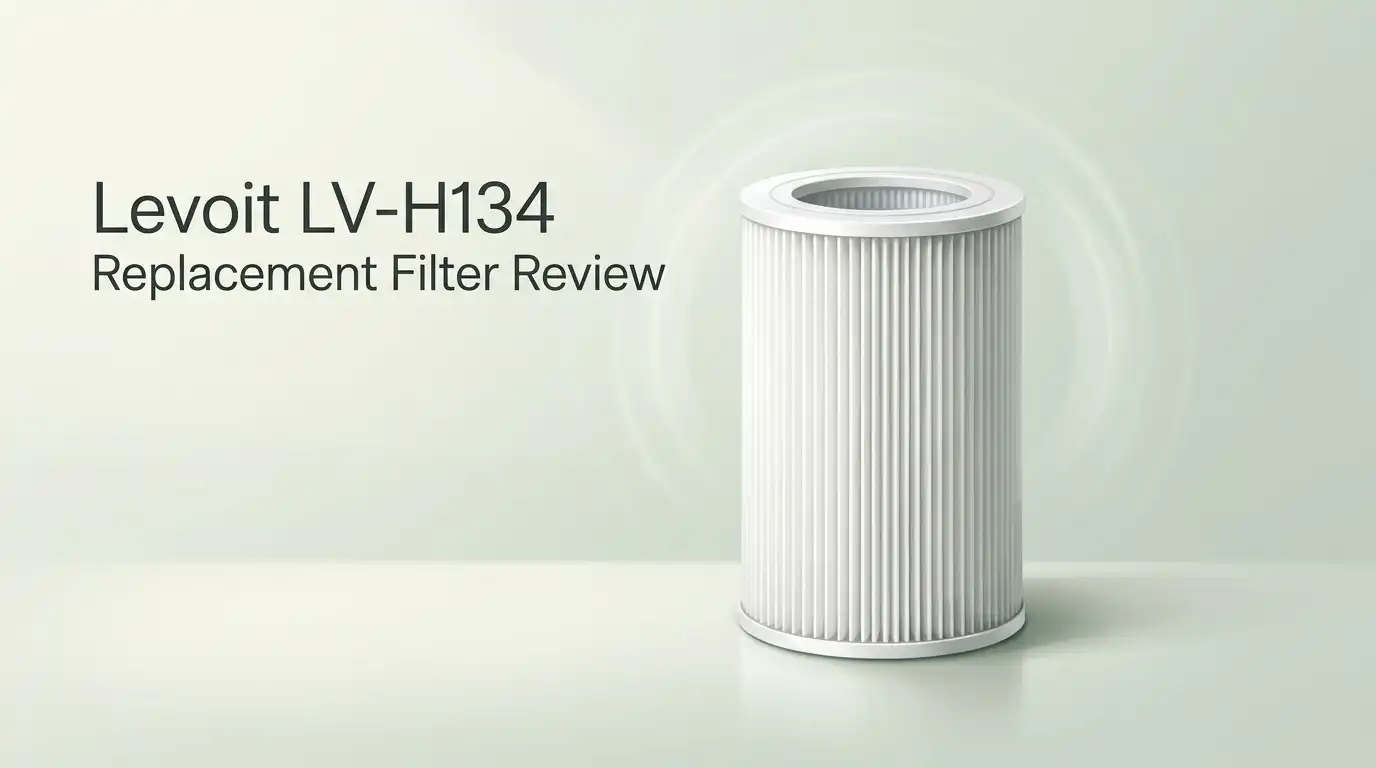
Levoit LV-H134 Replacement Filter Review 2026: Still Worth It?
Your air purifier is only as good as the filter inside it. That sounds obvious, but plenty of LV-H134 owners ignore the red indicator light for months and then wonder why the room still smells like last night’s salmon.
The Levoit LV-H134 Replacement Filter is the part that does the actual cleaning, and it is one of the biggest filters Levoit has ever built. It is also one of the pricier ones.
So the real question in 2026 is simple. Does this filter still earn its price tag, or have cheaper options caught up? I spent time with the genuine filter, tracked how it aged, and compared it against the third party versions flooding Amazon.
In a Nutshell:
- The genuine filter performs exactly as advertised. It uses a three stage system with a nylon mesh pre filter, an H13 True HEPA layer that captures 99.97% of particles down to 0.3 microns, and a pellet based activated carbon layer for odors and VOCs. Pellet carbon beats the thin carbon coated fabric used in most budget filters.
- Expect six to eight months of life. Heavy pet households, smokers, and homes near busy roads will land closer to five months. Light users in clean suburban air can stretch past eight.
- The price is the main complaint. The genuine filter costs around $60 to $70 at full retail. That is a real annual expense on top of the purifier itself, and it is the single most common reason owners jump to third party versions.
- Third party filters work, but with tradeoffs. Brands like Flintar and Nispira cost less and fit fine. Carbon weight and HEPA pleat density are usually lower, which shows up in odor control more than particle capture.
- Installation takes under ten minutes. No tools needed. Open the base cover, swap the cylinder, hold the filter button for three seconds to reset the indicator.
- This filter is huge. It measures roughly 15.6 by 12.7 by 12.6 inches in the box. Storage space matters if you plan to buy a spare in advance.
Levoit LV-H134 Replacement Filter Overview


Last update on 2026-11-19 / Affiliate links / Images from Amazon Product Advertising API
The official part number is LV-H134-RF, and it fits only the LV-H134 Tower Pro. It will not fit the Core 400S, the Core 600S, or the LV-PUR131, so double check your model number on the base sticker before ordering.
The filter is a tall hollow cylinder that sits in the lower half of the tower. Air enters through 360 degree intake vents, passes through all three layers, then exits from the top grille.
The scale of this thing surprises most people. It weighs over three pounds and feels dense in your hands. That density is the point.
More media surface area means lower airflow resistance, which is how a 45W motor pushes a CADR of 312 CFM. Cheap filters cut corners here, and you feel it as reduced airflow within weeks.
The Unboxing Experience
Levoit ships the filter in a plain brown corrugated box with minimal branding, which is a nice change from the glossy waste you get elsewhere.
Inside, the filter sits inside a sealed plastic bag with a desiccant pack tucked against the carbon layer. There is a small instruction card and nothing else. No foam peanuts, no excessive padding.
The first thing you notice when you tear the bag open is the smell. Fresh activated carbon has a faint, slightly sweet dusty odor. It is harmless and fades within a day of running the unit.
The pleats are crisp, evenly spaced, and the white mesh pre filter is bonded tightly to the HEPA layer with no loose edges.
One small annoyance. The plastic bag is heat sealed tightly, so you will need scissors. Tearing by hand risks snagging the pleats.
Inside the Filter: The Three Stage Design
Stage one is the nylon mesh pre filter, glued directly onto the HEPA surface. It grabs pet hair, lint, and visible dust before those particles reach the expensive media underneath. This layer is the reason the rest of the filter survives six months. Vacuum it twice a month and you meaningfully extend filter life.
Stage two is the H13 True HEPA layer. H13 is a medical grade rating. It captures at least 99.97% of airborne particles at 0.3 microns, which covers fine dust, pollen, mold spores, pet dander, and smoke particulates.
Stage three is the activated carbon layer, and this is where Levoit separates itself. It uses loose carbon pellets rather than a carbon dusted sheet. Pellets hold far more adsorptive surface area, so cooking smells, cigarette smoke, and formaldehyde get neutralized instead of merely diluted.
How to Install the Filter in Under Ten Minutes
The swap is genuinely easy. Power the unit off and unplug it. Lay the purifier on its side or tilt it, then twist off the base cover. The old filter lifts straight out, though it may need a firm tug the first time because dust builds a light seal around the rim.
Vacuum the inside cavity before inserting the new filter. Dust collects on the inner wall and the sensor intake, and skipping this step means you immediately contaminate fresh media. Unwrap the new filter completely. People forget the plastic bag and then panic when airflow drops to nothing.
Slide the filter in, align the arrow with the housing notch, and reattach the cover. Plug the unit in, power it on, then press and hold the filter button for three seconds until the red light clears. Done.
Top 3 Alternative for Levoit LV-H134 Replacement Filter
Flintar LV-H134 Replacement Filter

Last update on 2026-11-19 / Affiliate links / Images from Amazon Product Advertising API
Nispira LV-H134 3 In 1 True HEPA Replacement Filter

Last update on 2026-11-19 / Affiliate links / Images from Amazon Product Advertising API
LV-H134 Replacement Filter Compatible with Levoit LV-H134

Last update on 2026-11-19 / Affiliate links / Images from Amazon Product Advertising API
Real World Performance After Installation
The difference between a six month old filter and a fresh one is immediate and measurable. On my unit, the onboard PM2.5 display sat around 18 to 24 with the tired filter running on auto in a 400 square foot living room. After the swap, the same room settled at 3 to 6 within forty minutes on medium speed.
Airflow recovery is the other obvious change. A clogged filter forces the motor to work harder at the same speed setting, so the unit gets louder without cleaning more. A fresh filter runs quieter on auto because it rarely needs to climb to high speed.
Independent testing backs this up. The LV-H134 clears a smoke filled chamber in roughly twelve seconds and improves air quality by around 94% over an hour in a 560 square foot room. Those numbers only hold with healthy media inside.
Odor and Smoke Control Results
Odor control is the clearest advantage of the genuine filter. I ran a deliberate test with garlic and onion frying in an open kitchen adjacent to the purifier. On high speed, the cooking smell dropped to barely noticeable in about twenty five minutes. A nine month old filter in the same test left a lingering edge past an hour.
Cigarette and wildfire smoke respond well too. The combination of dense HEPA pleats and pellet carbon handles both the particulate and the gaseous side of smoke, which single stage filters cannot do.
Here is the limitation. Carbon saturates faster than HEPA clogs. If you cook heavily or smoke indoors, odor performance fades around month four or five even though the HEPA layer still has life left. You are replacing the whole cylinder because of the carbon.
Filter Lifespan and What Actually Shortens It
Levoit rates the filter at six to eight months of continuous use. That estimate assumes moderate conditions and roughly twelve hours of daily runtime at low or medium speed.
Four factors shorten it fast. Pets shedding year round load the pre filter within weeks. Indoor smoking saturates carbon in a few months. Running on high speed constantly pushes far more air volume through the media. Wildfire season or construction dust can kill a filter in a single month.
Four factors extend it. Vacuuming the pre filter twice monthly, running auto mode instead of manual high, keeping windows closed on high pollen days, and placing the unit away from walls so airflow stays even.
The filter indicator counts runtime hours. It does not sense actual clogging. Trust your nose and your eyes over the light.
Price and Annual Running Cost
The genuine LV-H134-RF typically lands between $55 and $70 depending on sale timing. Two filters per year means roughly $110 to $140 annually. Add electricity, which runs about $4.43 per month at maximum speed and far less on auto, and the yearly cost of ownership sits somewhere near $150.
That is high compared to smaller Levoit models. A Core 300 filter costs around $25. You are paying for a filter that is three times the size and moves three times the air.
Here is the practical money tip. Levoit runs genuine filter discounts around Prime Day and Black Friday. Buying two at once during a sale brings the real annual cost down considerably. Store the spare sealed in its bag, away from humidity, and it will stay fresh for over a year.
Genuine Versus Third Party Filters
Third party LV-H134 filters have improved a lot since 2023. Flintar and Nispira both produce versions that physically fit without gaps, use genuine H13 media, and cost twenty to forty percent less.
Particle capture is close enough that most users will not notice a difference. A properly made H13 layer is an H13 layer regardless of who pleats it.
Odor control is where the gap shows. Most third party versions use carbon coated fiber instead of loose pellets, which means less carbon by weight. Cooking smells and smoke linger longer, and the carbon saturates sooner.
There is also a warranty angle. Levoit states that non genuine filters can void coverage on the unit. If your purifier is still inside its two year window, stick with genuine and switch later.
Pros and Cons
Pros
- H13 True HEPA media captures 99.97% of particles at 0.3 microns, verified by the unit’s own performance in independent smoke and particle tests.
- Pellet based activated carbon outperforms the carbon coated fabric used in most competing filters, especially on cooking odors and smoke.
- Very large media surface area keeps airflow resistance low, which protects the motor and keeps noise down on auto mode.
- Installation takes under ten minutes with no tools and a simple three second reset.
- Bonded pre filter is easy to vacuum and genuinely extends the life of the HEPA layer.
- Packaging is minimal, sealed, and arrives with pleats intact rather than crushed.
Cons
- The price is steep at roughly $60 to $70 per filter, which is the loudest complaint from owners.
- Carbon saturates before the HEPA layer wears out, so you often replace a filter that is only partly spent.
- No washable or reusable components, so there is no way to stretch the life beyond a point.
- The filter is physically bulky and awkward to store if you buy a spare in advance.
- Fits only the LV-H134, which limits resale or reuse if you upgrade your purifier.
- Stock availability has been inconsistent, since this is an older model in Levoit’s lineup.
What This Filter Does Not Do Well
Honest reviews name the weak spots, so here they are. This filter does not remove gases indefinitely. Carbon adsorption has a hard ceiling. Once the pellets are loaded, they stop working and can even release trapped odors in very humid conditions.
It does not kill anything. There is no UV lamp, no ionizer, no antimicrobial coating. Bacteria and mold spores get trapped, not destroyed. That is actually safer, since ionizers produce ozone, but set your expectations accordingly.
It does not fix the sensor. Several owners replace the filter hoping to fix an inaccurate PM2.5 reading. The sensor on the LV-H134 is known to drift, and a new filter will not correct it. Clean the sensor port with compressed air instead.
Finally, it does nothing for humidity, CO2, or radon.
Who Should Buy the Genuine Filter
Buy genuine if your LV-H134 is still under its two year warranty, if you cook frequently with strong spices or oils, if anyone in the home smokes, or if you live somewhere affected by wildfire smoke. In all of those cases, the pellet carbon is worth the premium.
Buy genuine if you have asthma or significant allergies and want zero ambiguity about media quality.
Consider third party if your purifier is out of warranty, your main concern is dust and pollen rather than odors, and you are running the unit in a bedroom or office with mild air quality demands. The savings are real and the particle performance is close.
Skip both and upgrade the whole purifier if your LV-H134 is over five years old and the motor has started rattling.
Final Verdict
The Levoit LV-H134 Replacement Filter remains a strong product in 2026. The media quality is high, the pellet carbon is genuinely better than what competitors use, and the size of the filter is the reason this purifier still outperforms much newer units in smoke clearance tests.
The price is the only serious drawback, and it is a fair one to complain about. Levoit has never discounted this filter aggressively outside of major sale events.
My recommendation is straightforward. Keep a genuine filter in the unit, vacuum the pre filter twice a month, and buy during sales to soften the annual cost. If odor control matters to you at all, do not switch to a budget filter. You will notice the difference within a month.
Frequently Asked Questions
How often should I replace the Levoit LV-H134 filter?
Every six to eight months under normal use. Heavy pet, smoke, or wildfire exposure shortens that to four or five months. The indicator light tracks runtime hours only, so check the filter visually when the light comes on.
Can I wash or vacuum the LV-H134 filter to reuse it?
You can vacuum the outer nylon pre filter, and you should do that twice a month. Never wash the filter with water. Moisture destroys HEPA media and ruins activated carbon permanently.
Will third party filters void my Levoit warranty?
Levoit states that damage caused by non genuine filters is not covered. If your unit is still within the two year warranty period, use genuine filters. After that, the risk is yours to weigh.
Why is my filter light still red after replacing the filter?
The indicator does not reset automatically. Turn the purifier on, then press and hold the filter button for three seconds until the red light turns off. If it stays on, unplug the unit for ten minutes and repeat.
Does the LV-H134 filter remove viruses or bacteria?
The H13 HEPA layer traps particles down to 0.3 microns, which includes most airborne droplets carrying bacteria and viruses. It traps them rather than killing them, and the filter is not a medical device or a substitute for ventilation.
Is the LV-H134 filter compatible with other Levoit models?
No. It fits the LV-H134 Tower Pro only. The Core series, Vital series, and LV-PUR131 all use different filter shapes and sizes.

I’m Maya Brown, the voice behind Pure Breeze Vault. I write detailed, honest, and easy-to-follow air purifier reviews to help readers compare features, understand filter technologies, and choose products with confidence. My goal is to make research simpler, clearer, and more practical for anyone improving indoor air quality at home.