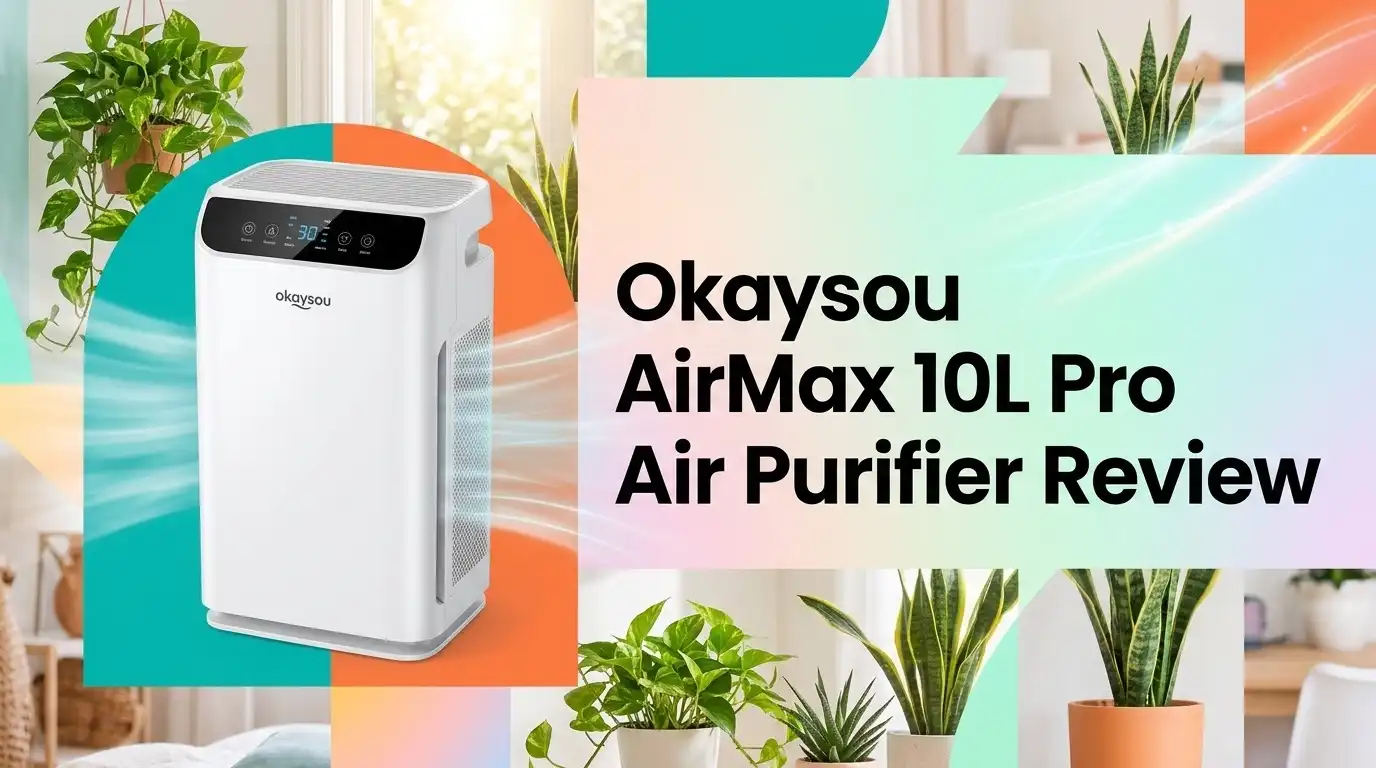
Okaysou AirMax 10L Pro Air Purifier Review 2026: Worth Buying?
You saw the Okaysou AirMax 10L Pro on TikTok. Maybe you saw it on a deal site. Now you want to know if it still makes sense in 2026.
This review gives you the honest answer. We cover the unboxing, the filters, real cleaning speed, noise, running costs and the big problem most sellers won’t tell you about.
By the end, you will know if this purifier deserves a spot in your home.
In a Nutshell
- The company is gone: Okaysou filed for bankruptcy, and in December 2023 a court turned the case into a liquidation. That means no official support, no official filters and no warranty you can count on.
- Cleaning power is below the claims: Okaysou says it covers 1,000 sq. ft. In real testing, it took 42 minutes to clean a room of about 728 cubic feet. That is slower than the cheaper Levoit Core 300.
- The filters feel thin: The “5 in 1” system is really three parts. The carbon filter is under 1 cm thick, and the prefilter’s glue can come loose.
- Energy use is high: It pulls about 58 watts on high speed. Similar purifiers clean faster on much less power.
- The good parts are real: You get an air quality sensor, auto mode, a timer, a child lock and simple buttons. Low speed is quiet enough for sleep.
- Bottom line: It’s fine if you get one for very little money as a used or open box unit. At full price, the alternatives below are the smarter choice.
What Is the Okaysou AirMax 10L Pro?
The Okaysou AirMax 10L Pro is a medium sized HEPA air purifier. It came out in December 2020 as a bigger version of the popular AirMax 8L.
Okaysou sold it as a large room purifier. The brand claimed a CADR of 250 cubic meters per hour, which is about 147 CFM. The box said it cleans 1,000 sq. ft. in one hour, 600 sq. ft. in 30 minutes and 300 sq. ft. in 15 minutes.
The main selling point was a 5 stage filter system. It promised to catch dust, pet hair, pollen, smoke and odors, and to break down gases like formaldehyde.
The price used to sit between $149.99 and $199.99. Today you mostly find it on resale sites, open box listings and clearance deals.
Unboxing and First Setup
The unboxing is simple and pleasant. The box arrives with clear pictures and button guides printed on the side, so you barely need the manual.
Inside, you find the white purifier, a power cord and the manual. The filters already sit inside the unit, but they come wrapped in plastic bags.
To reach them, pull the two small handles on the sides. The front panel pops right off. Take the filters out, remove every plastic bag and put them back in.
This step matters. If you skip it, the purifier blows air but cleans almost nothing. One more tip: hold the filter reset button for three seconds after setup, or the filter light may keep blinking. Setup takes about five minutes.
Key Specifications at a Glance
Here is what Okaysou promised, plus what testing showed.
The unit measures about 13.2 x 7.2 x 19 inches and weighs close to 19 pounds. The rated power is 70 watts. The official CADR is 250 cubic meters per hour, or roughly 147 CFM for dust.
The filter stack includes a washable prefilter, an H13 HEPA layer, a blue nano ionic silver layer and a honeycomb activated carbon filter. Okaysou said the HEPA layer captures 99.97% of particles down to 0.3 microns.
Features include auto mode, eco mode, turbo mode, three fan speeds, a timer with 1, 2, 4 or 8 hour settings, a child lock and a filter reset light. Okaysou recommended a new filter every six months. The original warranty was five years, but the bankruptcy makes it mostly worthless now.
Top 3 Alternative for Okaysou AirMax 10L Pro
Levoit Core 300


Last update on 2026-11-19 / Affiliate links / Images from Amazon Product Advertising API
Coway Airmega AP1512HH

Last update on 2026-11-17 / Affiliate links / Images from Amazon Product Advertising API
Winix 5510

Last update on 2026-11-17 / Affiliate links / Images from Amazon Product Advertising API
Design and Build Quality
The AirMax 10L Pro looks clean and modern. It has a white body, a square light panel on the front and a slim side profile. It blends into a bedroom or office without drawing attention.
If it looks familiar, there’s a reason. The design borrows a lot from popular models like the Levoit Vital 100 and the Coway Airmega AP1512HH. The side profile also looks like a smaller Alen purifier.
The body feels solid enough for daily use. The weak point is inside. Testers found small gaps on each side of the filters once they sit in the housing.
Those gaps let some air slip around the filters without being cleaned. A tighter fit would help. It’s a small detail, but it hurts real performance.
The 5 Stage Filter System Explained
The marketing shows five separate filters. The reality is three parts.
First is the washable prefilter. It catches hair, pet fur and lint, and it attaches to the HEPA filter with velcro. Second is the main filter. One side is white H13 HEPA, and the other side is the blue nano ionic silver layer. The ads made this look like two filters, but it is one.
Third is the honeycomb carbon filter. This part deserves some credit. It uses real carbon pellets instead of the cheap carbon coated fabric found in many budget units.
Still, the carbon filter is less than 1 cm thick. Thin carbon fills up fast with odors. Testers also saw the prefilter glue come loose the first time they pulled the velcro apart.
Real World Cleaning Performance
This is where the AirMax 10L Pro falls short. In a smoke test, it took 42 minutes to clear a test room of about 728 cubic feet at top speed.
That room is far smaller than 1,000 sq. ft. Yet the cheaper Levoit Core 300 cleared the same space four minutes faster. The Blueair Blue Pure 411+ has a lower CADR and still finished one minute faster.
So the 1,000 sq. ft. claim does not hold up. In real use, the purifier fits best in a bedroom, home office or small living room.
Users still report good results in those smaller spaces. One owner said she woke up less stuffy and noticed fewer smells drifting in from the apartment below. Just keep your room size expectations modest.
Noise Levels and Sleep Use
Noise is one of the better parts of this purifier. On speed 1, it measured about 38.8 dB from three feet away. That is a soft hum, similar to a quiet library.
Speed 2 rose to around 45.3 dB. Speed 3 reached 55.6 dB, which sounds like a normal conversation. That level matches other purifiers in this price group, like the Levoit Vital 100.
Many owners use the low setting overnight with no trouble. Several say it runs so quietly that they forget it’s on. That’s why the timer button is so handy.
One tip: the air quality light stays bright in auto mode. Light sleepers may want to point the unit away from the bed or use the sleep setting to cut the glow.
Smart Sensor, Auto Mode and Controls
The AirMax 10L Pro has an air quality sensor with a color ring. Blue means good air. Yellow means moderate air. Red means poor air.
The sensor powers auto mode. In auto mode, the fan speeds up when pollution rises and slows down when the air clears. Eco mode goes a step further and stops the fan when the sensor detects no pollution.
You control everything with four simple buttons: speed and mode, timer, filter reset and child lock. Hold the child lock for three seconds, and kids or pets can’t change your settings.
What’s missing? There is no app, no WiFi and no voice control. You can’t check the air quality from your phone. For many people that’s fine. For smart home fans, it’s a clear gap.
Energy Use and Running Costs
Here’s a hidden cost many buyers miss. The AirMax 10L Pro draws about 33 watts on speed 1 and around 58 watts on high.
That’s a lot for its cleaning power. The Blueair 411+ cleaned the same room faster while using only about 10 watts. More filter layers likely make the fan work harder.
Running it all day, every day costs roughly $88 per year in electricity at average US rates. Add genuine filters at about $49.95 every six months, and the yearly total reached around $188.
Genuine filters are now hard to find. Third party filter kits cost less, which can cut your filter bill roughly in half. Even so, electricity stays the bigger long term expense.
Okaysou AirMax 10L Pro Replacement Filters

Last update on 2026-11-18 / Affiliate links / Images from Amazon Product Advertising API
Filters are now the most important thing to plan for. Since Okaysou closed, only third party filters remain on the market.
Most compatible kits copy the original three part design. You get a two in one H13 filter with the prefilter attached, the blue filter layer and a carbon filter. These kits also fit the Aiibot A300, which uses the same filter size.
Quality varies by seller. Check that the kit says AirMax 10L Pro clearly, because the 8L and 10L Plus use different sizes.
If you own this purifier, buy two or three filter sets now. Third party sellers may stop making them as fewer units stay in use. Change filters every six months, or sooner if you have pets or smokers at home.
The Bankruptcy Problem: Support and Warranty
This is the biggest issue in 2026. Okaysou filed for Chapter 11 bankruptcy. Soon after, a patent lawsuit from Levoit’s parent companies added more pressure. Levoit said some Okaysou models copied its designs.
Amazon later joined a motion to turn the case into a Chapter 7 liquidation. A court approved it in December 2023. The company sold off its assets, and its website went offline.
What does this mean for you? The five year warranty is basically gone. There’s no customer service to call. You can’t order official parts.
If the motor or sensor fails, you will likely need a new purifier. That risk makes the price you pay even more important.
What the AirMax 10L Pro Does Not Do Well
An honest review needs a clear list of weak spots. Here they are.
It does not clean large rooms well. The 1,000 sq. ft. claim is unrealistic. Treat it as a bedroom purifier.
It does not use energy efficiently. Rivals clean faster on a fraction of the power.
The filters are not well built. The carbon layer is thin, the prefilter glue can fail and the side gaps let air slip past.
It offers no smart connection. You get no app, no remote control and no data history.
The marketing does not match the hardware. “5 in 1” really means three parts. And with the company gone, it has no long term support. That’s the most serious weakness of all.
Pros and Cons
Pros
- The air quality sensor and auto mode are rare at this price, and they work well for daily use.
- The four button panel is simple, and anyone in the house can learn it in a minute.
- Low speed runs quietly at about 38.8 dB, so it suits bedrooms and nurseries.
- The honeycomb carbon filter uses real carbon pellets for better odor control than fabric filters.
- The compact, clean design fits into most rooms without standing out.
- The child lock and timer add useful everyday convenience.
Cons
- Okaysou is bankrupt, so you get no warranty, no support and no official filters.
- Real cleaning speed falls well short of the 1,000 sq. ft. claim.
- High power draw raises yearly electricity costs.
- The filters are thin, the prefilter glue can fail, and small gaps let air bypass them.
- There is no app, WiFi or remote control.
- The “5 in 1” marketing makes the filter system sound bigger than it is.
Who Should Buy It in 2026?
The AirMax 10L Pro still fits a few buyers. If you find a new or open box unit for under $60, it can make sense as a backup purifier for a bedroom or small office.
It also suits people who already own one. Keep using it, stock up on third party filters and enjoy it while it lasts.
Who should skip it? Anyone with a large living room, an open floor plan or serious allergies. Skip it if you want a warranty or long term filter supply. Smart home fans should look elsewhere too.
For most new buyers, the Levoit Core 300 or the Coway Airmega AP1512HH gives better cleaning, lower running costs and real support.
Final Verdict
The Okaysou AirMax 10L Pro has a lot going for it on paper. It looks good, runs quietly and offers a sensor with auto mode. Those are real strengths for a budget purifier.
The problems are bigger, though. It cleans slower than cheaper rivals, uses more power and comes with thin filters. Most of all, the company behind it no longer exists. No support means higher risk.
Our rating is 2.5 out of 5 stars for 2026. Buy it only at a deep discount and only for a small room. Otherwise, choose one of the three alternatives above. You will get cleaner air, lower bills and much more peace of mind.
Frequently Asked Questions
Is Okaysou still in business in 2026?
No. Okaysou filed for bankruptcy, and in December 2023 a court converted the case to a Chapter 7 liquidation. The company website is offline, and official support has ended.
How big a room can the AirMax 10L Pro really clean?
Okaysou claimed 1,000 sq. ft. Real testing points to much smaller spaces. It works best in rooms of about 200 to 350 sq. ft., like bedrooms and offices.
Can I still buy filters for the Okaysou AirMax 10L Pro?
Yes. Third party filter kits are still sold online. Many also fit the Aiibot A300. Buy a few sets ahead of time, since supply may shrink.
Is the prefilter washable?
Yes. You can rinse the prefilter gently with water and let it dry fully. Be careful with the velcro, because the glue can come loose.
Does the AirMax 10L Pro remove odors?
It helps with light odors from cooking and pets. The honeycomb carbon uses real pellets, but the layer is thin, so heavy smoke or strong smells fill it up quickly.
Is the Okaysou AirMax 10L Pro quiet enough for sleeping?
Yes. On the lowest speed, it measured about 38.8 dB. Most people sleep fine with it running. Use the timer if you want it to shut off overnight.
Does the AirMax 10L Pro have an app or WiFi?
No. It has no app, no WiFi and no voice control. You control it with four buttons on the unit.
What is the best alternative to the Okaysou AirMax 10L Pro?
The Levoit Core 300 is the best budget pick for small rooms. For larger rooms, the Coway Airmega AP1512HH and the Winix 5510 offer stronger cleaning and ongoing brand support.

I’m Maya Brown, the voice behind Pure Breeze Vault. I write detailed, honest, and easy-to-follow air purifier reviews to help readers compare features, understand filter technologies, and choose products with confidence. My goal is to make research simpler, clearer, and more practical for anyone improving indoor air quality at home.