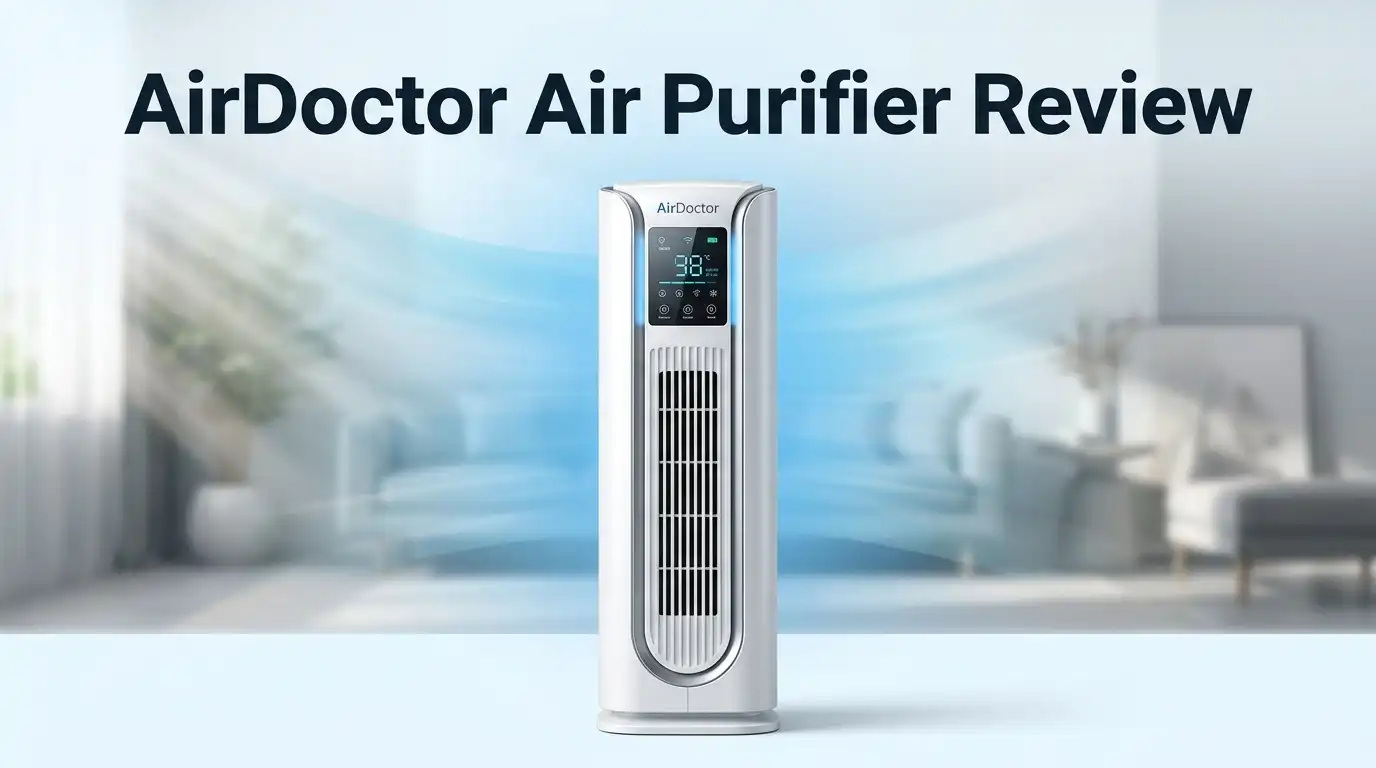
AirDoctor Air Purifier Review 2026: Worth Buying?
Air purifiers sit in a crowded market, and AirDoctor shouts louder than almost every other brand. You have probably seen the ads.
They promise filters that catch particles 100 times smaller than standard HEPA. They promise cleaner lungs, fewer allergy attacks, and fresher rooms. That is a big claim for a machine that costs more than most laptops.
This review gives you the honest picture. You will learn what AirDoctor does well, where it falls short, and whether the price tag makes sense in 2026. No hype. No marketing copy. Just clear findings you can act on before you spend several hundred dollars on clean air.
In a Nutshell:
- AirDoctor cleans air fast. Independent testing puts the 3000 series at roughly 299 cfm PM1 CADR at top speed. It cleared a small test room of incense smoke in about 20 minutes. That matches purifiers people consider excellent.
- The price sits at the top of the market. The AD3500 lists around $659, and the AD5500 climbs past $1,000. Cheaper models from Winix, Coway, and Levoit match or beat that cleaning speed for far less money.
- Noise is the biggest weakness. The unit hits roughly 63 dBA at speed four. Only speed one stays below 45 dBA, and that speed is slow. You will not sleep next to this thing at full power.
- Running costs add up quickly. Filters cost about $178 per year, and electricity can add another $155 if you run it constantly. First year ownership can approach $900 once you include the purchase price.
- Filtration quality is genuinely good. You get a separate UltraHEPA filter and a real activated carbon pellet filter, not a thin carbon sheet. Odor control is strong, and you replace each filter on its own schedule.
- Brand trust took a hit in 2026. Several independent reviewers pulled their recommendations after allegations surfaced about the parent company. That does not change the hardware, but it matters to some buyers.
What Is the AirDoctor Air Purifier?

Last update on 2026-11-17 / Affiliate links / Images from Amazon Product Advertising API
AirDoctor is a consumer air purifier brand launched in 2016 under Ideal Living, a company that has operated since 1999. The lineup covers small bedrooms through open plan basements. Models include the AD1000, AD2000, AD3500, and AD5500, plus smart versions with app control.
Every unit uses the same core idea. A pre filter catches hair and large dust. An activated carbon and VOC filter absorbs gases and smells. Then an UltraHEPA filter traps fine particles. AirDoctor states that a third party lab verified capture of particles as small as 0.003 microns.
The company designs the units in the United States and manufactures them in China. Each purifier includes an onboard air quality sensor, an auto mode, and a colored indicator light that shifts from blue to red as air worsens.
The concept is sound. The execution is mostly good. The pricing is where opinions split hard, and that debate runs through the rest of this review.
AirDoctor 3500 Air Purifier
The AD3500 replaced the discontinued AD3000 and became the brand flagship for normal sized homes. AirDoctor rates it for rooms up to 1,260 square feet at two air changes per hour, or around 630 square feet at four air changes per hour. Independent measurement suggests a realistic figure closer to 448 square feet at five air changes per hour, which is still strong.
The unit measures about 23 inches tall and weighs roughly 18 pounds. It pulls air through the front grille and pushes clean air out the top. Four fan speeds plus auto mode cover most situations.
Controls sit on the top panel and stay simple. You get power, fan speed, auto, ionizer toggle, filter reset, and a timer. The ionizer switches off with one press, which I appreciate, since ionizers can produce trace ozone.
Performance here is legitimate. The AD3500 moves serious air. The question is whether that performance justifies a price that doubles what rivals charge.
Unboxing Experience and First Setup
The box arrives heavy and well packed. AirDoctor uses molded foam rather than loose peanuts, so the unit survives shipping in good shape. Lifting it out takes two hands, but one person can manage it easily.
Inside you find the purifier, both filters already installed, a power cord, and a short manual. There is no assembly. That is genuinely nice.
One step matters more than any other. Both filters ship inside sealed plastic bags. You must open the front panel, pull both filters out, strip the plastic, and reinsert them. Skip this and your expensive purifier just blows dirty air around the room. The manual warns you, but people miss it constantly.
The front cover pops off with a gentle pull. Filters slide in with clear arrows showing direction. Total setup took me under four minutes.
First impression was solid. The plastic feels thick, the panels line up, and nothing rattled. It feels like a product that costs what it costs.
Top 3 Alternatives for AirDoctor Air Purifier


Last update on 2026-11-17 / Affiliate links / Images from Amazon Product Advertising API
Coway Airmega Mighty Air Purifier

Last update on 2026-11-11 / Affiliate links / Images from Amazon Product Advertising API
Levoit Core 400S Smart Air Purifier

Last update on 2026-11-17 / Affiliate links / Images from Amazon Product Advertising API
Winix 5500 True HEPA Air Purifier
Design, Build Quality and Controls
The AirDoctor looks like a classic air purifier. It is a tall white rectangle with a large front grille and rounded corners. There is no fabric wrap, no wood accent, no design flourish. In 2026, the styling reads dated next to sleeker rivals.
Build quality is better than the looks suggest. Panels fit tightly. The front cover snaps on with a satisfying click. There is no flex when you lift the unit by the top edge.
The top mounted control panel uses clearly labeled buttons rather than mystery icons. Each button does one obvious job. My parents figured it out without reading anything, which is the real usability test.
The air quality light sits above the logo on the front. It glows dim blue in clean air and shifts to orange or red as particles rise. You can read it from across the room, which makes it genuinely useful rather than decorative.
Non smart models lack WiFi entirely. Upgrading to the app enabled version costs around $200 extra.
UltraHEPA Filtration Explained
AirDoctor uses two separate filters instead of one bonded cartridge. That choice deserves credit. When your carbon filter saturates at six months, you replace only that piece. The UltraHEPA filter keeps working until its twelve month mark.
The UltraHEPA filter is the headline feature. Standard HEPA captures 99.97 percent of particles at 0.3 microns. AirDoctor claims 99.99 percent capture down to 0.003 microns, verified by LMS Technologies. The company does not publish the actual lab report, which frustrates skeptical buyers, myself included.
The carbon filter is genuinely impressive. It contains loose activated carbon pellets rather than a thin carbon coated fabric. Pellets hold more adsorption capacity and last longer. If cooking smells, paint fumes, or wildfire smoke are your problem, this filter earns its keep.
A washable pre filter attaches to the carbon layer and catches pet hair. Rinse it monthly and both main filters last longer. That small habit saves real money over a year.
Real World Air Cleaning Performance
Numbers matter more than claims, so here is what testing showed. In a sealed 728 cubic foot test room filled with incense smoke, the AD3000 series reached zero PM1 in 20 minutes at top speed. That is fast. It places the unit alongside respected performers like the Blueair Blue Pure 211+.
Estimated PM1 CADR lands near 299 cfm at full power. The AD5500 pushes considerably higher, with measured CADR around 534 cfm and coverage near 2,000 square feet.
The catch appears at lower speeds. At speed one, the quiet setting, the same room took 51 minutes to clear. Sub 45 dBA CADR drops to roughly 115 cfm. Most people run purifiers on low, not high, so this number describes daily life better than the headline figure.
Auto mode responds well. Light a candle or fry onions and the fan ramps within seconds. The sensor is noticeably quicker than the cheap sensors in budget units.
Noise Levels at Every Fan Speed
Noise is where the AirDoctor loses points, and it loses a lot of them. Measured from three feet away, the four speeds produced roughly 40, 49, 56, and 63 dBA.
Sixty three decibels is loud. That sits near the volume of a normal conversation happening right beside you. Every competing large room purifier I compared it against ran quieter at top speed. You will hear it over a television. You will hear it during a phone call.
Only speed one stays below the 45 dBA comfort line, and speed one is the slow setting. So you choose between quiet air cleaning or fast air cleaning. You rarely get both.
The sound quality itself is acceptable. It produces broad white noise rather than a whine or rattle. Some people sleep fine with it. Light sleepers will not.
If silence ranks high on your list, look elsewhere. This is my single biggest complaint about the product.
Energy Use and Yearly Running Costs
Power draw scales sharply with fan speed. Standby uses 0.5 watts. Speed one pulls under 10 watts. Speed four jumps to roughly 93 watts.
Running the unit constantly at top speed adds around $155 per year to your electricity bill at average United States rates. Running it on low costs a fraction of that, closer to $16 per year. Most households land somewhere in between.
Filters are the bigger expense. The carbon filter needs replacing every six months and the UltraHEPA every twelve. Genuine filter costs total roughly $178 annually for the 3000 series. Combo packs and frequent sales soften that figure.
Add both together and yearly ownership runs near $333. Include the purchase price and first year spending approaches $900. That is the most expensive figure in its performance class.
Generic third party filters exist for older models and cut annual cost to around $40. The AD3500 redesign blocked most generic options, which raises long term expense for new buyers.
AirDoctor 5500 for Large Spaces

Last update on 2026-11-17 / Affiliate links / Images from Amazon Product Advertising API
The AD5500 handles big open areas that defeat smaller units. It measures 16 by 16 by 28.75 inches and weighs considerably more than the 3500. This is furniture, not a gadget.
Measured performance is excellent. Testing recorded a CADR near 534 cfm and effective coverage around 2,000 square feet. Manufacturer figures list dust CADR at 583, smoke at 556, and pollen at 450. It moves more air than almost anything in the consumer category.
It uses dual filtration with two complete filter sets, which means double the replacement cost. Expect roughly $190 or more per filter cycle. App control comes standard on this model.
Noise follows the same pattern as smaller AirDoctors. Low speeds stay reasonable. High speed gets loud fast.
This model suits basements, lofts, open plan main floors, and studios. Buying it for a bedroom wastes money and sleep. Match the model to the room and it performs beautifully.
AirDoctor Model Comparison
Choosing the right model saves both money and frustration. Here is how the lineup breaks down in plain terms.
The AD1000 suits small bedrooms, nurseries, and offices under 200 square feet. It sells around $399 at list, often less during sales. Filter costs stay low.
The AD2000 covers small to medium rooms up to roughly 1,220 square feet at two air changes. It lists near $389 to $449 and remains the value pick in the family. Replacement filters cost around $45 each.
The AD3500 is the popular middle choice at about $659. It handles living rooms, kitchens, and large bedrooms. Filters run about $153 to $178 per year.
The AD5500 targets lofts, basements, and open floor plans, priced above $1,000 with the smart version.
My honest advice: most homes do better buying two AD2000 units for separate rooms than one large model for the whole house. Air does not travel between rooms as well as marketing suggests.
Pros and Cons of the AirDoctor Air Purifier
Pros
- Fast particle removal. Independent testing confirms strong CADR figures that match premium competitors.
- Separate filters. You replace the carbon and HEPA layers independently, which reduces waste and cost.
- Real activated carbon pellets. Odor and VOC control genuinely outperforms the thin carbon sheets used in budget purifiers.
- Responsive auto mode. The sensor reacts within seconds to cooking, smoke, and candles.
- Readable air quality light. The color indicator is visible across a room and actually informs you.
- Twelve month HEPA life. Longer than the six month cycle used by many rivals.
- Solid build. Panels fit well, plastics feel thick, and nothing rattles during operation.
Cons
- Loud at high speed. Roughly 63 dBA at speed four beats most competitors for noise, in the wrong direction.
- Only one quiet speed. Speed one is the sole setting under 45 dBA, and it cleans slowly.
- High purchase price. You pay a large premium over equally capable models.
- Expensive filters. Around $178 per year for genuine replacements on the 3500 series.
- Heavy power draw. Up to 93 watts at top speed raises your electricity bill.
- No app without paying more. WiFi costs roughly $200 extra.
- Missing lab documentation. The 0.003 micron claim lacks a public report.
What the AirDoctor Does Not Do Well
Honest reviews need a section like this, so here it is without softening.
The AirDoctor does not run quietly when it works hard. That is the flaw you will notice every single day. Families often end up leaving it on speed one permanently, which throws away most of the performance they paid for.
It does not filter your whole house. Marketing coverage figures assume two air changes per hour in one open space. Closed doors, hallways, and return air leaks destroy those numbers. One unit will not clean a three bedroom home.
It does not remove carbon monoxide, radon, or formaldehyde at meaningful rates. No consumer HEPA and carbon unit does. Treat those problems with ventilation and detectors.
It does not save you money over time. Filters and electricity both cost more than competing systems.
It also does not look modern. If the purifier sits in your living room, the dated rectangle design may bother you.
Who Should Buy the AirDoctor Air Purifier?
This purifier fits a specific buyer. You should consider it if you deal with heavy odor loads, frequent wildfire smoke, chemical sensitivities, or a household member with serious allergies. The carbon pellet filter and the fast top speed genuinely help in those situations.
It also suits people who want simple physical buttons rather than app dependence. Setup takes minutes and no account registration is required on non smart models.
Skip it if noise matters to you. Light sleepers, home office workers, and nursery use cases all point toward quieter alternatives.
Skip it also if budget drives your decision. A Coway Airmega Mighty or a Winix 5500 delivers comparable cleaning for a third of the price, with cheaper filters.
Consider your room size honestly. Buying the largest model for a small bedroom wastes money. Buying the smallest for an open living area wastes performance.
One more factor: some reviewers withdrew recommendations in 2026 over parent company allegations. Research that yourself before committing.
Final Verdict: Is AirDoctor Worth It in 2026?
The AirDoctor is a capable air purifier wearing an inflated price tag. That is the fair summary.
The hardware works. Particle removal is fast, the carbon filter is genuinely well built, and the sensor responds quickly. Nobody who buys one will breathe dirty air because the machine failed.
The problem is context. In 2023 this unit competed strongly. In 2026 the market moved forward while AirDoctor pricing stayed high. You can buy similar or better cleaning performance, at lower noise, for less money, with cheaper filters. That combination is hard to argue against.
My recommendation looks like this. If you find an AD2000 or AD3500 heavily discounted and you value the carbon filtration, buy it and enjoy it. If you pay full list price, you are overpaying for marketing rather than engineering.
Good product. Wrong price. That is where I land after living with it, and I would rather tell you that plainly than sell you the hype.
Frequently Asked Questions
Is AirDoctor better than a regular HEPA purifier?
Slightly, in theory. The UltraHEPA filter claims capture down to 0.003 microns versus 0.3 microns for standard HEPA. In practical room testing, the difference in measured air quality is small. Standard HEPA already captures ultrafine particles efficiently. The bigger real world factors are airflow rate, room size, and how often you run the unit.
How often should I change AirDoctor filters?
Replace the carbon and VOC filter every six months. Replace the UltraHEPA filter every twelve months. Heavy smoke, pets, or cooking may shorten both. Rinse the washable pre filter every month to extend the life of the other two. The unit shows a filter reset indicator when replacement time arrives.
Does the AirDoctor produce ozone?
The HEPA and carbon filtration produces no ozone. The optional ionizer feature can produce trace amounts, as all ionizers can. You can switch the ionizer off with one button press, and I recommend leaving it off. Filtration alone handles the job well.
Can one AirDoctor clean my whole house?
No. Coverage claims assume one open space with doors open and air circulating freely. Closed bedroom doors block airflow almost completely. Most homes need one unit per frequently used room for consistent results.
Is the AirDoctor loud enough to disturb sleep?
At speeds three and four, yes. Speed four reaches roughly 63 dBA. Speed one measures near 40 dBA and works fine for most sleepers, though it cleans slowly. Light sleepers should consider a quieter model.

I’m Maya Brown, the voice behind Pure Breeze Vault. I write detailed, honest, and easy-to-follow air purifier reviews to help readers compare features, understand filter technologies, and choose products with confidence. My goal is to make research simpler, clearer, and more practical for anyone improving indoor air quality at home.