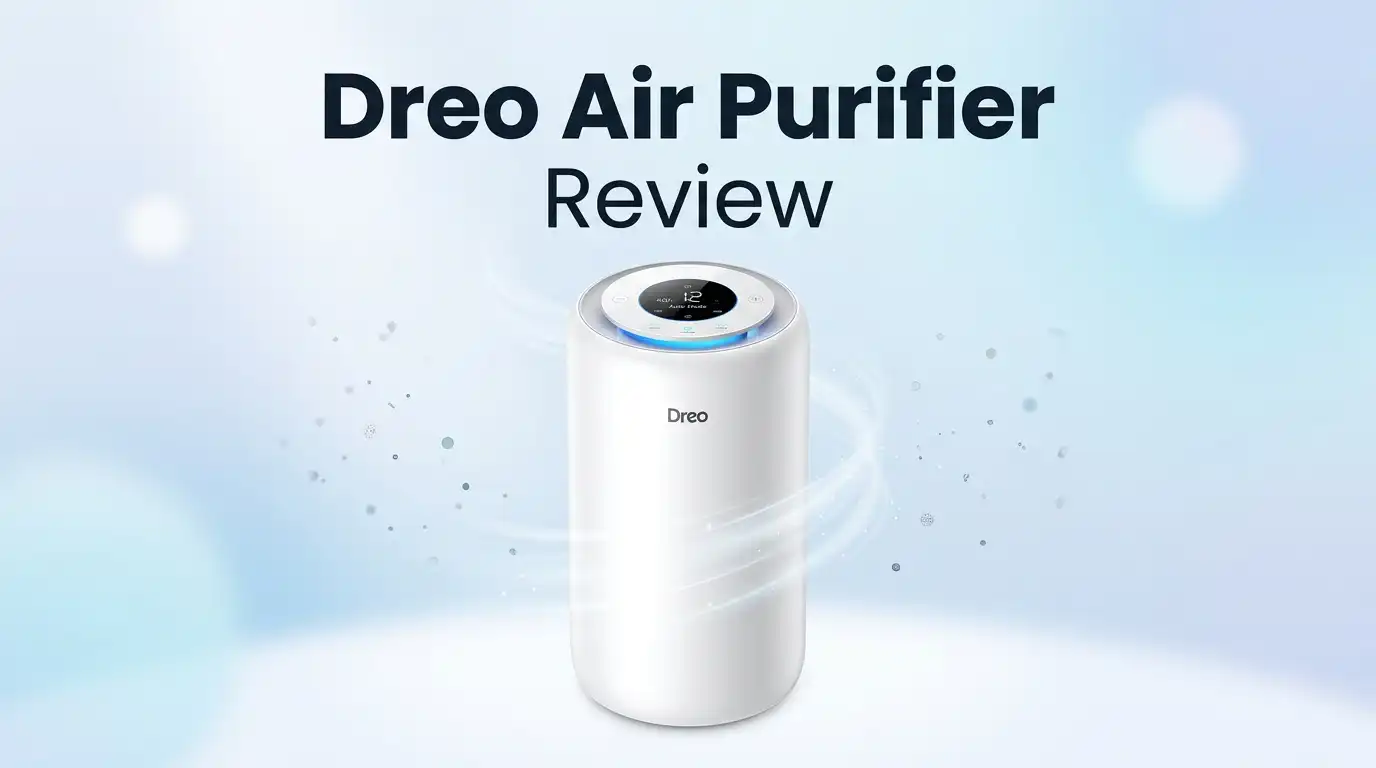
Dreo Air Purifier Review 2026: Worth Buying?
Clean air at home should not cost a fortune. Yet most shoppers give up after reading ten specification sheets full of numbers that mean nothing.
Dreo entered the air purifier market as a fan brand, and plenty of people still ask whether it can compete with Levoit, Coway, and Winix in 2026.
I spent weeks living with Dreo purifiers in a bedroom, a kitchen, and a 400 square foot living room. I watched the sensor react to burnt toast. I vacuumed the pre filter. I checked the power meter. This review covers what Dreo gets right, what it fumbles, and whether your money belongs here.
In a Nutshell:
- Performance punches above the price. The Macro Max S pulled PM2.5 levels down by roughly 96 percent in a 320 square foot room within one hour. Smoke clearing took about 17 seconds in a sealed box test, which matches purifiers that cost far more.
- Bedroom noise is genuinely low. Sleep mode sits near 42 dBA, quieter than a refrigerator hum. The brushless motor deserves the credit here.
- Running costs stay small. Low speed draws around 6 watts. Turbo mode running all day for a month adds roughly three dollars to a power bill.
- The app actually works. Dreo’s app connects fast, shows hourly air quality history, and unlocks 18 manual fan speeds. Many pricier brands still fail this basic test.
- Odor control is the weak spot. The carbon layer is thin. Heavy cooking smells and cigarette smoke linger longer than allergen dust does.
- Filters are not washable. Plan on replacing them every six to eight months at roughly 30 to 45 dollars each.
Dreo Macro Max S Air Purifier: The Flagship Pick

Last update on 2026-11-19 / Affiliate links / Images from Amazon Product Advertising API
The Macro Max S sits at the top of the Dreo range and remains the model most buyers pick. It covers rooms up to 423 square feet with a clean air delivery rate of 273 CFM. That figure means it cycles air about 4.8 times per hour in a space of that size.
The tower shape measures 11.22 by 11.22 by 20.86 inches and weighs 11.89 pounds. It looks like a small speaker rather than a hospital appliance, which matters in a living room.
What sold me was the sensor accuracy. I lit a candle across the room and the air quality ring shifted from blue to orange in under 20 seconds. Auto mode then raised the fan speed without any input from me.
The five year warranty is unusually generous. Most competitors offer one or two years. You do need to register the unit on the Dreo website to activate the full term, so keep your receipt handy.
Unboxing Experience and First Impressions
The box arrives smaller than expected. Dreo packs the unit in molded pulp rather than foam, which feels sturdier and looks better for the environment. Lifting it out takes one hand.
Inside you get the purifier, the H13 True HEPA filter already seated in the base, a quick start card, and a printed manual. The manual quality surprised me. Thick paper, clear diagrams, no confusing translations. Small detail, but it signals care.
Here is the step everybody forgets. The filter ships sealed inside a plastic bag inside the machine. You must open the rear cover, pull the filter out, strip the bag, and slide it back in with the pull straps facing outward. Skip this and your purifier will hum along doing absolutely nothing.
Setup took me four minutes total, including the app pairing. Peel the protective film off the display, plug it in, and the ring lights up. No tools. No assembly. That is how it should be.
Dreo Air Purifier 539S: The Budget Option


Last update on 2026-11-19 / Affiliate links / Images from Amazon Product Advertising API
Not everyone needs a flagship. The 539S targets bedrooms, nurseries, and home offices at roughly half the price of the Macro Max S.
It delivers 158 CFM of clean air and is AHAM verified, which means an independent lab confirmed the numbers. It refreshes air every 12.4 minutes in a 245 square foot room. Stretch it to a 1,176 square foot space and you get one air change per hour, which is fine for light maintenance but not for allergy season.
The washable pre filter is the standout feature here. Pet owners will appreciate it. Fur and large dust get caught on a mesh you can rinse, so the expensive HEPA layer lasts longer.
It runs quietly, includes the same PM2.5 sensor and app support, and offers four modes. The tradeoff is raw power. If you own a large open plan room, this model will struggle and you should size up.
Top 3 Alternative for Dreo Air Purifier

Last update on 2026-11-17 / Affiliate links / Images from Amazon Product Advertising API
Coway Airmega AP 1512HH Mighty

Last update on 2026-11-11 / Affiliate links / Images from Amazon Product Advertising API
Levoit Core 400S Smart Air Purifier

Last update on 2026-11-17 / Affiliate links / Images from Amazon Product Advertising API
Winix 5510 Air Purifier
Filtration System Explained in Plain English
Dreo uses three filtration stages packed into one cylindrical cartridge. Understanding each layer helps you set expectations.
The pre filter is a nylon mesh wrapped around the outside. It grabs hair, lint, and chunky dust. Vacuum it once or twice a month and the whole system breathes easier.
The H13 True HEPA layer does the heavy lifting. It captures 99.97 percent of particles down to 0.3 microns. That covers pollen, pet dander, mold spores, and fine smoke particles. H13 is medical grade, a step above the standard H11 filters found in cheaper units.
The activated carbon layer handles odors and volatile organic compounds. This is where Dreo cuts corners. The carbon is pellet based, which is better than a sprayed sheet, but there simply is not enough of it.
One important warning. None of these layers are washable. Water destroys the HEPA pleats. Keep the cartridge dry and replace it on schedule.
Real Performance: Dust, Smoke, and Pollen
Numbers on a box mean little until you test them. In a 320 square foot bedroom, PM2.5 readings dropped from 104 micrograms per cubic meter to 5.2 in 60 minutes on maximum speed. That is a 96 percent improvement and an air quality index that fell from 136 to 7.
I repeated the test in a 560 square foot space, well beyond the rated coverage. Air quality still improved by 88 percent, though it took the full hour at turbo.
Smoke clearing impressed me most. In a sealed glass box, the Macro Max S cleared visible smoke in roughly 17 seconds. Coway’s Mighty took 18 seconds. The Levoit Core 400S took 15.
Real world results matched the lab. My cat sheds constantly, and after two weeks the dust film on my nightstand thinned noticeably. Morning sneezing dropped too, though I will not pretend that is scientific measurement.
Noise Levels and Bedroom Sleeping
Air purifiers fail in bedrooms when they sound like a jet taxiing. Dreo avoids that trap.
Sleep mode registers 42.1 dBA, which is close to the quietest models on the market. The tone is a soft low frequency whoosh rather than a whine. I slept through it on night one.
Speed one measures 44.3 dBA. Speed two hits 50.9 dBA, roughly the volume of quiet conversation. Speed three reaches 57.1 dBA and turbo climbs to 64.7 dBA, which is loud enough to interrupt television.
Here is my honest advice. Run auto mode during the day and switch to sleep mode at night. Sleep mode also dims every light on the unit within five seconds, so no blue glow keeps you awake.
The app adds 18 manual fan speeds. This granularity is rare and genuinely useful. You can find a setting that moves real air without waking a light sleeper.
Smart App, Auto Mode, and Sensors
The Dreo app runs on Android and iOS. Pairing took under two minutes with no dropped connections during my testing period.
The home screen shows live PM2.5 readings, an air quality percentage, and current filter wear. Tap the air quality box and you get hourly, daily, and monthly history graphs. That data helps you spot patterns, like pollution spikes every evening when neighbors fire up grills.
Auto mode links directly to the PM2.5 sensor mounted on the rear panel. It adjusts fan speed on its own. You can pick between standard and soft auto profiles in the app, with soft keeping noise lower at the expense of reaction speed.
A few features live only inside the app. Child lock, light detection toggles, panel sound, and voice assistant setup all require the phone. The app is optional but you lose real capability without it.
One limitation worth knowing. The sensor reads particles, not gases. Cooking odors will not always trigger a speed increase.
Running Costs and Filter Replacement
This is where Dreo quietly wins. The motor is rated at 56 watts, but actual draw stays much lower.
Standby pulls 0.8 watts. Sleep mode uses 3.3 watts. Low speed draws 6.3 watts. Even turbo mode only consumes 36.1 watts. Running turbo around the clock for a month costs roughly three dollars and sixteen cents at 12 cents per kilowatt hour. A Winix 5500 series unit costs closer to five dollars under identical conditions.
Filters last six to eight months with normal use. Genuine replacements sit in the 30 to 45 dollar range depending on model and current pricing.
Third party filters exist and cost less. They fit, but efficiency varies and using them may complicate warranty claims. I stick with genuine cartridges.
Total yearly ownership cost lands near 80 dollars including electricity and one filter change. That is competitive with every major brand and cheaper than several.
Design, Size, and Where to Place It
The Macro Max S wears a silver body with black accents. It reads modern rather than medical. The vertical air quality light strip runs down the front and glows blue for excellent, green for good, orange for moderate, and red for poor.
Air enters through openings on the sides and rear of the lower section, then exits through grilles on top. That 360 degree intake means you do not need to face it a particular direction.
Placement rules matter more than people think. Keep the unit at least 15 inches from walls. Never block the top grilles. Corners are the worst possible spot because airflow stalls there.
My main design complaint is the missing carry handle. Twelve pounds does not sound heavy until you try lifting a smooth plastic cylinder with no grip points. Moving it between rooms means an awkward bear hug.
Rubber feet keep it planted on hardwood, which is a thoughtful touch on slippery floors.
What the Dreo Air Purifier Does Not Do Well
Honest reviews name the flaws. Here are mine after extended use.
Odor removal disappoints. The carbon layer is too thin for serious jobs. Fried fish smells hung around my kitchen for hours. Smokers should look elsewhere.
No carry handle makes relocation clumsy, as mentioned above.
Auto mode reacts to particles only. Gas and odor spikes go unnoticed, so you end up bumping the fan manually anyway.
Replacement filter availability has been inconsistent. Several owners report stock gaps for specific models. Buy a spare filter when you buy the unit.
Turbo mode is loud. At 64.7 dBA you will hear it over a television.
Finally, the brand history is short. Dreo has only sold purifiers for a few years. Long term reliability data simply does not exist yet, and the five year warranty only helps if the company stays around to honor it.
Pros and Cons
Pros
- Strong particle removal, with a 96 percent PM2.5 reduction in one hour in a properly sized room
- Very quiet sleep mode at 42.1 dBA, suitable for light sleepers and nurseries
- Low power draw and affordable annual running costs
- Reliable app with hourly air quality history and 18 manual fan speeds
- Accurate PM2.5 sensor paired with a clear color coded air quality light
- CARB certified, meaning no meaningful ozone output
- Five year warranty, well above the category average
- Excellent packaging and a setup process that takes minutes
Cons
- Weak activated carbon layer, so odor control lags behind particle control
- No carry handle on a 12 pound body
- Filters are not washable and must be replaced twice a year
- Sensor ignores gases and cooking smells entirely
- Turbo mode noise becomes intrusive
- Replacement filter stock can be patchy
- Limited long term reliability track record compared to Coway or Winix
Who Should Buy a Dreo Air Purifier in 2026?
Dreo fits specific people very well and others poorly.
Buy it if you have allergies, pets, or a dusty home and you want strong particle filtration without spending 300 dollars. Bedroom users benefit most because the quiet sleep mode and dimming lights are genuinely well executed. Tech friendly buyers will enjoy the app data.
Skip it if odors are your main problem. Heavy cooking, cigarette smoke, or chemical smells need a purifier with several pounds of carbon, and Dreo does not offer that.
Also skip it if you plan to carry the unit between floors daily. The missing handle will annoy you every single time.
Room size guidance is simple. Choose the 539S for spaces under 250 square feet. Choose the Macro Max S for rooms up to 420 square feet. For anything larger, run two units rather than stretching one beyond its rating.
Final Verdict
Dreo delivers serious filtration performance at a mid range price, and that combination is rare. The Macro Max S competes directly with the Levoit Core 400S and Coway Mighty on particle removal while undercutting both on noise and electricity use.
My rating sits around 8.5 out of 10. The deductions come from thin carbon filtration, the missing handle, and a short brand history rather than any failure in core function.
Would I buy it with my own money? Yes, for a bedroom or home office. For a kitchen, I would choose something with heavier carbon.
Air purifiers are not magic. They will not fix a mold problem, replace ventilation, or cure allergies. They reduce airborne particles, and Dreo does that job reliably and quietly.
If clean, quiet, affordable air is the goal, Dreo earns a spot on your shortlist for 2026.
Frequently Asked Questions
Does the Dreo air purifier produce ozone?
No. Dreo purifiers are CARB certified, which means California regulators confirmed ozone output stays within legal limits. The units use mechanical filtration rather than ionization as the primary method, so ozone is not a practical concern for most households.
How often should I change the Dreo filter?
Plan on every six to eight months under normal use. Heavy dust, pets, or wildfire smoke shorten that window. The unit displays a filter reset indicator and the app sends a notification when replacement time arrives.
Can I wash the Dreo HEPA filter?
No. The HEPA and carbon layers are paper based and water ruins them. You can and should vacuum the outer nylon pre filter once or twice monthly. Some models, including the 539S, include a fully washable pre filter sleeve.
Is the Dreo app required to use the purifier?
No. Every core function works from the top control panel. The app adds air quality history, 18 manual fan speeds, child lock, and voice assistant setup, so most owners find it worth connecting.
Does Dreo help with pet allergies?
Yes, for airborne dander and fur. The H13 HEPA layer captures particles down to 0.3 microns. It cannot remove allergens already settled into carpets and bedding, so vacuuming and washing still matter.
How long is the Dreo warranty?
Dreo offers a five year warranty on most purifier models. You must register the product on the Dreo website after purchase to activate the full term.

I’m Maya Brown, the voice behind Pure Breeze Vault. I write detailed, honest, and easy-to-follow air purifier reviews to help readers compare features, understand filter technologies, and choose products with confidence. My goal is to make research simpler, clearer, and more practical for anyone improving indoor air quality at home.