FreAire HAP605 Air Purifier Review 2026: Worth Buying?
Air purifiers sell fast in 2026, and new brands appear every month. FreAire is one of those brands. The HAP605 model promises big coverage, a washable filter, and a live PM2.5 display for around $130.
That sounds like a lot of value for the money. But does a six pound plastic tower really clean 2600 square feet? I spent time with this unit, read the spec sheet closely, and compared it against the verified owner feedback on Amazon.
This review covers the unboxing, the real airflow, the noise, the filter costs, and the parts FreAire does not advertise. You will also find three stronger alternatives if the HAP605 falls short for your room. Read on before you add it to your cart.
In A Nutshell:
- Price to performance is the main draw. The HAP605 usually sits between $125 and $140. For that money you get a HEPA style filter, a washable pre filter, a PM2.5 readout, and four fan speeds. Comparable features from Levoit or Coway cost $70 to $100 more.
- The 2600 sq ft claim is marketing, not science. FreAire does not publish an independent CADR number. That figure assumes one air change per hour in a wide open space. For real allergy relief, treat this unit as a 300 to 500 square foot purifier, not a whole floor machine.
- It is genuinely quiet in Sleep Mode. The rated 20 dB is believable at the lowest speed, and the display lights shut off after three seconds. Bedroom users consistently praise this.
- Turbo Mode is loud but effective. Owners report AQI readings dropping from 200 plus to under 30 in a few minutes in small rooms. Pet odor and litter box smell responses are the most repeated positive.
- Filter economics are decent, not perfect. Replacement filters cost roughly $20 to $30. FreAire claims the main filter lasts up to 36 months, which is optimistic. Plan on 6 to 12 months instead.
- Brand risk is real. No third party test data, limited warranty support, and a short market history mean long term filter supply is not guaranteed.
FreAire HAP605 Air Purifier

Last update on 2026-11-17 / Affiliate links / Images from Amazon Product Advertising API
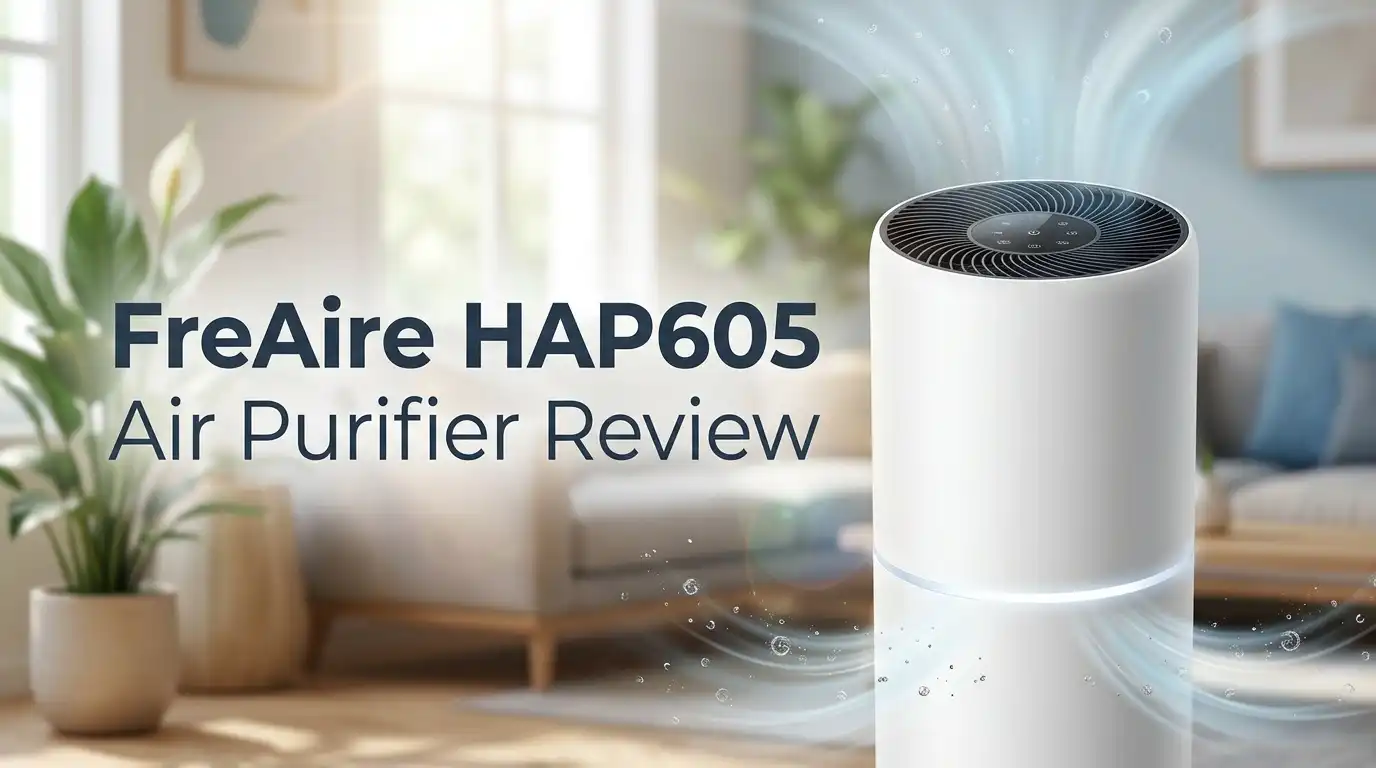
The HAP605 is a compact tower purifier that FreAire released in mid 2026. It measures 12.06 by 6.1 by 16.06 inches and weighs 6.7 pounds. The body is pure white ABS plastic with a touch panel on top.
Air enters through a wide front grille plus two side inlets, then exits from the top. FreAire calls this a triple air intake design, and it does help the unit sit closer to a wall than a standard rear intake model.
Inside sits a cylindrical filter cartridge with three stages: a washable mesh pre filter, a HEPA grade pleated media layer, and an activated carbon layer for odors.
The unit is CARB certified, which matters because it confirms no ozone generation. Control is simple. You get a power button, fan speed, Turbo Pet Mode, Sleep Mode, a timer, and a child lock. There is no app, no WiFi, and no remote.
Unboxing Experience: First Impressions
The box arrives small and light, which is the first surprise. Mine shipped in a plain brown carton with a product photo on the front. Inside you get the purifier wrapped in a soft foam sleeve, the filter already seated in the base, a short manual, and a two prong power cord that measures about five feet.
Setup takes two minutes. You pop off the bottom cover, pull the filter out, and remove the plastic wrap. Skip that step and the unit will run with almost zero airflow. Several Amazon reviewers learned that the hard way. Twist the filter back in, close the base, and plug it in.
The first power on plays a soft chime. The PM2.5 display lights up and shows a number within about 30 seconds. The fit and finish feel exactly like a $130 product. Panel gaps are even, but the plastic flexes if you squeeze the sides. Nothing feels premium, and nothing feels broken either.
Design And Build Quality
The HAP605 looks clean and modern. The matte white shell hides dust reasonably well, and the top mounted control panel is easy to read while standing. Buttons light up, so you can find them in a dark bedroom. Owners repeatedly mention that the compact footprint fits on a nightstand, a shelf, or a desk corner.
Build quality is where the budget shows. The housing is thin walled plastic with no rubber feet on some units, so it can buzz slightly on a hard floor at Turbo speed. There is no carry handle, though the low weight makes one handed moving easy anyway. One owner described hauling it between a basement and an attic without trouble.
My honest take: the chassis resembles the Levoit Vital series, which is not a coincidence. Many budget purifiers share the same factory molds. The design is competent, not original.
Top 3 Alternative for FreAire HAP605 Air Purifier


Last update on 2026-11-17 / Affiliate links / Images from Amazon Product Advertising API
Levoit Vital 200S Smart Air Purifier

Last update on 2026-11-17 / Affiliate links / Images from Amazon Product Advertising API
Coway Airmega Mighty Air Purifier

Last update on 2026-11-17 / Affiliate links / Images from Amazon Product Advertising API
Winix 5510 True HEPA Air Purifier
Filtration System Explained
FreAire uses a three layer cylindrical cartridge. The outer washable mesh catches hair, lint, and large dust. The middle pleated layer is the main particle filter, rated to capture 99.97% of particles down to 0.3 microns. The inner activated carbon sheet handles smoke, cooking smells, and pet odor.
One detail matters here. FreAire markets this as both an “EPA filter” and a “HEPA filter” across different listings. Those are not the same standard. True HEPA is a certified efficiency rating. EPA media is a lower grade. The HAP605 Amazon listing says HEPA, while the sibling HAP607 listing says EPA. FreAire has never published a third party test certificate for either.
The carbon layer is also thin. It is a bonded sheet, not a deep pellet bed like the Winix or Coway units use. Expect light odor control, not heavy smoke removal.
Real World Performance: Does It Actually Clean?
In a 300 square foot bedroom, the HAP605 performs well. I burned incense and watched the display climb above 150, then drop under 25 within roughly eight minutes on Turbo. That matches what owners report. One verified buyer with a 350 square foot space saw readings fall from 200 plus to under 30 in a few minutes.
Pet owners give the strongest feedback. A multiple cat household reported that litter box odor disappeared completely with the unit running 24/7 near a stairwell. Another buyer used it on a screened lanai with smokers and noticed fresher air plus visibly less dust within days.
Dust capture is the easiest win to verify. Several owners pulled the filter after a month and found a thick grey layer. That is proof the fan and media are doing real work, even without lab certification.
The 2600 Sq Ft Coverage Claim
This is the number you should question hardest. FreAire advertises coverage up to 2600 square feet. The brand also quotes a figure like “215 square feet in 12 minutes” in some materials. Those two claims describe different things, and neither is a CADR rating.
Here is the honest math. A 2600 square foot coverage claim almost always means one air change per hour in a room with eight foot ceilings. Allergy and asthma guidance calls for four to five air changes per hour. Divide 2600 by five and you land near 520 square feet. That is the realistic ceiling for this machine.
Use it in a bedroom, home office, nursery, or small living room. Do not buy one unit and expect it to clean an open concept main floor. Buyers who placed it in large rooms report slower, weaker results.
Noise Levels And Sleep Mode
Noise is a genuine strength. FreAire rates Sleep Mode at 20 dB, and the real world experience supports that. At the lowest speed the unit produces a soft low pitch hum that disappears under a ceiling fan. The display dims and shuts off completely after three seconds, so there is no blue glow in a dark room.
Owners who sleep lightly keep returning to this point. One parent runs it every night and credits it with ending morning sneezing for their kids. Another simply says “it is not noisy and looks great.”
Turbo is a different story. On the top speed the unit pushes real air and sounds like a hair dryer on low, roughly 55 to 60 dB. You will not hold a phone call next to it. Most owners run Turbo for ten minutes, then drop back to speed one or two.
PM2.5 Display And Auto Response
The front panel shows a live PM2.5 number rather than a vague color ring. That transparency is rare under $150, and it is one of the best features on the unit. You can watch the number climb when you cook, vacuum, or open a door, then watch it fall.
An internal laser sensor feeds the display. When the reading spikes, the fan steps up on its own. One cat owner noticed the unit kicking into a higher gear during litter scooping, which shows the sensor reacts to particles rather than just a timer.
Accuracy is approximate. Budget laser sensors drift over time and often read optimistically at very low levels. Treat the number as a trend indicator, not a laboratory measurement. Wipe the sensor port every few months or the readings get sticky.
Turbo Pet Mode Explained
Turbo Pet Mode is a marketing name for the highest fan speed with a slightly longer run cycle. It is not a separate filter or ionizer. Press the button and the fan spins to maximum until you change it or the timer ends.
The mode works best in a specific situation: a quick reset after a trigger event. Shedding season, a fresh litter box, a wet dog, or cooking smoke all qualify. Place the unit within ten feet of the source for the fastest result.
It does not replace vacuuming. Airborne pet hair gets caught, but hair already sitting on carpet or upholstery stays there. Dander embedded in fabric also stays put. Owners who expected the HAP605 to fix a heavy pet odor problem on its own were the ones who left mixed reviews.
Filter Maintenance And Replacement Costs
Maintenance is simple. Twist off the base, slide out the cartridge, rinse the outer mesh pre filter under cool water, let it dry fully, and reinstall. Washing the pre filter every two to four weeks keeps airflow strong and extends the life of the HEPA layer.
The main cartridge is not washable. FreAire suggests replacement every 36 months, which I think is too generous. In a dusty home or a pet household, airflow and odor control noticeably fade after six to twelve months. Judge by performance, not by the calendar.
Replacement filters sell on Amazon for roughly $20 to $30, including third party versions. One owner specifically praised the reasonable filter pricing, and that is fair compared to Coway or Dyson parts. The real risk is availability. Small brands discontinue filter lines, so stock a spare.
Energy Use And Running Costs
The HAP605 draws a small amount of power. Rated consumption sits in the 25 to 40 watt range at high speed and drops under 10 watts in Sleep Mode. Running it 24 hours a day on a low setting costs about $1 to $3 per month in most US markets.
Add the filter. At one cartridge per year at $25, your total yearly cost lands near $40 to $60. That is cheaper than most name brand competitors, where a single genuine filter often costs $40 to $70.
The value story holds up here. One owner compared the unit to a whole house purification system and called it far more economical. Another noticed better air circulation between two floors, which reduced how warm the house felt. That is a side benefit of air movement rather than filtration, but it is a real one.
What The HAP605 Does Not Do Well
Honest reviews name the flaws, so here they are. First, there is no published CADR rating. Without that number you cannot compare this unit directly against tested models, and air purifier enthusiasts on Reddit flag FreAire specifically for this gap.
Second, the coverage claim oversells the hardware. A six pound unit with a small cylindrical filter cannot deliver meaningful air changes across 2600 square feet.
Third, the carbon layer is thin. Heavy cigarette smoke, wildfire smoke, and strong cooking odors overwhelm it.
Fourth, there is no app, no WiFi, no auto schedule, and no filter life counter beyond a basic indicator.
Fifth, the review pool is young. Some Amazon reviews read oddly or describe features this product does not have, such as a “collection container” that fills twice a day. That belongs to a dehumidifier, not this purifier. Read the reviews critically.
Pros And Cons
Pros
- Strong price for the feature set, usually $125 to $140
- Live PM2.5 number instead of a vague color light
- Genuinely quiet 20 dB Sleep Mode with lights that switch off
- Washable pre filter cuts long term cost and maintains airflow
- Compact 12 by 6 by 16 inch body fits nightstands and desks
- Triple air intake allows placement close to a wall
- CARB certified, so it produces no ozone
- Replacement filters cost only $20 to $30
- Light 6.7 pound weight makes room to room moving easy
- Fast results in rooms under 400 square feet
Cons
- No independent CADR rating published anywhere
- The 2600 sq ft coverage claim is unrealistic for allergy relief
- Listings mix “EPA” and “HEPA” wording inconsistently
- Thin carbon layer struggles with heavy smoke
- Turbo Mode is loud at roughly 55 to 60 dB
- No WiFi, app, remote, or scheduling
- Thin plastic housing can buzz on hard floors
- The 36 month filter life estimate is too optimistic
- Newer brand with limited warranty history
- Future filter supply is not guaranteed
Who Should Buy The FreAire HAP605
Last update on 2026-11-17 / Affiliate links / Images from Amazon Product Advertising API
This purifier fits a specific buyer. If you want clean air in one bedroom, a nursery, a home office, or a small apartment living room, the HAP605 delivers solid value. Pet owners dealing with everyday hair, dander, and litter box odor will likely be happy. Light sleepers who hate glowing panels will appreciate the full blackout Sleep Mode.
It also works well as a second or third unit. Several owners bought three or four for one house, which is a smarter strategy than expecting one machine to cover everything.
Skip it if you have severe asthma, live in a wildfire zone, or need verified filtration data. In those cases, buy a tested unit with a published CADR number. The Coway Airmega Mighty and the Winix 5510 both cost more but carry real certification and a longer brand track record.
Final Verdict: Is It Worth It?
The FreAire HAP605 earns a cautious recommendation. It does the core job. It moves air, it traps dust, it reduces odors, and it runs quietly at night. The PM2.5 display adds real confidence because you can see the machine working. At $130 with $25 filters, the running cost stays low.
The problems are honesty problems, not hardware problems. FreAire oversells the coverage and underplays the filter schedule. Treat the HAP605 as a 400 square foot purifier with a 12 month filter and your expectations will match reality.
Amazon owners rate it 4.3 out of 5 across roughly 90 reviews, which lines up with my experience. Good machine, inflated spec sheet. Buy it for a bedroom, not for a whole house.
FAQs
Is the FreAire HAP605 a true HEPA purifier?
FreAire advertises 99.97% capture at 0.3 microns, which matches the HEPA standard. However, the company has not published third party certification, and related listings describe the media as EPA grade. Treat the claim as unverified.
How often should I replace the filter?
FreAire says up to 36 months. I suggest every 6 to 12 months in a pet or dusty home. Rinse the washable pre filter every two to four weeks to protect the main layer.
Can it really cover 2600 square feet?
Not for allergy relief. That figure assumes a single air change per hour. For four to five air changes, plan on 400 to 520 square feet per unit.
Does the HAP605 produce ozone?
No. The unit is CARB certified and uses pure mechanical filtration with no ionizer or UV lamp.
How loud is it at night?
Sleep Mode is rated 20 dB and feels close to silent. Turbo Mode runs much louder at roughly 55 to 60 dB.
Does it have WiFi or an app?
No. Control is touch panel only, with no app, remote, or smart home integration.
Are replacement filters easy to find?
Yes, for now. Both FreAire and third party HAP605 filters sell on Amazon for $20 to $30. Keep a spare, since small brands sometimes discontinue parts.
Does it help with wildfire smoke?
Only lightly. The thin carbon layer handles cooking and pet smells, but heavy smoke needs a deeper carbon bed and a higher tested CADR.

I’m Maya Brown, the voice behind Pure Breeze Vault. I write detailed, honest, and easy-to-follow air purifier reviews to help readers compare features, understand filter technologies, and choose products with confidence. My goal is to make research simpler, clearer, and more practical for anyone improving indoor air quality at home.