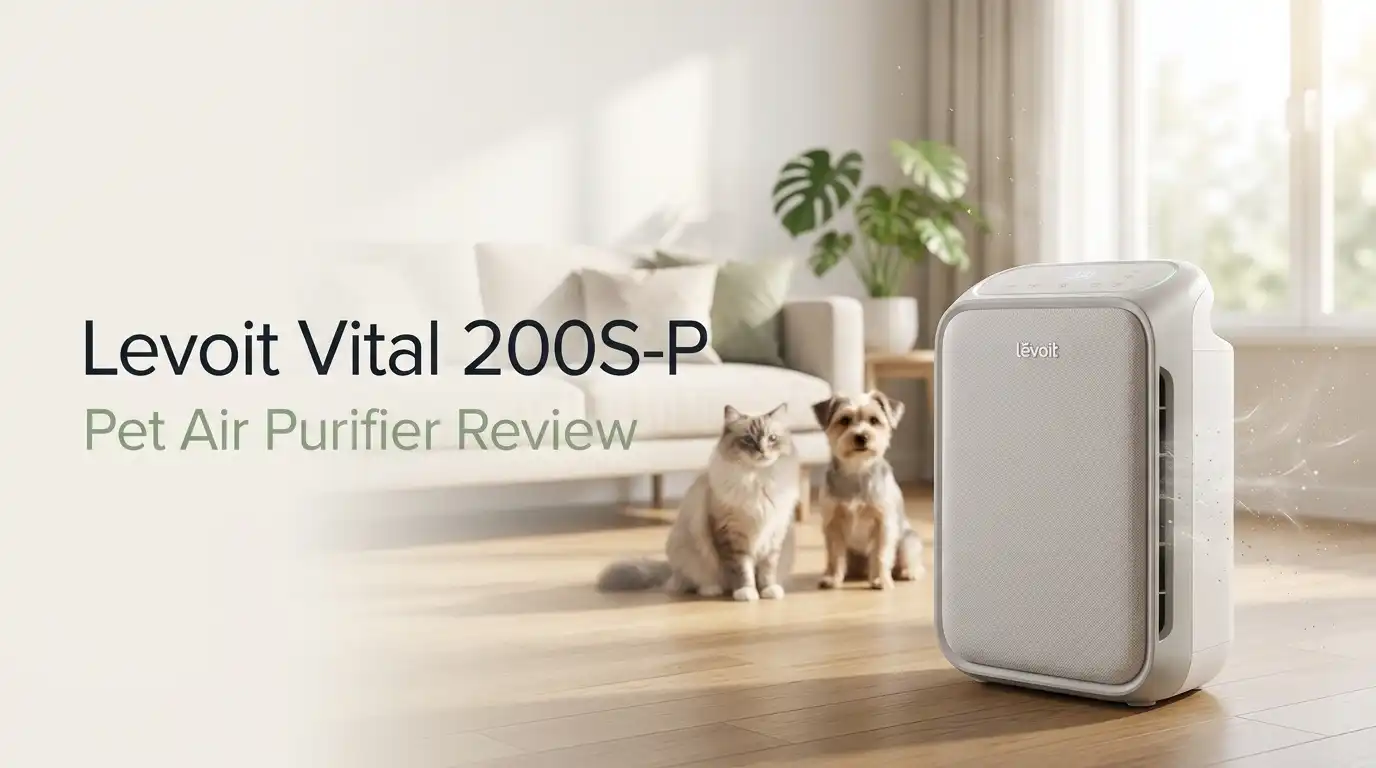
Levoit Vital 200S-P Pet Air Purifier Review 2026: Still Worth It?
Pet hair settles on everything. It clings to couches, floats through hallways, and lands in your coffee. Air purifiers promise to fix this, but most of them clog within weeks in a pet home. The Levoit Vital 200S-P claims it handles fur better than the rest.
I spent weeks living with this unit, testing airflow, measuring noise, and cleaning the prefilter more times than I care to count.
This review covers what the Vital 200S-P does well, where it falls short, and whether it deserves a spot in your home in 2026. No marketing fluff. Just honest observations from daily use.
In a Nutshell:
- Strong cleaning power for the price. The unit carries an AHAM Verifide rating of 250 CFM smoke CADR, which equals roughly 425 m³/h. Independent testing measured around 387 m³/h in a real bedroom, so the claim is honest rather than inflated.
- Built for pet homes. A washable nylon prefilter and a U shaped front vent catch fur before it reaches the main filter. This keeps the expensive filter working longer and saves real money over time.
- Quiet where it counts. At speed two, the unit measures around 43 dBA, which is quieter than several rivals at equivalent settings. Sleep mode is nearly silent.
- The air quality sensor is weak. It uses an infrared sensor instead of a laser sensor, and it overreports pollution badly. Auto mode is not trustworthy.
- Filters cost real money. Replacement filters run around $40 and last six to twelve months. Budget roughly $80 per year in a heavy pet household.
- Smart features actually work. The VeSync app, Alexa support, and multi stage scheduling are better than most competitors in this price range.
What Is the Levoit Vital 200S-P Air Purifier?


Last update on 2026-11-17 / Affiliate links / Images from Amazon Product Advertising API
The Levoit Vital 200S-P is a smart air purifier aimed at pet owners and large rooms. It uses a three stage mechanical filter and a WiFi connected control system. Levoit lists coverage up to 1875 square feet at one air change per hour.
Here is something important. The Vital 200S-P and the plain Vital 200S are the same machine. Both carry the LAP-V201S model code and both take the Vital 200S-RF filter. The P is a retail label, not a different pet version. Levoit confirms this directly.
The unit measures about 50 cm tall, 40 cm wide, and 22 cm deep. It weighs roughly 6 kg. That makes it chunky but stable. It pulls air from the front and pushes clean air out the top, which matters more than you might expect.
Unboxing the Vital 200S-P: First Impressions
The box arrives heavier than you expect for a mid range purifier. Inside, the unit sits wrapped in recycled cardboard rather than foam, with the detachable power cable in a separate sleeve. There is a quick start card, a manual, and nothing else. No gimmicks.
The first job is removing the plastic wrap from the filter. Many people forget this step and then wonder why airflow feels weak. Pull the front panel off with a gentle tug, lift out the filter, unwrap it, slide it back in. The whole process takes under a minute.
The build feels solid when you lift it. The matte plastic resists fingerprints. The molded handles on both sides are a small touch you appreciate immediately when carrying 6 kg across a room. Setup from box to running took me around five minutes.
Design and Build Quality Review
The Vital 200S-P looks like a chunky rectangle. It is wider than it is deep, and it sits low to the floor. This shape is not accidental. Because the intake sits entirely on the front face, you can push this unit flat against a wall without losing airflow.
Cylindrical purifiers draw air from all sides. Shove one against a wall and you block part of the intake, losing the CADR you paid for. The Levoit avoids that problem completely. For bedrooms with no open floor space, this is a genuine advantage.
The front panel features a U shaped vent running around the bottom and up both sides. Larger debris and fur gets pulled through this channel instead of coating the mesh. The control panel sits on top with a light sensor that dims the display automatically at night. The power cable detaches, so a chewed cord means a cheap replacement rather than a dead unit.
Top 3 Alternatives for Levoit Vital 200S-P

Last update on 2026-11-11 / Affiliate links / Images from Amazon Product Advertising API
Levoit Core 400S Smart Air Purifier

Last update on 2026-11-17 / Affiliate links / Images from Amazon Product Advertising API
Winix 5520 Air Purifier with Air Quality Monitor

Last update on 2026-11-17 / Affiliate links / Images from Amazon Product Advertising API
Coway Airmega AP-1512HH Mighty Air Purifier
Filtration System: What Is Inside the Filter?
The Vital 200S-RF filter uses three layers. First comes a washable nylon prefilter that catches hair, lint, and large fur particles. Second is the main particulate layer, rated to capture at least 99.97% of particles at 0.3 microns. Third is an activated carbon layer holding around 250 grams of pelleted coconut shell carbon.
That carbon amount deserves attention. Many purifiers in this bracket use a thin carbon dusted mesh that stops absorbing odors within weeks. Pelleted carbon holds far more adsorptive material, which is why this unit handles litter box smells better than cheaper models.
One honest note. Levoit no longer advertises this as True HEPA or H13 after Dyson challenged the claim through the National Advertising Division. The company now states the filter performs at HEPA grade in sleep mode only. At higher fan speeds, single pass efficiency drops. In practice this matters less than total airflow, but you should know the full story.
Real World Cleaning Performance Test
Spec sheets lie. Independent decay testing does not. In a sealed 29.4 m³ bedroom, testers burned incense until PM2.5 hit roughly 500 µg/m³, then ran the purifier and measured how long it took to drop below 5 µg/m³.
| Fan Speed | Measured CADR | Time to 90% | Time to 99% |
|---|---|---|---|
| Max | 387 m³/h | 10 min | 19 min |
| Half | 172 m³/h | 22 min | 43 min |
| Sleep | 83 m³/h | 48 min | 87 min |
At full power the room cleared in about 19 minutes. That measured 387 m³/h figure sits roughly 9% under the claimed 425 m³/h, which is within normal variance for a furnished room rather than a sealed lab chamber. This is an honest performer. It beats the Levoit Core 300 comfortably and sits close to pricier Xiaomi units.
Pet Hair and Odor Control Performance
This is where the Vital 200S-P earns its name. The washable prefilter is the single most useful feature for anyone with cats or dogs. Fur collects on the nylon mesh instead of embedding itself into the expensive main filter.
The routine is simple. Pull the front panel, lift the prefilter, rinse it under the tap, let it dry fully, put it back. Doing this every two to four weeks extends main filter life noticeably. In multi pet homes this saves real money each year.
Odor control works well too. The carbon layer reduces litter box smell and wet dog smell within an hour of running on speed three. It does not eliminate strong odors instantly, and it will not fix a litter box that needs cleaning. But in a normal pet home, the difference is clear within a day.
Noise Levels: Is It Quiet Enough for Bedrooms?
Levoit quotes 23 to 54 dB. Measured at one meter, the real figures run a bit higher. Max speed came in around 60 dBA, which is louder than the official ceiling. At full tilt, this unit is noisy. You will not sleep through it.
Speed two tells a better story. There it measured roughly 43 dBA, which beat several competitors reaching 47 dBA at similar settings. Four decibels sounds small written down, but the decibel scale is logarithmic. In practice it is the difference between noise you forget about and noise that keeps grabbing your attention.
Sleep mode is genuinely quiet. It drops below the ambient noise floor of most bedrooms. Many users lose track of whether the unit is even running. For nighttime use in a bedroom, this performs very well.
Smart Features and the VeSync App
The S stands for smart, and the implementation is better than most. Setup took about two minutes. Download VeSync, create an account, hold the power button to enter pairing mode, and the app finds the device. Mine connected on the first attempt.
The app gives you auto, sleep, pet mode, and four manual fan speeds. You can lock the control panel remotely and toggle the light sensor. Scheduling goes further than most purifier apps allow. You can build multi stage routines that run a high speed burst for 30 minutes, drop to level one for an hour, then hold sleep mode until morning.
Alexa and Google Home both work properly, including individual fan speed control by voice. Home Assistant support is built in through the VeSync integration, though it polls the cloud rather than working locally.
The Air Quality Sensor Problem
Here is the biggest weakness. The Vital 200S-P uses an infrared dust sensor rather than the laser sensor found in the pricier Core 400S and Core 600S. Infrared sensors are significantly less accurate, and this one proves it.
The unit overreports pollution by large margins. During real spikes where dedicated monitors read 100 to 150 µg/m³, the Levoit displayed above 600. At clean baseline it often shows 20 µg/m³ while a reference monitor a meter away reads under 5.
Worse, it reports spikes that never happened. Testing recorded phantom readings above 400 µg/m³ while a calibrated monitor beside it showed 20 in a closed room. Levoit also declines to publish the PM2.5 thresholds that trigger auto mode speed changes. My honest advice is to skip auto mode entirely and pick a manual fan speed you like.
Filter Replacement Cost and Running Expenses
A genuine Vital 200S-RF filter costs around $40. Levoit rates it for six to twelve months. In a home with multiple pets, plan for the six month figure even with diligent prefilter washing. That works out to roughly $80 per year in filters.
Electricity is cheap by comparison. Running at speed two for twelve hours daily costs around $10 per year at typical rates. Even running it 24 hours a day lands near $20 annually. Power draw is genuinely low.
Add it up and yearly running cost sits near $90. Over three years you spend about $270 in consumables on top of a $189 purchase price. The filters will cost more than the purifier itself. That is worth knowing before you commit. Third party filters exist and cost less, but they void the AHAM performance figures.
What the Vital 200S-P Does Not Do Well
Honest reviews list the failures. Here they are.
The sensor is the main letdown. It is inaccurate enough that the air quality graph in the app is only useful for spotting trends, not actual concentrations. Auto mode makes decisions based on bad data.
Max speed is louder than advertised at around 60 dBA. The coverage claim of 1875 square feet relies on one air change per hour, which does almost nothing for a room in active use. The realistic figure is closer to 380 square feet at nearly five air changes per hour.
Home Assistant control requires internet access since it polls the VeSync cloud. There is no local control. The integration has broken before during authentication changes. Finally, the unit takes up more floor width than a cylindrical purifier of similar output.
Pros and Cons of the Levoit Vital 200S-P
Pros
- AHAM Verifide CADR rating confirms performance was measured independently rather than in house
- Washable nylon prefilter catches pet hair and extends main filter life significantly
- Front facing intake lets you place the unit flat against a wall without losing airflow
- Quiet at speed two around 43 dBA, which beats several rivals at the same setting
- Generous 250 grams of pelleted activated carbon for genuine odor control
- Purely mechanical filtration with no ionizer, no UV lamp, and no ozone concerns
- Excellent VeSync app with multi stage scheduling, Alexa, and Home Assistant support
- Detachable power cord and molded side handles make it easy to move between rooms
- Low electricity draw at roughly $10 per year on moderate use
Cons
- Infrared air quality sensor reads far too high and invents pollution spikes
- Auto mode is unreliable because the sensor data driving it is inaccurate
- Replacement filters cost around $40 and may need changing every six months in pet homes
- Max speed reaches roughly 60 dBA, louder than the quoted 54 dB ceiling
- The 1875 square feet coverage claim is based on just one air change per hour
- No local network control, so smart features depend on cloud connectivity
- Control panel lock button is easy to trigger accidentally by pets sitting on top
Who Should Buy the Levoit Vital 200S-P?
Buy this unit if you own pets and want a purifier that survives fur season. The washable prefilter and U shaped vent make a visible difference compared to cylindrical units that turn into hairballs within weeks.
It also suits bedrooms with limited floor space. The front facing intake means wall placement costs you nothing in performance. If you run a smart home, the Home Assistant and Alexa support is better than most competitors offer here.
Skip it if you want accurate air quality readings. The sensor simply is not good enough for that job. If monitoring matters to you, buy a dedicated air quality monitor separately and run the purifier on a fixed speed. Also skip it if you need coverage for a genuinely large open plan space, since 380 square feet is the realistic working limit.
Final Verdict: Is It Worth Buying in 2026?
Last update on 2026-11-17 / Affiliate links / Images from Amazon Product Advertising API
The Levoit Vital 200S-P is a solid purchase for pet owners in 2026. It does what the box claims, backed by independent AHAM certification rather than in house marketing numbers. Measured performance landed within 9% of the stated figure, which is honest by industry standards.
What lifts it above rivals is everything around the fan. The molded handles, the detachable cord, the light sensor that dims the panel at night, and the washable prefilter all reveal thoughtful design after weeks of use. The VeSync app is one of the better manufacturer apps available.
Two things hold it back. The sensor is poor, and filters add up over time. Neither flaw is severe enough to disqualify it. At $170 to $190, this remains one of the better value pet purifiers you can buy right now.
Frequently Asked Questions
Is the Vital 200S-P the same as the Vital 200S?
Yes. Both units share the LAP-V201S model code and use the identical Vital 200S-RF filter. The P is a retail designation, not different hardware. Any review of the 200S applies equally to the 200S-P.
Does the Vital 200S-P use a real HEPA filter?
Levoit states the filter performs at HEPA grade in sleep mode, tested by an independent lab. It no longer carries True HEPA or H13 branding. At higher fan speeds, single pass efficiency drops below that standard.
What room size does it actually cover?
Levoit lists 1875 square feet at one air change per hour. The realistic working figure is around 380 square feet at nearly five air changes per hour, which is the rate that keeps a lived in room clean.
Should I use auto mode on the Vital 200S-P?
No. The infrared sensor overreports pollution and registers phantom spikes. Pick a manual fan speed instead, or automate the unit using a separate air quality monitor through Home Assistant.
How often should I wash the prefilter?
Every two to four weeks in a pet home. Rinse the nylon mesh under running water, let it dry completely, then reinstall it. This habit extends main filter life and saves money.
Does it remove pet odors effectively?
Yes, within reason. The 250 grams of pelleted activated carbon reduces litter box and pet smells noticeably within an hour on speed three. It will not mask odors from an uncleaned source.

I’m Maya Brown, the voice behind Pure Breeze Vault. I write detailed, honest, and easy-to-follow air purifier reviews to help readers compare features, understand filter technologies, and choose products with confidence. My goal is to make research simpler, clearer, and more practical for anyone improving indoor air quality at home.