Shark HP102 Air Purifier Review 2026: Still Worth It?
The Shark HP102 looks like a small speaker, sits quietly on a nightstand, and shows you your air quality on a bright round screen.
That combination makes it one of the most popular compact purifiers on Amazon. But popularity does not always mean performance. I spent time with this unit, compared it against independent lab results, and looked closely at the parts Shark does not advertise.
This review covers real test numbers, the unboxing, the running costs, and the honest weak spots. If you want a small purifier for a bedroom, office, or nursery, read this before you spend your money.
In A Nutshell:
- Performance beats its own spec sheet. Independent testing cleared a 120 square foot room by about 94 percent in 60 minutes. A separate lab cleared a 728 cubic foot room in 38 minutes. That is strong for a unit this small.
- Room coverage claims are inflated. Shark advertises 500 square feet. At the industry standard of 4.8 air changes per hour, the realistic figure is closer to 124 square feet. Treat this as a small room machine.
- It is genuinely quiet. Measured output runs from roughly 36 to 52 decibels depending on the meter and distance. Speed 1 and 2 disappear into background noise.
- The sensor is the standout feature. Clean Sense IQ tracks PM1, PM2.5, and PM10, which most rivals in this price band do not do.
- No app, no WiFi, no voice control. In 2026 that feels dated. The purifier has no smart connectivity at all.
- Filters cost real money. Genuine filters are pricey and sometimes out of stock. Generic packs cut the yearly cost to roughly 30 dollars.
Shark HP102 Air Purifier With Nanoseal HEPA

Last update on 2026-10-04 / Affiliate links / Images from Amazon Product Advertising API
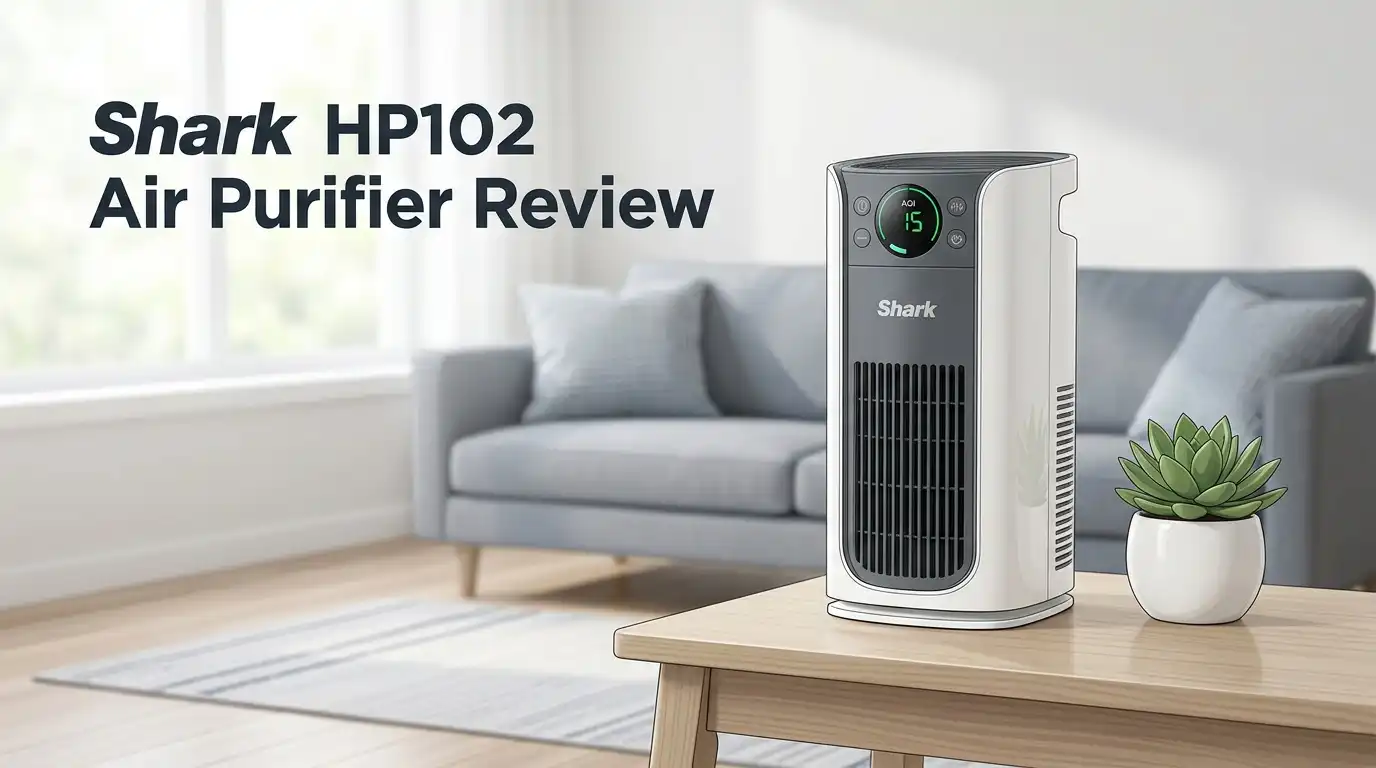
The Shark HP102 is a cylindrical purifier built for small spaces. It measures about 8.7 by 8.7 by 14.6 inches and weighs 5.85 pounds.
Air enters through vents around the lower body, passes through a single cylindrical filter cartridge, and exits through grilles on top. Shark calls the filter media Nanoseal HEPA, and it carries a Microban coating that limits bacterial growth on the filter surface.
The unit is CARB certified and does not produce ozone. There is no ionizer inside, which matters if you avoid byproduct emitting technology.
You get four fan speeds, auto mode, eco mode, a timer, a child lock, a filter life indicator, and a three level display dimmer. Shark backs it with a two year limited warranty. It sells in white and black.
The Unboxing Experience
The box is compact and surprisingly light. Inside you find the purifier, the filter already seated in the base, and a user manual.
There are no extras, no spare filter, and no carry bag. Shark lists a remote control in the manual, yet several buyers and reviewers report no remote in the box, so do not count on one.
Setup takes about three minutes. You peel protective tape off the body, flip the unit upside down, twist off the base, and pull out the filter. The filter arrives sealed in plastic.
You must remove that plastic bag or the purifier will move no air at all. Reinsert the filter, close the base, plug it in, and tap power. The first thing most people notice is the display lighting up with a live air quality reading. That moment sells the product better than any marketing page.
Design And Build Quality
The HP102 feels more expensive than it is. The plastics are thick, the seams line up, and nothing rattles when you tilt it. Shark’s manufacturing experience with vacuums and blenders shows here. Reviewers who placed it beside a Levoit Core 300S consistently rated the Shark higher on build feel.
The front display is the visual hook. A glowing ring circles a digital readout, and the ring changes color based on air quality. Controls sit flat on the top rim and respond to a light touch.
There is no carry handle, which is a small annoyance even on a 5.85 pound unit. The air intake also does not wrap a full 360 degrees. Part of the lower body is sealed, so one side of the filter loads with dust faster than the other.
Top 3 Alternative for Shark HP102

Last update on 2026-10-03 / Affiliate links / Images from Amazon Product Advertising API
Levoit Core 300S Smart Air Purifier


Last update on 2026-10-02 / Affiliate links / Images from Amazon Product Advertising API
Shark NeverChange Air Purifier HP152

Last update on 2026-10-03 / Affiliate links / Images from Amazon Product Advertising API
Coway Airmega Mighty Air Purifier
Three Stage Filtration Explained
The HP102 uses one cartridge that combines three stages. The pre filter is a fine mesh layer bonded to the outside. It grabs pet hair, lint, and dust clumps before they reach the finer media. Vacuum it every two weeks and the rest of the filter lasts longer.
The second stage is an activated carbon layer, and this one is worth noting. Shark uses pelletized carbon rather than a thin carbon coated fabric. Pellets hold more carbon, so odor and VOC removal is better than you expect at this size. Testers found it neutralized cooking smells and burnt match odor faster than several compact rivals.
The third stage is the True HEPA layer, rated to capture 99.97 percent of particles down to 0.3 microns. Shark also claims 99.98 percent at 0.1 to 0.2 microns under a cleanroom test standard, though that figure has never been independently confirmed.
Real Room Coverage And CADR Numbers
This is the most important section of the review. Shark markets the HP102 for rooms up to 500 square feet. That number is technically achievable only at one air change per hour, meaning the air cycles through the filter once every 60 minutes. That is too slow for allergies, smoke, or pet dander.
Measured CADR sits around 91 CFM for dust, 80 CFM for smoke, and 94 CFM for pollen. Run those figures at the recommended 4.8 air changes per hour and you get about 124 square feet of real coverage. One lab suggested up to 219 square feet if you accept a lower change rate.
So treat this as a desk, nursery, home office, or small bedroom purifier. Putting it in an open plan living room will disappoint you.
How Well Does It Actually Clean The Air
Despite the modest CADR, the HP102 punches above its weight. In a 120 square foot test room running at maximum speed for 60 minutes, PM2.5 dropped from 102.6 to 7.9 micrograms per cubic meter. AQI fell from 132 to 8. That is a 94 percent improvement, and it beat several compact competitors in the same test.
In a larger 194 square foot room, slightly beyond the recommended size, it still delivered a 92 percent improvement in the same hour.
A separate reviewer filled a 728 cubic foot office with incense smoke and the HP102 reached zero detectable PM1 in 38 minutes, faster than the Levoit Core 300. In a sealed smoke box it cleared visible smoke in just 29 seconds.
Noise Levels Across Four Speeds
Noise is where the HP102 shines for bedroom use. Measurements vary by testing distance, but the pattern is consistent. One lab recorded 41.7, 44.8, 48.9, and 56.5 decibels across the four speeds. Another, measuring from three feet away, recorded 36.1, 37.2, 44.6, and 52.2 decibels.
Either way, speeds 1 and 2 are whisper quiet. The motor produces a smooth low pitched hum with no clicking or whine. Speed 3 is still comfortable for watching television. Speed 4 is clearly audible, though softer than most rivals at full tilt, partly because the fan simply moves less air.
Pair the lowest brightness setting with speed 1 and you can sleep next to it without noticing. You can also mute the button beeps by holding Air Info and Child Lock together for two seconds.
Clean Sense IQ Sensor And The Display
The sensor is the feature that justifies the price gap over cheaper purifiers. Clean Sense IQ reads PM1, PM2.5, and PM10 in real time. Most purifiers under 200 dollars read PM2.5 only. PM1 covers ultrafine particles, and PM10 covers pollen and mold spores, so you see a fuller picture.
Tap the Air Info button to cycle through five readouts: percent clean air, estimated minutes to clean air, PM1, PM2.5, and PM10. The time to clean air figure is oddly satisfying to watch. The LED ring glows blue for good, amber for fair, and red for poor.
One reviewer cross checked the readings against a laboratory grade reference sensor and the numbers matched. The sensor also reacts within seconds, which many budget sensors do not.
Modes, Controls, And Everyday Use
Auto mode links the sensor to the fan. The purifier raises and lowers speed on its own, so you can leave it alone for weeks. Auto mode is also the cheapest and gentlest way to run it, since it spends most of its time on low.
Eco mode kicks in automatically. When auto mode holds a 100 percent clean air reading for ten minutes, the fan drops further to save power and stretch filter life. The timer runs from 1 to 12 hours. Child lock freezes every button after a two second hold.
Brightness has three levels, though the power button and brightness indicator never switch off completely. The filter life indicator doubles as a reset button. Hold it for three seconds after a filter swap.
Running Costs And Filter Replacement
The motor is rated at 24 watts and draws about 20.5 watts at top speed. Running it flat out 24 hours a day for a month adds roughly two dollars to an electricity bill. Running it on auto costs far less. Annual electricity works out near 31 dollars at full tilt.
Filters are the real expense. Shark recommends replacement every 6 to 12 months, and genuine filters carry a premium price while often sitting out of stock. Generic two packs sell for roughly 20 to 30 dollars and keep yearly filter cost near 30 dollars. Total ownership lands around 61 dollars per year.
One tip from Shark’s own manual: flip the filter upside down every three months. Because the intake is not a full circle, this evens out dust loading and extends filter life.
What The Shark HP102 Does Not Do Well
Honest reviews list the failures, so here they are. The 500 square foot claim is misleading and the single biggest reason buyers feel let down. There is no app, no WiFi, and no voice control, which puts it behind the Levoit Core 300S at a similar price.
The air quality sensor is buried in the upper housing and is nearly impossible to reach for cleaning. Dust buildup will reduce its accuracy over time, and you cannot do much about it. There is no carry handle. The advertised remote control often does not arrive. The intake vents do not circle the full body, so filter loading is uneven. Genuine filter availability is inconsistent. Finally, some owners on forums argue Shark purifiers are simply overpriced for the airflow they deliver.
Pros And Cons
Pros
- Excellent real world particle removal for its size, with 94 percent improvement in 60 minutes during independent testing
- Very quiet at low and medium speeds, which suits bedrooms and nurseries
- Clean Sense IQ sensor reads PM1, PM2.5, and PM10 with accuracy that matched a reference meter
- Pelletized activated carbon handles odors better than thin carbon coated fabric
- Build quality and materials feel a step above most budget purifiers
- Low power draw at roughly 20.5 watts on maximum speed
- No ozone output and CARB certified
- Bright, readable display with three brightness levels and a child lock
Cons
- Advertised 500 square foot coverage is unrealistic, with 124 square feet the honest figure
- No app, WiFi, or voice control in 2026
- Sensor is sealed away and cannot be cleaned
- Genuine replacement filters are expensive and frequently unavailable
- No carry handle and no 360 degree air intake
- Remote control is listed but often missing from the box
Shark HP102 Versus Levoit Core 300S
These two land in the same price range and the same room size bracket. The Core 300S has slightly higher CADR and full app and voice control, which the Shark lacks completely. Levoit filters are also easier to find and cheaper.
The Shark wins on three points. Build quality feels sturdier, so it should last longer. The display is far better, showing live numbers rather than a single colored dot. And the sensor reads three particle sizes instead of one. In smoke testing the HP102 cleared a room two minutes faster than the Core 300.
Pick the Levoit if you want smart control and cheap filters. Pick the Shark if you want a better screen, a better sensor, and a nicer object on your shelf.
Who Should Buy The Shark HP102
Buy it if you need a purifier for a small bedroom, nursery, home office, dorm room, or small kitchen under roughly 150 square feet. It is ideal for people who want to see their air quality rather than trust a marketing claim, and for anyone sensitive to fan noise at night.
Skip it if your room is larger than 200 square feet, if you want app control, or if you want the lowest possible yearly filter cost. Heavy smoke exposure or strong ongoing odors also call for a bigger machine with more carbon.
Overall this is a well built, quiet, genuinely effective small room purifier held back by one oversized marketing claim and one missing feature. Match it to the right room and you will like it.
Frequently Asked Questions
Does the Shark HP102 produce ozone?
No. The HP102 contains no ionizer and produces no ozone. It is CARB certified, meaning it meets California’s strict emissions rules for indoor air devices.
How often should I change the Shark HP102 filter?
Shark recommends every 6 to 12 months depending on use. The filter life indicator will flash when it is time. Check the filter yourself every few months and replace it early if it looks heavily loaded or smells stale.
Is the Shark HP102 filter washable?
No. The HEPA and carbon media must stay dry. You can vacuum the outer pre filter mesh every two weeks and wipe the housing with a microfiber cloth every two months.
Does the Shark HP102 have WiFi or an app?
No. There is no app, no WiFi, and no voice assistant support. All control happens through the touch panel on top of the unit.
What room size does the Shark HP102 really cover?
Shark advertises 500 square feet, but that assumes only one air change per hour. For meaningful cleaning at 4.8 air changes per hour, plan for about 124 square feet.
Does the Shark HP102 come with a remote control?
The manual mentions one, but many units ship without it. Do not buy this purifier expecting remote operation.
What warranty does Shark offer on the HP102?
A two year limited warranty. Register the product on Shark’s website shortly after purchase so your coverage is on file.

I’m Maya Brown, the voice behind Pure Breeze Vault. I write detailed, honest, and easy-to-follow air purifier reviews to help readers compare features, understand filter technologies, and choose products with confidence. My goal is to make research simpler, clearer, and more practical for anyone improving indoor air quality at home.