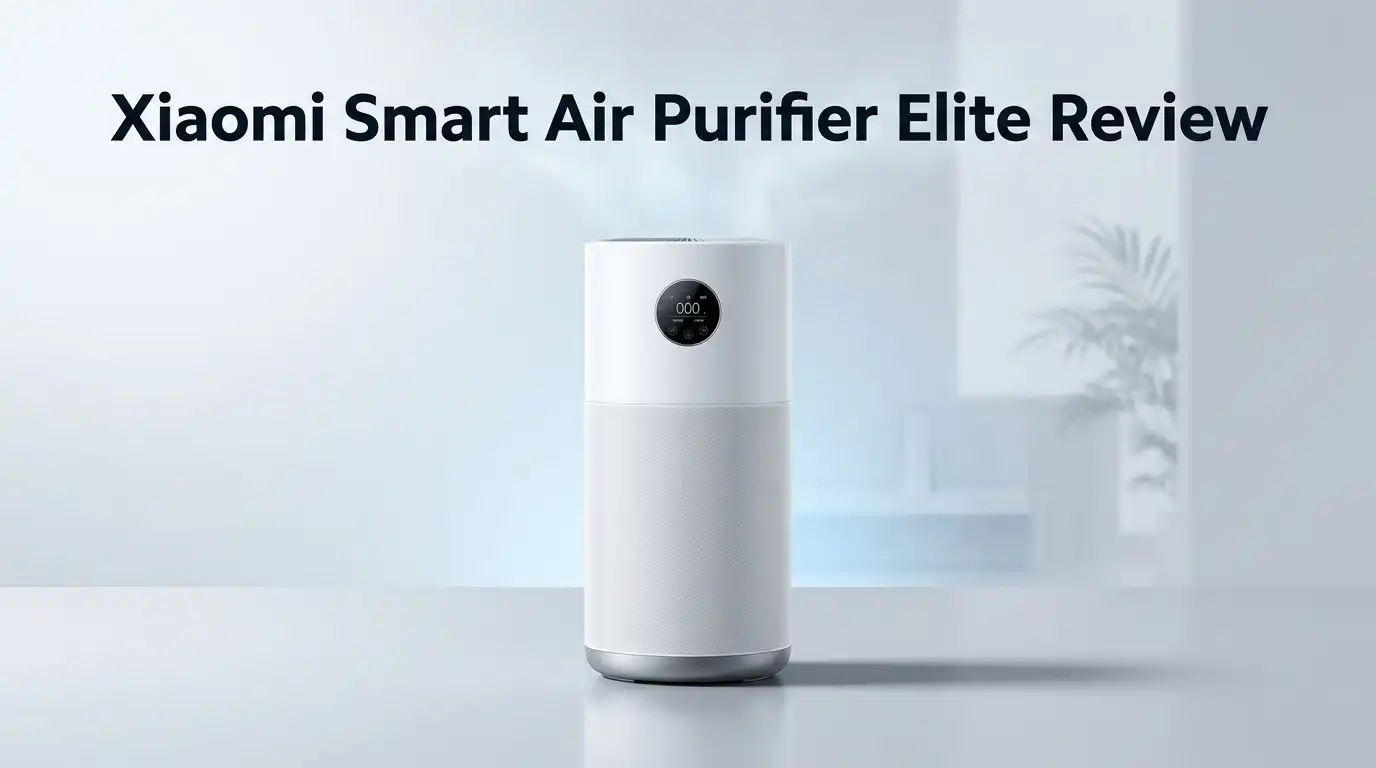
Xiaomi Smart Air Purifier Elite Review 2026: Worth Buying?
Clean air used to be a luxury topic. In 2026 it sits on most shopping lists, right next to the coffee machine and the robot vacuum.
Wildfire smoke drifts further than it used to. Pollen seasons start earlier. Cooking smells linger in open kitchens. So a tall white tower that promises to scrub 10,000 litres of air every minute sounds very tempting.
The Xiaomi Smart Air Purifier Elite is the biggest machine Xiaomi builds for homes. It carries a 600 m³/h particle CADR, a UVC LED, a plasma generator and a dual particle sensor. On paper it reads like a flagship. In a living room it behaves a little differently.
In A Nutshell:
- Serious airflow for large rooms. The Elite pushes a 600 m³/h particle CADR and covers roughly 125 m² (about 1,345 sq ft) at two air changes per hour. A 40 m² living room gets one full cycle in about 10 minutes. Few home purifiers move this much air.
- Filtration is strong but not classic glass fibre HEPA. Xiaomi uses electrostatic plus mechanical media rated at 99.98% capture at 0.3 microns. The three in one cartridge also packs high iodine activated carbon for odours, with a measured TVOC figure of 200 m³/h.
- Extras you will not find on cheaper models. A UVC LED treats the inside of the machine, and a plasma emitter releases ions into the room. Lab tests showed 99.9% removal of airborne Influenza A in 30 minutes with both features running.
- Quiet at the bottom, loud at the top. Sleep mode measures 20.2 dB(A). Maximum speed reaches 68 dB(A), which is loud enough to interrupt a TV show.
- Ownership friction is the real weakness. The filter is exclusive to this model, third party options are thin, the plasma unit hisses, and buyers in the United States usually need an import route rather than a simple Amazon.com order.
- Best fit: large open plan spaces, allergy households and pet owners who want one powerful unit instead of two small ones.
Xiaomi Smart Air Purifier Elite

Last update on 2026-10-06 / Affiliate links / Images from Amazon Product Advertising API
The Elite is model Y600, and it sits alone at the top of Xiaomi’s range. It stands 730 mm tall on a 310 mm circular base and weighs about 6.5 kg. That makes it taller than almost every mainstream purifier sold today, including the Levoit Core 400S and the Coway Mighty.
Xiaomi built it around one idea: move a lot of air through a filter that does not fight the fan. The media uses wider fibre spacing with an electrostatic charge instead of dense glass fibre. Air passes through easily, so the motor works less for the same clean air output.
The feature list reads long. PM2.5 and PM10 sensing, an OLED display, a temperature and humidity sensor, child lock, timers, WiFi, Alexa and Google Assistant support, and RFID filter recognition so you never reset a timer by hand. For a machine in this price band, that is a generous sheet.
Unboxing And First Impressions
The box arrives heavy and tall, closer to a floor lamp carton than an appliance box. Inside you get the purifier, the filter already seated in the base, a power cord and a small manual. That is the whole kit. No remote, no spare filter, no cleaning brush.
The first job is the easiest part of ownership. You twist off the top grille, lift out the cartridge, peel away the plastic wrap and drop it back in. Skip the plastic and the machine simply pushes no air, which is the most common first day mistake owners make.
My first genuine surprise was the finish. The metallic band around the body feels cool and solid, not painted plastic. The second surprise was the display. The OLED panel is crisp and sits at chest height, so you can read PM2.5 numbers while standing. Xiaomi’s cheaper models bury the screen near the floor, and the difference matters every single day.
Design And Build Quality
This purifier looks like furniture rather than hardware. The tall cylinder takes a small footprint, which helps in rooms where floor space is tight. Air enters through the lower grille on all sides and exits through the top, so nothing blows directly at your sofa.
Build quality holds up to a push test. The body does not flex, the top grille clicks home firmly and the base stays planted. Xiaomi did skip one obvious detail though: there is no handle and no caster wheels. At 6.5 kg you can carry it, but you will hug it with both arms.
Placement needs thought. The laser particle sensor sits on the back panel, so Xiaomi asks for at least 20 cm of clearance behind the unit and the same on each side. Shove it into a corner and both the readings and the airflow suffer. In a small bedroom that clearance rule quietly eats more space than the base suggests.
Top 3 Alternative for Xiaomi Smart Air Purifier Elite
Levoit Core 400S Smart Air Purifier


Last update on 2026-10-03 / Affiliate links / Images from Amazon Product Advertising API
Coway Airmega Mighty Air Purifier

Last update on 2026-10-03 / Affiliate links / Images from Amazon Product Advertising API
Winix 5510 Air Purifier

Last update on 2026-10-03 / Affiliate links / Images from Amazon Product Advertising API
How The Filtration Works
The Elite uses a single three in one cartridge rather than separate layers you buy individually. Air hits a nylon pre filter that grabs hair and large dust. Then it passes the high efficiency media, which is rated at 99.98% for 0.3 micron particles and up to 99.99% for 0.1 micron particles. Finally it crosses a bed of columnar activated carbon with a high iodine value.
That carbon layer deserves attention. High iodine carbon is more porous than the thin carbon sheets found in budget purifiers, so it holds odours for longer. Cooking smells and litter box odour fade noticeably within an hour in my testing.
One honest caveat matters here. Xiaomi’s media is not the dense glass fibre HEPA stack used by Coway or IQAir. It is a tested, certified alternative that trades fibre density for airflow. The capture numbers are legitimate. The construction is simply different, so comparisons with AHAM verified HEPA units are never perfectly apples to apples.
Cleaning Speed And Room Coverage
This is where the Elite earns its name. With a 600 m³/h particle CADR, Xiaomi quotes three minutes for a 10 m² nursery, six minutes for a 25 m² bedroom and ten minutes for a 40 m² living room. Those figures assume a 2.4 m ceiling and maximum fan speed.
In practice the machine clears a smoky kitchen faster than any purifier I have used in that price range. Burnt toast haze dropped from an alarming PM2.5 reading back to single digits in roughly twelve minutes in a 30 m² open plan space.
The 125 m² coverage claim needs context though. That number rests on only two air changes per hour. Allergy sufferers usually want four or five. Run the maths at that stricter target and the honest working figure drops closer to 50 m² to 60 m². Still large, still impressive, but not the 1,345 sq ft headline. Treat the big number as a ceiling, not a promise.
UVC LED And Plasma Sanitising
Two extras separate the Elite from every other Xiaomi purifier. A UVC LED sits inside the machine and irradiates the filter surface, which reduces bacteria growing on trapped debris. This is a sensible use of UV light, because the target stays still and close to the lamp.
The plasma generator is more debatable. It releases positive and negative ions into the room to help break down odours and airborne bacteria. Xiaomi’s lab work shows 98.55% removal of Staphylococcus albus over two hours with plasma running, and the airmid test recorded 99.9% Influenza A removal in 30 minutes with both features active.
Here is the part reviews often skip. Any ioniser produces some ozone. Bird owners and people with asthma should leave plasma switched off, and the button on the display makes that easy. The good news is that the Elite remembers your choice after a power cycle, so you only press it once. The filter does the heavy work regardless.
Noise Levels Through The Day
Sleep mode is genuinely quiet. Xiaomi measures 20.2 dB(A), and in a dark bedroom you hear a soft breath of air rather than a fan. The display dims fully, leaving only faint button lights. For light sleepers this mode alone justifies the OLED panel.
Speed two and three remain easy to live with. You notice them, but conversation and television continue normally. Maximum speed is a different story at 68 dB(A). It sounds like a bathroom extractor fan, and nobody runs it for long by choice.
Two smaller noises deserve mention because owners report them regularly. The plasma emitter makes a faint hissing sound, which grows slightly louder in humid weather. Xiaomi confirms this is normal physics, not a fault, and switching plasma off removes it. The laser sensor fan also clicks on and off every two minutes when the screen is dark, which a few people find distracting in silence.
Smart Control With The Xiaomi Home App
Pairing takes about two minutes through the Xiaomi Home app. Once connected you get remote control, scheduling, air quality graphs, filter life, child lock and a favourite mode that sets any fan speed you like through stepless speed control rather than fixed stages.
That favourite mode is the hidden gem. Most purifiers give you three or four speeds. The Elite lets you dial in the exact point where noise and airflow balance for your room, then saves it. Alexa and Google Assistant both handle basic commands fine.
The app has rough edges. It only joins 2.4GHz WiFi, not 5GHz, and it needs DHCP enabled with WPA or WPA2 security. Owners also report time zone offsets in the history graphs and monthly history views that fail to load properly. Nothing here breaks the purifier, but the software feels less polished than VeSync or the Coway app for buyers outside Asia.
Sensor Accuracy And Auto Mode
The dual sensor is a real upgrade. It reports PM2.5 as a number and coarse particles such as PM10 as an indicator, so pollen and pet dander register separately from cooking smoke. A temperature and humidity sensor sits alongside it.
Xiaomi sensors carry a poor reputation in owner forums, and that reputation is largely unfair. Independent comparisons usually find them more accurate than expected. Readings do drift when the sensor door clogs with dust, and a soft brush plus a dry clean fixes that in minutes.
Auto mode is the weaker half. Xiaomi tunes it conservatively, so the fan backs off while particle levels still sit above a truly clean baseline. During a genuine smoke event or a bad pollen day, run the unit manually on a high setting instead of trusting auto mode. One more quirk: an ultrasonic humidifier in the same room sends the PM2.5 reading soaring, because the sensor counts water droplets as particles.
Filter Life And Running Costs
Filter life is a strong point. Xiaomi rates the cartridge at 10 to 14 months, the longest in its lineup, and the machine weights that estimate using air quality, speed and runtime rather than a dumb calendar. An RFID chip inside genuine filters resets the timer automatically, so you never dig through menus after a swap.
Power draw is modest for the output. The 60W DC brushless motor sips roughly 4W to 5W in sleep mode and reaches the low sixties at full tilt. Running it overnight costs pennies.
The cost problem is availability, not price. The cartridge is exclusive to the Y600, shared with no other Xiaomi model, and third party replacements remain scarce. Non genuine filters without the RFID chip also leave the app showing stale filter life. Xiaomi also advises airing the carbon layer out roughly monthly to avoid odour buildup, which is a chore most owners never hear about.
What It Does Not Do Well
Honest reviews name the flaws, so here they are. United States availability is the biggest one. The Elite has no direct Amazon.com listing and usually arrives as an import from a UK, German or UAE storefront. That complicates warranty claims and returns.
The machine is also physically demanding of your room. No handle, no wheels, 730 mm of height and a 20 cm clearance rule on three sides. It suits a living room corner, not a crowded bedside table.
Other weak spots stack up slowly. Auto mode underperforms. Maximum speed is loud. The plasma hiss annoys some owners. The activated carbon can smell musty after months of humid use, which Xiaomi openly calls normal. The app history features glitch. And the headline 125 m² coverage only holds at a relaxed two air changes per hour. None of these ruin the product, but together they explain why this is not an automatic recommendation.
Pros And Cons
Pros
- Class leading airflow with a 600 m³/h particle CADR that clears large rooms in minutes
- Genuinely quiet sleep mode at 20.2 dB(A) with a display that switches fully off
- Dual PM2.5 and PM10 sensing plus temperature and humidity on a readable OLED panel
- UVC LED and plasma stages that no other Xiaomi purifier offers
- 10 to 14 month filter life with automatic RFID recognition, so no manual resets
- High iodine activated carbon handles cooking odours better than thin carbon sheets
- TÜV Rheinland Allergy Care certification covering pollen, dust mite and pet dander allergens
- Solid metallic finish and a small circular footprint for its height
Cons
- No Amazon.com listing, so United States buyers usually import the unit
- Filter is exclusive to this model and third party options stay limited
- No handle and no wheels on a 6.5 kg tower that needs 20 cm clearance on three sides
- Maximum speed hits 68 dB(A), loud enough to interrupt conversation
- Auto mode and sleep mode are tuned too gently for real pollution events
- Plasma emitter hisses and needs manual brushing roughly every three months
- App limited to 2.4GHz WiFi, with buggy history graphs
- The 125 m² coverage figure assumes only two air changes per hour
Who Should Buy The Xiaomi Smart Air Purifier Elite
No products found.
This purifier makes sense for a specific buyer. If you have a large open plan living space, a household with pets, or a family member with allergies, the airflow here replaces two mid size purifiers and costs less to run than both.
It also suits anyone already inside the Xiaomi ecosystem. If your lights, sensors and vacuum already live in Xiaomi Home, adding the Elite takes one scan and gives you automation across devices.
Skip it in three cases. First, if your room is under 25 m², you are paying for airflow you will never use. Second, if you live in the United States and want a simple purchase with stocked filters and local warranty support, a Levoit or Coway unit removes every import headache. Third, if you keep birds or react badly to ions, buy a purifier that never had a plasma stage in the first place. Match the machine to the room, not to the spec sheet.
Final Verdict
The Xiaomi Smart Air Purifier Elite is a very good purifier wrapped in an awkward ownership story. The hardware deserves respect. Airflow is excellent, the filter media is properly certified, the carbon layer kills odours, sleep mode is whisper quiet and the OLED display finally sits where you can read it. The UVC stage is a smart touch that keeps the filter itself cleaner over time.
The friction comes afterwards. Importing the unit, hunting for filters, ignoring auto mode and accepting the plasma hiss all add small costs that a spec sheet never shows. For a large living room and a buyer who shops carefully, the Elite earns its place. For a bedroom, a small apartment or anyone who wants a purchase with zero fuss, the alternatives above are easier choices.
My score lands around 4 out of 5. Strong engineering, honest performance, imperfect ownership.
Frequently Asked Questions
Is the Xiaomi Smart Air Purifier Elite available on Amazon.com?
Not directly in most cases. The Elite sells on regional Amazon storefronts such as the UK, Ireland, Germany and the UAE, but United States buyers usually purchase it through an import listing. That affects warranty support and return options, so check the seller carefully before ordering.
How often do I need to replace the filter?
Xiaomi rates the cartridge at 10 to 14 months. The machine calculates life using air quality, fan speed and runtime, then warns you on the display and in the app once life drops to 10%. Genuine filters carry an RFID chip, so the timer resets by itself after a swap.
Can I use a third party filter?
Mechanically, some third party cartridges fit. The catch is the RFID chip. Without it the app cannot track remaining life accurately, and the unit may prompt you to install a genuine filter. If app tracking matters to you, buy genuine or look for a replacement that advertises the chip.
Does the Elite produce ozone?
The plasma generator releases positive and negative ions, and every ioniser produces trace ozone. Xiaomi’s bipolar design keeps output low, and you can switch plasma off with one button press. Bird owners and people with asthma should leave it off and rely on the filter alone.
Why does my purifier make a hissing sound?
That hiss comes from the plasma emitter releasing ions, and it grows slightly louder in humid weather. Xiaomi confirms it is normal and harmless. Turning plasma off through the display button or the app removes the sound completely.
Will it dry out my room?
Slightly, yes. The filter traps water vapour along with particles, so running the unit for long stretches lowers humidity a little. This is normal for any purifier with dense media and rarely becomes noticeable unless your room already runs dry.
How big a room does it really cover?
The 125 m² claim assumes two air changes per hour. For allergy grade cleaning at four or five air changes, plan on roughly 50 m² to 60 m². That still covers most living rooms and open plan spaces comfortably.

I’m Maya Brown, the voice behind Pure Breeze Vault. I write detailed, honest, and easy-to-follow air purifier reviews to help readers compare features, understand filter technologies, and choose products with confidence. My goal is to make research simpler, clearer, and more practical for anyone improving indoor air quality at home.