
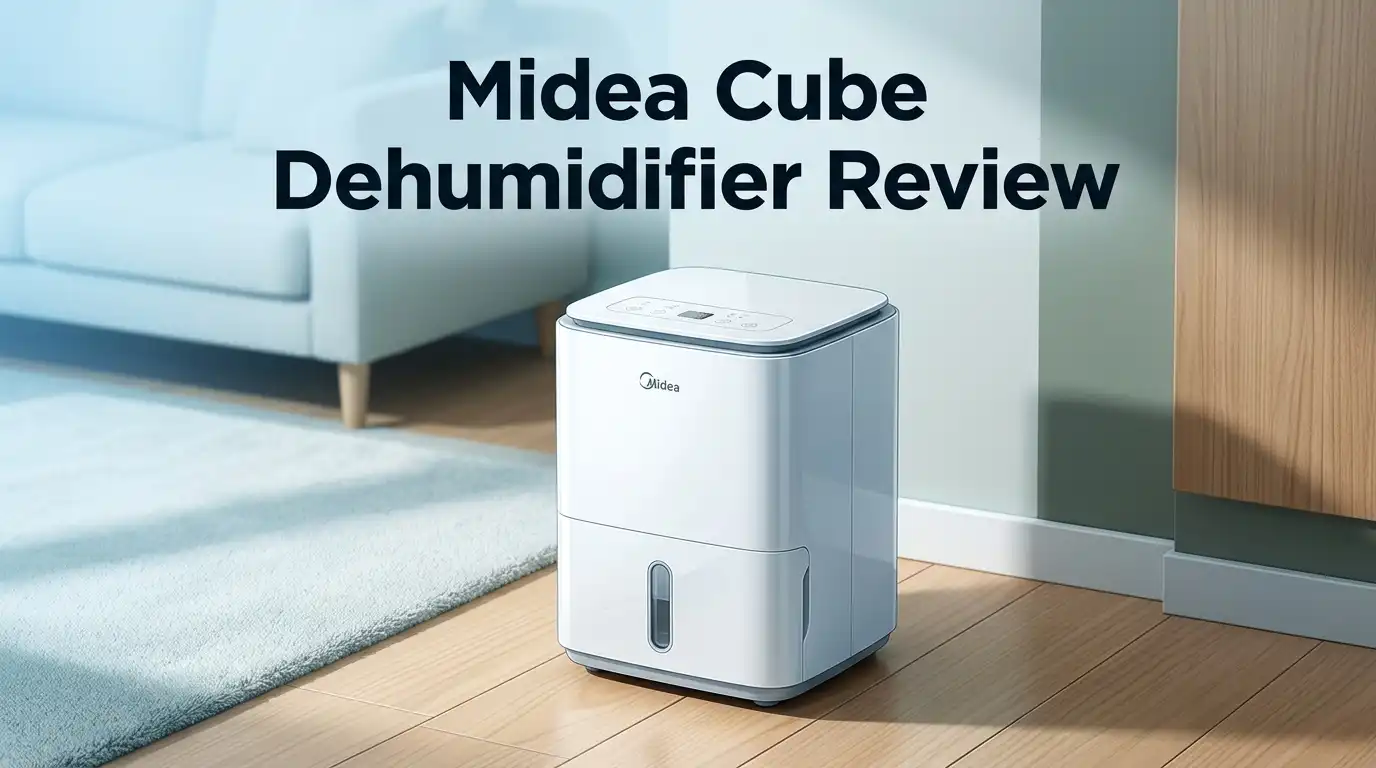
Midea Cube Dehumidifier Review 2026: Still Worth It?
Basement humidity ruins things quietly. Boxes soften, tools rust, and a musty smell settles into the carpet. I dealt with that problem for two summers before buying the Midea Cube.
This dehumidifier looks strange, stacks like a toy block, and holds more water than almost anything else on the shelf. That odd shape is the whole point.
I ran this unit through a wet basement, a damp laundry room, and a garage that smelled like old rain. This review covers real performance, the unboxing, the app, the noise, and the flaws Midea does not advertise.
In A Nutshell:
- Moisture removal is the strongest part. Independent lab testing dropped a test room from 90% humidity to 40% in under 8 minutes. Most rival 50 pint units needed 9 to 14 minutes for the same job.
- The water tank is the real selling point. At 4.25 gallons, it holds roughly three times more water than a typical bucket. You empty it far less often, which matters in a basement with no floor drain.
- Energy use stays low for its class. The Cube pulled about 512 watts at 50% humidity in testing. Many 50 pint competitors draw over 600 watts, so your power bill notices the difference.
- Noise output is genuinely low on high fan speed. It measured near 66 dB while moving 430 CFM of air. That airflow normally creates much louder noise.
- The warranty is the weak spot. One year only. Long term owner reports also mention coil icing and sensor faults after a year or two of heavy use.
- It splits into two pieces. The main unit lifts off the tank, so you can run it bucketless with a hose or nest it for storage.
What Is The Midea Cube Dehumidifier?

Last update on 2026-10-04 / Affiliate links / Images from Amazon Product Advertising API
The Midea Cube is a portable compressor dehumidifier with a stacking two piece body. The top section holds the compressor, fan, and coils. The bottom section is a large water tank. You can sit the top on the tank, or lift it off and drain through a hose instead.
Midea sells the Cube in 20 pint, 35 pint, and 50 pint versions. The 50 pint model covers spaces up to 4,500 square feet. A pump version also exists for people who need to push water upward into a sink.
The shape is not a gimmick. Air enters through three sides and exits from a wide top vent. That layout moves more air with less noise than a standard box dehumidifier.
Unboxing Experience: What Is Inside The Box
The box arrived heavy and tall, around 42 pounds of appliance. Midea packs the Cube in molded foam with the main unit already seated inside the tank. That nesting position saves shipping space and tells you something about how the product works.
Inside you get the dehumidifier, a 2 foot gravity drain hose, and a printed manual. That is it. No extension hose, no pump tubing on the standard model, and no cord wrap.
The manual surprised me. It is clear, well illustrated, and actually useful. I set the unit up without checking a video. The filters slide out from the sides with a light pull. The control panel uses real rubber buttons instead of flat touch pads, and the LCD screen reads clearly from across a room.
Design And Build Quality
The Cube feels sturdier than most dehumidifiers under $300. The plastic has some weight to it. Panels do not flex when you lift the unit by the top handle. Testing labs gave it top marks for durability, and owner feedback supports that for the first year.
Two curved air filters wrap the side intakes. They pop out easily for rinsing. The top exhaust vent is wide, which spreads airflow instead of blasting it at one wall.
One design choice annoyed me. There is no cord storage hook. The power cord dangles loose, and you end up coiling it by hand every time you move the unit. Traditional dehumidifiers solved this problem years ago with a simple hook on the back.
Setup And First Run Experience
Setup took about six minutes. I placed the Cube in the middle of the basement, gave it a foot of clearance on the intake sides, and plugged it in. The unit beeps once and shows current room humidity right away.
My basement read 72%. I set the target to 45%, chose high fan speed, and walked away. The compressor kicked on within seconds.
Three hours later the display read 52%. By morning it held steady at 45%, and the musty smell had faded noticeably. The tank was about half full.
For continuous use, I connected the included hose to the drain port and ran it to a floor drain. You can do this with the tank attached or removed, which is a smarter design than most rivals allow.
Top 3 Alternative For Midea Cube Dehumidifier


Last update on 2026-10-04 / Affiliate links / Images from Amazon Product Advertising API
GE 50 Pint Portable Dehumidifier with Built In Pump

Last update on 2026-10-04 / Affiliate links / Images from Amazon Product Advertising API
Frigidaire 50 Pint Dehumidifier with WiFi

Last update on 2026-10-04 / Affiliate links / Images from Amazon Product Advertising API
hOmeLabs WiFi Enabled Dehumidifier for Large Rooms
Moisture Removal Performance
This is where the Cube earns its reputation. In controlled testing across dozens of high capacity units, the Cube pulled a 50 square foot test room from 90% humidity down to 40% in 7 minutes and 39 seconds. The next best performer took 8 minutes and 32 seconds. Several popular models needed over 10 minutes.
The reason is airflow. The Cube moves up to 430 CFM. Many competitors move 180 to 230 CFM. More air across the coils means faster water extraction.
In my basement, the difference showed up as recovery speed. After I opened the basement door on a humid day, humidity spiked. The Cube pulled it back down within an hour. My old unit took most of an afternoon to do the same thing.
Energy Efficiency And Running Costs
The Cube carries an Energy Star rating, and the numbers back it up. Independent testing measured roughly 512 watts of draw at 50% humidity. Comparable 50 pint units often sit above 600 watts.
That gap matters because dehumidifiers run for hours. At 12 cents per kilowatt hour and eight hours of daily use, the Cube costs around $15 per month. A 620 watt unit under the same schedule costs closer to $18.
Efficiency also depends on how you use it. Running the Cube on high fan speed with a realistic target, around 45% to 50%, keeps cycles short. Setting the target to 35% forces the compressor to fight physics, which burns power for little comfort gain.
Noise Level: How Loud Is It?
Noise testing put the Cube at 66.4 dB on high fan speed. That sounds high on paper until you compare airflow. Rival units measured 69 to 73 dB while moving less than half the air.
The wide intake surface and large top vent do the work. Air moves slowly across a big opening instead of rushing through a small one, and slow air is quiet air.
There is a catch worth knowing. On low fan speed the Cube is not the quietest option. It measured 65.4 dB, while some competitors dropped to 62.7 dB. The Cube barely gets quieter when you slow the fan.
My honest take: it is fine in a basement or garage. In a bedroom, the compressor hum will bother light sleepers.
Water Tank And Drainage Options
The tank is the headline feature. It holds 4.25 gallons, roughly 34 pints. Average tanks in this class hold 12 to 13 pints. I emptied mine once every two days instead of twice a day.
A full tank weighs about 35 pounds, which is a lot to carry. Midea solved this with a Fill Level button. You can cap the tank at 2.25, 3, 3.75, or 4.25 gallons. Smaller fill levels mean lighter lifting.
For drainage, you have three paths. Gravity draining through the included hose works with or without the tank. Bucketless mode removes the tank entirely and shrinks the footprint. The separate pump model pushes water up into a sink or window.
Smart Features And App Control
The Cube connects to home WiFi and works with the Midea app plus Alexa voice commands. The app shows live room humidity, lets you change modes, adjusts the target level, and sends a notification when the tank fills.
I used the app more than expected. Checking basement humidity from upstairs beats walking down to squint at a display.
Setup was not flawless. The Cube needs a 2.4 GHz network, and my mesh router required me to separate the bands before pairing worked. Once connected, it stayed stable.
The app is functional, not polished. Menus feel dated and scheduling options are basic. If smart control is your main reason for buying, some rivals offer smoother software.
Midea Cube 20 Pint For Smaller Rooms

Last update on 2026-10-04 / Affiliate links / Images from Amazon Product Advertising API
Not everyone needs 50 pints. The 20 pint Cube handles spaces up to 1,500 square feet and uses the same stacking design and oversized tank. Testing labs rate it the strongest small dehumidifier they have measured, drawing only 262 watts at 50% humidity.
This is the version I recommend for bedrooms, closets, single room apartments, and small crawl spaces. It costs less, weighs less, and still empties far less often than a standard compact unit.
Choose by space, not by ambition. An oversized dehumidifier in a small room short cycles, which wears the compressor and wastes power. Match the pint rating to the square footage and the dampness level.
What The Midea Cube Does Not Do Well
Honest reviews list failures, so here they are.
The warranty runs one year. That is short for a $250 appliance with a compressor inside. Some owner reports describe coils icing over and units refusing to dehumidify after roughly a year of continuous basement duty. Others report the unit beeping once on plug in and then staying dead.
Cord storage does not exist. Low fan speed is not quiet. The app feels basic. Only two fan speeds exist, and there is no fine adjustment between them.
The Cube also struggles below 41 degrees Fahrenheit. Cold garages in winter push it outside its operating range, where icing becomes likely. A desiccant dehumidifier suits unheated spaces better.
Maintenance And Filter Care
Maintenance is simple and takes five minutes per month. Slide out both side filters, rinse them under warm water, let them dry fully, and slide them back. A check filter light reminds you when the interval arrives.
Empty and rinse the tank weekly even if you drain by hose, because standing water grows biofilm. A cap of white vinegar and a rinse handles it.
Keep at least 12 inches of clearance around the intake sides. Pushing the Cube against a wall starves the fan, which slows moisture removal and raises power draw.
Do not skip filter cleaning. Clogged filters are the most common cause of coil icing, and icing is the most common Cube complaint I found in owner forums.
Pros And Cons Of The Midea Cube
Pros
- Fastest moisture removal among tested 50 pint units, clearing 90% to 40% humidity in under 8 minutes
- Lowest power draw in its class at roughly 512 watts, with Energy Star certification
- Massive 4.25 gallon tank that holds about three times more water than rivals
- Adjustable fill level so you can lift a lighter tank
- Quiet on high fan speed despite 430 CFM airflow
- Flexible drainage including bucketless gravity mode and a pump version
- Nests into itself for compact storage
- Accurate humidity sensor, reading within 2% of actual room levels
Cons
- Only a one year manufacturer warranty
- Owner reports of coil icing and unit failure after a year of heavy use
- No cord storage hook anywhere on the body
- Low fan speed is not meaningfully quieter than high
- Only two fan speeds and limited mode adjustment
- App interface feels dated with basic scheduling
- Full tank weighs about 35 pounds
- Will not operate reliably below 41 degrees Fahrenheit
Who Should Buy The Midea Cube?
Buy the 50 pint Cube if you have a damp basement, a large finished lower level, or a home over 2,000 square feet with humidity above 60%. The oversized tank makes it the best choice for anyone without a floor drain nearby.
Buy the 20 pint Cube for bedrooms, apartments, and single rooms under 1,500 square feet.
Skip the Cube if you need a bedroom unit and sleep lightly, since the compressor hum stays present on low. Skip it for an unheated winter garage, where cold temperatures invite icing.
Consider a rival with a longer warranty if you plan to run the unit around the clock for years. Some brands offer multiyear coverage on the sealed system, and that protection has real value.
Final Verdict: Is It Worth Buying In 2026?
Yes, with one caveat. The Midea Cube does the core job better than anything else in its price range. It removes moisture faster, uses less electricity, runs quieter under load, and holds three times more water than standard units. Those are not marketing claims. They are measured results.
The caveat is longevity. A one year warranty and scattered reports of second year failures mean you are trading warranty comfort for performance. I still think the trade is worth it for most homes, especially if you clean the filters monthly and keep the unit in a heated space.
My rating: 4.5 out of 5. It is the dehumidifier I would buy again for a basement.
Frequently Asked Questions
How many pints do I need for my basement?
A 20 pint unit suits spaces up to 1,500 square feet with mild dampness. A 35 pint unit covers about 3,500 square feet. Choose 50 pints for large basements, standing water history, or humidity above 70%. Oversizing slightly is safer than undersizing.
Why is my Midea Cube icing up?
Icing usually comes from dirty filters, blocked airflow, or room temperature below 41 degrees Fahrenheit. Clean both side filters, pull the unit away from walls, and check the room temperature. The automatic defrost mode should clear light frost on its own.
Can I run the Midea Cube without the water tank?
Yes. Lift the main unit off the tank, connect the drain hose to the port, and run the hose to a floor drain. This bucketless mode gives the Cube a much smaller footprint and removes emptying from your routine entirely.
Does the Midea Cube need WiFi to work?
No. All modes, fan speeds, timers, and humidity targets work from the control panel. WiFi only adds app monitoring, remote adjustment, tank full alerts, and Alexa voice commands.
How long does the Midea Cube last?
Most owners report three to five years of regular use. Continuous 24 hour basement duty shortens that. Monthly filter cleaning and proper clearance are the two habits that extend compressor life the most.
Is the pump version worth the extra cost?
Only if you cannot drain downhill. The pump pushes water up into a sink or out a window, which solves basements without floor drains. If gravity draining works in your space, save the money and skip it.

I’m Maya Brown, the voice behind Pure Breeze Vault. I write detailed, honest, and easy-to-follow air purifier reviews to help readers compare features, understand filter technologies, and choose products with confidence. My goal is to make research simpler, clearer, and more practical for anyone improving indoor air quality at home.