Mila Air Purifier Review 2026: Worth It?
Clean air feels invisible until the day it is not. Wildfire haze, cat dander, a new sofa that smells like a chemistry lab, or a spring pollen count that turns your face into a faucet. These moments send people shopping for an air purifier, and the Mila keeps showing up on the shortlist.
Mila is the purifier that looks like furniture and thinks like a thermostat. It has eight sensors, seven filter options, a friendly app, and a price tag that makes you pause. So the real question in 2026 is simple. Does the smart brain justify the spend, or are you paying extra for personality?
I spent time with the Mila Air 3 and the smaller Mila Air Mini, read the lab data from independent testers, and dug through owner complaints that Mila would probably rather you skipped. This review covers the good, the frustrating, and the parts nobody advertises.
In a Nutshell:
- The Mila Air 3 cleans well for its size. Independent lab testing measured a PM1.0 CADR of 391 cubic meters per hour at full speed, which suits dining rooms, offices, and larger bedrooms. Mila rates it for spaces around 1,000 square feet, but that figure assumes fewer air changes per hour.
- Seven filters make it genuinely flexible. You pick The Big Sneeze for allergies, The Critter Cuddler for pets, The Overreactor for VOCs and formaldehyde, and you swap as your life changes. No other mainstream brand offers this much choice on one machine.
- It is very quiet at low speed and loud at high speed. Testers logged 33.4 dBA at speed one and 62.7 dBA at maximum. Sleepers will love the bottom end and dislike the top end.
- Running costs run high. Filters cost roughly $69 to $109 each and last about six months. Add electricity and you land near $200 per year, which is more than most rivals.
- Reliability is the weak spot. Owner reports describe fan bearing noise, dead units, and sensor glitches after a year or two. Mila now ships a longer warranty, which suggests the company knows.
- Buy it for the smarts and the design. Buy something else if raw clean air per dollar is your only metric.
Mila Air 3 Smart Home Air Purifier

Last update on 2026-11-18 / Affiliate links / Images from Amazon Product Advertising API
The Mila Air 3 is the flagship. It stands about 16 inches tall on a 11.8 inch square footprint and weighs roughly 13 pounds, so one hand carries it between rooms. The third generation swaps in a new motor and a custom fan, and Mila claims it runs about 16 percent quieter than the previous model while pushing more air.
Inside sits a single large filter cartridge, not a stack of separate layers. You choose that cartridge when you order. The top surface holds a small display and three touch buttons, so you can control the unit without your phone.
What sets it apart is the sensor package. Eight sensors track particulate matter, VOCs, carbon monoxide, temperature, and humidity in real time. The purifier then picks its own fan speed. You mostly leave it alone.
Unboxing the Mila: What Arrives in the Box
The box is heavier than expected and the packaging leans premium. Mila uses molded pulp inserts rather than foam, and the copywriting on the inner flaps is chatty in a way that either charms you or does not.
Lift the unit out and you find the filter already seated inside the chassis. This is the step people get wrong. The filter ships inside a sealed plastic bag, and Mila plasters a bright sticker on the front telling you to remove it. Pop the outer shell off, pull the bag, drop the filter back in, and reattach the shell. Two minutes, no tools.
Also in the box: a long power cord at roughly 75 inches, a short quick start card, and the wooden legs already attached. There is no remote control, which feels like an omission at this price. Everything else runs through the display or the app.
Design and Build Quality
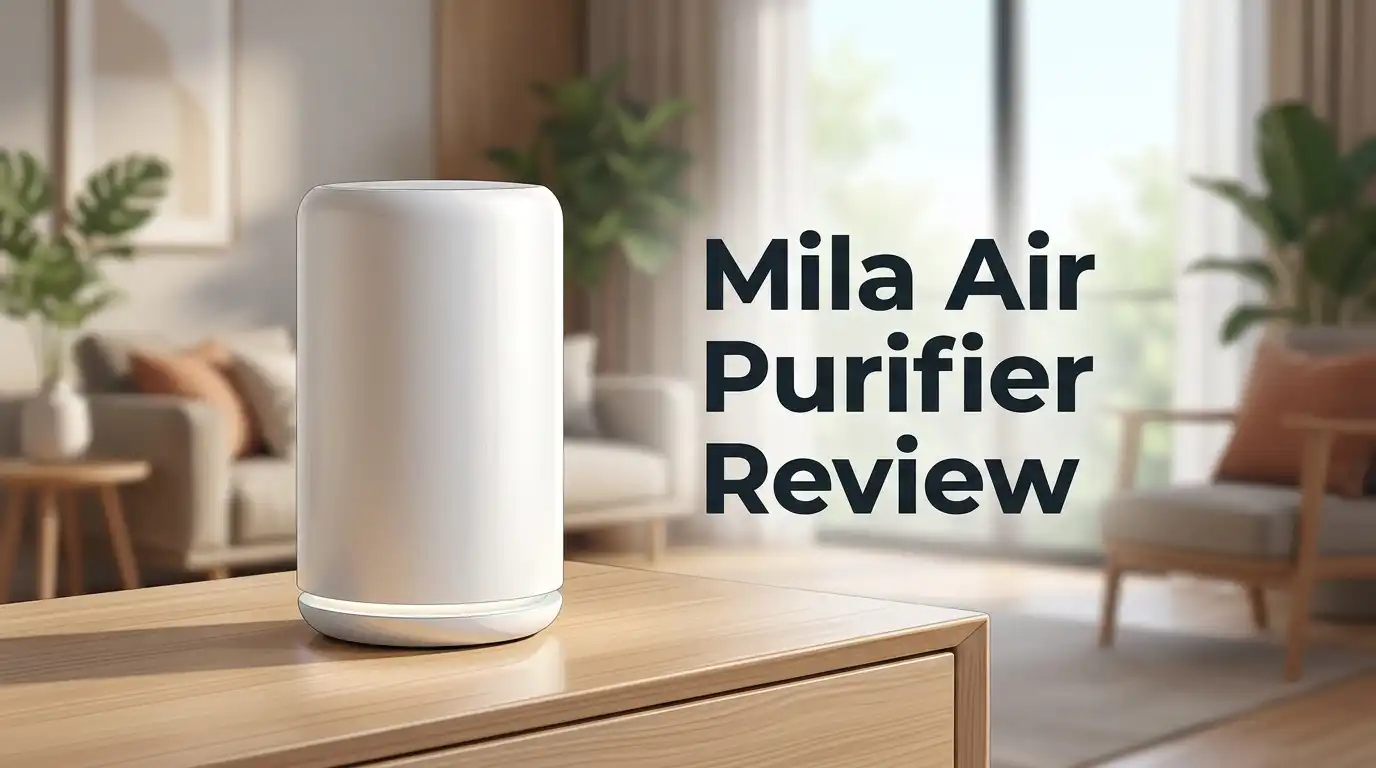
The Mila is one of the few purifiers people leave in the living room on purpose. The dotted fabric grille, the rounded corners, and the pale wooden legs read more like a small speaker than an appliance. It sits low enough to tuck beside a sofa arm without dominating the space.
Build quality feels solid in the hand. The shell clicks on firmly, the touch panel responds without lag, and the screen dims automatically at night so it does not glow across a dark bedroom.
Two colors exist: Purely White and Midnight Black. Neither shows dust badly, which matters more than you would think on a device that sits in a room collecting airborne debris.
One small gripe. There are no wheels and no recessed handle, so moving it upstairs means a two hand carry. At 13 pounds that is fine, but it is not effortless.
Mila Air Mini: The Smaller Sibling

Last update on 2026-11-18 / Affiliate links / Images from Amazon Product Advertising API
The Air Mini arrived for people who wanted Mila brains in a bedroom sized body at a lower price. It measures 11 by 11 by 15 inches and delivers a clean air delivery rate around 290 cubic meters per hour with the Critter Cuddler filter, circulating air in a 652 square foot room roughly every 30 minutes.
The Mini drops from eight sensors to six. You keep particulate sensing for PM1, PM2.5, and PM10, plus temperature, humidity, and carbon monoxide. You lose some of the VOC depth found on the Air 3.
Filter choice narrows to four options instead of seven. For a bedroom, a nursery, or a home office, that is plenty. The Mini also keeps the same eight custom modes, including Sleep, White Noise, Energy Save, and Child Lock.
Pricing usually lands near $280, so the gap between Mini and Air 3 is smaller than the specification gap suggests.
Top 3 Alternative for Mila Air Purifier


Last update on 2026-11-17 / Affiliate links / Images from Amazon Product Advertising API
Levoit Vital 200S-P

Last update on 2026-11-17 / Affiliate links / Images from Amazon Product Advertising API
Coway Airmega Mighty AP-1512HH

Last update on 2026-11-17 / Affiliate links / Images from Amazon Product Advertising API
Blueair Blue Pure 211i Max
Seven Filter Choices Explained
This is Mila’s cleverest idea. Instead of one generic filter, you pick the cartridge that matches your problem.
The Basic Breather uses H12 HEPA with no carbon and delivers the highest airflow. The Big Sneeze steps up to H13 HEPA for pollen, dander, and dust allergies. The Critter Cuddler pairs H13 HEPA with carbon tuned for ammonia, which is the filter cat owners want.
The Rookie Parent and The Home Wrecker add increasing amounts of carbon for nursery odors and renovation fumes. The Mama to Be and The Overreactor move up to H14 HEPA, with The Overreactor carrying about 1.25 pounds of activated carbon.
Here is the honest tradeoff. More carbon and denser HEPA mean cleaner air but lower airflow. The Overreactor drops CADR noticeably compared to The Big Sneeze. Pick based on your actual problem, not on the biggest number.
Real World Cleaning Performance
Lab testing tells a consistent story. At full speed, the Air 3 with an H13 filter measured a PM1.0 CADR of 391 cubic meters per hour, with a recommended room size near 360 square feet for fast, thorough cleaning.
Constrain it to a quiet 45 dBA and the figure falls to about 214 cubic meters per hour, suitable for roughly 197 square feet. That is the number that matters for bedrooms, because nobody runs a purifier at speed ten while sleeping.
Earlier generation testing in a small sealed room cleared incense smoke in about 35 minutes, which matched expectations for its rated airflow.
Translation for your home: the Mila handles a bedroom, office, or dining room confidently. In a large open plan living space it works, but it needs to run hard, and running hard means noise.
Noise Levels and Sleep Use
At its lowest setting the Mila is genuinely hushed. Testers recorded 33.4 dBA, quiet enough that you notice the room feels calm rather than hearing a fan. It sits comfortably under the noise floor of most bedrooms.
Push it to maximum and you reach 62.7 dBA, described by testers as similar to a small cordless vacuum running nearby. That is disruptive during a film or a phone call.
Mila tries to solve this with presence detection. The purifier senses when you enter the room and drops speed, then ramps back up when you leave. In practice this works well and is one of the features that justifies the smart badge.
Sleep mode and White Noise mode both help. Sleep mode caps speed and dims the display. White Noise mode holds a steady hum instead of cycling up and down.
Smart Features and the Mila App
The app is where Mila separates itself. Setup is unusually painless. You hold the mode button for five seconds, join the temporary network, and follow the prompts. It pairs with Android and iPhone without the usual struggle.
Once connected you get live air quality readings, filter life tracking, and eight configurable modes. Housekeeping Mode starts the purifier an hour before bedtime so the room is clean when you climb in. Bubble Boy Mode simply keeps air as clean as possible at all times. Turndown Service and Energy Save manage cost and comfort.
The Air 3 works with Apple Home, Amazon Alexa, and Google Home. Monthly home health reports summarize trends inside your home and in your neighborhood.
Mila also publishes a public status page for app and connectivity issues, which is refreshingly transparent.
Sensors and Air Quality Data
Eight environmental sensors sit inside the Air 3. They monitor PM1, PM2.5, PM10, VOCs, carbon monoxide, temperature, and humidity. The onboard display shows a live air quality index score and an estimated time to clean the room.
This data feeds the automatic mode. When you fry onions or light a candle, the number climbs and the fan responds within seconds. Watching it react is oddly satisfying and it teaches you things about your house.
The carbon monoxide sensor deserves a mention. It is rare on purifiers and adds a genuine safety layer, though it does not replace a certified CO alarm.
One caution from owner reports. Some units have produced wildly inaccurate VOC spikes, showing chemical plant readings in an ordinary bedroom. Mila support has replaced affected units, but the sensors are not infallible.
Running Costs and Filter Prices
This is where the Mila stings. Filters need replacing every six to nine months and cost roughly $69 to $109 depending on which cartridge you choose. Two filters a year puts you at $140 to $210.
Electricity is the cheap part. The Air 3 draws under 40 watts at maximum, so continuous use costs roughly $60 per year at typical rates, and far less in automatic mode.
Total annual running cost lands near $200, which is higher than almost every mainstream rival.
Mila offers an auto refill subscription that lowers the purchase price and ships a fresh filter every six months. It also extends the warranty, which makes it the sensible route if you are buying anyway. Just remember a subscription is a recurring commitment, not a discount.
Reliability: The Part Nobody Advertises
Authentic reviews have to include the bad news, and Mila has a pattern worth knowing.
Search owner forums and you find repeated reports of fan bearing noise developing after roughly a year, units that stop powering on, motherboard failures, and display glitches that survive firmware resets. Several long term owners describe multiple failed units across multiple generations.
Customer support gets consistently good marks. People describe fast, polite replies and free replacements inside warranty. The frustration starts when the warranty ends and the answer becomes a discount on a new model.
Mila has extended warranty coverage since the early units shipped, which reads like an acknowledgment. The Air 3 uses a redesigned motor that is meant to address exactly this.
Treat the extended warranty as essential rather than optional. That is the honest advice.
What the Mila Does Not Do Well
No dehumidifying, no humidifying, no heating, and no cooling. It moves air through a filter and nothing else.
It does not remove mold from walls, fix a damp basement, or eliminate a persistent odor at its source. Carbon filters reduce smells, they do not cure them.
Value per dollar is poor if you only count clean air. A Levoit or Coway at half the price moves similar or greater volumes of air. You are paying for sensors, software, and styling.
Other shortfalls: there is no remote control, no built in filter change indicator light on the unit itself, no timer function in the traditional sense, and no wheels. The filter names are also deliberately cute, which makes comparison shopping harder than it needs to be.
Finally, the high speed noise is real. Anyone buying for a large open room should hear it first.
Pros and Cons of the Mila Air Purifier
Pros
- Genuinely quiet at low speed at 33.4 dBA, which makes it easy to sleep beside.
- Seven filter options let you match the machine to allergies, pets, babies, renovations, or VOCs.
- Eight sensors including carbon monoxide give live, useful air quality data rather than a vague colored light.
- The app is excellent, with painless pairing, eight smart modes, and Apple Home, Alexa, and Google Home support.
- Presence detection quiets the unit when you walk in and deep cleans when you leave.
- Compact and attractive, so it blends into living spaces instead of hiding in corners.
Cons
- Expensive to buy and to run, with annual costs near $200.
- Loud at maximum speed at 62.7 dBA, which is intrusive during TV or conversation.
- Reliability reports are concerning, especially fan noise and power failures after a year or two.
- Lower clean air per dollar than Levoit, Coway, or Blueair equivalents.
- No remote, no wheels, no timer, and no onboard filter change light.
- Playful filter names make specification comparisons unnecessarily confusing.
Who Should Buy the Mila Air Purifier
Buy the Mila if you want a purifier that manages itself. People who forget to change settings, who travel, or who simply want the air handled without thought get real value from the automation.
It suits allergy sufferers who want to switch filters seasonally, pet owners dealing with ammonia and dander, and expectant parents who want H14 filtration in a nursery.
It also suits anyone who cares how their home looks. This is the rare appliance you do not hide.
Skip it if your priority is maximum airflow per dollar. A Levoit Vital 200S-P or Coway Mighty delivers comparable or better cleaning for less money, and both have longer reliability track records.
Skip it too if you need coverage across a large open plan floor. Mila recommends one unit per room, and that math gets expensive quickly.
Final Verdict
The Mila Air 3 remains the most thoughtful air purifier you can buy in 2026. The sensors are accurate most of the time, the app is the best in the category, the design earns its place in a living room, and the filter system is a genuinely good idea that nobody else has copied properly.
It is also the purifier that asks the most of you. A high upfront price, filters that cost real money twice a year, and a reliability record that includes too many unhappy long term owners.
My honest position: buy it with the subscription and the extended warranty, or buy something plainer and save several hundred dollars.
If smart features matter to you, the Mila is worth it. If clean air is all that matters, it is not.
Frequently Asked Questions
Is the Mila air purifier worth the money in 2026?
It is worth it if you value automation, sensor data, and design. The Air 3 cleans well for its size and runs quietly at low speed. It is not worth it if you only want maximum airflow per dollar, because cheaper rivals from Levoit and Coway match or beat its cleaning power.
How often do Mila filters need replacing?
Mila recommends replacement every six months, and testing suggests six to nine months depending on air quality and runtime. Filters cost roughly $69 to $109 each. The auto refill subscription ships a new one automatically and reduces the upfront purchase price.
Is the Mila Air 3 quiet enough for a bedroom?
Yes at low speed. Testing measured 33.4 dBA at speed one, which is barely audible. At maximum speed it reaches 62.7 dBA, which will wake light sleepers. Use Sleep mode or White Noise mode overnight and the noise stops being an issue.
What is the difference between the Mila Air 3 and the Air Mini?
The Air 3 is larger, offers seven filter choices, carries eight sensors, and delivers higher airflow. The Air Mini is smaller, offers four filters, carries six sensors, and suits bedrooms up to roughly 650 square feet. Both share the same app and smart modes.
Which Mila filter should I choose?
Choose The Big Sneeze for pollen and dust allergies, The Critter Cuddler for pets and litter box odors, The Rookie Parent or Home Wrecker for household odors and renovation fumes, and The Overreactor for VOCs and formaldehyde. Remember that heavier carbon and denser HEPA reduce airflow.
Does the Mila air purifier remove smoke and VOCs?
Yes, provided you choose a filter with activated carbon. HEPA alone captures smoke particles but not gases. The Overreactor and Home Wrecker carry the most carbon and handle VOCs, formaldehyde, and lingering smoke odors best.
Are Mila air purifiers reliable?
This is the weakest area. Owners report fan bearing noise, units that stop powering on, and occasional sensor faults after a year or more. Support is responsive and replaces faulty units inside warranty. Buying the extended warranty is strongly recommended.

I’m Maya Brown, the voice behind Pure Breeze Vault. I write detailed, honest, and easy-to-follow air purifier reviews to help readers compare features, understand filter technologies, and choose products with confidence. My goal is to make research simpler, clearer, and more practical for anyone improving indoor air quality at home.