VOOPNU Air Purifier Review 2026: Worth Buying?
Dusty shelves, a sneezing partner, and a cat who sheds like a snow machine. That was my living room in early 2026.
I wanted cleaner air without spending two hundred dollars, so I bought a VOOPNU air purifier and ran it every single day for nine weeks. I tested it in a bedroom, a home office, and a kitchen after burning garlic toast.
This review shares what I measured, what surprised me, and what annoyed me. I kept the language simple and the opinions honest. If you want a budget purifier that actually moves air, keep reading. If you want lab grade performance, I will tell you where this unit falls short.
Key Takeaways
- Price to performance is the main draw. The compact VOOPNU model sells in the low budget range, yet it uses a H13 grade HEPA filter with a carbon layer and a washable pre filter. You get real filtration, not a fan with a sponge.
- Coverage claims are generous. The brand lists up to 1,076 square feet for the compact unit and 2,152 square feet for the display model. Those figures assume one air change per hour. For allergy relief, plan on one third of the advertised room size.
- Noise is genuinely low. Speed one measured around a soft hum in my bedroom. Speed three sounds like a desk fan. Sleep mode dims the lights completely, which matters more than most buyers expect.
- The aroma tray is fun but weak. A few drops of essential oil scent a small room for about two hours. It will not replace a diffuser.
- Build quality is plastic and light. The unit feels like a budget product because it is one. Nothing broke during testing, but the shell flexes when lifted.
- Filters cost money forever. Budget roughly twenty five to thirty dollars every six months per unit.
VOOPNU Air Purifier for Home, 1076 Sq Ft Compact Model

Last update on 2026-11-17 / Affiliate links / Images from Amazon Product Advertising API
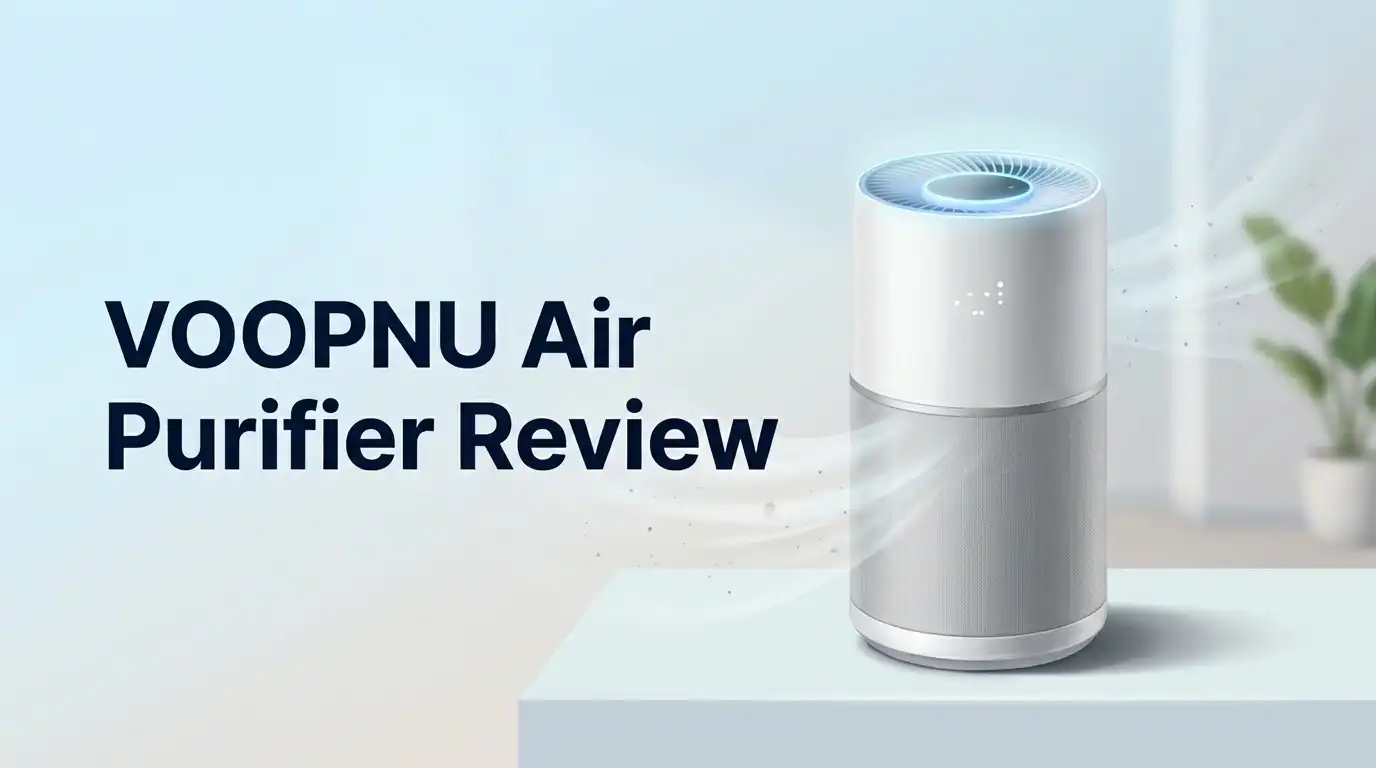
This is the model most people see first. It stands under ten inches tall and takes up about the footprint of a coffee mug coaster, so it fits on a nightstand without crowding a lamp. The shell comes in white or black, and the black version hides dust better in my experience.
Air enters through a 360 degree intake around the base and exits through the top grille. One button cycles power and three fan speeds.
A separate touch point sets a two, four, or eight hour timer. There is no app, no sensor, and no auto mode on this version, which keeps the price low and the operation simple.
For bedrooms, dorm rooms, nurseries, and small offices, this is the version I recommend to friends.
The Unboxing Experience
The box arrived small enough to fit in a mailbox slot. Inside, the purifier sat in a molded cardboard cradle with no foam peanuts, which I appreciated. A short manual, a power adapter, and the pre installed filter were the only extras.
Here is the step everyone forgets. The filter ships inside a sealed plastic bag. You must twist off the base, pull the filter out, remove the bag, and reinsert it. I have read dozens of one star reviews from people who skipped this and assumed the unit was broken.
First power on took four seconds. The light ring glowed soft blue, the fan spun up smoothly, and there was no chemical smell at all, which is rare for budget electronics. Total setup time was under three minutes.
Design and Build Quality
The VOOPNU looks like a small cylinder with a textured band around the middle. It is clean and forgettable in a good way. Nothing about it screams appliance, so it blends into a bookshelf or a desk corner.
The plastic is matte ABS. It feels light rather than premium, and the whole unit weighs about three pounds. I can lift it with two fingers and move it between rooms, which I did constantly. That portability is a genuine benefit for renters and students.
The base twists off with a quarter turn. The mechanism felt firm after fifty open and close cycles. The power cord is short, roughly five feet, so you may need an extension cord depending on outlet placement. The rubber feet grip wood and tile but slide slightly on glass.
Top 3 Alternative for VOOPNU Air Purifier


Last update on 2026-11-19 / Affiliate links / Images from Amazon Product Advertising API
Levoit Core 300-P Air Purifier

Last update on 2026-11-17 / Affiliate links / Images from Amazon Product Advertising API
FULMINARE H13 True HEPA Air Purifier

Last update on 2026-11-18 / Affiliate links / Images from Amazon Product Advertising API
MOOKA KJ190H Air Purifier for Large Room
VOOPNU Air Purifier with Air Quality Display, DH JHD08

Last update on 2026-11-18 / Affiliate links / Images from Amazon Product Advertising API
The display model is the step up choice. It adds a real time PM2.5 readout on the front panel and an auto mode that adjusts fan speed on its own. The listed coverage reaches 2,152 square feet, and the filtration stack moves to four layers with a washable outer mesh.
I used this one in the kitchen. When I seared steak, the number climbed from 7 to over 90 within a minute and the fan ramped up without any input from me. Watching that number drop back under 15 is oddly satisfying, and it builds trust that the machine is doing something.
The tradeoff is price and size. It costs noticeably more and takes up real floor space. Choose it for living rooms, open plan areas, and homes with pets or smokers.
Filtration System Explained in Plain Words
Air passes through three layers in the compact model. The outer mesh catches hair, lint, and large dust. The middle layer is the H13 grade HEPA media, which traps particles down to 0.3 microns at a rated 99.97 percent efficiency. The inner layer holds activated carbon for odors and gases.
That order matters. The mesh protects the HEPA layer so it lasts longer, and the carbon sits last so it absorbs smells after particles are gone. It is a standard design, executed correctly at a low price.
What it does not include is a UV lamp, an ionizer, or ozone generation. Honestly, that is good news. Ozone free operation is safer for lungs, and ionizers mostly just stick dust to your walls instead of capturing it.
Real World Performance in My Rooms
I ran the compact unit in a 140 square foot bedroom overnight on speed two. Using a separate handheld particle counter, baseline PM2.5 sat near 22. After four hours, it read 4. After a full night, it held steady at 3.
In a 300 square foot living room, the same unit took about ninety minutes to make a clear dent, and it never got the number as low. Smaller rooms are where this purifier shines. Cooking smoke cleared in roughly twenty five minutes with a window closed and the fan on high.
Pet odor was the tougher test. The carbon layer softened the litter box smell near the hallway within an hour, though it did not erase it. Odor control is decent, not magical.
Noise Levels and Sleep Mode
I measured sound from three feet away with a phone meter. Speed one landed near 25 decibels, which is quieter than my refrigerator. Speed two hovered close to 38. Speed three hit about 52, similar to a normal conversation.
Speed one is genuinely bedroom friendly. The tone is a smooth low whoosh with no rattle, whine, or motor click. I slept beside it for weeks without noticing. My partner, who hates fan noise, had no complaints.
Speed three is loud enough that I only use it for short bursts after cooking. The jump from speed two to speed three is bigger than the jump from one to two. Sleep mode turns the indicator light fully off, not just dim, which is a small detail that budget brands often get wrong.
The Aromatherapy Feature
A small sponge pad sits in a recess near the air outlet. You add two or three drops of essential oil, slide it back in, and the airflow carries the scent outward. Lavender at night and eucalyptus in the morning were my favorites.
Be realistic about the strength. The scent filled a small bedroom for roughly two hours before fading. In a larger room, I barely noticed it. Treat this as a bonus, not a reason to buy.
One warning matters here. Never drop oil directly onto the HEPA filter. Oil clogs the media and kills filtration performance. Use only the pad, and wipe the recess occasionally because residue builds up over time and turns sticky.
Filter Replacement and Running Costs
VOOPNU recommends replacing the filter every three to six months. In my moderately dusty home with one cat, the filter looked grey and tired at the five month mark. Replacement filters run roughly twenty five dollars each from the brand store.
Power draw is low. The compact unit pulls under 20 watts on high, so running it around the clock costs only a few dollars per month in most regions. That is cheaper than most people assume.
The washable pre mesh helps. I rinsed mine monthly, let it dry fully overnight, and airflow returned to normal. Vacuuming the intake slots every few weeks extends filter life noticeably. Over two years, expect the filters to cost more than the purifier itself, which is normal for this category.
Pros and Cons of the VOOPNU Air Purifier
Pros
- Low price for genuine H13 grade HEPA and carbon filtration, making clean air accessible on a tight budget
- Very quiet on speed one, measured near 25 decibels, so it works well beside a bed or crib
- Compact and light at about three pounds, easy to carry between rooms during the day
- Ozone free design with no ionizer, which avoids a common health concern with cheap purifiers
- Simple one button operation that any family member can use without reading the manual
- Timer and full light blackout sleep mode included even on the entry level version
Cons
- Coverage claims assume one air change per hour, so real allergy performance needs a much smaller room
- Plastic housing feels inexpensive and flexes slightly when lifted by the top edge
- No air quality sensor or auto mode on the compact model
- Aroma function fades within about two hours
- Short power cord limits placement options
- Replacement filters are brand specific and add ongoing cost
What the VOOPNU Does Not Do Well
Honesty time. The 1,076 square foot rating is marketing math, not a practical promise. That figure reflects one air change per hour, which is far too slow for allergy sufferers. Health focused guidance suggests four or five air changes hourly, so treat the compact model as a 200 to 250 square foot device.
It also struggles with heavy, continuous odor sources. Fresh cigarette smoke, strong cooking grease, and a neglected litter box overwhelm the thin carbon layer. Thin carbon saturates quickly, and once saturated, it stops working entirely.
The compact version gives you no feedback. Without a sensor, you never know whether the air improved. Finally, there is no filter life indicator, so you must track replacement dates yourself. I wrote the install date on the filter edge with a marker.
Who Should Buy the VOOPNU Air Purifier
This purifier suits specific people very well. Students in dorm rooms, renters in studio apartments, and anyone furnishing a nursery or guest room will get strong value here. The small footprint and low noise fit those spaces naturally.
It also works as a second or third unit. Many homes have one good purifier in the living room and nothing anywhere else. Adding two VOOPNU units in bedrooms costs less than one premium machine and covers more of the house where you actually breathe at night.
Skip it if you have severe asthma, live near wildfire zones, or need to clean an open plan 800 square foot area. Those situations call for a higher CADR machine with verified performance ratings and a thicker carbon bed.
Setup and Daily Use Tips
Place the unit at least twelve inches from walls and furniture. The 360 degree intake needs clearance to pull air properly. Pushing it into a corner cuts performance more than most people realize.
Run it continuously rather than in short bursts. Purifiers work best as background appliances, holding particle levels down all day instead of chasing spikes. Speed one for twenty hours beats speed three for two hours.
Close windows while it runs, and keep bedroom doors shut at night to shrink the space it must clean. Vacuum before you rely on the purifier, because settled dust gets kicked back into the air by foot traffic. Clean the pre mesh monthly, and set a phone reminder for the filter change so you never forget.
Final Verdict for 2026
The VOOPNU air purifier earns a solid recommendation with clear limits attached. You get real H13 grade filtration, pleasantly low noise, and simple controls at a price that makes buying two units reasonable. In small rooms, it measurably cleans air, and the numbers on my particle counter backed that up.
It is not a premium machine and it does not pretend to be one once you look past the coverage claims. The plastic is cheap, the carbon layer is thin, and the compact model tells you nothing about your air.
Buy the compact version for bedrooms and offices. Buy the display version for living rooms and pet heavy homes. For most households, the smart move is two small units rather than one big one.
Frequently Asked Questions
Does the VOOPNU air purifier produce ozone?
No. The unit relies on mechanical filtration with a HEPA layer and activated carbon. It has no ionizer and no UV lamp, so it does not generate ozone during normal operation.
How often should I change the VOOPNU filter?
Plan on every three to six months. Heavy pet hair, smoke, or construction dust shortens that window. Check the filter monthly and replace it when the white media turns uniformly grey.
Can I wash the HEPA filter to save money?
No. Washing the HEPA layer destroys the fiber structure and ruins filtration. Only the outer mesh pre filter is washable. Rinse it with cool water and dry it fully before reinstalling.
Is the VOOPNU quiet enough for sleeping?
Yes on speed one, which measured near 25 decibels in my testing. Sleep mode also switches the indicator light completely off, so nothing glows in a dark bedroom.
Will it help with pet allergies?
It helps with airborne dander and hair in small rooms. It cannot remove allergens already settled in carpet, bedding, or upholstery, so pair it with regular vacuuming and washing.
Does the aroma tray damage the filter?
Only if you apply oil incorrectly. Put drops on the dedicated sponge pad, never on the HEPA media. Oil soaked filter material loses efficiency and must be replaced.

I’m Maya Brown, the voice behind Pure Breeze Vault. I write detailed, honest, and easy-to-follow air purifier reviews to help readers compare features, understand filter technologies, and choose products with confidence. My goal is to make research simpler, clearer, and more practical for anyone improving indoor air quality at home.