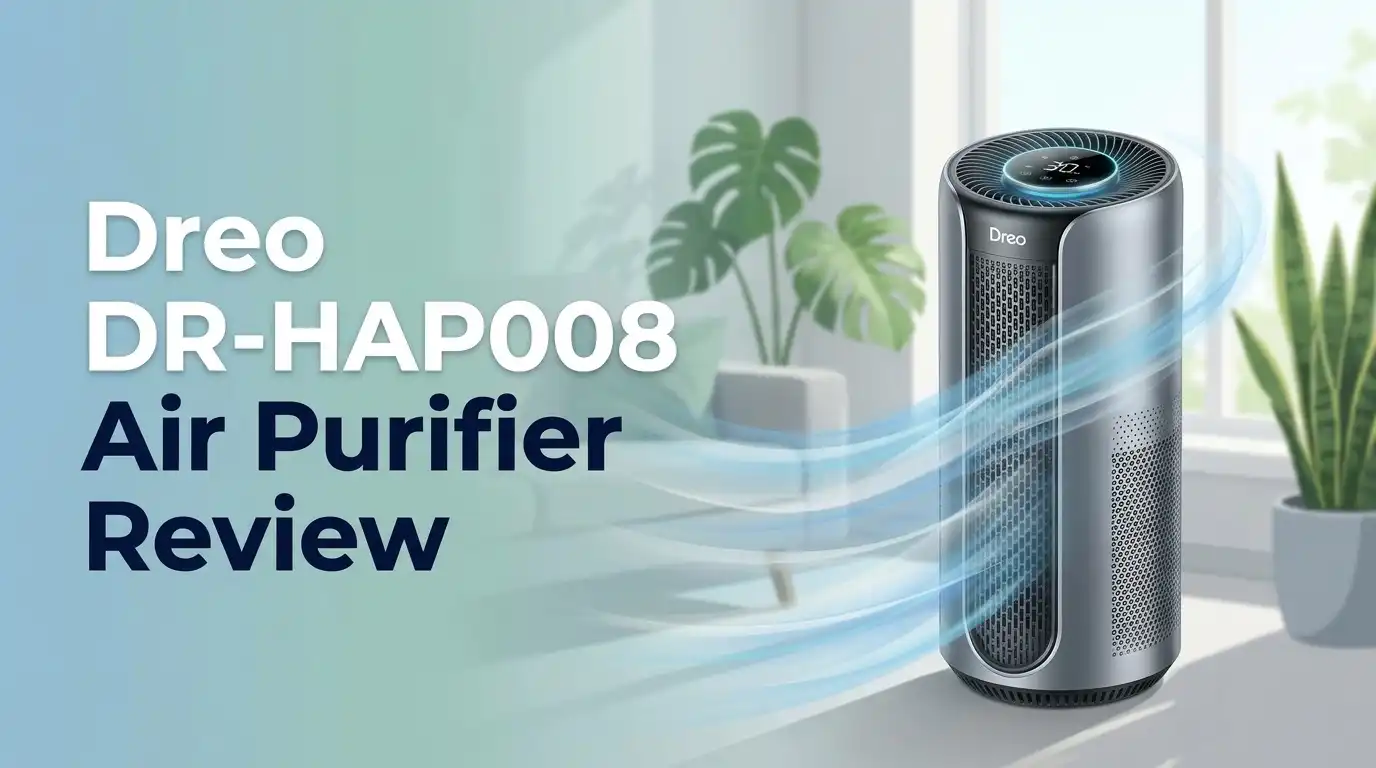
Dreo 338 Air Purifier Review 2026: Worth Buying?
Clean air matters more than ever. Dust, pet dander, pollen, and cooking smoke build up inside closed rooms every single day. Most people never notice until allergies flare or a stale smell lingers in the bedroom.
The Dreo 338, sold under the model code DR-HAP008, promises to fix that for under one hundred dollars. It pairs a true HEPA filter with a real time PM2.5 sensor and a whisper quiet sleep mode.
That combination usually costs far more. So does this budget purifier actually deliver clean air, or does it just move it around? I tested it, listened to it, and lived with it. Here is everything you need to know before you buy.
In a Nutshell:
- Strong value for the price. The Dreo 338 delivers a 115 CFM CADR and true H13 grade HEPA filtration for roughly $89.99, which undercuts most branded rivals with similar specs.
- Best suited to bedrooms and small offices. Dreo rates it for 856 sq ft at one air change per hour, but the realistic number is 178 sq ft at 4.8 air changes per hour. Treat the smaller figure as the honest one.
- Genuinely quiet at night. Sleep mode runs near 18 dB, quieter than a whisper, and it dims the display so the room stays dark.
- No WiFi and no app. This is the manual version. If you want phone control, scheduling, and filter tracking, you need the 338S instead.
- Filters cost $26.99 and last 6 to 8 months. That works out to roughly $45 per year in running costs, which is fair but not the cheapest.
- The weak spots are real. The carbon layer is thin, heavy odors linger, and the top mounted controls are easy to bump. It is a great small room purifier, not a whole home solution.
Dreo 338 Air Purifier Overview


Last update on 2026-11-18 / Affiliate links / Images from Amazon Product Advertising API
The Dreo 338 sits in the brand’s entry level purifier range. It is a tower style unit measuring about 9.21 inches wide and 14 inches tall. Inside sits a brushless DC motor and a 3 layer filter that captures particles down to 0.3 microns.
Dreo calls the airflow design TurboPure, which simply means the unit pulls air in through a 360 degree intake and pushes it out the top in a spiral pattern.
The headline features are the real time PM2.5 readout, an RGB air quality ring, four fan speeds, a 12 hour timer, and a small aroma pad compartment for essential oils.
It is AHAM Verifide, so the performance claims come from independent testing rather than marketing. That certification alone separates it from dozens of no name purifiers on Amazon.
Unboxing the Dreo DR-HAP008
The box arrives smaller than expected. Lift the lid and you find the purifier wrapped in a cloth style bag rather than cheap foam, which feels like a nice touch at this price.
Underneath sits a slim user guide and a small envelope holding three aroma pads, one of which comes already installed.
The filter ships inside the unit, sealed in plastic. You must twist off the base, pull the filter out, remove the wrapping, and reinstall it. Skip that step and the purifier will run but clean nothing. The whole setup takes under two minutes. No tools, no assembly, no confusing diagrams.
First impressions are positive. The plastic feels dense rather than hollow. There is a faint new plastic smell for the first two days, which fades on its own.
Design and Build Quality
The 338 looks deliberately plain, and that works in its favour. A fabric style mesh wraps the lower two thirds of the body. The top holds a circular air outlet surrounded by touch controls.
A small LED panel shows the live PM2.5 number in digits, so you see an actual reading instead of a vague colour.
It weighs around 7 pounds, light enough to carry between rooms with one hand. There is no handle, though, so you end up gripping the body. The matte finish hides dust well, which matters for a device that sits in a corner for months.
My one complaint concerns the controls. They sit flat on the top surface. Set a book or a phone on top and you will change the fan speed by accident.
Top 3 Alternatives for Dreo 338 Air Purifier

Last update on 2026-11-18 / Affiliate links / Images from Amazon Product Advertising API
Levoit Core 300S Smart Air Purifier

Last update on 2026-11-17 / Affiliate links / Images from Amazon Product Advertising API
Winix 5510 Air Purifier

Last update on 2026-11-17 / Affiliate links / Images from Amazon Product Advertising API
Blueair Blue Pure 411a Max Air Purifier
Filtration System Explained
The Dreo 338 uses a single cylindrical cartridge that holds three stages. The outer layer is a pre filter mesh that grabs hair, lint, and large dust.
Behind it sits the H13 grade HEPA layer, which captures 99.97 percent of particles at 0.3 microns. That covers pollen, dust mite debris, pet dander, mould spores, and most smoke particles.
The final layer is activated carbon, which handles odors and some volatile organic compounds. This is where the design shows its budget roots.
The carbon layer is thin, closer to a coated sheet than a packed granular bed. It softens cooking smells and mild pet odor well enough. It will not erase cigarette smoke or fresh paint fumes.
Importantly, there is no ioniser and no UV lamp, so the unit produces zero ozone. For anyone with asthma, that absence is a genuine benefit.
Real World Performance and Coverage
Numbers first. The 338 delivers a CADR of 115 CFM. Dreo advertises coverage up to 856 sq ft, but that figure assumes only one air change per hour. One air change per hour is far too slow for allergy relief.
The useful figure is 178 sq ft at 4.8 air changes per hour, which means the unit refreshes the air roughly every 12.4 minutes. That is the number to plan around.
In a 150 sq ft bedroom, the sensor dropped from a reading of 48 down to single digits within about 20 minutes on speed three.
In a 300 sq ft open living room, the same drop took closer to an hour. The lesson is simple: match the room to the smaller rating. Push it into a large open plan space and performance falls off quickly.
Noise Levels and Sleep Mode
Noise is where this purifier genuinely impresses. Dreo quotes 18 dB in sleep mode, and real world use backs that up. On the lowest setting the unit produces a soft hum that disappears under the sound of a ceiling fan. You have to lean close to confirm it is running.
Speed two stays comfortable for working or watching television. Speed three becomes noticeable but not intrusive. Speed four is loud, somewhere around 50 dB, and best reserved for short bursts after cooking.
Sleep mode also kills the display lights completely. No glowing ring, no digits, no standby LED. Anyone who has thrown a sock over a glowing purifier at 2am will appreciate that detail. This is one of the quietest purifiers you can buy at this price.
Auto Mode and PM2.5 Sensor
The built in laser sensor reads particle levels continuously and feeds a number to the display. A coloured ring backs it up: blue means good, green means moderate, orange and red mean poor. In auto mode, the fan adjusts speed on its own based on that reading.
The sensor reacts fast. Lighting a candle, frying onions, or spraying deodorant triggers a jump within seconds, and the fan ramps up accordingly. That responsiveness makes auto mode genuinely usable rather than a gimmick.
Accuracy is reasonable but not laboratory grade. The readings track the right direction and magnitude, though they tend to settle lower than a dedicated monitor. Treat it as a trend indicator, not a precise measurement. One limitation stands out: the sensor detects particles only, so it ignores gases and VOCs entirely.
The Aroma Pad Diffuser Feature
Dreo includes a small compartment near the base that holds a felt aroma pad. You add a few drops of essential oil, slide the pad back in, and the airflow carries the scent through the room. Three pads come in the box.
It works, but keep expectations modest. The scent is subtle and short lived, usually fading within two or three hours. It perfumes a bedroom lightly rather than filling a hallway.
A warning matters here. Never drip oil directly onto the HEPA filter. Oil clogs the fibres, reduces airflow, and can encourage mould growth. Dreo’s own guidance says the same. Used correctly with the pad, the feature is a pleasant extra. Used carelessly, it ruins a $27 filter.
Energy Use and Running Costs
The brushless DC motor keeps power draw low. On sleep mode the unit pulls only a few watts. Even at full speed it stays modest, well under the draw of a single old incandescent bulb.
Running it 24 hours a day on a low or auto setting typically adds a very small amount to a monthly electricity bill, often less than a few dollars depending on local rates. That makes continuous operation practical, which matters because purifiers only work while they run.
Filter costs are the bigger expense. A genuine replacement filter sells for $26.99 and lasts 6 to 8 months under normal use. Budget around $45 per year. Heavy pet households or smokers should expect to replace filters nearer the six month mark, pushing annual costs higher.
Filter Replacement and Maintenance
Maintenance is refreshingly simple. Twist the base counterclockwise, lift it off, pull the old filter out, drop the new one in, and twist the base back. The process takes under a minute and requires no tools.
Vacuum the outer mesh every few weeks to keep airflow strong. A clogged pre filter forces the motor to work harder and shortens filter life.
One quirk trips people up constantly. The filter change reminder does not reset by itself. After fitting a new filter, press and hold the reset button for five seconds until the indicator turns off. Many one star reviews come from users who missed this step and assumed the unit was faulty. It is a documented procedure, just poorly signposted on the device itself.
Dreo 338 vs Dreo 338S: Which One Should You Pick?
This confuses a lot of buyers, so here is the clear distinction. The hardware is essentially identical. Same motor, same 115 CFM CADR, same filter, same noise floor, same sensor.
The difference is connectivity. The 338 has no WiFi, no app, and no voice control. Everything runs from the touch panel on top. The 338S adds WiFi, which brings app control, scheduling, remote monitoring, filter life tracking, and Alexa or Google Assistant support.
Choose the 338 if the purifier lives in a bedroom and you simply want it to run quietly. Choose the 338S if you want to start it before arriving home or track air quality history on your phone. The price gap is usually small, so smart control is often worth it.
What the Dreo 338 Does Not Do Well
Honest reviews name the flaws, so here they are.
Odor removal is average. The thin carbon layer handles light cooking smells but struggles with smoke, litter boxes, and strong chemical fumes. A dedicated carbon purifier beats it easily here.
The coverage claim is misleading. The 856 sq ft figure is technically accurate under AHAM rules but practically useless. Real performance lives at 178 sq ft.
No VOC or gas detection. The sensor sees particles only, so the display can read clean while the room smells strongly.
Top mounted controls get bumped. Placing anything on top changes settings.
Filters are proprietary. Third party options exist but quality varies, so you are mostly locked into Dreo pricing. None of these are dealbreakers at this price, but they are real.
Pros and Cons
Pros
- Excellent price to performance ratio with a 115 CFM CADR for under one hundred dollars
- AHAM Verifide certification confirms the airflow and coverage claims independently
- Extremely quiet sleep mode near 18 dB with all lights switched off
- True H13 grade HEPA filtration down to 0.3 microns with no ozone output
- Fast reacting PM2.5 sensor with a numeric display and responsive auto mode
- Simple filter swaps that take under a minute with no tools required
- Low energy draw from the brushless DC motor makes continuous running affordable
Cons
- Weak carbon layer leaves strong odors and smoke partly untouched
- 856 sq ft coverage claim overstates practical room size by a wide margin
- No WiFi or app on this model, which requires stepping up to the 338S
- Sensor ignores gases and VOCs, so readings can look clean in a smelly room
- Top controls are easy to trigger by accident when objects sit on the unit
- Filter reminder needs a manual reset, which confuses many first time owners
Dreo 338 Air Purifier Price and Value in 2026
Last update on 2026-11-18 / Affiliate links / Images from Amazon Product Advertising API
At $89.99 list price, the Dreo 338 sits in the most competitive segment of the market. It faces the Levoit Core 300 range, the Blueair 411a Max, and a crowd of budget rivals.
Its advantage is specification density. You get a laser PM2.5 sensor with a numeric readout, a feature many competitors reserve for higher tiers. You also get AHAM certification, which plenty of similarly priced units lack entirely.
Discounts appear often, and the unit has dropped well below list price during sales events. At any price under seventy dollars it becomes an easy recommendation. Factor in roughly $45 yearly for filters when calculating total cost. Over three years you are looking at about $225 all in, which remains reasonable for continuous clean air.
Who Should Buy the Dreo 338?
This purifier fits specific people very well. Allergy sufferers who need pollen and dust control in a bedroom will benefit most. The quiet sleep mode means it runs all night without disturbing anyone.
Pet owners in small apartments get good dander capture, though the mild odor control means you may still notice litter smells.
Students and renters will appreciate the low price, small footprint, and easy portability between rooms.
Skip it if you need whole home coverage, serious smoke removal, or VOC filtration. Large open plan living spaces need a higher CADR unit. Households dealing with wildfire smoke or heavy cooking odors should invest in a purifier with a thick granular carbon bed. Buy it for the right room and it performs admirably.
Final Verdict
The Dreo 338 earns a solid recommendation with clear boundaries. It does the core job properly. True HEPA filtration, verified airflow, a responsive sensor, and near silent night operation add up to a purifier that punches above its price.
The flaws are honest ones. Odor control is average. The coverage claim is optimistic. There is no app on this version. None of that undermines the fundamentals.
For a bedroom, home office, nursery, or dorm room under roughly 180 sq ft, it is one of the best values available right now. Pay the small premium for the 338S if smart control appeals to you.
Overall rating: 4.3 out of 5. A quiet, capable, affordable purifier that knows exactly what it is.
Frequently Asked Questions
Is the Dreo 338 the same as the DR-HAP008?
Yes. DR-HAP008 is the official model number and Dreo 338 is the marketing name. They refer to the identical product. The DR-HAP008S, or Dreo 338S, is the WiFi enabled version of the same purifier.
How often should I replace the filter?
Dreo recommends every 6 to 8 months under normal use. Homes with pets, smokers, or heavy dust may need replacement closer to six months. Remember to hold the reset button for five seconds afterwards to clear the reminder light.
Can the Dreo 338 remove cigarette smoke?
Partially. The HEPA layer captures smoke particles effectively, but the thin carbon layer struggles with the gaseous compounds that cause the smell. It reduces smoke noticeably without eliminating the odor entirely.
Does it produce ozone?
No. The Dreo 338 uses purely mechanical filtration with no ioniser and no UV lamp. It generates zero ozone, making it safe for people with asthma or respiratory sensitivity.
Can I really use it in an 856 sq ft room?
Technically yes, but the air would only change once per hour, which is too slow for meaningful results. Plan for rooms around 178 sq ft for proper performance at nearly five air changes per hour.
Does it have a washable filter?
No. The HEPA and carbon layers cannot be washed or vacuumed clean. Washing destroys the filter media. You may gently vacuum the outer pre filter mesh, but the cartridge itself must be replaced.
Is it loud enough to disturb sleep?
No. Sleep mode runs near 18 dB and switches off all display lighting. Most users report it blends into background room noise completely.

I’m Maya Brown, the voice behind Pure Breeze Vault. I write detailed, honest, and easy-to-follow air purifier reviews to help readers compare features, understand filter technologies, and choose products with confidence. My goal is to make research simpler, clearer, and more practical for anyone improving indoor air quality at home.