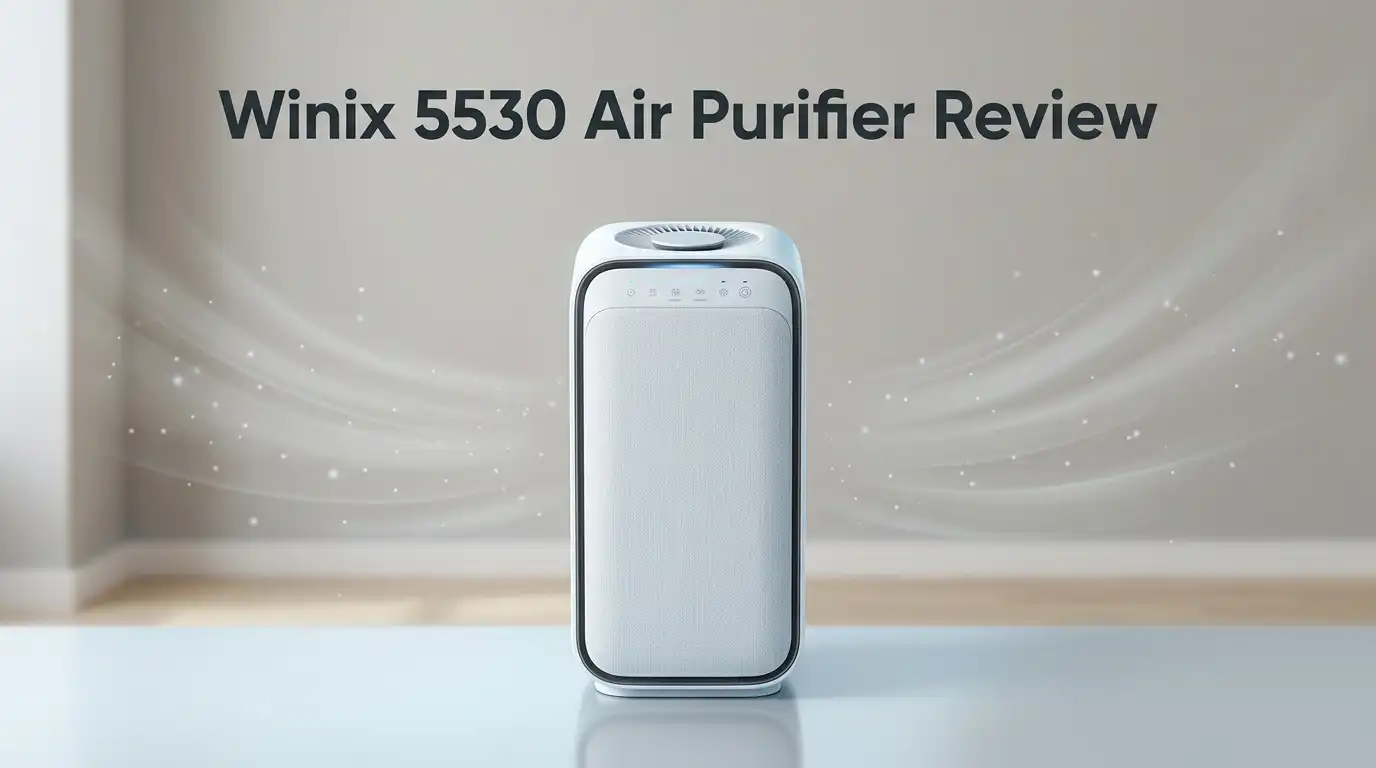
Winix 5530 Air Purifier Review 2026: Worth Buying?
Clean air sounds simple until you start shopping for it. Prices jump from $80 to $800, and every box promises the same thing. The Winix 5530 sits right in the middle of that mess, and it carries a strong family name.
It replaces the beloved Winix 5500-2, a model that earned a cult following before Winix retired it in the US. So the big question is fair: does the new version keep the magic, or did Winix trade performance for an app?
I have spent time with the specs, the lab data, the filter costs, and the complaints real owners post online. This review covers the unboxing, the noise, the quirks, and the parts Winix would rather you skip. Read on before you spend the money.
In a Nutshell:
- Strong cleaning power for the price. Independent lab testing measured a PM1 CADR of 258 CFM at top speed, which comfortably covers a room around 404 square feet. That beats several purifiers costing twice as much.
- Very quiet on low, loud on high. It runs at a near silent 32.4 dBA on speed one and climbs to roughly 60.7 dBA at full power. That top speed sounds like a normal conversation in the room.
- App control is the headline upgrade. The 5530 adds WiFi, a timer, and remote control through the Winix app, features the old 5500-2 never had.
- Filters stay affordable. The genuine Filter Q pack runs about $49.99 and lasts 12 months. Generic versions sell for far less, which keeps yearly running costs low.
- The ionizer is optional. PlasmaWave can be switched off completely, a real plus if ozone concerns you.
- It is not perfect. The particulate filter is marketed as True HEPA but carries no HEPA certification, the display cannot be fully turned off, and there is no physical remote.
What Is the Winix 5530 Air Purifier?


Last update on 2026-11-17 / Affiliate links / Images from Amazon Product Advertising API
The Winix 5530 is a mid range tower purifier built for medium and large rooms. Winix calls it the new generation of the 5500-2, and the family resemblance shows. You get the same slim rectangular body, the same pellet carbon approach to odors, and the same PlasmaWave ionizer.
The differences live in the details. The 5530 wears a clean white finish instead of black, adds WiFi app support, and uses five fan speeds instead of four.
Winix markets it for rooms up to 1,882 square feet in one hour, which really means one air change in a very large space. Treat that number as marketing, not a room rating. Real world coverage for meaningful cleaning sits closer to 400 square feet.
Unboxing the Winix 5530
The box arrives heavier than you expect for a 12 pound machine, mostly because of the cardboard bracing. Winix packs the unit upright with foam caps on the top and bottom corners. There is no plastic clamshell to fight with, which is a small mercy.
Inside you find the purifier, a quick start guide, and a warranty card. That is it. The filters ship pre installed inside the unit, so your first job is popping the front panel off and pulling the plastic wrap from the HEPA and carbon filters. Skip this step and the machine barely moves air. Plenty of first time buyers miss it.
The front cover lifts off with a firm tug. No tools, no screws. Setup from box to running takes about four minutes, and the power cord measures a generous 74.8 inches, so you are not hunting for an extension lead.
Design and Build Quality
The 5530 measures 13.4 inches wide, 8.2 inches deep, and 21.9 inches tall. That shallow depth is the design win here. It tucks against a baseboard without pushing into walkways, which matters in apartments and narrow bedrooms.
The white plastic shell feels solid rather than premium. Panel gaps are tight, the front cover clicks into place with a satisfying snap, and nothing rattles when the fan spins up. At 12.1 pounds it is light enough to carry between rooms with one hand using the recessed grip at the back.
The looks are plain. This is a white box with a slot on top. It will not win any design awards next to a Blueair or a Dyson, but it also disappears into a room instead of demanding attention.
The Four Stage Filtration System Explained
Winix advertises four stages. In practice you get three physical layers plus an ionizer, which is worth knowing before you buy.
The first layer is a washable fine mesh pre filter that catches hair, lint, and large dust. The second is the particulate filter, marketed as True HEPA. Independent testers note it is not HEPA certified, so take the 99.99 percent claim as a manufacturer figure rather than a verified one.
The third layer is a pellet based activated carbon filter, and this is a genuine strength. Pellets hold more carbon than the thin sheet filters used in budget purifiers, so odor control lasts longer.
The fourth stage is PlasmaWave, the bipolar ionizer. It is a technology, not a filter. You can turn it off.
Top 3 Alternative for Winix 5530

Last update on 2026-11-17 / Affiliate links / Images from Amazon Product Advertising API
Winix 5510 Air Purifier

Last update on 2026-11-17 / Affiliate links / Images from Amazon Product Advertising API
Levoit Core 400S-P Air Purifier

Last update on 2026-11-17 / Affiliate links / Images from Amazon Product Advertising API
Coway Airmega AP-1512HH Mighty Air Purifier
Real World Cleaning Performance
Numbers tell the story better than claims. In controlled testing with the ionizer switched off, the 5530 delivered a measured PM1 CADR of 258 CFM, or 439 cubic meters per hour. That rate supports a recommended room size of roughly 404 square feet at maximum fan speed.
Drop to a quieter setting and performance drops too, as it does with every purifier. At speed two, where noise stays under 45 dBA, the measured rate falls to 122 CFM, good for about 190 square feet. That is still respectable for overnight use in a bedroom.
What this means day to day: dust, pollen, and pet dander clear fast when you run it high for twenty minutes, then settle into auto mode. Smoke and cooking smells fade noticeably within half an hour.
Noise Levels at Every Fan Speed
Noise makes or breaks a bedroom purifier. The 5530 splits the difference between quiet and powerful.
On its lowest speed it registers about 32.4 dBA from three feet away. That is a soft hum, quieter than most refrigerators, and easy to sleep through. Speeds two and three stay comfortable for a home office or a living room with the TV on.
Speed five is a different animal. At roughly 60.7 dBA, it sounds like someone talking beside you. You will not watch a film or hold a phone call with it running wide open. My advice is simple: blast it for twenty minutes when you walk in, then drop it to speed two. You get most of the cleaning with almost none of the noise penalty.
Auto Mode and the Air Quality Sensor
The onboard particle sensor drives auto mode, and it works well enough to trust. A color ring on top gives you a read at a glance. Blue means good air, orange means fair, and red means poor.
The sensor reacts quickly to real triggers. Searing a steak, lighting a candle, or vacuuming the carpet all push the ring to orange or red within seconds, and the fan ramps up on its own. It settles back down a few minutes later.
There is also a light sensor. When the room goes dark, the 5530 slips into sleep mode automatically, dimming the display and dropping the fan. You cannot turn the display off manually, which annoys light sensitive sleepers, though the dimmed state is faint enough for most people.
The Winix App and Smart Features
WiFi is the main reason to choose the 5530 over the older 5500-2. The Winix app pairs in a few minutes and gives you remote control, fan speed adjustment, filter life tracking, and a timer function that is not available on the unit itself.
The app is clean and free of the pop up ads that clutter some competitor apps. It is also fairly basic. You will not find detailed history graphs, exact PM2.5 numbers, or rich automation rules like the ones Levoit and Xiaomi offer. It shows current air quality, current mode, and little else.
Being honest, app control on an air purifier is convenience, not necessity. Still, adjusting the fan from bed without getting up is genuinely nice, and there is no physical remote in the box.
PlasmaWave: Should You Leave It On?
PlasmaWave releases positive and negative ions that are meant to break down airborne pollutants. Like all ionizers, it produces a small amount of ozone as a byproduct. Winix states output stays below the accepted 0.05 ppm safety threshold.
Here is the practical truth. Testing shows the physical filters do nearly all the heavy lifting. Lab runs with PlasmaWave disabled still produced excellent particle removal. The ionizer adds a modest boost at best.
If anyone in your home has asthma, allergies, or respiratory sensitivity, turn it off and leave it off. Press and hold the PlasmaWave button and the indicator goes dark. You lose almost nothing. If ozone does not worry you, leaving it on is fine. The choice being yours is the point.
Filter Replacement Costs and Maintenance
Running costs matter more than sticker price over five years. The 5530 uses the Filter Q pack, which also fits the Winix 5510 and 5520.
Genuine filters sell for around $49.99 from Winix, often listed at $79.99 before discount. Third party versions on Amazon drop to roughly $16 to $20. Winix recommends replacing the particulate and carbon filters every 12 months. Neither one is washable.
The pre filter is washable, and you should rinse it every two to four weeks. Pet owners should check it weekly. A clogged pre filter starves the fan and makes the whole unit work harder.
One design plus: the filters are not bonded together. You can replace the carbon alone if odors break through before the HEPA layer expires.
Energy Use and Yearly Running Costs
The 5530 sips power at the settings most people actually use. Low and medium speeds pull single digit wattage, comparable to its predecessor, which drew about 6.5 watts on speed one and 9 watts on speed two. Top speed is the expensive setting, climbing past 50 watts.
Based on figures from comparable Winix towers, expect roughly $45 to $50 per year in electricity running it around the clock at moderate speeds. Add $50 for genuine filters and your total lands near $100 annually. Use generic filters and that drops closer to $65.
That is cheap for a purifier this capable. Many competing machines in the same size class cost $120 or more per year in filters alone.
What the Winix 5530 Does Not Do Well
Every honest review needs this section. The 5530 has real weaknesses.
It gets loud at full power. At 60.7 dBA, speed five is disruptive in a quiet room. Quieter machines exist if silence is your priority.
The HEPA filter is not certified. Winix markets it as True HEPA, but it carries no third party HEPA certification. Performance is still strong, yet the label oversells.
The display cannot be switched off. It dims automatically in the dark, and that is your only option.
Gas and VOC removal is limited. Pellet carbon helps with everyday odors, but no consumer purifier at this price makes a serious dent in high VOC levels.
The app is thin, and there is no remote control. Marketing coverage figures are also inflated, as they usually are.
Pros and Cons of the Winix 5530
Pros
- Excellent particle filtration with a measured 258 CFM CADR at top speed
- Near silent at 32.4 dBA on its lowest fan setting
- PlasmaWave ionizer can be disabled completely
- Slim 8.2 inch depth fits neatly along walls and baseboards
- Reliable auto mode with a responsive air quality sensor and color coded light
- Affordable filters with plentiful generic options, keeping yearly costs near $65 to $100
- Separate filter layers make the pre filter easy to clean and the carbon easy to swap
- WiFi app control, timer, and filter life tracking included
- Two year manufacturer warranty
Cons
- Noticeably loud at maximum speed, around 60.7 dBA
- Particulate filter is not HEPA certified despite the True HEPA label
- Display cannot be turned off manually, only dimmed
- No physical remote control included
- App lacks history graphs and exact PM2.5 readings
- Advertised 1,882 square foot coverage is optimistic marketing
- Plain design that some buyers find boring
- Tall body does not fit on a nightstand or low shelf
Who Should Buy the Winix 5530?
Last update on 2026-11-17 / Affiliate links / Images from Amazon Product Advertising API
Buy this purifier if you want strong, proven filtration without paying a premium for styling. It suits bedrooms, living rooms, home offices, and open plan spaces up to about 400 square feet.
Pet owners get the most value here. The washable pre filter handles fur, the pellet carbon tackles litter box and wet dog smells, and the quiet lower speeds will not spook nervous animals. Allergy sufferers also do well, since the unit clears pollen and dander fast on high.
Skip it if absolute silence is your top requirement, or if you need a purifier small enough for a desk or nightstand. Also skip it if you want deep smart home integration with detailed air quality logging. Other brands do that better, though usually for more money.
Final Verdict: Is the Winix 5530 Worth It in 2026?
Yes, with one condition: buy it on sale. At its $219.99 list price the 5530 faces stiff competition. Shoppers have reported it dropping near $130, and at that figure it is one of the best value purifiers you can buy.
The performance is real. Strong CADR, genuinely quiet low speeds, cheap filters, and an ionizer you can switch off add up to a machine that earns its place. The flaws are honest ones, not dealbreakers. Loud top speed, an uncertified HEPA label, and a basic app are easy trade offs at this price.
The old 5500-2 was a legend, and the 5530 carries that torch well. It cleans air fast, costs little to run, and stays out of your way. For most homes, that is exactly enough.
Frequently Asked Questions
Is the Winix 5530 the same as the 5500-2?
No, though they are close relatives. The 5530 is the newer generation. It adds WiFi app control, a fifth fan speed, a light sensor for automatic sleep mode, and a white finish. The 5500-2 was discontinued in the US and Canada in 2025.
How often should I change the Winix 5530 filter?
Winix recommends replacing the particulate and carbon filters every 12 months. The washable mesh pre filter should be rinsed every two to four weeks, or weekly in homes with pets. The unit has a filter change indicator that reminds you.
Does the Winix 5530 produce ozone?
PlasmaWave generates a small amount of ozone as a byproduct. Winix states output stays below 0.05 ppm. You can disable PlasmaWave entirely, and the physical filters still deliver excellent particle removal without it.
What size room does the Winix 5530 cover?
Lab testing supports roughly 404 square feet at maximum fan speed and about 190 square feet at a quiet speed two. The advertised 1,882 square feet refers to a single air change per hour, which is not the same as effective cleaning.
Can I use third party filters in the Winix 5530?
Yes. The unit uses the Filter Q pack, and many generic versions are sold online for $16 to $20, compared with about $50 for genuine Winix filters. Quality varies between brands, so read recent buyer feedback before ordering.
Is the Winix 5530 loud at night?
Not on low. At 32.4 dBA, speed one is a soft hum most sleepers ignore. The automatic sleep mode also dims the lights and reduces fan speed when the room goes dark. Only the top speed becomes genuinely disruptive.

I’m Maya Brown, the voice behind Pure Breeze Vault. I write detailed, honest, and easy-to-follow air purifier reviews to help readers compare features, understand filter technologies, and choose products with confidence. My goal is to make research simpler, clearer, and more practical for anyone improving indoor air quality at home.