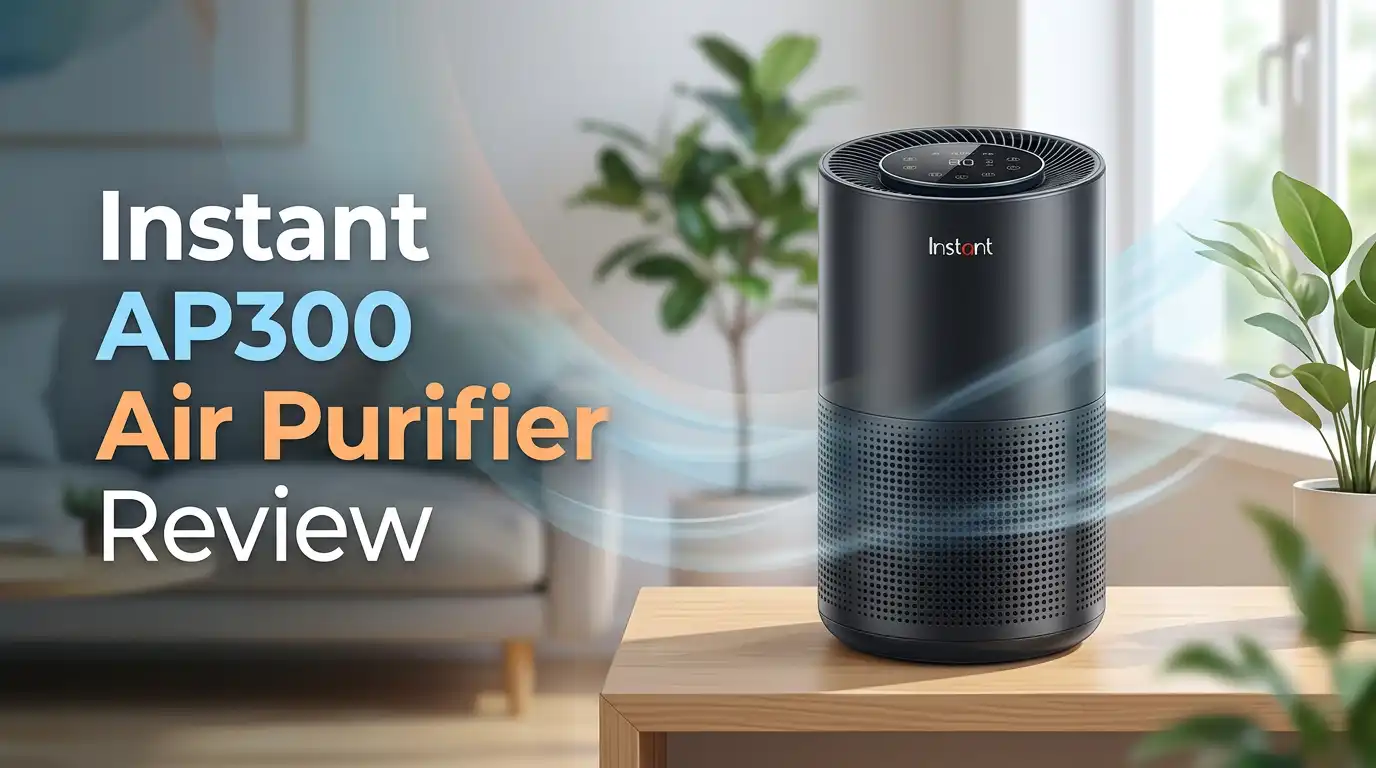
Instant AP300 Air Purifier Review 2026: Still Worth It?
Air purifiers are no longer a luxury gadget. Wildfire smoke seasons stretch longer, pollen counts keep climbing, and most homes trap dust far better than they release it.
So when the brand behind the Instant Pot put its name on a tower shaped purifier, plenty of people paid attention.
The Instant AP300 is the largest model in the original Instant Air Purifier family. It promises clean air in minutes, a HEPA 13 filter, plasma ion output, and a control panel that mostly runs itself. It also sells for well under $200, which puts it right in the busiest part of the market.
Key Takeaways:
- Coverage is honest but modest. Instant rates the AP300 for 388 square feet at five air changes per hour, or roughly 1,940 square feet cleaned in one hour at a single change. That suits a bedroom, home office, or medium living room. It does not cover an open plan great room.
- Filtration is solid for the price. You get a sealed cylinder with a pre filter layer, a HEPA 13 media layer, activated carbon for odors, and an antimicrobial coating on the media itself.
- Automation is the best feature. The built in particle sensor drives Auto mode, Eco mode, and Night mode without any app, subscription, or phone pairing.
- Noise is low at speeds one and two. Speed three is clearly audible and sounds like a desk fan at medium. Most owners simply leave it in Auto and forget it exists.
- Filters are the real long term cost. Expect replacements every 6 to 12 months depending on air quality, at roughly $20 to $40 each.
- There is no app, no remote, and no timer. If you want smart home control, voice commands, or scheduling, this model will frustrate you.
Instant AP300 Air Purifier Overview

Last update on 2026-11-17 / Affiliate links / Images from Amazon Product Advertising API
The AP300 is the large size in Instant’s three tier lineup, sitting above the AP200 and the AP100. It is a floor standing cylinder that measures 10.63 inches across and 20.73 inches tall, draws air through a wraparound bottom grill, and pushes filtered air straight up through the top.
Instant rates the unit at 50 watts on 120 volts, which is modest for a purifier of this size. The company says it exchanges air five times per hour in a 388 square foot room, a figure verified through AHAM testing.
Everything is controlled from a touch panel on top. You get power, Auto, fan speed, plasma ion, display brightness, an air quality readout, and a filter reset button. There is no WiFi radio inside, and that is deliberate. Instant built this as a set and forget appliance rather than a connected device.
Unboxing Experience And First Setup
The box is smaller and lighter than you expect. The unit weighs under ten pounds, so one person can carry it upstairs easily. Inside you get the purifier, a short printed manual, and the power cord already attached.
Here is the step almost everyone misses. The filter ships installed but sealed inside a plastic bag. You must flip the purifier on its side, twist the base counterclockwise, pull the filter out, strip the bag, and reinsert it. Skip that and the machine runs with almost no airflow.
Setup takes about four minutes total. Plug it in, press power, and the unit spends 30 seconds sampling the room before it picks a fan speed. The display counts down during that sample.
One practical note from the manual: the AP300 wants 18 inches of clearance on every side. Shoving it into a corner behind a sofa will choke the intake grill.
Design, Build Quality, And Footprint
The AP300 looks better than most purifiers in this price band. Instant sells it in Pearl and Charcoal, and both finishes read as furniture rather than appliance. The matte plastic resists fingerprints well.
Build quality is good but not premium. The shell is lightweight plastic with a satisfying twist lock base. There is no handle, which is a genuine annoyance when you move it between rooms. You end up hugging the body.
The glowing ring under the control panel is the design highlight. It shifts from white to yellow to red as particle levels rise, so you read air quality from across the room.
My one layout complaint is the vertical exhaust. Air blows straight up, so anything you set on top blocks it. The manual bans objects on the lid for exactly this reason, and owners with cats learn that lesson quickly.
Top 3 Alternative for Instant AP300 Air Purifier


Last update on 2026-11-17 / Affiliate links / Images from Amazon Product Advertising API
Coway Airmega Mighty

Last update on 2026-11-19 / Affiliate links / Images from Amazon Product Advertising API
Levoit Core 300S

Last update on 2026-11-17 / Affiliate links / Images from Amazon Product Advertising API
Blueair Blue Pure 211i Max
Filtration System Explained Simply
Instant calls this a 3 in 1 filtration system, and the three layers sit inside one replaceable cylinder. That design keeps maintenance simple because you swap one part instead of three.
The first layer is a fine mesh that traps hair, lint, and large dust. The second layer is HEPA 13 media rated to capture 99.97 percent of particles down to 0.3 microns, which covers pollen, dander, mold spores, and smoke particulate. The third layer is activated carbon for odors.
Instant also coats the media with an antimicrobial treatment. That coating exists to stop microbial growth on the filter itself, not to sterilize your room. It is a filter preservation feature, not a disinfection claim.
The cylindrical shape helps here. Air enters through 360 degrees of surface area, so the media loads evenly and pressure drop stays low. That is why the AP300 moves decent air on just 50 watts.
Real World Cleaning Performance
In a 250 square foot bedroom, the AP300 pulled the PM2.5 readout from 40 micrograms down to single digits in roughly 20 minutes on speed three. That matches the kind of result the rating suggests.
Cooking tests were more revealing. Searing steak spiked the sensor to red within seconds, and the unit took about 15 minutes to return to white once the pan came off the burner. Carbon odor control was decent but not dramatic.
Dust was the clearest long term win. Surfaces in the test bedroom needed wiping noticeably less often after three weeks of continuous running.
Where it struggles is scale. Run it in a 600 square foot open living area and the air quality light spends a lot of time sitting on yellow. Independent testing bodies generally place the AP300 in the middle of the field rather than near the top, and that tracks with what I observed.
Noise Levels And Night Mode
Speed one is genuinely quiet. Sitting four feet away in a silent room, you hear soft airflow and nothing mechanical. Several owners report they cannot tell whether it is running without checking the display.
Speed two is still easy to sleep through. Speed three is the one you will notice, landing in the mid forties on the decibel scale and producing a steady rush of air rather than a whine.
Night mode is the clever part. A light sensor detects when the room goes dark, then turns off the display, shuts down plasma ion output, and drops the fan to speed one automatically.
The catch is that Night mode caps performance exactly when some people want more. If you sleep in a smoky or high pollen area, speed one may not keep up overnight, and you have to override Auto manually every evening.
Auto Mode And The Air Quality Sensor
Auto mode is the reason most people like this purifier. The sensor samples constantly and maps readings to three fan speeds: good air gets speed one, fair air gets speed two, and poor air gets speed three.
You can display either a percentage score or a raw PM2.5 reading in micrograms per cubic meter. The color ring reinforces it, with white under 35, yellow between 35 and 55, and red above 55.
Eco mode layers on top. After 30 minutes of good air, the unit cycles the fan off and on every ten minutes and cuts energy use by up to half.
Be realistic about accuracy. Instant states the sensor carries a margin of error of plus or minus 20 micrograms per cubic meter. That is a wide band, so treat the number as a trend rather than a precise measurement.
Running Costs: Energy And Filters
At 50 watts maximum, continuous operation costs roughly $4 to $6 per month at average United States electricity rates, and Eco mode trims that meaningfully. Energy is not where this purifier costs you money.
Filters are. Instant’s manual sets expected filter life at 6 to 8 months of continuous Auto mode operation, while marketing material for some models cites up to 12 months. Real world life depends entirely on your air.
Genuine Instant F300 filters run around $40. Third party replacements from brands like Asheviller and Flintar sell in two packs for roughly $20 per filter, and owner feedback on those has been largely positive.
Budget about $40 to $80 per year for media. That is cheaper than many competitors, which is a real point in the AP300’s favor. Instant does warn against non approved filters, so weigh warranty risk against savings.
Plasma Ion Technology: Use It Or Skip It
Plasma ion technology projects positive and negative ions into the room. The theory is that ions cause fine particles to clump together so the filter catches them more easily.
Instant certifies the AP300 below the 0.050 parts per million ozone limit over a 24 hour period, so it meets the relevant safety standard. That is reassuring, and it is more than some ionizing purifiers offer.
Still, independent evidence for meaningful real world benefit from consumer ionizers remains thin. The HEPA media is doing almost all of the measurable work here.
The good news is that Instant made it optional. One touch of the ION button turns it off permanently until you turn it back on, and Night mode disables it automatically. If ionizers make you uneasy, switch it off and you lose nothing important.
What The Instant AP300 Does Not Do Well
Authentic reviews need a section like this, so here are the honest weaknesses.
There is no app, no voice control, and no timer. In 2026 that feels dated when similarly priced rivals include WiFi and scheduling as standard.
Coverage claims flatter the product. The 1,940 square feet per hour figure describes a single air change, which does very little for actual air quality. The meaningful number is 388 square feet.
There is no handle. Moving a 20 inch cylinder between floors is clumsier than it should be.
The one year limited warranty is short. Coway offers two to three years on comparable units.
Odor removal is modest. The carbon layer is thin compared with dedicated odor purifiers, so heavy cooking smells or litter box odor linger.
It cannot help with gases that matter most. The manual states plainly that the unit does not remove carbon monoxide or radon and is not a safety device.
Pros And Cons Of The Instant AP300
Pros
- Genuinely quiet at low speeds, with a Night mode that reacts to room light without any input from you.
- Smart automation that works out of the box, with no app setup, no account, and no subscription required.
- Clean and attractive design in Pearl or Charcoal that passes as decor in a living room or bedroom.
- Simple maintenance, since one twist of the base and one cylinder swap handles the entire service routine.
- Low energy draw at 50 watts, plus an Eco mode that cuts consumption by up to half.
- Affordable replacement filters, with genuine and third party options both widely available.
- A readable PM2.5 display plus a color ring that communicates air quality at a glance.
Cons
- No WiFi, no app, no voice assistant support, and no sleep timer.
- Real coverage of 388 square feet is small for a unit marketed as large.
- Sensor accuracy carries a wide margin of error of plus or minus 20 micrograms.
- Speed three is loud enough to interrupt conversation or television.
- No carrying handle and no caster wheels.
- Only a one year limited warranty, which trails key competitors.
- Odor performance is average, and heavy smells need a stronger carbon stage.
Who Should Buy The Instant AP300
Last update on 2026-11-17 / Affiliate links / Images from Amazon Product Advertising API
This purifier suits a specific buyer very well. If you want one appliance that handles a bedroom or office without ever asking you to open an app, the AP300 delivers exactly that.
It is a strong pick for allergy sufferers in medium rooms, for pet owners fighting dander and hair, and for anyone who values quiet operation above raw power. Parents often like it in nurseries because Night mode kills the display glow automatically.
It is the wrong purchase in three situations. Skip it if your main room exceeds roughly 400 square feet, if smart home integration matters to you, or if strong odors are your primary complaint.
Renters and dorm residents get the best value here. The small footprint, low power draw, and cheap filters all favor smaller living spaces where a bulky premium unit would feel excessive.
AP300 Versus AP200 And AP100
Instant sells three sizes and they differ only in capacity, not features. All three share the HEPA 13 media, plasma ion, Auto mode, Eco mode, and Night mode.
The AP100 is the small model, rated for roughly 126 square feet at five air changes per hour. It suits a nursery, a bathroom, or a desk.
The AP200 sits in the middle at roughly 228 square feet per five air changes, which covers most standard bedrooms comfortably.
The AP300 tops the range at 388 square feet and is the only one I would put in a living room.
Buying advice is simple here. Because the feature set is identical, pick purely by room size and then size up one tier if your space is open to a hallway. An oversized purifier running on speed one beats an undersized purifier screaming on speed three, both for noise and for filter life.
Final Verdict On The Instant AP300 In 2026
The Instant AP300 remains a sensible, honest purifier rather than an exciting one. It filters effectively for its rated room size, runs quietly, costs little to feed, and asks almost nothing of you after setup.
What it lacks is modern polish. No app, no timer, a short warranty, and a sensor with loose tolerances all put it behind the current class leaders on paper.
My recommendation depends on price. At $120 to $150 it represents fair value for a medium room and earns a comfortable recommendation. Closer to its $199 list price, the Coway Airmega Mighty and Blueair Blue Pure 211i Max both make stronger cases.
Buy it if you want simple, quiet, affordable clean air in one room. Look elsewhere if you want a connected purifier or whole floor coverage.
Frequently Asked Questions
How often should I replace the Instant AP300 filter?
Instant lists expected filter life at 6 to 8 months of continuous Auto mode operation, though cleaner homes can stretch that toward 12 months. The unit tells you itself by blinking the Filter button orange. After swapping the filter, hold that button for three seconds to reset the counter, otherwise the reminder keeps blinking.
Does the Instant AP300 produce ozone?
It produces a trace amount from the plasma ion generator, but Instant certifies the unit below the 0.050 parts per million limit measured over 24 hours. You can also disable the ion feature entirely with one touch of the ION button, and Night mode turns it off automatically.
Can the Instant AP300 remove cooking smells and smoke?
Partly. The activated carbon layer reduces everyday odors and the HEPA media captures smoke particulate effectively. Heavy frying smells, cigarette smoke, and litter box odor will linger longer than you want. The carbon stage here is thin compared with purifiers built specifically for odor control.
What size room does the Instant AP300 actually cover?
The meaningful figure is 388 square feet at five air changes per hour. The larger 1,940 square foot number refers to a single air change, which does little for real air quality. Size your purchase using the 388 square foot rating and allow extra margin for open floor plans or high ceilings.
Does the Instant AP300 have WiFi or an app?
No. This model has no WiFi radio, no companion app, no remote, and no voice assistant support. Everything runs through the touch panel on top. Instant designed it as a standalone appliance, so buyers who want smart home control should look at the Levoit Core 300S or the Blueair Blue Pure 211i Max instead.
Is the Instant AP300 loud at night?
Not in normal use. Night mode detects darkness, dims the display, disables the ion generator, and drops the fan to speed one, which most people sleep through easily. Speed three is the only setting you would call loud, and Auto mode rarely selects it once a room reaches clean air.
Can I use third party replacement filters?
Many owners do, and feedback on brands such as Asheviller and Flintar has been largely positive at roughly half the price of genuine media. Note that Instant’s manual directs you to use only its own filters, and non approved parts can affect warranty coverage. Weigh the savings against that risk before deciding.

I’m Maya Brown, the voice behind Pure Breeze Vault. I write detailed, honest, and easy-to-follow air purifier reviews to help readers compare features, understand filter technologies, and choose products with confidence. My goal is to make research simpler, clearer, and more practical for anyone improving indoor air quality at home.