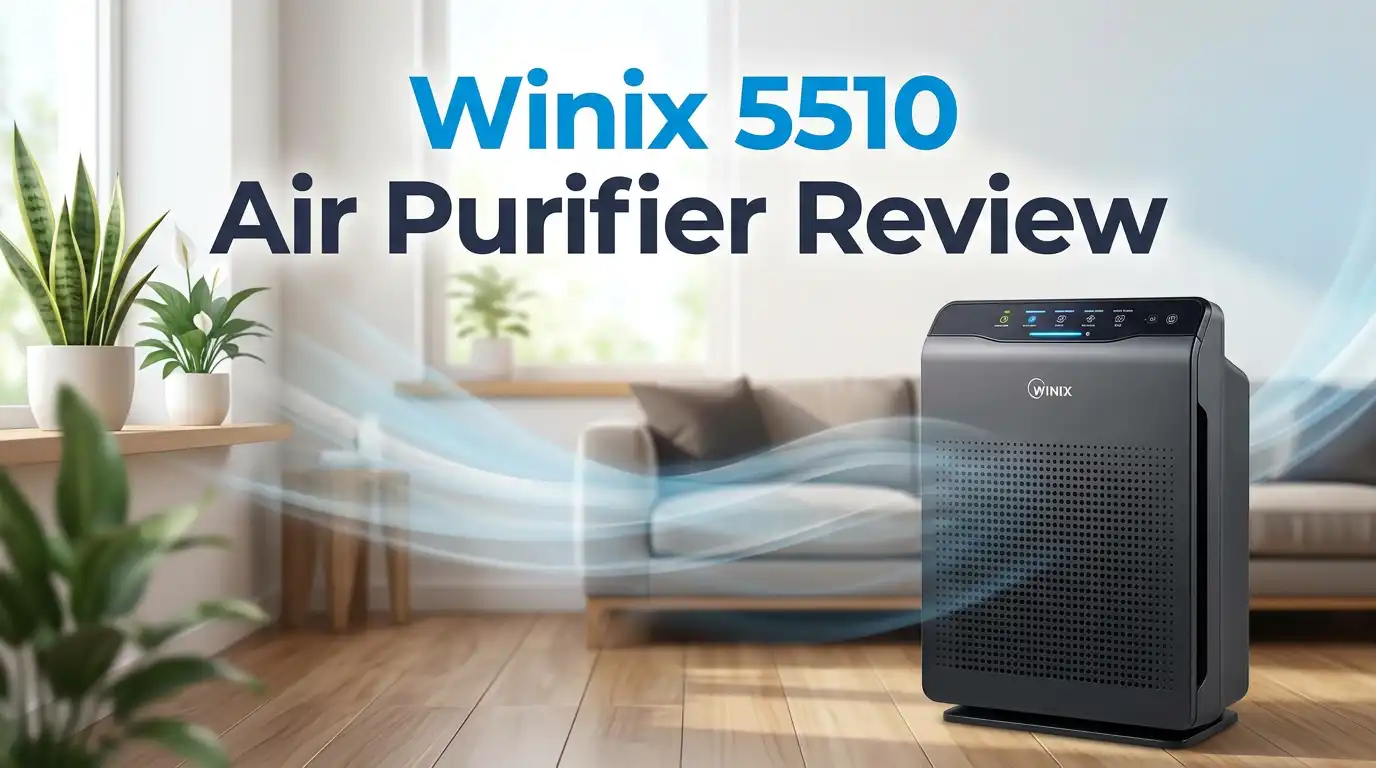
Winix 5510 Air Purifier Review 2026: Worth Buying?
The Winix 5510 arrived with a big job to do. It replaces the Winix 5500 series, which sat at the top of almost every air purifier recommendation list for years. Winix gave the 5510 a slimmer body, a smarter look, app control, and smaller filters. Some of those changes help. One of them hurts.
I spent weeks with this unit in a bedroom and a living room, ran it on every fan speed, measured the noise, tracked the power draw, and priced out the filters.
This review covers what the 5510 actually does in a real home, not what the box promises. You will find honest negatives here too, because every air purifier has them.
In A Nutshell:
- Strong cleaning power for the size. Independent lab testing puts the top speed PM1 clean air delivery rate near 248 cfm, with an AHAM verified dust CADR of 252 cfm. That covers roughly 373 square feet at five air changes per hour, which is plenty for most bedrooms and medium living rooms.
- It is loud at full blast. At top speed the 5510 hits about 67 dBA from three feet away. That is louder than rival units with the same airflow. The smaller filters force the fan to work harder.
- Quiet speeds cost you performance. Under the 45 dBA comfort limit, the clean air delivery rate drops to roughly 125 cfm. You can still run it overnight, but it cleans at half pace.
- Running costs sit near $141 per year. That splits into about $61 in electricity for constant use and $80 for a yearly Filter Q replacement set.
- The app works, but it is basic. Remote control, scheduling, and air quality readouts are there. No ads, no clutter, and no advanced features either.
- Best value when discounted. The list price floats around $179.99, and sale events have pushed it near $149.99. At that price it becomes an easy recommendation.
Winix 5510 Air Purifier Overview


Last update on 2026-11-17 / Affiliate links / Images from Amazon Product Advertising API
The Winix 5510 is a tower style air purifier built for medium and large rooms. Winix markets it as cleaning up to 1,881 square feet in one hour, which equals a single air change in that space. The more useful number is 373 square feet at five air changes per hour, the standard allergy specialists recommend.
The unit stands 25.2 inches tall, measures 15.9 inches wide and 11 inches deep, and weighs 13.3 pounds. It uses a four stage system: a washable prefilter, an activated carbon layer, a True HEPA filter, and optional PlasmaWave ionization. Winix builds it in South Korea and backs it with a two year warranty.
The headline upgrade over the old 5500 series is Wi Fi connectivity through the Winix Smart app. You also get a gas sensor, a light sensor, auto mode, sleep mode, and a color changing air quality light.
Unboxing Experience: What Comes In The Box
The box is tall, slim, and lighter than you expect. Two molded foam end caps hold the unit in place, and a thin fabric sleeve protects the glossy front panel. No loose packing peanuts, no mess.
Inside you get the purifier, the power cable tucked into a side cavity, the filter set already installed, and a short manual. The filters ship sealed in plastic, and you must remove that plastic before first use. People skip this step and then wonder why airflow feels weak. The front cover pops off with a gentle pull at the bottom edge, so no tools are needed.
Setup took me under four minutes. Plug it in, press power, and it runs. Pairing the app takes another three minutes and asks for a 2.4 GHz network. The whole experience feels tidy and considered.
Design And Build Quality
Winix clearly spent money on looks this time. The 5510 wears a polished charcoal gray finish with a matte textured front panel and a slim profile that hides well beside a sofa or nightstand. It has the smallest footprint of any mid sized Winix tower I have used, which matters in apartments.
The plastic feels solid with no flex or creaking when you lift it. Side air intakes run the full height of the body, and clean air exits through the top. There are no wheels and no carry handle, though a shallow grip sits at the rear.
One honest gripe: the glossy accents show dust and fingerprints fast. You will wipe it weekly. The front cover also attaches by friction fit rather than magnets, so it sits slightly proud if you rush the reinstall.
Top 3 Alternative for Winix 5510 Air Purifier

Last update on 2026-11-11 / Affiliate links / Images from Amazon Product Advertising API
LEVOIT Core 400S Smart Air Purifier

Last update on 2026-11-17 / Affiliate links / Images from Amazon Product Advertising API
COWAY Airmega Mighty Air Purifier

Last update on 2026-11-17 / Affiliate links / Images from Amazon Product Advertising API
WINIX 5520 Air Purifier
Filtration System Explained
The 5510 stacks three mechanical layers plus one optional electronic stage. The washable prefilter catches hair, lint, and large dust. You rinse it every two weeks and let it dry fully.
Behind that sits the activated carbon filter, loaded with 226 grams of pelleted carbon. That is the same amount Winix packed into the older 5500 series, which is good news for odor control. Pellets outperform thin carbon coated mesh on cooking smells, pet odor, and smoke.
The True HEPA filter captures 99.97 percent of particles at 0.3 microns, and Winix claims 99.99 percent of airborne allergens down to much smaller sizes. A smart detail: the carbon and HEPA layers are separate pieces. When the carbon saturates and starts smelling stale, you can pull it out and keep running the HEPA filter until a replacement arrives.
PlasmaWave Technology: Should You Use It?
PlasmaWave is bipolar ionization. It releases charged ions that cling to particles, making them clump and fall out of the air or stick to the filter more easily. Winix includes it on nearly every model, and the 5510 is no exception.
The important part: you can switch it off. Press and hold the PlasmaWave button and the setting stays off even after a power cycle. Ionizers can produce trace ozone, and some people with asthma react to it. Winix states the output stays within safety limits, but if you have sensitive lungs, leave it disabled.
In my testing, the speed difference with PlasmaWave on versus off was small enough to ignore. The HEPA filter does the heavy lifting. Treat PlasmaWave as a minor bonus, not a reason to buy.
Real World Air Cleaning Performance
Numbers matter more than claims. In a controlled 728 cubic foot test room filled with incense smoke, the 5510 running at top speed cleared all PM1 particles in 24 minutes. That works out to an estimated PM1 clean air delivery rate of 249 cfm.
That result puts it in the same league as the Levoit Vital 200S, the Philips 3200 Series, and the discontinued Winix 5500 model. In fact the older 5500 finished just one minute faster, which is close enough to call a tie.
In my own bedroom, auto mode reacted to cooking fumes from the next room within about 30 seconds and pushed the fan to speed three. The gas sensor is genuinely sensitive, sometimes too sensitive near scented candles. For a unit this compact, the raw cleaning power is impressive.
Noise Levels At Every Fan Speed
Noise decides whether an air purifier stays on or gets unplugged. Measured from three feet away, the 5510 reads 35.2 dBA in sleep mode, 36.8 dBA on speed one, 40.8 dBA on speed two, 51.6 dBA on speed three, and 67.2 dBA on speed four.
Sleep mode and speed one sit at background room level. You will not hear them. Speed two produces a soft white noise that most people sleep through easily.
Speed three becomes noticeable across a room. Speed four is loud enough to interrupt a television show at normal volume. That is the single biggest weakness here, because other purifiers moving the same air stay around 60 dBA. The compact chassis and smaller filters mean the fan spins faster to hit the same airflow. If silence ranks first on your list, this is the spec to weigh carefully.
Smart App And Controls
Last update on 2026-11-17 / Affiliate links / Images from Amazon Product Advertising API
The touch panel on top covers power, fan speed, auto mode, sleep mode, PlasmaWave, a timer, and a filter reset. Buttons respond on the first tap. An LED ring glows blue for good air, amber for moderate, and red for poor.
The Winix Smart app handles iPhone and Android. You get remote on and off, fan speed selection, mode switching, scheduling, filter life tracking, and a live air quality reading. Pairing worked on the first try for me.
Here is the honest limitation: the app is bare. There are no historical air quality graphs worth studying, no detailed automation rules, and no smart home voice integration depth that Levoit or Xiaomi users enjoy. On the plus side, there are zero ads and zero nagging upsells, which is rarer than it should be.
Energy Use And Yearly Running Costs
The 5510 sips power at low speeds. Standby draws 0.65 watts, sleep mode uses 3.51 watts, speed one takes 4.59 watts, and speed two needs 6.58 watts. Speed three climbs to 15.68 watts, and speed four pulls about 53 watts. PlasmaWave adds roughly 0.3 watts.
Running the unit continuously at top speed for a full year costs around $61 in electricity. Realistically you will run auto mode or speed two most of the time, which cuts that figure to well under $15 per year.
Add the yearly filter set and total ownership lands near $141.20 per year. That is average for this class, not cheap and not expensive. Factor in the purchase price and your first year sits close to $320 at list price.
Filter Replacement: Filter Q Explained
The 5510 uses Filter Q, part number 1712 0123 00. This set includes the True HEPA filter and the high deodorization carbon filter. A genuine Winix set runs about $49.99 directly from Winix America, while bundled or multipack listings have sold for closer to $79.99.
Important warning: Filter Q does not fit the older 5500 or 5300 models. The 5510 filters are physically smaller. If you are upgrading from an older Winix, your spare filters will not work and your stock becomes useless.
Winix rates the set for 12 months. Real life varies. Heavy smoke, pets, or wildfire season can cut that to six or eight months. The filter indicator uses a runtime timer, not a pressure sensor, so judge by smell and airflow rather than trusting the light blindly. Third party filters exist and cost less, though quality swings widely.
Winix 5510 Compared To The Older Winix 5500 Series
This comparison drives most purchase decisions. The 5510 wins on design, footprint, app control, and sensors. It is noticeably slimmer and looks far more expensive on a shelf.
The older 5500 series wins on quiet operation and filter economy. Its larger filters let the fan spin slower for the same airflow, so it stayed around 60 dBA at top speed. It also performed better at low, quiet fan speeds.
The deciding factor is availability. The 5500 and 5300 models have both been discontinued, so remaining stock is scarce and often overpriced. If you already own a 5500 that still works, there is no performance reason to upgrade. If you are buying fresh in 2026, the 5510 is the current Winix pick in this size bracket, and the 5520 is its near identical sibling with a different front cover.
What The Winix 5510 Does Not Do Well
An honest review names the flaws plainly. Top speed noise is the headline problem. At 67 dBA it is louder than competing units with the same airflow, and you will not want it on speed four while watching a film or working.
Low speed cleaning is the second issue. Below 45 dBA the clean air delivery rate falls to roughly 125 cfm, so overnight cleaning takes close to an hour in a medium room.
The app lacks depth, with thin data history and limited automation. There is no carry handle, which makes moving it between rooms awkward. Filters are proprietary and incompatible with older Winix models, locking you into Filter Q. Finally, the auto mode gas sensor triggers on candles, perfume, and cleaning sprays, which can be annoying. None of these are dealbreakers, but all of them are real.
Pros And Cons Of The Winix 5510
Pros
- Strong cleaning speed for a compact body, clearing a 728 cubic foot test room of fine particles in 24 minutes at top speed.
- AHAM verified CADR of 252 cfm for dust, which supports five air changes per hour in rooms up to roughly 373 square feet.
- Separate carbon and HEPA layers with 226 grams of pelleted carbon, giving real odor control and flexible replacement.
- Smallest footprint of any mid sized Winix tower, with an attractive polished charcoal finish that suits modern rooms.
- Clean, ad free app with reliable pairing, scheduling, and remote control.
- Very low power draw at usable speeds, under 7 watts on speed two.
- Two year warranty and South Korean manufacturing.
Cons
- Loud at top speed, hitting 67.2 dBA from three feet away.
- Cleaning power halves at quiet fan speeds, dropping to around 125 cfm under 45 dBA.
- App features are basic next to Levoit and Xiaomi equivalents.
- Filter Q is not compatible with older Winix 5500 or 5300 filters.
- No carry handle or wheels for moving between rooms.
- Glossy panels show dust and fingerprints quickly.
Who Should Buy The Winix 5510
Buy the 5510 if you want strong cleaning power in a slim, good looking tower and you mostly plan to run auto mode or mid speeds. It suits bedrooms, home offices, nurseries, and medium living rooms up to about 370 square feet.
Allergy and pet households get good value here thanks to the generous carbon load and the washable prefilter. Smart home fans who simply want phone control and scheduling will be satisfied.
Skip it if noise sensitivity is your top concern. The Winix T810 delivers similar top speed performance with better quiet speed cleaning. Skip it also if you want deep app analytics, where Levoit and Xiaomi lead. And if you need coverage for an open plan space above 500 square feet, step up to a larger unit instead of forcing this one to run flat out.
Final Verdict
The Winix 5510 is a good air purifier that trades a little comfort for a lot of style. It cleans nearly as fast as the beloved model it replaces, fits into tighter spaces, adds app control, and keeps the carbon load that made Winix popular for odor control. That is a fair package at $179.99 and a strong one at $149.99.
The noise at top speed is the compromise you accept. Smaller filters plus a smaller body equal a harder working fan. Most owners will never use speed four for long, so the issue fades in daily use.
My overall take: a solid 8 out of 10. It is the sensible Winix choice in 2026 for medium rooms, provided you buy it on sale and plan for an $80 filter bill each year.
Frequently Asked Questions
Is the Winix 5510 better than the Winix 5500 series?
It is better on design, size, and smart features, but slightly worse on noise and quiet speed cleaning. Top speed performance is nearly identical, with the older model finishing about one minute faster in controlled testing. Since the 5500 and 5300 models are discontinued, the 5510 is the practical choice today.
How often do you replace Winix 5510 filters?
Winix rates Filter Q for 12 months. Heavy pet, smoke, or wildfire exposure can shorten that to six or eight months. Rinse the washable prefilter every two weeks to extend the life of the HEPA and carbon layers.
Does the Winix 5510 produce ozone?
PlasmaWave uses bipolar ionization, which can create trace ozone. Winix states output stays within accepted safety limits. You can disable PlasmaWave permanently with a long press on the button, and the HEPA filter still handles the cleaning work on its own.
What room size does the Winix 5510 cover?
Winix advertises 1,881 square feet in one hour, which equals one air change. For genuine allergy relief at five air changes per hour, plan for about 373 square feet. A standard bedroom or medium living room is the sweet spot.
Is the Winix 5510 loud enough to disturb sleep?
No, as long as you use sleep mode or speed one, both of which measure under 37 dBA. Speed two at 40.8 dBA reads as gentle white noise. Only speed four, at 67.2 dBA, becomes genuinely intrusive.
Can you use the Winix 5510 without the app?
Yes. Every function including power, fan speed, auto mode, sleep mode, timer, and PlasmaWave works from the top touch panel. The app adds remote control and scheduling, but the purifier runs perfectly as a standalone appliance.
Are third party Winix 5510 filters safe to use?
They fit and they cost less, but filtration quality and carbon volume vary between brands. Genuine Filter Q sets guarantee the rated 226 grams of carbon and tested HEPA media. If allergies are the reason you bought the unit, genuine filters are the safer pick.

I’m Maya Brown, the voice behind Pure Breeze Vault. I write detailed, honest, and easy-to-follow air purifier reviews to help readers compare features, understand filter technologies, and choose products with confidence. My goal is to make research simpler, clearer, and more practical for anyone improving indoor air quality at home.