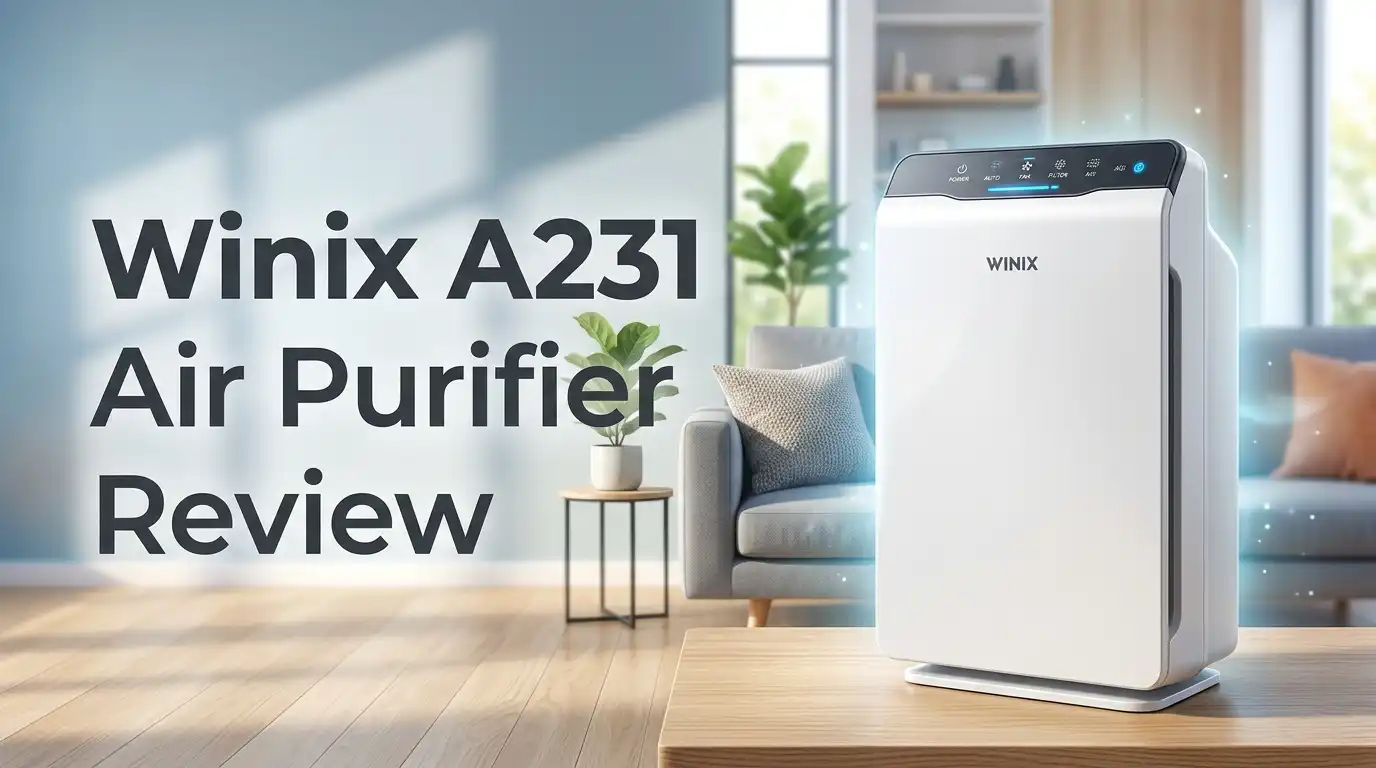
Winix A231 Air Purifier Review 2026: Still Worth It?
Small air purifiers usually disappoint. They look cute on a nightstand, then they struggle to clean even a tiny bedroom. The Winix A231 breaks that pattern. It costs less than many name brand rivals, yet it pushes real airflow and carries a verified CADR rating.
I spent weeks living with this unit in a bedroom, a home office, and a kitchen corner. I tracked how fast it cleared dust, how loud it got at full speed, and how much it added to my power bill. I also found a few things that genuinely annoyed me.
This review covers all of it. You get the unboxing, the test numbers, the honest weak spots, and a clear answer on whether the A231 deserves your money in 2026. If you want a compact purifier that punches above its price, keep reading.
Key Takeaways
- Strong cleaning power for the size. The A231 carries a CADR of roughly 147 to 154 CFM, which covers rooms up to 230 square feet with nearly five air changes per hour. That beats most compact purifiers in the same price bracket.
- Real test results back it up. Independent testers cleared a small test room of fine particles in about 40 minutes at top speed. One lab recorded a 95% air quality improvement in a 194 square foot room within one hour.
- Four stage filtration with a washable pre filter. You get a nylon mesh pre filter, a True HEPA layer, an activated carbon layer, and optional PlasmaWave ionization that you can switch off with one tap.
- Cheap to maintain. The Filter O cartridge lasts 12 months and costs around $40. Generic versions drop that to roughly $15 per year. Few brands are this fair on filter pricing.
- It is loud at full blast and weak on odors. Expect 58 to 66 dBA on high, which is too loud for sleep. The thin carbon layer fades fast against cooking smells and smoke.
- No app, no remote, no settings memory. This is a manual purifier with auto mode. After a power cut it resets to default settings, with PlasmaWave back on.
Winix A231 Air Purifier Overview

Last update on 2026-10-04 / Affiliate links / Images from Amazon Product Advertising API
The Winix A231 is the smallest purifier in the Winix lineup. Winix is a South Korean company that has built air quality products since 1973, so this is not a random no name unit from a marketplace seller. In Europe the same machine sells as the Winix Zero Compact. In black it carries the model code A230.
The shape is a simple cylinder with a slightly flared base. Air enters through vents around the bottom, passes through the filter cartridge, then exits from the grille on top. That bottom intake design matters because it pulls in settled dust that floor level units often miss.
Winix rates it for 230 square feet, and the unit is AHAM Verifide plus Energy Star certified. It also holds CARB certification, which covers ozone safety. Those third party checks are rare at this price and they are the main reason I trust the numbers on the box.
Unboxing Experience: What You Actually Get
The box is small, light, and easy to carry upstairs with one hand. Inside you find the purifier itself, a user manual, and nothing else. No remote, no spare filter, no extra fittings. The packaging uses molded cardboard rather than foam, which felt reassuring for anyone who hates throwing away plastic.
The filter arrives already installed inside the base, still sealed in a plastic bag. This step trips up a lot of buyers. You must twist open the bottom cover, slide the cartridge out, tear off the plastic wrap, then slot it back in and twist the cover shut.
Skip that step and your purifier will blow air around your room while cleaning absolutely nothing. Winix prints the warning in the manual, but it is easy to miss.
Setup took me under three minutes. Plug it in, tap power, and the air quality ring glows. No app pairing, no account, no firmware wait. Honestly refreshing.
Design and Build Quality Impressions
The A231 measures 9.5 by 9.5 by 14.6 inches and weighs about 6.75 pounds. It sits comfortably on a desk, a nightstand, or the floor beside a sofa. The plastic feels thick and the seams line up neatly, so it does not creak when you pick it up.
There is no carrying handle, which is my first small gripe. You end up gripping the body with both hands when moving it between rooms.
The control panel sits flat on top. You get touch buttons for power, fan speed, auto mode, sleep mode, and PlasmaWave, plus a filter change alert. A light ring circles the panel and changes color with air quality: blue for good, amber for fair, red for poor.
One clever touch beats the competition. The base locks firmly in place, so the filter never drops out when you lift the unit off the floor. Anyone who has had a Levoit Core 300 spill its filter on the carpet will appreciate this.
Top 3 Alternatives for Winix A231


Last update on 2026-10-05 / Affiliate links / Images from Amazon Product Advertising API
Levoit Core 300 Air Purifier

Last update on 2026-10-03 / Affiliate links / Images from Amazon Product Advertising API
Coway Airmega Mighty AP 1512HH Air Purifier

Last update on 2026-10-03 / Affiliate links / Images from Amazon Product Advertising API
Winix 5510 Air Purifier
Four Stage Filtration Explained Simply
The A231 uses one cylindrical cartridge called Filter O, part number 1712 0110 00. It combines three layers in a single unit, and PlasmaWave acts as the fourth stage inside the machine.
The pre filter is a fine nylon mesh wrapped around the outside. It grabs pet hair, lint, and large dust. You should vacuum it every two weeks. This simple habit protects the HEPA layer and keeps airflow strong.
The True HEPA layer does the heavy lifting. Winix rates it at H13 grade, capturing 99.97% of particles down to 0.3 microns. That covers pollen, dust mites, fine dust, pet dander, and smoke particles.
The activated carbon layer is a fiber sheet coated in carbon rather than loose pellets. This is the weakest part of the design. It helps with light cooking smells for a few months, then fades. Heavy smoke or strong pet odors need a purifier with far more carbon.
Real Performance: How Fast Does It Clean?
Numbers on a box mean little, so here is what testing shows. In a small test room, the A231 at top speed with PlasmaWave on cleared all traceable fine particles in 40 minutes. With PlasmaWave switched off, it took 46 minutes.
For comparison, the popular Levoit Core 300S needed about 45 minutes in the same room at a higher price. That makes the A231 a genuine value winner.
A separate lab test measured air quality in a 194 square foot room. PM2.5 dropped from 105.6 to 5.5 micrograms per cubic meter in one hour, a 95% improvement. AQI fell from 138 to 7.
Pushed into a larger 320 square foot room, it still managed a 92% improvement in an hour. That tells me the A231 can stretch slightly past its rating, though you will need full fan speed to do it.
Run it on the lowest setting and performance drops hard. One test showed 86 minutes to clear the same room. Low speed is for maintenance, not for cleanup.
Noise Levels at Each Fan Speed
Noise decides whether you actually use a purifier or unplug it in frustration. Measurements vary by room and meter placement, so treat these as a range.
On the lowest setting, the A231 sits around 35 to 40 dBA. That is a soft hush, quiet enough for sleeping or a video call. Sleep mode also dims every light on the panel, which I loved in a dark bedroom.
Medium lands near 48 to 54 dBA, roughly the sound of a quiet conversation. It is noticeable but easy to ignore while cooking or cleaning.
High speed is the problem. Readings range from 58 up to 66 dBA depending on the test method. That is genuinely loud. I never ran it on high while working or sleeping.
The good news is the tone. The fan produces a smooth low pitched whoosh rather than a whine, which makes it far less irritating than many cheap purifiers.
Auto Mode, Sensor, and Smart Features
The A231 includes an onboard air quality sensor at the back of the unit. It feeds the color ring and powers auto mode, which adjusts fan speed on its own. Good air means low speed, fair air means medium, poor air means high.
Auto mode works well in kitchens. When I seared a steak, the ring turned red within a minute and the fan ramped up without any input from me.
One detail buyers should know. The sensor on this model reads gases and odors, not particle counts. So dust kicked up by vacuuming may not trigger a response the way cooking smoke does.
A light sensor adds another automatic touch. When the room goes dark, the unit shifts into sleep mode by itself.
What you do not get is connectivity. There is no WiFi, no app, no voice control, and no remote. If you want scheduling or phone control, step up to a model like the Winix 5510.
Running Costs: Power Bill and Filters
Measured power draw is about 40 watts at top speed and under 10 watts in sleep mode. Running the unit flat out around the clock for a month costs roughly $3.50 at average US rates, or close to $70 per year.
That is higher than I expected from a compact purifier. The motor is rated at 55 watts, which is big for this size class. Running it on auto or low cuts the bill sharply.
Filters are where Winix wins. The genuine Filter O costs about $40 and lasts 12 months. Levoit charges noticeably more for filters on similar sized units.
Third party filters exist and drop annual costs to roughly $15 when bought in a two pack. Performance may vary, so weigh the savings against the risk.
All in, budget somewhere between $85 and $120 per year to run this purifier, depending on fan speed and filter choice.
Filter Replacement and Maintenance Steps
Maintenance is simple enough that nobody needs the manual twice. The unit lights a filter change indicator when the 12 month timer runs out.
To swap it, unplug the purifier and flip it over. Twist the bottom cover in the direction of the arrows and lift it off. Pull the old cartridge straight out, unwrap the new one, and slide it in with the open side facing up.
Twist the cover back until it locks. Then hold the filter indicator button for about five seconds to reset the timer.
Between swaps, vacuum the pre filter mesh every two weeks. Wipe the sensor opening at the back with a dry cloth every month so it keeps reading accurately.
Keep the unit at least 12 inches away from walls and furniture. Blocked intakes choke airflow and ruin performance, which is the single most common mistake I see owners make.
Where the Winix A231 Falls Short
Honest reviews name the flaws, so here are mine after extended use.
Odor control fades. The thin carbon sheet handled kitchen smells for the first couple of months, then clearly lost effectiveness. For strong pet odors, smoke, or VOCs, this is the wrong purifier.
No settings memory. Unplug the unit or lose power, and it returns to default settings with PlasmaWave switched back on. If you dislike ionizers, you must remember to disable it every single time.
High speed is too loud for bedrooms and offices, which pushes you toward medium and slower cleaning.
Unlit arrow buttons. The fan speed arrows do not illuminate, so adjusting speed in a dark room becomes guesswork.
Room size limits are real. Despite marketing claims about large coverage in one hour, this unit struggles in spaces above roughly 230 square feet. Oversizing a purifier is almost always smarter than undersizing one.
Pros and Cons of the Winix A231
Here is the quick balance sheet after weeks of use and a close read of independent lab data.
Pros
- Excellent particle removal for the price, clearing a small test room in about 40 minutes and improving air quality by 95% in lab conditions
- AHAM Verifide, Energy Star, and CARB certified, so the performance claims come with third party backing
- Affordable 12 month filter at roughly $40, with cheaper generic options available
- Auto mode plus air quality sensor included, features that cost extra on many rival compact models
- PlasmaWave can be turned off, which most ionizer equipped purifiers do not allow
- Secure base design means the filter never falls out when you move the unit
- Compact footprint and light weight make it easy to shift between rooms
- Two year warranty from an established brand
Cons
- Weak odor and VOC control because the carbon layer is a coated fiber sheet, not pellets
- Loud on high speed, peaking near 58 to 66 dBA
- No WiFi, app, remote, or voice control
- Settings reset after a power loss, re enabling PlasmaWave
- Higher power draw than several competing compact purifiers
- No carrying handle and no unlit speed buttons for night use
Winix A231 vs Levoit Core 300S
This is the matchup most buyers care about, so let me be direct.
The Winix A231 cleans faster. Independent testing put it ahead of both the Core 300 and the Core 300S on fine particle removal, finishing roughly five minutes sooner in the same room.
The A231 also includes an air quality sensor and auto mode at a lower price. With Levoit, those features sit behind the pricier S version.
Filter economics favor Winix too. A genuine Winix cartridge runs about $40 per year against noticeably more for Levoit equivalents.
The Core 300S wins on connectivity. It offers WiFi, app control, and voice assistant support, which the A231 completely lacks. It also runs quieter at the top setting.
My take: choose the A231 if raw cleaning performance and running cost matter most. Choose the Core 300S if you want app control and a quieter maximum speed.
Who Should Buy the Winix A231?
Last update on 2026-10-04 / Affiliate links / Images from Amazon Product Advertising API
This purifier fits specific situations very well. Small bedrooms under 230 square feet are its sweet spot, especially for people dealing with dust, pollen, and pet dander.
Home office desks suit it nicely. Run it on low or medium while you work and it stays unobtrusive.
Dorm rooms and nurseries benefit from the sleep mode, light sensor, and low filter costs. Students on tight budgets will appreciate the yearly maintenance bill.
Allergy sufferers get genuine value here, since HEPA filtration handles the particles that trigger most symptoms.
Skip it if you need odor removal, smoke control, or coverage above 250 square feet. Also skip it if app control is a dealbreaker. In those cases, look at the Winix 5510 or the Coway Airmega Mighty instead.
Final Verdict: Is It Worth It in 2026?
Yes, with clear eyes about its limits. The Winix A231 remains one of the best value compact purifiers available, and nothing in the past year has changed that.
You get lab verified cleaning power that outruns pricier rivals, an air quality sensor, a working auto mode, a two year warranty, and the cheapest genuine filters in its class. For a unit that often sells under $100, that combination is hard to beat.
The compromises are real though. Odor control disappoints, high speed is loud, and the missing app will bother some buyers. The settings reset after a power cut is the kind of detail that gets more irritating over time.
If you want maximum particle removal per dollar in a small room, buy it with confidence. If you want smart features or serious odor control, spend more and size up.
Frequently Asked Questions
Does the Winix A231 produce ozone?
PlasmaWave releases a tiny amount of ozone as a byproduct. The unit is CARB certified, meaning output stays below the legal safety limit. You can also switch PlasmaWave off entirely with one button press if you prefer zero ionization.
What size room does the Winix A231 cover?
Winix rates it for 230 square feet at nearly five air changes per hour. Marketing numbers quoting over 1,000 square feet refer to a single air change, which is not enough for real cleaning. Stick to rooms under 250 square feet.
How often should I change the filter?
Replace the Filter O cartridge every 12 months. The indicator light tells you when. Heavy dust, smoke, or pet hair may shorten that to eight or nine months. Vacuum the pre filter mesh every two weeks to protect filter life.
Is the Winix A231 the same as the A230?
Yes. The A230 is black and the A231 is white and grey. Features, filters, and performance are identical. In Europe the same machine sells as the Winix Zero Compact.
Can the Winix A231 remove cooking smells?
Only partly, and only for a while. The carbon layer is thin and loses effectiveness within a few months. For serious odor or VOC problems, choose a purifier with a heavier pelleted carbon filter.
Does the Winix A231 have WiFi or an app?
No. There is no WiFi, no mobile app, no remote, and no voice control. All controls sit on the touch panel at the top. Auto mode handles adjustments automatically based on the sensor reading.
Is it quiet enough to sleep with?
On low speed and in sleep mode, yes. It measures around 35 to 40 dBA and dims all lights. High speed is far too loud for sleeping, so set it on low or auto overnight.

I’m Maya Brown, the voice behind Pure Breeze Vault. I write detailed, honest, and easy-to-follow air purifier reviews to help readers compare features, understand filter technologies, and choose products with confidence. My goal is to make research simpler, clearer, and more practical for anyone improving indoor air quality at home.