Winix C545 Air Purifier Review 2026: Still Worth It?
Air purifiers used to be a luxury buy. Now they sit next to the couch in millions of homes. The Winix C545 is one of the most talked about models in that crowd, mostly because Costco keeps dropping it to tempting prices and shoppers keep telling their friends about it.
But the C545 is not a new machine. It earned its Energy Star certification back in 2019. So the real question in 2026 is simple. Does an older design still clean air fast enough to beat the shiny new models sitting beside it on the shelf?
I spent time with this unit, read through hundreds of owner reports, and compared its tested numbers against newer rivals. This review covers the unboxing, the filters, the app, the noise, the running costs, and the parts that genuinely annoy people. No fluff. Just what you need before you spend your money.
In a Nutshell:
- Cleaning speed is the main strength. The C545 carries a CADR of 243 for dust, 246 for pollen, and 232 for smoke. Independent testing cleared a 728 cubic foot room of fine particles in roughly 19 to 26 minutes. That beats several pricier units, including the Levoit Core 400S.
- The price to power ratio is excellent. At Costco prices near $130, you pay about $0.53 per CADR point. Very few mid sized purifiers match that value, and the box usually ships with two years of spare filters.
- The carbon filter is the weak link. Winix uses a thin carbon coated fabric sheet instead of pelleted charcoal. It handles light cooking smells, but it struggles with heavy odors, paint fumes, and strong VOCs.
- It gets loud at full blast. Speed four measures about 59 dB, which is louder than many competitors at a similar size. Sleep mode sits near 36 dB and is perfectly livable.
- Smart features are rare at this price. You get wifi, app control, Alexa support, air quality readings, and a light sensor that triggers sleep mode automatically. The app itself feels dated and sometimes drops connection.
- Best fit: bedrooms, nurseries, home offices, and living rooms up to 360 square feet where dust, pollen, and pet dander are the main problem.
What Is the Winix C545 Air Purifier?

Last update on 2026-10-03 / Affiliate links / Images from Amazon Product Advertising API
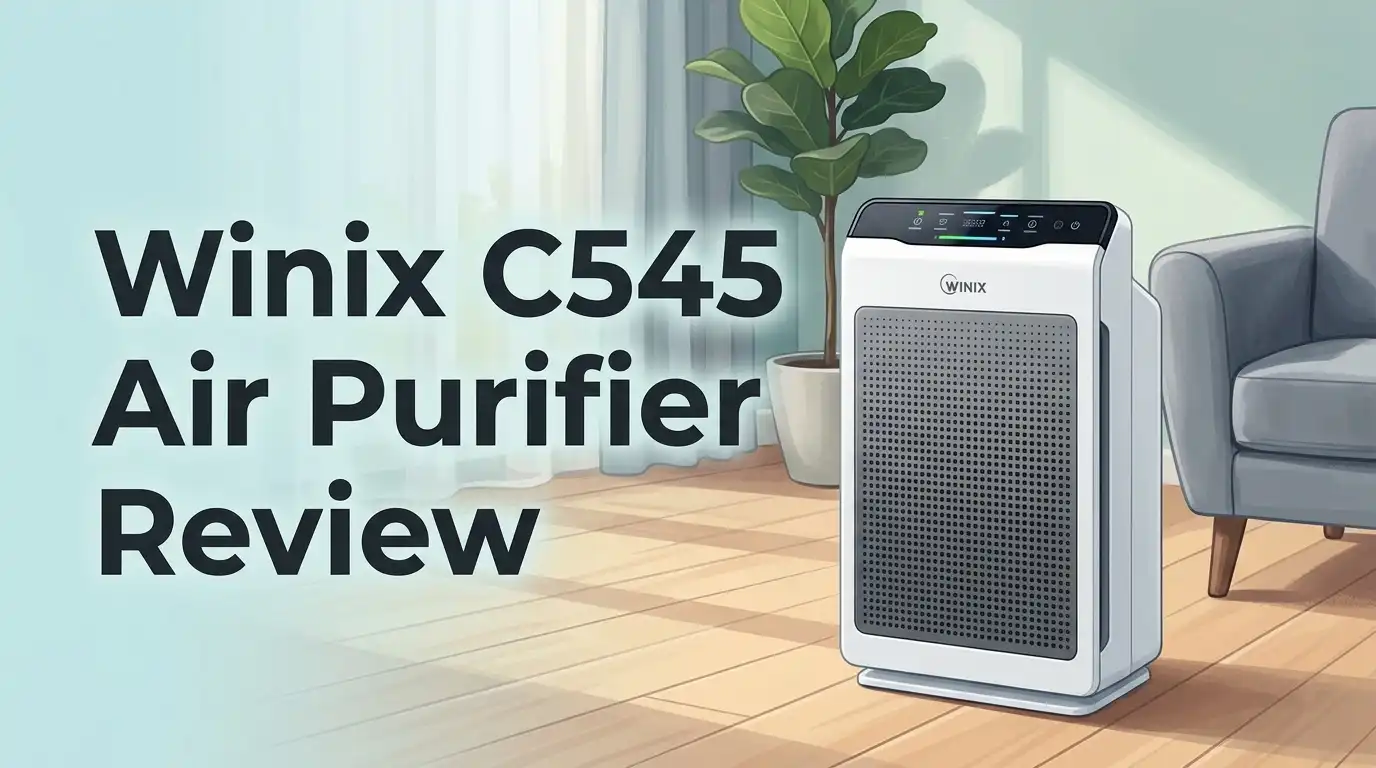
The Winix C545 is a mid sized tower purifier built for rooms up to 360 square feet. It runs a four stage system: a washable mesh pre filter, a carbon coated odor filter, a True HEPA filter, and the PlasmaWave ionizer.
Winix has been making air cleaning gear for over fifty years, and this Korean brand grew fast in North America during the pandemic years. The C545 became the volume seller because warehouse clubs pushed it hard.
The unit measures 13.7 inches wide, 8.4 inches deep, and 20.5 inches tall. It weighs 11 pounds, so you can carry it between rooms without strain. It pulls air through the front panel and pushes clean air out of the top, which means you can push it closer to a wall than side intake models.
Unboxing the Winix C545
The box is plain brown cardboard with a product photo on the front. Nothing fancy. Inside you get the purifier wrapped in a thin plastic bag, foam corner blocks, a short manual, and a quick start card.
Here is the part that surprised me. When you pop off the front panel, you find a second complete set of filters already stacked inside the unit, each piece individually sealed. That is one spare HEPA filter and eight spare carbon sheets. Most brands sell those separately.
Setup took about four minutes. You unwrap only the filters you plan to use now, slot them in order, snap the panel back, and plug it in. Leave the spare filters sealed in their plastic, because exposed carbon starts absorbing odors from your closet the moment it meets air.
Design and Build Quality
The C545 wears a matte white shell with softly rounded edges. It looks plain. It will not win design awards, and it does not try to. Honestly, that plainness helps it blend into a bedroom corner.
Build quality feels solid for the price. The plastic has no creaks, the top vent grille is sturdy, and the base stays planted on carpet or hardwood.
One small gripe stands out. The front panel attaches with plastic clips instead of magnets, so you need a firm tug to remove it and a careful press to reseat it. Newer Winix models use magnetic tabs, which feel much nicer.
The control panel sits flat on the top edge. You get arrow buttons for fan speed, an auto mode, a sleep mode, and a wifi indicator. Everything is labeled clearly, so most owners never open the manual.
Top 3 Alternative for Winix C545

Last update on 2026-10-06 / Affiliate links / Images from Amazon Product Advertising API
Winix 5500 Air Purifier with True HEPA


Last update on 2026-10-03 / Affiliate links / Images from Amazon Product Advertising API
Levoit Core 400S Smart Air Purifier

Last update on 2026-10-03 / Affiliate links / Images from Amazon Product Advertising API
Coway Airmega Mighty Air Purifier
Four Stage Filtration Explained
Stage one is the washable pre filter. This plastic mesh catches hair, lint, and pet fur. Winix asks you to vacuum or rinse it every two weeks. Do this. A clean pre filter protects the expensive HEPA layer and keeps airflow strong.
Stage two is the odor filter, a thin black fabric sheet treated with activated carbon. It handles light smells.
Stage three is the True HEPA filter, which captures 99.97% of particles down to 0.3 microns. That covers dust, pollen, mold spores, dander, and smoke particles. This filter is AHAM verified, so the numbers are not marketing guesses.
Stage four is PlasmaWave, the built in ionizer.
The removable pre filter deserves praise. Many cylindrical rivals glue their pre filter to the HEPA, which makes basic cleaning far more annoying than it needs to be.
PlasmaWave Technology: Help or Hype?
PlasmaWave is a bipolar ionizer. It releases charged particles that cluster airborne pollutants together so filters catch them more easily, and it breaks some gas molecules apart.
Winix states ozone output below 0.01 ppm, and the unit holds CARB certification in California. So it is legal and tested.
Still, I am not sold on it. Ionizers can react with household chemicals and produce byproducts you did not ask for. Owners also report more dust settling on surfaces near the unit when PlasmaWave runs, because heavier clusters drop before reaching the filter.
The good news is control. Hold both arrow buttons for three seconds and PlasmaWave switches off. The small LED tells you its state. My only complaint here is that the feature turns on by default every time the unit powers up, which feels backwards.
Real Cleaning Performance and CADR
Numbers first. The C545 posts a CADR of 243 for dust, 246 for pollen, and 232 for smoke. That works out to 4.8 air changes per hour in a 360 square foot room.
Independent lab style testing in a 728 cubic foot room showed the C545 stripping out fine PM1 particles in roughly 19 to 26 minutes at top speed, depending on the sensor used. That is genuinely fast for a unit in this price band.
For context, the pricier Levoit Core 400S and the smart Mila purifier both finished slower in the same test room. The Levoit Vital 200S edged ahead by a few minutes, but it costs noticeably more.
In daily use the auto mode reacts quickly to cooking smoke and aerosol sprays. Dust levels in a bedroom drop within half an hour. Allergy sufferers report real relief during pollen season.
Noise Levels in Daily Use
Noise is where opinions split. Measured from three feet away, the C545 reads about 36 dB on speed one, 39 dB on speed two, 43 dB on speed three, and 59 dB on speed four.
Speeds one and two are easy background noise. You can sleep, read, or hold a conversation without strain. Sleep mode also kills the LED lights, which matters in a dark bedroom.
Speed four is a different story. It produces a loud rushing sound, closer to a bathroom fan than white noise. Many owners say they only use top speed when they are out of the room. The Coway Airmega Mighty and the Smart Air SA600 both run quieter at full power.
My advice is to run auto mode and let the sensor handle the spikes while you are busy elsewhere.
Smart App and Wifi Features
The Winix Smart app connects over 2.4 GHz wifi. Once paired, you can set schedules, change fan speed remotely, check indoor and outdoor air quality, and track HEPA filter life. Alexa voice control works too.
Getting a wifi purifier at this price is still unusual, so this is a real selling point.
The app experience is the problem. Signup feels long and clunky, and pairing demands access to your precise location before it will proceed. Winix says that is for outdoor air data, but it cannot be skipped.
Connection drops happen. Closing and reopening the app usually fixes it, though that gets old. European and UK buyers should note the app was pulled from those regions back in 2021 over data protection rules, so the C545 works there as a manual unit only.
Auto Mode and the Light Sensor
Auto mode uses an onboard particle sensor to set fan speed by itself. A color coded LED shows the result. Blue means clean air and low fan. Amber means fair air and medium fan. Red means polluted air and top speed.
The sensor reacts fast. Fry bacon or spray deodorant and the light flips to red within seconds.
The feature I like most is the ambient light sensor. When auto mode is active and you switch off the room lights, the C545 drops into sleep mode on its own. Fan speed falls, LEDs dim, and the room stays quiet.
It is a small touch that makes the purifier feel thoughtful. One caveat applies. In a bright room with constant mild pollution, auto mode can hover on higher speeds longer than some people want.
Filter Replacement Costs
The C545 uses Winix Filter S, part number 1712 0096 00. Genuine sets run about $60 per year for one HEPA filter plus four odor sheets, and Costco often bundles them cheaper in two packs.
Third party sets sell for around $35 and cover two HEPA filters with eight carbon sheets, which works out near $17 per year. Quality varies, so read recent buyer feedback before you commit.
The HEPA filter lasts 12 months. The carbon sheet needs swapping every three months.
Here is a real annoyance. The unit and app only track HEPA filter life, not the carbon sheets. You have to remember those yourself, so set a phone reminder. Genuine filters also go out of stock on major sites fairly often, since this is an older platform.
Energy Use and Running Costs
Power draw is modest. The C545 pulls 0.27 watts in standby, 4.15 watts on speed one, 6.6 watts on speed two, 10.15 watts on speed three, and 51.3 watts on speed four.
Running PlasmaWave adds almost nothing, roughly 0.3 watts.
Running the unit nonstop for a full year costs around $78 in electricity at average US rates, plus filters. Total yearly cost lands near $114 with cheaper filters, or closer to $190 if you run it hard with genuine parts.
That is average, not outstanding. The Levoit Vital 200S and TaoTronics AP003 both sip less power while delivering similar airflow. If you plan to run the purifier 24 hours a day in auto mode, expect the lower end of that range, because auto mode rarely sits on speed four.
What the Winix C545 Does Not Do Well
Honest reviews name the flaws, so here they are.
Odor and chemical removal is weak. The carbon coated fabric saturates quickly. Heavy smokers, people near wildfire smoke, and anyone sensitive to paint or formaldehyde fumes should look at units with pelleted carbon instead.
Top speed is loud. At 59 dB, it interrupts TV and conversation.
The app needs rebuilding. The interface feels old, location permission is forced, and drops are common.
It is not a whole house solution. A single C545 cannot handle an open plan 1100 square foot layout, despite optimistic marketing math.
Filter tracking is incomplete for the carbon sheets, and PlasmaWave defaults to on at every power cycle.
None of these are deal breakers for a dust and allergy focused buyer. They matter a lot if odors are your main problem.
Pros and Cons of the Winix C545
Pros
- Fast particle removal, clearing a test room in about 19 to 26 minutes
- Strong CADR numbers of 243 dust, 246 pollen, and 232 smoke
- Excellent value at roughly $0.53 per CADR point
- Two years of spare filters included in the box
- Washable removable pre filter that is easy to maintain
- Wifi app control, Alexa support, and air quality readings at a budget price
- Ambient light sensor that triggers sleep mode automatically
- PlasmaWave ionizer can be switched off completely
- Low power draw on everyday fan speeds
- Two year manufacturer warranty
Cons
- Thin carbon fabric filter handles odors and VOCs poorly
- Noisy at 59 dB on the highest fan speed
- Winix Smart app feels dated and drops connection
- App unavailable in Europe and the UK
- Carbon filter needs replacing every three months with no reminder system
- PlasmaWave switches on by default at every startup
- Plastic clips hold the front panel instead of magnets
- Genuine replacement filters can be hard to find
Who Should Buy the Winix C545?
Buy this purifier if dust, pollen, pet dander, or general allergens drive your decision. In that job it performs above its price class, especially at Costco sale prices.
It suits bedrooms, nurseries, home offices, and medium living rooms. Pet owners will appreciate the washable pre filter. Tech fans get app control that competitors charge far more for.
Skip it if odors rule your life. Heavy cooking smells, cigarette smoke, or chemical fumes need pelleted activated carbon, so the Winix 5500 or the Coway Airmega Mighty make more sense.
Also skip it if silence matters more than speed, or if you live in Europe and want the smart features.
Think of the C545 as a particle specialist, not an all rounder. Judge it on that basis and it rarely disappoints.
Final Verdict: Winix C545 in 2026
Last update on 2026-10-03 / Affiliate links / Images from Amazon Product Advertising API
Seven years after launch, the Winix C545 still earns a recommendation. That says a lot about the core engineering.
You get fast particle cleaning, proven AHAM verified HEPA filtration, sensible smart features, and two years of filters in the box. For a bedroom or office under 360 square feet, the performance per dollar remains hard to beat.
The flaws are real though. The odor filter is the compromise that pays for everything else. The app needs work. The top fan speed will test your patience.
My rating sits at 4.2 out of 5. If you find it near $130, buy it with confidence. If it climbs above $180, spend that money on a newer model with better carbon filtration instead.
Price watching is the single best tip for this purifier.
Frequently Asked Questions
Is the Winix C545 discontinued?
Winix no longer sells the C545 as a new unit on its own site, offering it mainly as a certified refurbished model. Retailers including Costco, Amazon, and Target still carry new stock. Newer models like the 5520 and 5510 are the brand’s current push, so expect availability to shrink over time.
How big a room does the Winix C545 cover?
It is rated for 360 square feet at 4.8 air changes per hour. Marketing sometimes quotes 1742 square feet, but that figure assumes only two air changes per hour, which is too slow for allergy relief. Stick to 360 square feet for real results.
Should I leave PlasmaWave on?
That is your call. Ozone output is below 0.01 ppm and the unit is CARB certified, so it meets safety standards. Many owners still turn it off to avoid ion byproducts and extra surface dust. The HEPA filter does the heavy lifting either way.
How often do I change the C545 filters?
Replace the True HEPA filter every 12 months and the carbon odor sheet every three months. Vacuum or rinse the washable pre filter every two weeks. Set a calendar reminder for the carbon sheets, because the unit does not track them.
Can the Winix C545 remove cigarette smoke?
It captures smoke particles well thanks to its 232 smoke CADR. It handles the lingering smell poorly, because the thin carbon fabric saturates fast. Heavy smoke situations call for a purifier with pelleted activated carbon.
Is the Winix C545 loud?
On speeds one through three it stays between 36 and 43 dB, which most people describe as gentle background noise. Speed four hits 59 dB and is noticeably loud. Auto mode keeps the fan low most of the time.
Does the Winix C545 work without wifi?
Yes. All buttons, auto mode, sleep mode, and the air quality sensor work fully offline. Wifi only adds remote control, scheduling, outdoor air data, and Alexa commands.

I’m Maya Brown, the voice behind Pure Breeze Vault. I write detailed, honest, and easy-to-follow air purifier reviews to help readers compare features, understand filter technologies, and choose products with confidence. My goal is to make research simpler, clearer, and more practical for anyone improving indoor air quality at home.