Levoit Core Mini Air Purifier Review 2026: Still Worth It?
Small air purifiers promise clean air without the bulky tower or the painful price tag. The Levoit Core Mini sits at the center of that promise. It costs less than a nice dinner out, weighs about as much as a full water bottle, and fits on a nightstand with room to spare.
But tiny machines have tiny fans. That fact matters more than any marketing claim on the box. I spent weeks testing this unit on a desk, beside a bed, and inside a car, and I also compared my notes against independent lab data from testing labs that measure smoke clearance and decibel output.
This review covers the good, the frustrating, and the parts Levoit would rather you skip. You will learn how fast it actually cleans, what filters really cost per year, and which rooms it simply cannot handle.
In a Nutshell:
- Performance is honest but limited. The Core Mini delivers a clean air delivery rate near 41 CFM. That covers roughly 60 square feet properly, not the 250 square feet often advertised in listings.
- It is genuinely quiet. Independent sound meters recorded about 37 dBA on speed one and 44.5 dBA at full blast. Most users sleep beside it with no trouble.
- Power draw is almost nothing. The unit sips between 2.8 and 6.4 watts. Running it nonstop for a full year costs under ten dollars in electricity for most US households.
- Filters are the real expense. The bonded filter lasts four to six months and costs more per cubic foot of coverage than filters for larger Levoit models. Annual running cost lands near eighty dollars.
- Best use cases are small and specific. Desks, cars, RVs, dorm cubicles, nurseries, and bathrooms suit it well. Living rooms and open kitchens do not.
- Build quality punches above the price. Solid plastic, no rattles, a two year warranty, and no ozone producing ionizer inside.
What Is the Levoit Core Mini Air Purifier?


Last update on 2026-11-17 / Affiliate links / Images from Amazon Product Advertising API
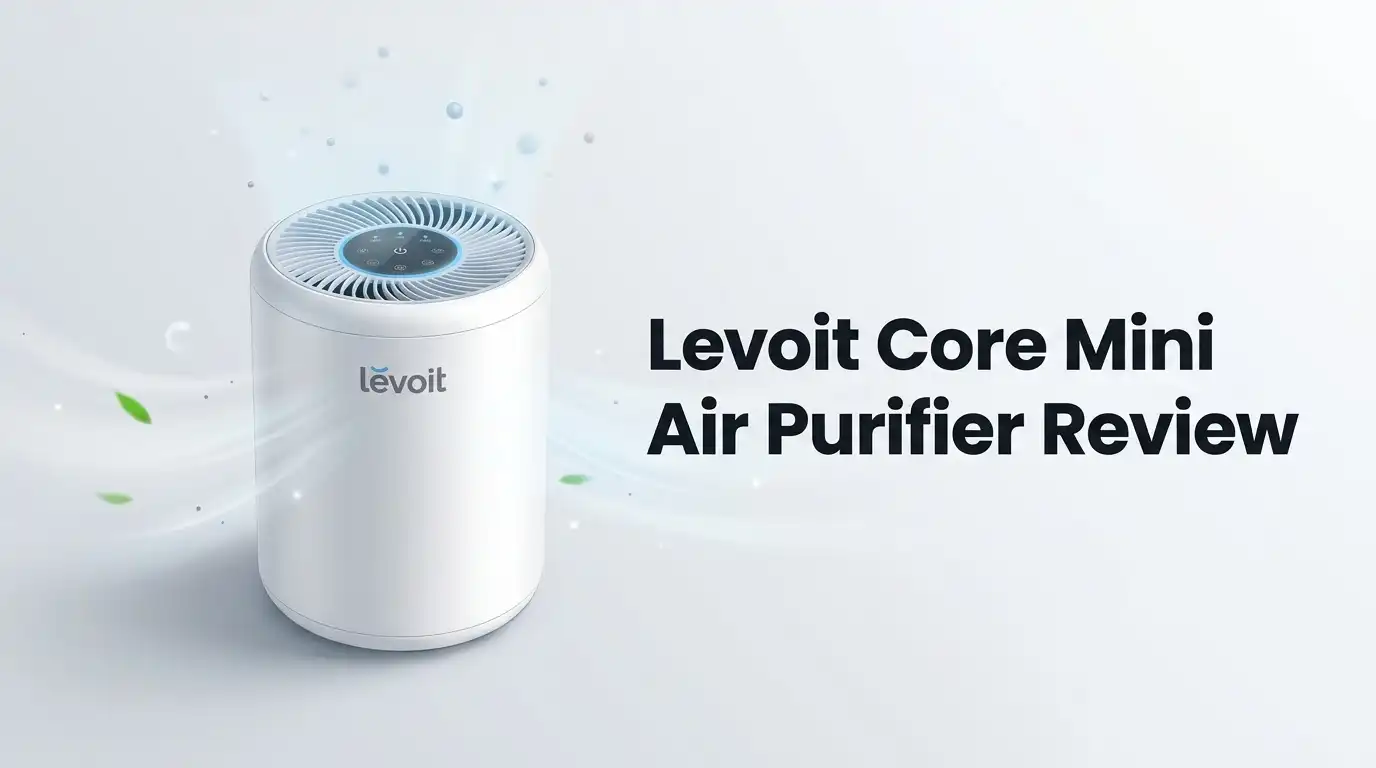
The Levoit Core Mini is a compact desktop air purifier made by Vesync, the company behind Levoit, Etekcity, and Cosori. It stands 10.4 inches tall and measures 6.5 inches across. Weight sits at 2.2 pounds, so you can carry it in one hand or drop it into a backpack.
Air enters through vents around the base. A small fan pulls that air through a cylindrical filter. Clean air exits from the top. There is no app, no sensor, and no auto mode. You get three fan speeds, a power button, and a filter reset light.
Levoit built this unit as an entry point, not a flagship. The newer Core Mini P version adds a night light and a slightly refreshed filter, while the classic model keeps things bare. Both share the same body and the same motor.
What matters most here is the honesty of the hardware. No ionizer. No UV lamp. No ozone. Just a fan and a filter doing simple physical work.
The Unboxing Experience
The box arrives small enough to surprise you. Mine measured barely larger than a shoebox and weighed almost nothing when I lifted it off the porch.
Inside, Levoit uses molded cardboard instead of foam. The purifier sits snug in a paper sleeve. You get the unit, a short USB power adapter with a wall plug, a quick start card, and a warranty leaflet. That is the entire contents list.
The filter ships pre installed inside the base. A plastic wrapper covers it, and you must remove that wrapper before first use. Levoit prints a warning sticker on the body, which is smart, because forgetting this step chokes airflow completely.
Twisting off the bottom cap takes two seconds. The cap clicks back with a satisfying quarter turn. First impressions were positive. The plastic feels dense rather than hollow, panel gaps line up evenly, and the matte finish resists fingerprints.
Setup from open box to running took me under ninety seconds. No tools. No app registration. Plug in, press power, done.
Design, Controls, and Build Quality
The Core Mini looks like a small speaker. Levoit sells it in white, green, pink, and blue, so it blends into most desks and bedrooms without shouting for attention.
The control panel sits flat on top. Four soft touch buttons handle everything: power, low, medium, and high. A small light ring glows white when the unit runs. Anyone can operate this without reading instructions.
The top surface also doubles as a shelf. I placed a phone there, though Levoit does not recommend blocking the air outlet. The rubber feet grip well, and I never knocked it over during testing.
Build quality feels better than the price suggests. There are no creaks when you squeeze the body. The bottom cap threads smoothly even after dozens of filter checks.
One design weakness stands out. There is no handle and no cord wrap. The power cable dangles loose, which looks messy on an open desk. A simple channel on the base would have solved that.
Top 3 Alternative for Levoit Core Mini

Last update on 2026-11-17 / Affiliate links / Images from Amazon Product Advertising API
Winix A231 Air Purifier

Last update on 2026-11-18 / Affiliate links / Images from Amazon Product Advertising API
Levoit Core 300S P Smart Air Purifier

Last update on 2026-11-17 / Affiliate links / Images from Amazon Product Advertising API
Blueair Blue Pure 411a Max Air Purifier
How the Filtration System Works
Levoit uses a three stage bonded filter inside a single cylinder. You cannot separate the layers, so all three replace together.
The outer layer is a fine mesh pre filter. It grabs hair, lint, and large dust before they reach the finer material. Vacuuming this outer surface once a month extends filter life noticeably.
The middle layer is the particle filter. It captures fine dust, pollen, mold spores, and smoke particles down to very small sizes. Levoit rates this material at H13 grade efficiency in its current listings.
The inner layer holds activated carbon. Carbon adsorbs odors from cooking, pets, and smoke. The carbon quantity here is small because the whole filter is small, so odor control fades faster than particle control.
One important note on labeling. Levoit stopped advertising Core series filters as True HEPA after an advertising review challenge from a competitor. The filters still capture particles effectively, but they are not third party HEPA certified. That distinction matters if you need certified filtration for medical reasons.
Real World Air Cleaning Performance
Numbers tell the clearest story here. Independent testing puts the Core Mini at roughly 41 CFM clean air delivery rate for smoke and around 39 CFM for dust according to Energy Star listings.
Translate that into room size. For five air changes per hour, which is the standard recommendation for allergy sufferers, the Core Mini properly serves about 60 square feet. That is a walk in closet, a small bathroom, or the space directly around your desk.
In a 728 cubic foot test room, the unit needed roughly 136 minutes to clear smoke particles down to zero. Larger budget units finish the same job in 40 to 50 minutes.
My own experience matched that pattern. Placed 18 inches from my chair, the Core Mini noticeably reduced dust and stale smells in my personal breathing zone within an hour. Placed across a 12 by 14 foot bedroom, the effect became hard to notice at all.
Distance is everything with this machine. Keep it close, and it works. Keep it far, and it mostly decorates.
Noise Levels and Sleep Friendliness
Quiet operation is the Core Mini’s strongest feature. Sound meter readings from 3 feet away recorded 37 dBA on speed one, 38 dBA on speed two, and 44.5 dBA on speed three.
For context, a quiet library sits near 40 dBA. Speed one is quieter than most refrigerators. I ran it beside my pillow for two weeks and never once woke because of it.
The sound character helps too. There is no high pitched whine and no motor buzz. You hear smooth white noise, which many light sleepers actually prefer.
Speed three does become audible. It is not loud, but the airflow hiss cuts through a silent room. During television viewing or conversation, it disappears completely.
One caveat worth mentioning. Because the fan is small, you naturally want to run it on high to get useful airflow. High speed is where the noise sits. So the practical daily noise level is closer to 44 dBA than 37 dBA if you want real cleaning.
Even so, this remains one of the quietest purifiers in its price range.
Energy Use and Yearly Running Costs
The Core Mini barely touches your power bill. Measured consumption runs 1.2 watts on standby, 2.8 watts on low, 5.9 watts on medium, and 6.4 watts at top speed.
Running continuously at maximum for a full year costs roughly seven dollars at average US electricity rates. That is less than one takeout coffee per month.
Filters change the math completely. Genuine Levoit replacement filters cost around 22 to 25 dollars. Levoit recommends replacement every four to six months, which means two or three filters per year.
Add it together and your yearly cost lands near eighty dollars. For a purifier that covers 60 square feet, that ratio is poor. A Levoit Core 300S costs about sixty dollars per year to run and cleans several times more air.
Third party filters exist for roughly seventeen dollars and work acceptably for most users, though they void the two year warranty coverage on filter related issues. Choosing them cuts annual cost to about forty five dollars.
Filter Replacement and Maintenance
Replacing the filter takes under a minute. Turn the unit upside down, twist the base cap counterclockwise, pull the old filter straight out, and slide the new one in.
The filter indicator light glows after roughly 2,200 hours of runtime. Hold the power button for three seconds to reset it after installing a fresh filter. Levoit does not print this clearly on the unit, which frustrates many first time owners.
Maintenance beyond filter swaps is simple. Wipe the outer shell with a dry cloth. Vacuum the intake vents monthly. Never wash the filter with water, because moisture destroys the carbon layer and invites mold.
Filter life depends heavily on your air. Homes with pets, smokers, or heavy cooking may see four month intervals. A clean office desk might stretch to seven months without airflow loss.
One honest warning here. Buy your filters from a verified seller. The market is full of counterfeit Levoit filters with thin media and almost no carbon, and those cheap copies quietly ruin performance.
The Aromatherapy Feature
Levoit includes a small aroma sponge pad tucked inside the base cap. You drop a few drops of essential oil onto the sponge, reinstall the cap, and the airflow carries the scent through the room.
This surprised me. A fifty dollar air purifier with a built in diffuser feels generous. Levoit does not lock you into proprietary oils either, so any lavender, eucalyptus, or citrus oil works.
The scent output is gentle. In a small bedroom, three or four drops perfume the space for several hours. It never becomes overwhelming the way ultrasonic diffusers can.
There is a logical tension worth naming. An air purifier removes airborne particles, and then you deliberately add volatile compounds back into the air. People with asthma or chemical sensitivity should skip this feature entirely.
The sponge is also easy to lose. It sits loose in the cap, and mine fell out twice during filter changes. Replacement sponges cost almost nothing, but keep track of yours.
What the Levoit Core Mini Does Not Do Well
Honest reviews name the weak points clearly, so here they are.
Room coverage claims are inflated. Marketing mentions 250 square feet. That figure assumes a single weak air change per hour. Real allergy relief needs five changes, which drops usable coverage to about 60 square feet.
There is no air quality sensor and no auto mode. You guess when to raise the fan speed. Competing units near this price now include PM2.5 readouts.
There is no timer and no app control. You turn it off manually or leave it running.
Odor removal fades quickly. The carbon layer is thin, so strong kitchen smells return within a couple of months of use.
Filter economics are the biggest flaw. You pay nearly as much per filter as owners of much larger Levoit models pay, while getting a fraction of the airflow.
Finally, the power cord is short and permanently attached to a small wall adapter. Placement options shrink in rooms with few outlets.
Levoit Core Mini vs Levoit Core 300S
This comparison decides most purchases, so it deserves real attention.
The Core 300S stands about 8.7 inches wide and 14.2 inches tall. It delivers roughly 140 CFM, more than three times the Core Mini’s output. It cleans a standard 220 square foot bedroom properly, which the Mini cannot approach.
The 300S adds WiFi, app scheduling, voice assistant support, an auto mode on newer versions, and a true sleep mode that drops to 24 dB. Its filters cost about the same as Core Mini filters yet last the same four to six months while cleaning far more air.
Price separates them by roughly forty to fifty dollars depending on sales.
My recommendation is straightforward. If you need to clean a bedroom, office, or any real room, stretch your budget to the 300S. The cost per unit of clean air is dramatically better.
Choose the Core Mini only when size truly matters, such as a car console, a camper shelf, a cubicle, or a bedside table in a very small space.
Pros and Cons of the Levoit Core Mini
Here is the balanced summary after extended testing.
Pros
- Extremely compact size fits on desks, nightstands, car consoles, and RV counters where full size purifiers cannot go.
- Very quiet operation, measured between 37 and 44.5 dBA, making it comfortable for sleeping and focused work.
- Tiny energy appetite at 2.8 to 6.4 watts, costing under ten dollars per year in electricity.
- No ionizer and no ozone output, which makes it safe for asthma sufferers and small children.
- Simple button controls that anyone can use without an app or a manual.
- Built in aroma sponge accepts any essential oil brand you already own.
- Two year manufacturer warranty backed by responsive customer support.
- Light enough at 2.2 pounds to pack in a suitcase for hotel stays.
Cons
- Clean air delivery rate of about 41 CFM limits genuine coverage to roughly 60 square feet.
- Annual filter cost near fifty to seventy five dollars is high relative to the machine’s output.
- No air quality sensor, no auto mode, no timer, and no app connectivity.
- Carbon layer is thin, so odor control weakens after a few months.
- Filters are not third party HEPA certified despite high efficiency claims.
- Short attached power cord restricts placement flexibility.
Who Should Buy the Levoit Core Mini
Last update on 2026-11-17 / Affiliate links / Images from Amazon Product Advertising API
This purifier fits a specific buyer, and that buyer will love it.
Desk workers benefit most. Place it within two feet of where you sit and it creates a clean breathing pocket around you. That personal zone effect is real and measurable.
Travelers and van dwellers form the second group. It fits in luggage, runs on minimal power, and improves stale hotel or camper air noticeably.
Dorm students, apartment renters with tiny bedrooms, and parents wanting gentle filtration in a nursery corner all fit the profile too.
Skip it if you have any of these situations. Rooms above 100 square feet. Pets that shed heavily. Active wildfire smoke seasons. Strong cooking odors that travel. Serious allergy or asthma symptoms requiring certified filtration.
For those cases, spend more once rather than feeling disappointed daily. The Core Mini is a good product placed in the wrong room, and a frustrating product placed in a big one.
Match the machine to the space and satisfaction follows naturally.
Final Verdict: Is the Core Mini Worth Buying in 2026?
The Levoit Core Mini earns a qualified recommendation. It does exactly what a fifty dollar, two pound purifier can physically do, and it does that quietly and reliably.
Build quality is solid. Noise levels are excellent. Power consumption is negligible. Setup takes ninety seconds. Levoit backs it with a real two year warranty and genuine replacement parts.
The weaknesses are equally clear. Coverage is small, filter costs are disproportionate, and smart features are entirely absent. Marketing coverage claims overstate real capability by a wide margin.
My honest position after weeks of use: buy it as a personal purifier, not a room purifier. On a desk, beside a pillow, or in a vehicle, it delivers noticeable value for the money.
If you want one machine to clean an actual bedroom, spend the extra forty dollars on a Core 300S or a Winix A231. You will get three times the performance for similar running costs.
Know what you are buying, and the Core Mini will not disappoint you.
Frequently Asked Questions
How many square feet does the Levoit Core Mini really cover?
Marketing lists up to 250 square feet, but that assumes one weak air change per hour. For real allergy relief at five air changes hourly, honest coverage is about 60 square feet.
Is the Levoit Core Mini loud enough to disturb sleep?
No. It measures roughly 37 dBA on speed one and 44.5 dBA on high. Most users find the smooth white noise helpful rather than disruptive.
How often should I replace the Core Mini filter?
Levoit recommends every four to six months. Homes with pets or smokers need the shorter interval. The indicator light reminds you after about 2,200 hours of runtime.
Can I wash and reuse the filter?
No. Water destroys the carbon layer and can grow mold inside the media. You may gently vacuum the outer mesh, but never rinse the filter.
Does the Core Mini produce ozone?
No. It contains no ionizer and no UV lamp. Filtration happens purely through mechanical airflow, which makes it safe for children and asthma sufferers.
Does it remove cooking smells and pet odors?
Partially. The activated carbon handles light odors well when the filter is fresh. Heavy or persistent kitchen smells need a larger purifier with more carbon.
Is the Core Mini P different from the standard Core Mini?
The Core Mini P is the current version. It shares the same body and motor, adds an optional night light on some models, and uses an updated filter with the same replacement schedule.

I’m Maya Brown, the voice behind Pure Breeze Vault. I write detailed, honest, and easy-to-follow air purifier reviews to help readers compare features, understand filter technologies, and choose products with confidence. My goal is to make research simpler, clearer, and more practical for anyone improving indoor air quality at home.