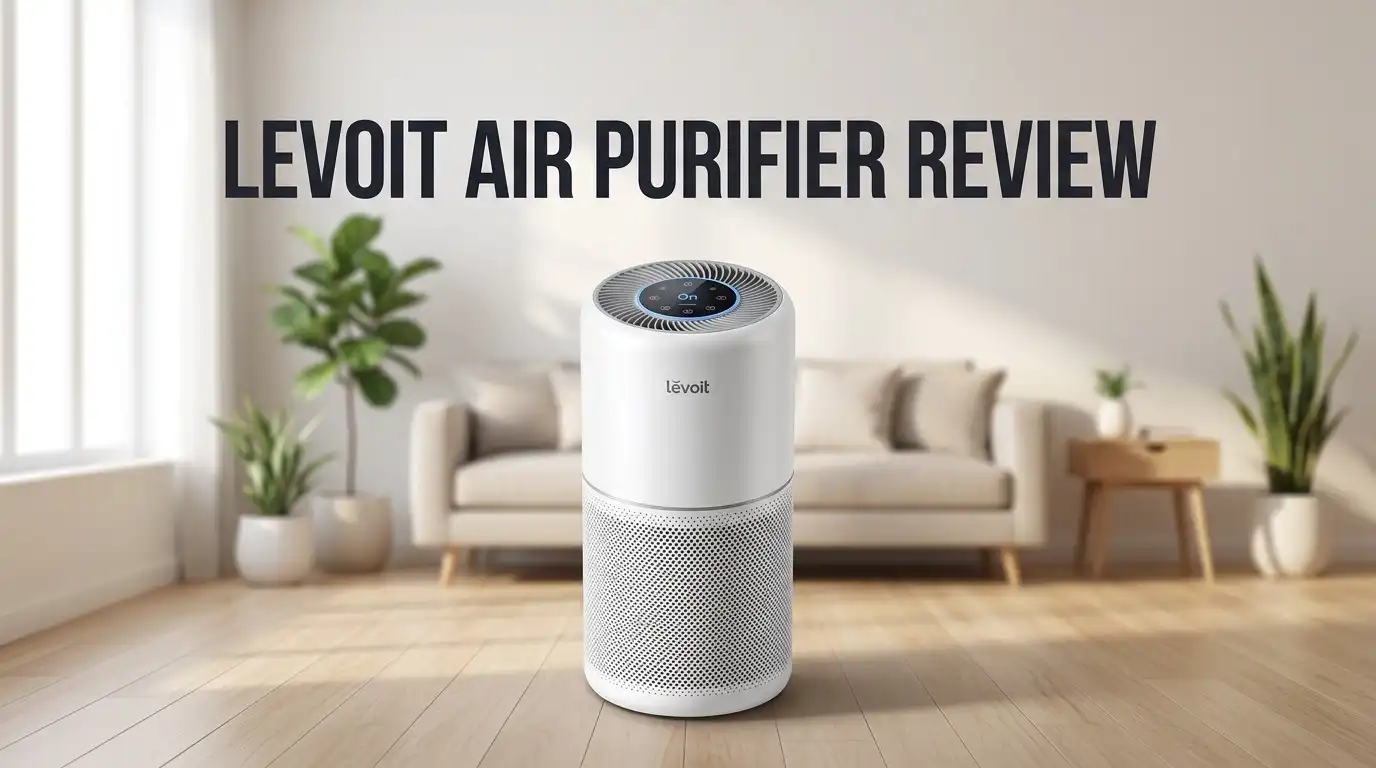
Levoit Air Purifier Review 2026: Still Worth It?
Air purifiers used to cost hundreds of dollars. Levoit changed that. The brand now sits at the top of almost every bestseller list on Amazon, and millions of homes run one right now. But popularity does not always mean quality.
I have spent real time with Levoit units, read through independent lab data, and dug into what owners complain about after a year of use. Some Levoit models clean air faster than purifiers costing three times more. Others are close to useless. That gap matters, and most reviews never mention it.
This review covers what Levoit gets right in 2026, what it gets wrong, which models deserve your money, and which ones you should walk past. No fluff, no copied marketing claims. Let’s get into it.
In a Nutshell: Key Takeaways
Short on time? Here is the honest summary of everything below.
- The Vital 200S is the smartest buy for most homes. It clears a 728 cubic foot test room of smoke particles in roughly 24 minutes at top speed. That beats several purifiers priced above $230. At around $190, it delivers excellent value and covers rooms up to 373 square feet with five air changes per hour.
- The Core 600S wins for large open spaces. With a PM1 CADR near 375 CFM, it handles rooms up to 562 square feet. It also gets loud at 62 decibels on turbo, so treat that top speed as a burst tool, not a daily setting.
- Levoit quietly dropped its True HEPA claims in 2023 after Dyson challenged the wording through the BBB National Advertising Division. Performance did not change, but the labeling was misleading. You deserve to know that before buying.
- Running costs stay genuinely low. The Vital 200S pulls only 44.55 watts at full power, which works out to roughly $73 per year if you run it constantly. Filters last about 12 months on the Vital line.
- Several Levoit models are not worth buying. The Core Mini, LV H132, LV H128, and Vital 100 all underperform badly. One took 162 minutes to clean a small test room. Avoid them.
- Bonded filters are the biggest design flaw. Particle media and carbon sit fused together, so you replace both even when only one is spent. That raises long term cost.
Why Levoit Became the Default Air Purifier Brand
Levoit launched in 2017 under parent company VeSync, with headquarters in California and manufacturing in China. The brand grew fast for one clear reason: it priced real performance under $100 when competitors would not.
The original Core 300 proved the point. It cost $99 and cleaned air faster than units twice its price. Reviewers noticed. Shoppers noticed more. Within a few years Levoit owned the top spots in the air purifier category on Amazon.
The strategy is simple and effective. Levoit builds solid mechanical filtration, skips gimmicks like ionizers and UV bulbs, and passes the savings along. Every Levoit purifier is ozone free because it uses filters instead of electrical charge. That single decision protects your lungs better than most premium features.
The brand also invested in software. The VeSync app is one of the better purifier apps available, with scheduling, auto mode, and voice control through Alexa and Google Assistant. Smart features at budget prices pulled in buyers who had never considered air purification before.
Customer support helps too. Levoit runs service centers across the US, Europe, and Asia, and offers discounts to military personnel, veterans, teachers, medical staff, and first responders through VerifyPass.
Still, the catalog has grown messy. Levoit sells dozens of models with confusing names, and quality varies wildly between them. That is the real problem you face as a shopper in 2026.
Levoit Vital 200S: The Model Most People Should Buy


Last update on 2026-11-17 / Affiliate links / Images from Amazon Product Advertising API
This is the one I recommend without hesitation. The Vital 200S sits at roughly $190 and outperforms purifiers that cost double.
Independent testing clocked it at 24 minutes to clear incense smoke particles from a 728 cubic foot room. That is faster than the $230 Coway Mighty2, faster than the $230 Blueair 311i Max, and faster than a $900 Dyson unit. Read that again, because it reframes what you should pay for clean air.
The numbers behind it: a top speed PM1 CADR of 249 CFM and an AHAM verified PM2.5 CADR of 254 CFM. That covers 373 square feet at five air changes per hour, which suits most living rooms and master bedrooms.
The removable washable prefilter is my favorite detail. A clogged prefilter chokes the main filter and kills performance. Being able to pull this one out and rinse it under a tap every two weeks extends filter life considerably.
Noise stays reasonable. Speed 2 measures 41.9 decibels from three feet away, quiet enough for sleeping. Even at that low setting it cleared the test room in 46 minutes, which is faster than the Core 200S managed at full blast.
Energy draw is tiny at 44.55 watts maximum. Filters run 12 months, double the lifespan of the Core range. The onboard sensor feeds an LED ring that shifts color with air quality.
Weakness: the dust sensor is infrared, not laser, so it needs regular cleaning to stay accurate.
Levoit Core 600S: Real Power for Large Rooms

Last update on 2026-11-17 / Affiliate links / Images from Amazon Product Advertising API
If your living space runs open plan, the Vital 200S will struggle. The Core 600S is the answer at just under $300.
Its PM1 CADR of 375 CFM ranks among the strongest in the entire Levoit catalog, matched only by the far pricier EverestAir. In testing it cleared the smoke filled room in 16 minutes. That result nearly matches a $667 professional grade unit from Smart Air.
Practically speaking, it maintains five air changes per hour in rooms up to 562 square feet. Big basements, combined kitchen and dining areas, and large family rooms all fall inside that range.
The cylindrical filter stacks three layers: an outer mesh prefilter, particle media, and pelleted carbon on the inside. You can choose your filter variant between Pet Allergy, Smoke Remover, and Toxin Absorber depending on what bothers you most.
It also carries Levoit’s Airsight Plus laser dust sensor mounted on the side. Laser sensors react faster to PM2.5 than optical sensors and do not demand frequent cleaning. Real time particle readings appear on the display in micrograms per cubic meter.
Two deep side handles make a 13.7 pound unit easy to shift between rooms.
The honest downsides: top speed hits 62.3 decibels, louder than most rivals at similar power. The prefilter mesh cannot be detached, so you must remove the whole filter cylinder to vacuum it.
Top 3 Alternative for Levoit Vital 200S

Last update on 2026-11-11 / Affiliate links / Images from Amazon Product Advertising API
Levoit Core 400S Smart Air Purifier

Last update on 2026-11-17 / Affiliate links / Images from Amazon Product Advertising API
Levoit Vital 100S Air Purifier

Last update on 2026-11-18 / Affiliate links / Images from Amazon Product Advertising API
Levoit Core 300S Smart Air Purifier
Unboxing Experience: What Actually Arrives
Levoit keeps packaging plain, and I appreciate that. Recycled cardboard, molded pulp inserts, no plastic clamshells. The box carries the unit, a short quick start card, a full manual, and the power cable. That is it.
The first surprise catches almost everyone. Your filter arrives already seated inside the purifier, but it is sealed in a plastic bag. If you plug the unit in and press the power button without removing that bag, you get airflow and zero filtration. Twist off the base or back panel, pull the filter, strip the plastic, and reseat it. Skip this step and your purifier does nothing.
On the Vital 200S, the back panel pops off with light finger pressure. On the Core 600S, you twist the bottom cover counterclockwise. Neither needs tools.
Setup takes about four minutes total. Plug in, download VeSync, create an account, scan the code in the manual, and connect to your 2.4 GHz network. The app will not see 5 GHz bands, which trips up plenty of people with modern routers.
Build quality feels appropriate for the price. Matte plastic, decent panel gaps, no rattles. The control buttons are capacitive touch and respond cleanly. It does not feel luxurious, but nothing feels cheap either.
There is a faint plastic smell for the first day or two. It fades.
Filtration Explained: What Three Stages Really Do
Levoit markets three stage filtration across the lineup. Here is what each layer actually handles.
Stage one is the prefilter. This nylon or mesh layer traps large debris: pet fur, lint, hair, dust bunnies. It exists to protect the expensive layer behind it. On the Vital models you can remove and wash it. On the Core models you vacuum it in place.
Stage two is the particle filter. Pleated media captures fine particles down to 0.3 microns, which covers pollen, mold spores, dust mite debris, smoke particles, and dander. This layer does the real health work. It is the reason your allergy symptoms drop.
Stage three is activated carbon. Carbon adsorbs gases and odors that particle filters pass straight through. Cooking smells, litter box odor, cigarette smoke gases, and some VOCs get trapped here. Levoit uses pelleted carbon rather than a thin sprayed coating, which holds far more material and lasts longer.
Now the flaw. On most Levoit models, stages two and three come bonded together as one unit. Carbon saturates faster than particle media does. When the carbon stops working, you throw away a perfectly functional particle filter with it.
Higher carbon variants exist for smoke and pet households, which helps. But the fused design still wastes money, and Levoit has stuck with it across generations.
The HEPA Labeling Issue You Should Know About
This deserves its own section because Levoit does not advertise it.
For years Levoit sold its purifiers using the phrase True HEPA. In 2023, Dyson challenged that claim through the BBB National Advertising Division. VeSync then voluntarily stopped using True HEPA in its advertising rather than defend the claim.
That timeline speaks for itself. If the filters had met genuine HEPA specification, fighting the challenge would have been straightforward.
So what changed in your air? Practically nothing. Clean Air Delivery Rate scores did not move. The units clean air exactly as fast as before. Testing organizations confirmed that CADR results stayed identical, and Smart Air publicly noted that Corsi Rosenthal boxes using ordinary MERV filters already prove fast filtration without HEPA certification.
HEPA is a specific standard: 99.97 percent capture at 0.3 microns. A filter can sit slightly below that line and still clean a room quickly, because air passes through it hundreds of times per hour. Airflow rate matters more than single pass efficiency for real world results.
My problem is honesty, not physics. Levoit charged premium trust on a label it could not support, then quietly edited its listings. Newer listings now use phrases like HEPA Sleep Mode, which is marketing language, not a filtration grade.
Buy Levoit for measured CADR performance. Do not buy it for the HEPA badge.
Noise Levels and Real Sleep Performance
Noise decides whether you actually use a purifier or unplug it at bedtime. Levoit performs unevenly here.
The Vital 200S measures 38.3 decibels on speed 1 and 41.9 on speed 2 from three feet away. Both sit below normal conversation and below most refrigerators. Speed 3 jumps to 53.8 decibels, and speed 4 reaches 57.7, which is noticeable but not harsh.
The Core 600S runs 37.9 decibels in sleep mode and 44.4 on speed 1. Speed 4 spikes to 62.3 decibels, loud enough to interrupt television. Use turbo for fifteen minutes after cooking, then drop it back down.
The Vital 100S is the quiet champion relative to its size, topping out at 53.8 decibels while still delivering a 148 CFM PM1 CADR.
Sound character matters as much as volume. Levoit fans produce broadband white noise rather than whine or tonal hum. Many owners find it helps them sleep. I am one of them. There is no bearing rattle on new units, though some owners report a slight click after two years of constant running.
One real complaint: the display lights. The LED air quality ring glows brightly enough to bother light sleepers. All models let you dim or disable it, but you need to hunt through button combinations or the app to find the setting.
VeSync App and Smart Features Tested
The VeSync app is better than it needs to be at this price point.
Connection runs over 2.4 GHz WiFi. Setup involves scanning a code and entering your network password. Mine connected on the first try and has stayed online for months. Some owners report dropouts after router changes, fixed by removing and readding the device.
Inside the app you get fan speed control, mode switching, scheduling, timers, filter life percentage, and air quality history graphs. The history view is genuinely useful. You can watch PM2.5 spike when you fry onions and see how long recovery takes.
Auto mode is the feature most people should use daily. The onboard sensor reads particle levels and adjusts fan speed automatically. It idles quietly in clean air and ramps up when something changes. Set it once and forget the unit exists.
Voice control works through Alexa and Google Assistant. Saying “turn on the bedroom purifier” works reliably.
Now the criticisms. The app requires an account, which means your air quality data lives on VeSync servers. There is no local only control option and no HomeKit support, which frustrates Apple households. The app also pushes promotional notifications for filters and other VeSync products. You can disable those, but they should not be on by default.
Auto mode on infrared sensor models occasionally overreacts to humidity from showers.
Filter Replacement and Long Run Costs
This is where budget purifiers sometimes ambush you. Levoit mostly behaves well.
Genuine replacement filters run roughly $25 to $50 depending on model and carbon variant. The Vital 200S filter lasts about 12 months. The Core 600S runs 6 to 12 months. The Vital 100S needs replacing around 6 months. The EverestAir stretches to 15 months, the longest in the range.
Electricity adds little. The Vital 200S draws 44.55 watts at maximum, which totals about $73 per year running constantly at average US rates. On speed 2, where most people leave it, draw falls to 8 watts. That is less than a single LED light bulb.
Standby consumption sits under 1.5 watts across the lineup.
Add it up and a Vital 200S costs roughly $110 per year to own including one filter change and continuous operation. That is fair.
Two warnings. First, third party filters flood Amazon at half the price. Some perform acceptably. Many use thin carbon coating instead of pellets and lose odor control within weeks. Fit tolerances also vary, and gaps let air bypass the media entirely.
Second, the filter life counter runs on a timer, not on actual airflow resistance. It does not know whether your air is clean or filthy. Check your filter visually before trusting the reminder.
What Levoit Air Purifiers Do Not Do Well
Authentic reviews name the failures. Here are Levoit’s.
Bonded filters waste money. You cannot replace carbon separately from particle media. In a smoky or pet heavy home, carbon saturates in months while the particle layer stays fine. You pay for both anyway.
Infrared sensors drift. The Vital 200S, Vital 100S, and Core 300S all use optical or infrared dust sensors instead of laser units. These need cleaning every few weeks with a dry swab. Skip that and auto mode makes bad decisions. Several owners report sensors reading high permanently after a year.
Gas and VOC removal is limited. Carbon quantity in the Core and Vital lines is modest compared to dedicated VOC purifiers. Heavy chemical odors, fresh paint, and formaldehyde outgassing need far more carbon than these units carry.
No humidity or temperature control. Air purifiers only filter. Levoit sells separate humidifiers, and combining functions is not an option here.
The lineup is confusing. Core, Vital, EverestAir, plus suffix letters and numbers that overlap. Two models at similar prices can differ enormously in performance. Levoit does nothing to help you tell them apart.
Several models are simply weak. The Core Mini, LV H132, LV H128, and Core 200S all failed to clean a small test room in reasonable time. One needed 162 minutes. These stay on shelves because they are cheap and popular, not because they work.
Pros and Cons of Levoit Air Purifiers
Pros
- Performance per dollar is outstanding on the right models. The Vital 200S and Core 600S beat purifiers priced two and three times higher in independent particle removal testing.
- Energy consumption stays remarkably low. Most models draw under 50 watts at full power and under 10 watts at comfortable speeds, keeping annual electricity cost near $70 or less.
- Every unit is completely ozone free because Levoit relies on mechanical filtration rather than ionizers or UV lamps. That protects respiratory health.
- The VeSync app is polished and genuinely useful, with air quality history, scheduling, auto mode, and reliable Alexa and Google Assistant integration.
- Washable prefilters on the Vital range extend main filter life and cut replacement frequency, which saves real money over years.
- Two year manufacturer warranty plus responsive support centers in the US, Europe, and Asia.
- Filter variants let you choose extra carbon for smoke, pets, or chemical odors.
Cons
- Bonded particle and carbon filters force full replacement even when only one layer is exhausted, raising ownership cost unnecessarily.
- The True HEPA advertising retraction damaged trust, even though measured cleaning speed never changed.
- Infrared and optical sensors on cheaper models require frequent manual cleaning and drift over time.
- Top fan speeds get loud. The Core 600S hits 62.3 decibels, louder than most competitors at similar power output.
- Several models in the catalog perform poorly and should be avoided entirely, yet Levoit keeps selling them.
- No HomeKit support and no local only control, so app use requires a cloud account.
- Carbon volume is too small for serious VOC or chemical odor removal.
Which Levoit Model Fits Your Room
Match the unit to your square footage. Getting this wrong wastes money in both directions.
Under 220 square feet covers most bedrooms, offices, and dorm rooms. The Vital 100S at around $140 delivers 148 CFM PM1 CADR and handles that space with five air changes per hour. It draws only 27.3 watts at top speed, the most efficient unit Levoit makes.
220 to 375 square feet includes larger bedrooms and average living rooms. The Vital 200S is the clear pick here at $190. The Core 400S offers nearly identical performance at $220, so there is little reason to pay more.
375 to 560 square feet means open plan areas and big basements. The Core 600S at $300 covers this properly. Do not try to stretch a smaller unit across this much space. It will run loud constantly and still lose.
Above 560 square feet needs either the $500 EverestAir or two smaller units placed apart. Two Vital 200S units often outperform one large purifier because air mixes better with distributed sources, and they cost about the same together.
One correction to common advice: bigger is not automatically better. An oversized purifier in a small room wastes electricity and filter capacity. The right size lets you run a low quiet speed continuously, which cleans better than running a big unit occasionally.
Levoit Compared to Coway, Blueair, and Winix
Context matters, so here is how Levoit stacks up.
Against Coway, Levoit wins on price and often on speed. The Coway Airmega Mighty2 costs $230 and cleaned a test room slower than the $190 Vital 200S. Coway builds slightly better hardware and holds a stronger reliability record over five years. Pick Coway if longevity outweighs upfront savings.
Against Blueair, Levoit wins on value again. The Blueair 311i Max costs $230 and lost the same comparison. Blueair units run quieter at equivalent airflow and use a distinctive electrostatic assist design. Their filters cost more.
Against Winix, the contest is closer. Winix prices similarly and includes PlasmaWave ionization, which many buyers actively disable because it can produce trace ozone. Levoit’s ozone free stance is the safer choice for sensitive lungs.
Against Dyson, Levoit wins decisively on cost per unit of clean air. A $900 Dyson purifier performed worse in particle removal than the $190 Levoit. Dyson sells design, heating, cooling, and formaldehyde breakdown. You are not buying filtration efficiency.
Against Corsi Rosenthal boxes, Levoit loses on raw airflow per dollar but wins on noise, looks, and living room acceptance. A DIY box fan build moves more air for under $100. It also looks like a box fan taped to filters, because it is.
Final Verdict: Is Levoit Worth Buying in 2026?
Yes, if you choose carefully.
The Vital 200S remains the best air purifier most people can buy for under $200. It cleans faster than units costing twice as much, sips electricity, runs quietly enough for a bedroom, and needs new filters only once a year. That combination is hard to beat in 2026.
The Core 600S earns its place for larger rooms, provided you accept the noise at top speed.
Levoit is not a premium brand, and pretending otherwise helps nobody. The bonded filters are a real cost flaw. The sensor quality on cheaper models is mediocre. The HEPA labeling episode showed a company willing to overstate its product until challenged. Carbon volume is too low for anyone fighting chemical odors.
But performance data does not lie. These units move clean air efficiently at prices that put air purification inside reach for normal households. That accomplishment is worth respecting.
My advice: buy the Vital 200S for a bedroom or living room, the Core 600S for open plan space, and the Vital 100S if your budget stops near $140. Skip the Core Mini, LV H132, LV H128, and Core 200S entirely. They are cheap for a reason.
Run it on auto, clean the prefilter every two weeks, and replace the filter on schedule. Do that and your air genuinely improves.
Frequently Asked Questions
Are Levoit filters real HEPA filters?
Not officially, not anymore. VeSync stopped using True HEPA in its advertising in 2023 after a challenge through the BBB National Advertising Division. The filters still capture fine particles effectively and CADR ratings never changed, but they do not carry certified HEPA grading. Judge these purifiers on measured cleaning speed instead of the label.
How often should I replace a Levoit filter?
It depends on the model. Vital 200S filters last about 12 months. Core 600S filters run 6 to 12 months. Vital 100S needs changing around 6 months, and the EverestAir stretches to 15 months. Check the filter visually rather than trusting the timer, since the counter runs on hours, not actual dirt load.
Can I wash a Levoit filter to reuse it?
Only the prefilter. Washable prefilters appear on the Vital range and the EverestAir, and rinsing one every two weeks extends main filter life. Never wash the main particle and carbon filter. Water destroys the pleated media and ruins carbon adsorption permanently.
Do Levoit air purifiers produce ozone?
No. Every Levoit air purifier uses mechanical filtration without ionizers or UV lamps, which makes the entire lineup ozone free. This matters for anyone with asthma or respiratory sensitivity, since ozone generating purifiers can irritate airways.
Should I run my air purifier all day?
Yes, continuous operation works best. A purifier only cleans air passing through it, so stopping and starting lets particle levels rebuild. Running a correctly sized unit on a low quiet speed constantly beats running an oversized one occasionally. Energy cost stays under $80 per year on most models.
Which Levoit model is best for pet owners?
The Vital 200S with the Pet Allergy filter variant handles fur, dander, and litter odor well. Its removable washable prefilter catches hair before it clogs the main filter, which matters enormously in pet households. For large homes with multiple animals, step up to the Core 600S.
Where should I place my Levoit air purifier?
Place it in the room where you spend the most hours, usually a bedroom. Keep at least twelve inches of clearance around air inlets and outlets. Corners and spots behind furniture restrict airflow and cut performance significantly. Elevated positions help slightly with particle circulation.

I’m Maya Brown, the voice behind Pure Breeze Vault. I write detailed, honest, and easy-to-follow air purifier reviews to help readers compare features, understand filter technologies, and choose products with confidence. My goal is to make research simpler, clearer, and more practical for anyone improving indoor air quality at home.