Winix Air Purifier Review 2026: Worth Buying?
Bad indoor air sneaks up on you. You notice a stuffy nose at 6 a.m., dust on the shelf you wiped last week, and a lingering smell from last night’s salmon. Winix has quietly solved that problem for families since 1973, and its 2026 lineup is the strongest yet.
This review covers the models people actually buy this year, with real test data, honest complaints, and filter costs you can plan around.
I pulled numbers from independent lab testing, AHAM certification records, and long term owner reports. I also cover what Winix gets wrong, because no purifier is perfect.
In a Nutshell:
- The Winix 5510 is the current mainstream pick. It replaced the legendary 5500 model, which Winix discontinued in the United States and Canada. The 5510 cleans a 728 cubic foot test room in 24 minutes at top speed, which is one minute behind the older unit.
- Winix sends its purifiers to AHAM Verifide for independent CADR testing. The 5510 carries a verified dust CADR of 252 cfm. That covers rooms up to roughly 372 square feet at five air changes per hour.
- PlasmaWave can be switched off. Many purifiers hide an ionizer you cannot disable. Winix lets you turn it off with one button, and the units hold California Air Resources Board certification for low ozone.
- Yearly running cost sits near $141. That figure combines about $61 in electricity for nonstop use and $80 for a genuine filter set. Generic filters drop that cost sharply.
- Top speed is loud. The 5510 hits 67.2 dBA, louder than similar sized rivals. Speed 2 measures a gentle 40.8 dBA, but cleaning slows to 47 minutes.
- Build quality is genuinely good. Every Winix unit is made in South Korea, carries a two year warranty, and uses a removable pre filter you can rinse under the tap.
Winix 5510 Air Purifier: The Flagship Pick


Last update on 2026-11-17 / Affiliate links / Images from Amazon Product Advertising API
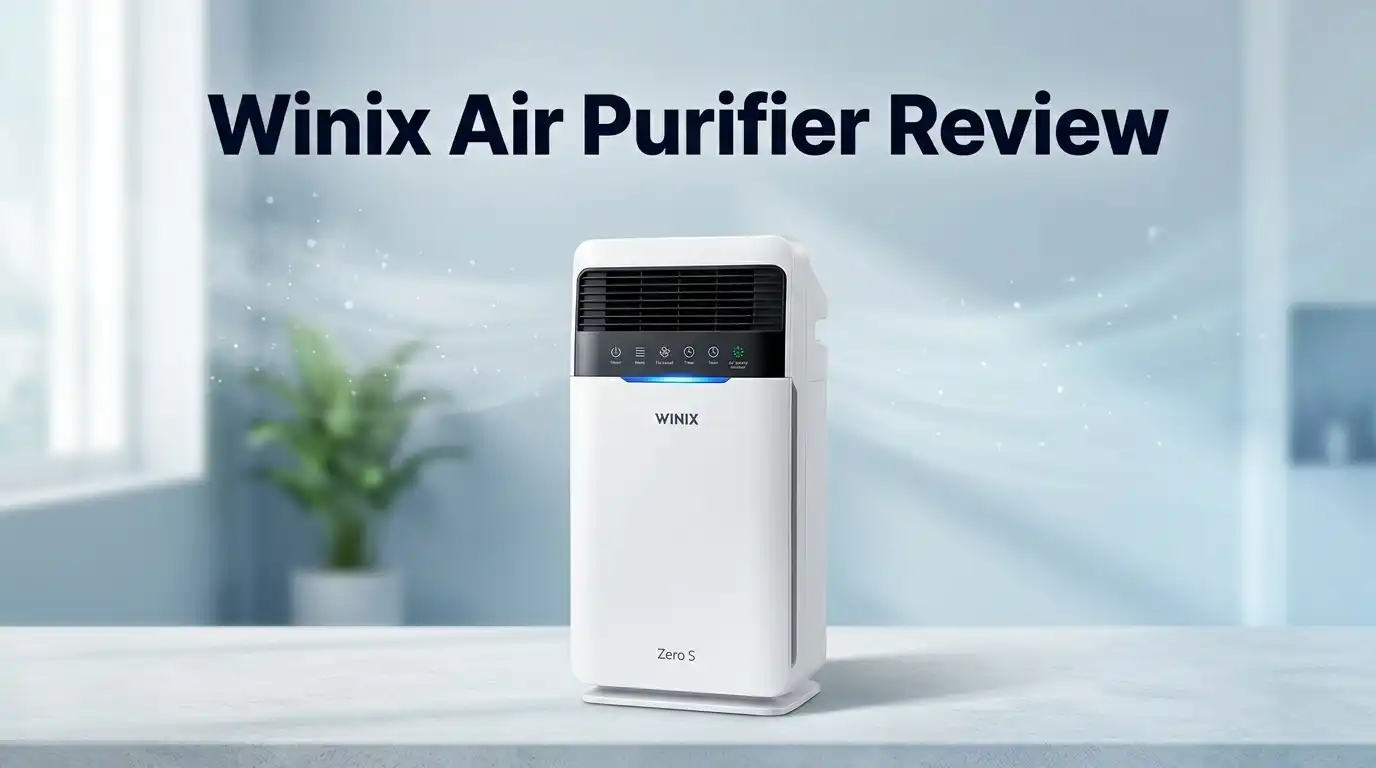
The Winix 5510 is the model I recommend to most people in 2026. It arrived as the direct successor to the beloved 5500 series, and it fixes two long standing complaints: the dated boxy shell and the missing app.
The body measures 15.9 by 11 by 25.2 inches and weighs just over 13 pounds. That is noticeably smaller than the unit it replaced, which matters if you plan to slot it beside a nightstand or a sofa arm.
Inside you get three real filtration layers. A removable mesh pre filter grabs hair and lint. A pelleted activated carbon filter handles odors and gases, with 226 grams of carbon packed in. Behind that sits a True HEPA filter rated at 99.99% capture down to 0.3 microns.
Performance holds up under testing. Independent labs recorded a top speed PM1 CADR near 249 cfm, which lines up neatly with the AHAM certified 252 cfm dust figure. In plain terms, this thing moves air.
The control panel is simple. Four fan speeds, sleep mode, auto mode, a PlasmaWave toggle, and a timer. An LED ring shifts from blue to amber to red as particle levels climb, so you get feedback without opening your phone.
My honest take: the 5510 is not a leap forward in raw cleaning power. It is a smarter, prettier, more compact version of a proven machine. For most bedrooms and living rooms, that trade works.
Unboxing the Winix 5510: What Arrives in the Box
Unboxing a Winix feels reassuringly plain, and I mean that as a compliment. The carton is brown cardboard with simple printing, no glossy lifestyle photography, no magnetic flap drama.
Lift the lid and you find the purifier wrapped in a thin fabric sleeve, seated between two molded pulp end caps. Winix dropped most of the polystyrene, which is a small win for anyone who hates picking foam beads off the carpet.
Under the unit sits a flat accessory tray. Inside: a printed quick start guide, the full manual, and the power cord tucked into a cardboard channel. The cord measures roughly six feet, which is adequate but not generous for awkward outlet placement.
Here is the step most people miss. The HEPA and carbon filters ship already installed but sealed in plastic bags. You must pop off the front panel, lift out both filters, tear away the plastic, and reseat them. Carbon goes in first, HEPA second.
If you skip that step, the purifier will hum along and push dirty air around your room. Winix prints a warning sticker on the front grille, and you should not peel it off until you have done the job.
Total setup time runs about four minutes. The panel snaps back with a satisfying click, and the unit plays a soft chime when you press power. It is a small Korean appliance habit that I find oddly charming.
Winix 5530: The Newest Model for 2026

Last update on 2026-11-17 / Affiliate links / Images from Amazon Product Advertising API
Winix launched the 5530 as the app connected step up in the same family, and it has quickly become the brand’s headline unit. It shares the DNA of the discontinued 5500 series but adds smart control and a refreshed white shell.
The rated coverage is generous. Winix claims it cleans rooms up to 1,882 square feet in one hour, which translates to roughly 376 square feet at the tighter five air changes per hour standard that allergy sufferers should use.
You get a 4 stage system here: washable pre filter, activated carbon, True HEPA, and optional PlasmaWave. Smart sensors drive auto mode, adjusting fan speed in real time as cooking smoke or dust spikes appear.
Independent testers rate the 5530 highly for filtration strength and quiet mid speed operation. It also takes up less floor space than several competing large room purifiers, which helps in apartments.
What is missing? Voice assistant support is limited compared with Levoit, and there is no Energy Star listing on some retail variants. Owners also report that the app occasionally drops the device and needs a reconnect.
Filter replacement follows the newer Filter Q style cartridge, so do not assume your old 5500 filters will fit. They will not. The newer filters are physically smaller.
If you want the freshest Winix hardware with app control and you have a genuinely large open space, the 5530 is the one to look at first.
Top 3 Alternative for Winix 5510

Last update on 2026-11-17 / Affiliate links / Images from Amazon Product Advertising API
WINIX 5520 Air Purifier

Last update on 2026-11-17 / Affiliate links / Images from Amazon Product Advertising API
WINIX AM90 Air Purifier

Last update on 2026-11-17 / Affiliate links / Images from Amazon Product Advertising API
Winix C545 Air Purifier with PlasmaWave
How Winix Filtration Actually Works
Winix uses layered mechanical filtration, and understanding the order helps you maintain it properly.
Air enters through a washable mesh pre filter on the front panel. This layer catches pet hair, carpet fluff, and large dust. Winix asks you to vacuum or rinse it every three months. Skip that chore and HEPA efficiency can fall by as much as 40%, according to filtration researchers.
Next comes the activated carbon filter. Older Winix models used carbon impregnated fabric, which is cheap and only handles light odors. Current models use pelleted granular carbon, which ventilation standards recommend for medium duty odor work like cooking smells and pet smells.
The third layer is the True HEPA filter. Winix rates it at 99.99% capture of particles at 0.3 microns, and the brand backs that claim with third party lab testing rather than marketing copy alone. That distinction matters after a well publicized advertising dispute forced a rival brand to soften its own HEPA claims.
The fourth stage, PlasmaWave, is optional and electronic rather than mechanical. More on that in the next section.
One practical detail I appreciate: the carbon and HEPA layers are separate physical filters on most Winix models. When the carbon starts smelling stale, you can pull it out and keep running HEPA alone until a replacement arrives. Purifiers with a single fused cartridge give you no such flexibility.
PlasmaWave Explained: Should You Turn It On?
PlasmaWave is the feature that generates the most confusion and the most forum arguments, so let me be direct about it.
PlasmaWave is bipolar ionization. The unit releases both positive and negative ions, which electrically charge airborne particles and help them clump together and stick to the filter. Winix also credits it with breaking down odor molecules and gases.
Does it help? Modest amounts. In controlled testing, the 5510 cleaned the test room in 24 minutes with PlasmaWave enabled. The older 5500 model cleaned in 23 minutes with it on and 24 minutes with it off. The difference is within a rounding error for particles.
Does it carry risk? Ionization can produce small amounts of ozone and, in some studies, can convert existing compounds into new volatile organic compounds. Winix units are certified by the California Air Resources Board, meaning ozone output stays under 0.050 parts per million.
Here is my recommendation. If anyone in your home has asthma, leave PlasmaWave off. The HEPA and carbon layers do the heavy lifting anyway. If you are fighting stubborn kitchen or pet odors and nobody is sensitive, switching it on is reasonable.
One irritation worth flagging: several Winix models forget your PlasmaWave setting after a power cut. The unit boots back up with ionization enabled. If you deliberately keep it off, check the panel after any outage.
Air Cleaning Performance: The Real Numbers
Marketing square footage claims are nearly useless, so let’s use measured data instead.
Independent testers filled a 728 cubic foot sealed room with incense smoke and tracked PM1 particles until they hit zero. The Winix 5510 finished in 24 minutes at top speed. The discontinued 5500 model managed 23 minutes.
For context, that places Winix in strong company. A Levoit Vital 200S took 23 minutes. A Coway Airmega AP-1512HH needed 26 minutes with its ionizer running. Winix delivers upper tier cleaning speed at a mid tier price.
AHAM certified figures for the 5510 read 252 cfm for dust. The older 5500 model posted 243 cfm dust, 232 cfm smoke, and 246 cfm pollen. These are verified numbers from a third party, not factory estimates.
Now the important caveat. Nobody runs a purifier at top speed all night. It is too loud. So testers also measure performance at speeds under 45 dBA, the threshold used for quiet classrooms.
At speed 2, the 5510 cleared the same room in 47 minutes with an estimated CADR near 125 cfm. That is roughly half its headline power. The older 5500 model needed 45 minutes at speed 2.
The practical lesson: size up. If your bedroom is 300 square feet, a purifier rated for 370 square feet at full blast will underperform at the quiet speeds you actually use overnight. Buying slightly bigger than the label suggests is the single best decision most buyers can make.
Noise Levels and Sleep Mode Behavior
Noise decides whether a purifier gets used or unplugged, so this section deserves real attention.
Measured from three feet away, the Winix 5510 produces 35.2 dBA in sleep mode, 36.8 dBA at speed 1, 40.8 dBA at speed 2, 51.6 dBA at speed 3, and 67.2 dBA at speed 4.
That top figure is genuinely loud. It beats a Coway Mighty at 60.1 dBA and even an AirDoctor 3000 at 63.6 dBA. The cause is simple physics: Winix shrank the body and the filters, so the fan works harder to push the same volume of air.
The older 5500 model was gentler, topping out at 58.9 dBA. If you owned one and upgrade to a 5510, you will notice the difference on turbo.
The good news is the bottom half of the range. Sleep mode and speed 1 sit near the noise floor of a quiet bedroom. The sound is broadband white noise rather than a whine, which most sleepers find easy to tune out.
Sleep mode also dims the LEDs almost completely. A light sensor on the front panel detects darkness and drops the unit into sleep automatically, which is a thoughtful touch for anyone who hates glowing appliances at 2 a.m.
My habit with Winix units: run speed 3 or 4 for twenty minutes after cooking, then drop to sleep mode for the night. You get the burst of cleaning without the roar during quiet hours.
The Winix Smart App and Auto Mode
App control arrived late to Winix, and it shows.
The Winix Smart app works on iPhone and Android. It handles the basics competently: power, fan speed, timers, mode switching, filter life tracking, and a live air quality readout from the onboard sensor.
The interface is clean and free of advertising, which is more than I can say for several rival apps that push shopping banners at you. Pairing takes a couple of minutes over 2.4 GHz WiFi.
What is missing is depth. There are no detailed historical pollution graphs, no rich automation rules, and no scheduling flexibility comparable to Levoit or Xiaomi. Reviewers describe the app as bare bones but functional, and that is fair.
Auto mode is the feature I use most. A particle sensor and a gas sensor feed the controller, which raises fan speed when it detects smoke, dust, or cooking fumes. It reacts within seconds to a lit match or a hot pan.
One maintenance note that owners skip: the sensor needs cleaning. Dust builds on the optical sensor over a few months and makes auto mode either lazy or twitchy. A gentle pass with a dry cotton swab every three months fixes it.
If app control is your main priority, Winix is serviceable rather than excellent. If you mostly want a reliable auto mode and occasional phone access, it is perfectly adequate.
Running Costs: What Winix Really Costs Per Year
The sticker price is only the beginning, so here is the full yearly picture.
Electricity. The 5510 draws 3.51 watts in sleep mode, 6.58 watts at speed 2, and 52.62 watts at top speed. Running it nonstop for a full year costs roughly $61 at average United States electricity rates.
Filters. A genuine Winix filter set carries a list price of $79.99 and lasts about 12 months. That brings total yearly running cost to approximately $141.
Compare that with rivals. A Levoit Vital 200S runs near $97 per year. A Coway Mighty lands around $124. A Levoit Core 400S sits near $127. Winix is competitive but not the cheapest to maintain.
There is a big savings lever, though. Winix models are popular enough that generic filters are abundant. Owners of the older 5500 series found compatible sets for as little as $15 to $19 per year. Third party filters for newer models are appearing steadily.
Should you use generics? They cut costs dramatically, but quality varies and some carry far less activated carbon. My middle path is to use genuine filters if odors are your main concern and generics if you are mainly chasing dust and pollen.
Budget one more small line item: nothing. The pre filter is washable, the carbon on several models is rinsable, and there are no proprietary cartridges or subscriptions. Winix does not lock you into a filter club, and that deserves credit.
What Winix Does Not Do Well
An honest review needs a section like this, so here are the real weaknesses.
Top speed noise is a problem on newer models. The 5510 at 67.2 dBA is louder than it should be for its output. Sound sensitive buyers should look at the Winix T810 instead, which delivers similar power with better quiet speed performance.
Settings memory is absent on several models. Lose power and the unit forgets your preferences, including your PlasmaWave choice. Competing brands solved this years ago, and it is frustrating that Winix has not.
The app lags behind. It works, but it is plain. No rich data history, no deep automation, and occasional dropped connections reported by owners.
Filter compatibility got messy. Newer models use smaller Filter Q cartridges that do not fit older Winix units. Buyers upgrading within the brand often order the wrong filters the first time.
Discontinuations sting. Winix retired the 5500 and 5300 series, which were the brand’s best value champions. Current models cost more and do not clean noticeably faster.
Auto mode depends on a sensor that clogs. Neglect the cleaning and auto mode becomes unreliable. Winix does not remind you in the app.
None of these are dealbreakers on their own. Taken together, though, they explain why Winix is a strong value brand rather than a premium one. You are buying proven filtration and Korean build quality, not polish.
Pros and Cons of Winix Air Purifiers in 2026
Here is the summary in plain bullet form.
Pros
- AHAM Verifide certification on the main models, so CADR claims come from a third party lab rather than the marketing department.
- True HEPA plus pelleted activated carbon in separate layers, which handles both particles and odors and lets you replace one layer at a time.
- Removable washable pre filter that rinses under a tap, unlike integrated pre filters on several Levoit models.
- PlasmaWave can be disabled, and units carry California Air Resources Board certification for low ozone output.
- Strong cleaning speed for the money, with the 5510 clearing a test room in 24 minutes, matching purifiers costing far more.
- Made in South Korea with a two year manufacturer warranty, which is unusual at this price point.
- Wide filter availability, including affordable generic options that cut long term costs significantly.
Cons
- Loud at top speed, with the 5510 reaching 67.2 dBA, noticeably louder than the model it replaced.
- Performance halves at quiet speeds, dropping to roughly 125 cfm at 40.8 dBA.
- No settings memory after a power outage on several models, including the PlasmaWave toggle.
- Basic app with limited history, automation, and occasional connection drops.
- Filter sets are not cross compatible between older and newer generations.
- Best value models were discontinued, leaving pricier successors in their place.
Which Winix Model Fits Your Room?
Picking the right size matters more than picking the right brand, so use room area as your guide.
Small bedroom or office up to 200 square feet. The Winix C545 handles this easily. It offers similar internals to the mid range models in a white shell and stays quiet at the speeds you will actually use.
Standard bedroom or living room, 200 to 370 square feet. This is 5510 territory, and it is the sweet spot for the brand. You get app control, real HEPA, generous carbon, and enough headroom to run at speed 2 overnight.
Large open plan space, 370 to 500 square feet. Look at the 5530 or the 5520. Both are rated above 1,880 square feet per hour, which works out near 375 square feet at the stricter five air changes standard.
Whole floor or open concept great room. The Winix T810 is rated for 1,968 square feet per hour and performs better than the 5510 at low fan speeds. It is the pick for sound sensitive buyers with big spaces.
Homes with pets and cooking odors. Prioritize carbon quantity over square footage. The AM90 offers a washable carbon filter, which cuts replacement costs, though washable carbon loses odor capacity over time.
A quick rule I trust: divide the marketing square footage by five. That gives you the realistic coverage at a decent air change rate. Anything larger and you are just buying a number on a box.
Winix vs Levoit vs Coway: An Honest Comparison
These three brands dominate the mid price market, and each wins on a different axis.
Winix wins on filtration substance. Separate carbon layers, generous pelleted carbon, removable pre filters, AHAM certification, and Korean manufacturing. Owners on enthusiast forums frequently call Winix the best sub $200 unit available.
Levoit wins on software and refinement. The app is more polished, with detailed air quality history and better automation. The Vital 200S also cleaned a test room in 23 minutes while costing less per year to run, near $97 versus $141.
Coway wins on longevity and quiet reliability. The AP-1512HH Mighty has been a recommendation staple for a decade. It is quieter at top speed, at 60.1 dBA, though it cleaned the same room two minutes slower.
Where does that leave you? If odors and pet dander are your main enemy, choose Winix for the carbon. If you want smart features and slick app control, choose Levoit. If you want a set and forget appliance with a long track record, choose Coway.
One thing all three share: they use real mechanical filtration. Avoid any purifier that relies mainly on ionization, UV, or plasma without a genuine HEPA filter behind it. That is where the actual cleaning happens.
Price wise, all three cluster between $150 and $220 during sale events. Buy during Prime Day or Black Friday and you can often save $50 or more.
Maintenance Tips That Extend Filter Life
A few simple habits keep a Winix running well and save real money.
Vacuum the pre filter every three months. Pop the front panel, lift the mesh, and run a vacuum brush over it. Rinse it under warm water if it looks greasy from cooking. Let it dry completely before reinstalling.
Rinse washable carbon filters if your model has one. Several Winix units allow this every three months. Use cool water, no soap, and dry for a full 24 hours. A damp filter breeds odor rather than removing it.
Never wash the HEPA filter. Water destroys the fiber structure permanently. If the HEPA looks gray, that is normal. Replace it on schedule, not on appearance.
Clean the air quality sensor. Locate the small vent on the side or rear, and swipe gently with a dry cotton swab. Dusty sensors make auto mode behave erratically.
Keep 12 inches of clearance. Winix units draw air from the front and exhaust upward. Pushing one flush against a wall or behind a curtain chokes airflow.
Run it continuously rather than in bursts. Purifiers work by cumulative air exchange. A unit running at speed 1 all day removes far more than a unit blasted for one hour.
Mark your calendar for filter changes. Genuine Winix filters last 12 months in typical homes. Heavy pet households, smokers, or wildfire regions should plan for eight to nine months instead.
Final Verdict: Is a Winix Worth Buying in 2026?
Yes, for most buyers, with clear eyes about the trade offs.
Winix earns its reputation on substance. The filtration is real, the CADR numbers are independently verified, the carbon is generous, the pre filter is washable, and the units are built in South Korea with a two year warranty. Very few brands at this price can claim all of that.
The 5510 is my default recommendation. It cleans a room in 24 minutes, covers roughly 372 square feet, runs at a whisper in sleep mode, and costs about $141 a year to maintain. At sale prices near $150, it is excellent value.
The 5530 is the pick for larger spaces and for buyers who want the newest hardware with app control. The C545 suits small rooms and tighter budgets. The T810 is the answer for anyone who prizes quiet operation above all.
But be realistic about the weaknesses. Top speed is loud, the app is basic, settings reset after a power cut, and quiet mode performance drops by half. If those matter deeply to you, a Levoit or Coway may fit better.
My closing advice is the same advice I give friends. Buy one size larger than the label suggests, turn PlasmaWave off unless you need odor help, run it around the clock on a low speed, and actually clean the pre filter. Do those four things and a Winix will quietly improve your air for years.
Frequently Asked Questions
Is the Winix 5500-2 still available in 2026?
No. Winix confirmed it discontinued both the 5500 and 5300 series in the United States and Canada. Remaining stock sells through occasionally, and both genuine and generic filters are still widely available for existing owners.
Does PlasmaWave produce ozone?
It produces a very small amount. Winix models hold California Air Resources Board certification, which requires ozone output below 0.050 parts per million. You can also switch PlasmaWave off entirely, which I recommend for anyone with asthma.
How often do Winix filters need replacing?
Genuine HEPA and carbon sets last about 12 months in typical homes. Heavy pet households, smokers, and wildfire prone regions should plan on eight to nine months. The mesh pre filter is washable and never needs replacing.
Can I use generic filters in my Winix?
Yes, and many owners do. Generic sets can cost as little as $15 to $19 per year versus $80 for genuine filters. Quality varies, and cheaper options often contain less activated carbon, so genuine filters remain the better choice for odor control.
Is Winix quieter than Levoit?
Not at top speed. The Winix 5510 reaches 67.2 dBA, while comparable Levoit models stay lower. At sleep mode and speed 1, Winix is very quiet at around 35 to 37 dBA, which is what matters for overnight use.
What room size should I buy for?
Divide the advertised square footage per hour by about five. A model rated for 1,880 square feet per hour realistically covers 370 square feet at five air changes per hour, which is the standard allergy sufferers should use.
Where are Winix air purifiers made?
All Winix units are manufactured in South Korea, not China. The company has produced air quality equipment since 1973 and submits its purifiers to AHAM Verifide for independent CADR testing.

I’m Maya Brown, the voice behind Pure Breeze Vault. I write detailed, honest, and easy-to-follow air purifier reviews to help readers compare features, understand filter technologies, and choose products with confidence. My goal is to make research simpler, clearer, and more practical for anyone improving indoor air quality at home.