Xiaomi Air Purifier 4 Pro Review 2026: Still Worth It?
Clean air feels invisible until you lose it. One smoky evening, one dusty renovation, or one spring pollen wave, and suddenly you notice every breath. That is the moment most people start shopping for an air purifier, and the Xiaomi Smart Air Purifier 4 Pro keeps showing up on the shortlist.
This machine promises a lot for a mid range price. You get a laser particle sensor, an OLED screen, app control, voice assistant support, and a claimed particle CADR of 500 m³/h. On paper it looks like a flagship product wearing a budget price tag.
But paper specs never tell the full story. Does it actually clear a room fast? Is it quiet enough to sleep beside? Do the filters drain your wallet? And what annoying quirks will nobody mention in the product listing?
In a Nutshell:
- Strong cleaning for the price. Independent testing measured a PM1 CADR of roughly 285 cfm at top speed, enough for five air changes per hour in rooms up to about 448 sq ft. That beats several purifiers costing twice as much.
- Quiet performance is the real win. At speed 2 the unit runs near 44.5 dBA and still delivers around 174 cfm. You can clean a bedroom without a wind tunnel soundtrack.
- Running costs stay low. Energy draw ranges from 4.4 watts in sleep mode to 45.9 watts at full blast. Yearly cost lands near $162 including filters, which is cheap for this class.
- The ionizer is a sticking point. It generates trace ozone, and you can only switch it off inside the Mi Home app. No physical button exists for it.
- There is a known whine. Several testers and owners report a high pitched motor noise at low fan speeds. In a silent bedroom at 2 a.m., it gets noticed.
- Availability is regional. The 4 Pro sells widely across the UK, Europe, and Asia. Buyers in the United States often see import listings, odd pricing, or different model names instead.
Xiaomi Smart Air Purifier 4 Pro Overview

Last update on 2026-11-17 / Affiliate links / Images from Amazon Product Advertising API
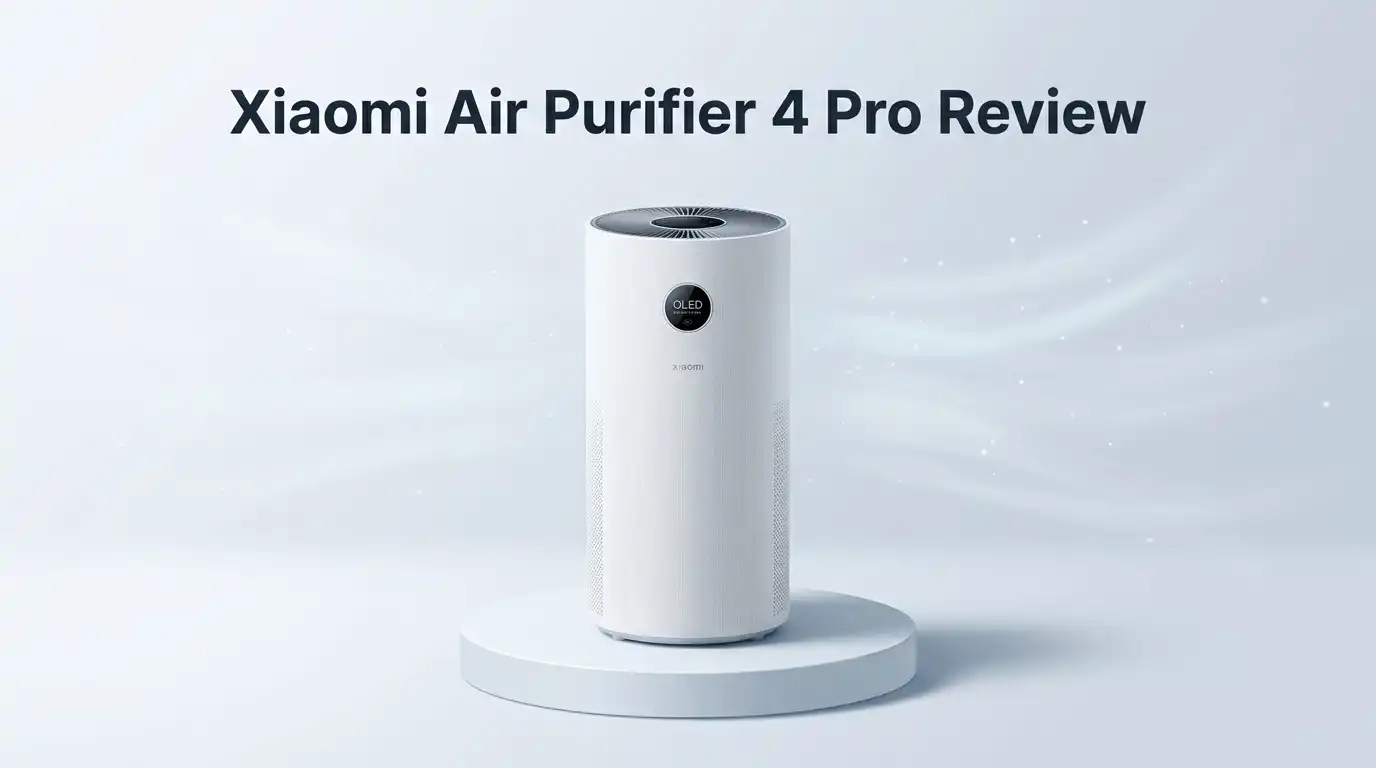
The Xiaomi Smart Air Purifier 4 Pro sits in the middle of Xiaomi’s air care lineup. It is a tall cylinder that pulls air in through a 360 degree intake and pushes clean air out of the top. Xiaomi rates it for rooms between 35 and 60 m², which works out to roughly 375 to 645 sq ft.
The headline figure is a particulate CADR of 500 m³/h, with Xiaomi claiming 8,330 litres of clean air released every minute. It carries TÜV Rheinland Allergy Care certification, which means an outside lab verified its allergen reduction claims.
What separates the Pro from cheaper Xiaomi models is sensing. You get a laser particle sensor that reads both PM2.5 and PM10, plus temperature and humidity sensors. All of that data appears on the front OLED screen and inside the app. For a purifier in this price bracket, that level of feedback is unusual and genuinely useful.
Unboxing Experience: What Arrives in the Box
The box is tall, narrow, and heavier than you expect at around 15 lbs. Xiaomi packs it in moulded foam with minimal plastic, which feels appropriate in 2026.
Inside you find the main body, the filter already seated in the base, a power cable, and a small multilingual manual. That is the entire contents list. No remote, no spare filter, no extra accessories.
The first real step catches people out. The filter ships wrapped in plastic. You must pop off the bottom cover, slide the cylinder out, strip the wrapping, and reinsert it. Skip this and your purifier will run while moving almost no air. The manual mentions it, but the instruction is easy to miss.
Assembly takes under three minutes. There are no screws and no tools. Plug it in, press power, and the OLED wakes up instantly with a live air quality reading. That first number, often higher than you hoped, is oddly motivating.
Design, Size, and Build Quality
The 4 Pro measures roughly 10.8 x 10.8 x 26.7 inches. It is tall but narrow, so it tucks beside a sofa or nightstand without dominating the room. The all white plastic body looks clean and plain rather than stylish.
Build quality is solid without feeling premium. Panels fit tightly, the base cover clicks on firmly, and nothing rattles during operation. It is honest plastic, not luxury plastic.
The front OLED display is the standout design feature. It shows PM2.5 readings, temperature, humidity, fan mode, and WiFi status in crisp white text. Two touch buttons below handle power and mode cycling.
One clever touch sits on the back: a small button that dims the screen. Bedroom users will reach for it on night one. One design miss stands out. There is no handle and no carry grip, so moving the unit between rooms means hugging a smooth cylinder.
Top 3 Alternative for Xiaomi Air Purifier 4 Pro


Last update on 2026-11-11 / Affiliate links / Images from Amazon Product Advertising API
LEVOIT Core 400S Smart Air Purifier

Last update on 2026-11-19 / Affiliate links / Images from Amazon Product Advertising API
COWAY Airmega Mighty2 Air Purifier

Last update on 2026-11-17 / Affiliate links / Images from Amazon Product Advertising API
WINIX 5510 Air Purifier with App Support
How the Filtration System Works
The 4 Pro uses a single cylindrical filter that combines three jobs in one unit. The outer layer is a mesh pre filter that catches hair, lint, and large dust. The middle layer is a pleated HEPA grade particle filter rated to capture 99.97% of fine particles. The inner layer holds 650 grams of pelleted activated carbon for odours and gases.
Pelleted carbon matters here. Many budget purifiers use a thin carbon coated sheet that saturates within weeks. Pellets hold far more adsorption capacity, so cooking smells and pet odours fade properly.
Carbon has limits worth knowing. It handles everyday household odours well. It struggles with heavy ongoing VOC sources such as fresh paint fumes or constant chemical exposure. No consumer purifier at this price solves serious VOC problems.
There is also an optional ionizer that releases negative ions. It produces trace ozone as a side effect, which is why many buyers disable it immediately.
Real World Air Cleaning Performance
Independent testing gives a clearer picture than marketing numbers. In a controlled test room of 728 cubic feet, the 4 Pro took 24 minutes to drive PM1 particles down to zero. Testers estimated a PM1 CADR around 285 cfm.
Translated into practical terms, that supports five air changes per hour in rooms up to roughly 448 sq ft. That covers most bedrooms, home offices, and medium living rooms comfortably.
Context helps. The 4 Pro cleared the room faster than the far more expensive Dyson Big+Quiet BP06, which needed 30 minutes. It also matched results from popular units like the Coway Airmega 250S and Blueair 311i Max.
It is not the fastest purifier you can buy. Cheaper no frills models with bigger fans, such as the AirFanta 3Pro, finished the same test in 17 minutes. But those models lack sensors, apps, and screens. The 4 Pro trades a little raw speed for intelligence.
Noise Levels and Sleep Mode Reality
Noise decides whether a purifier gets used or unplugged. Measured from three feet away, the 4 Pro ranges from 35.3 dBA in sleep mode to 59.2 dBA at top speed.
Those lower numbers are genuinely good. Speed 1 and speed 2 both sit near 35 dBA, which registers as a soft background hush. Speed 3 climbs to 44.5 dBA, still acceptable for daytime work. Top speed at 59.2 dBA is loud enough to interrupt a conversation, so most people run it only while away or during cooking.
Here is the honest problem. Multiple testers and owners report a high pitched whining sound from the fan motor at low speeds. During the day you never notice it. In a silent bedroom at night, that thin whine becomes impossible to unhear. Some units are worse than others, which suggests manufacturing variance rather than a universal flaw.
Smart Features and the Mi Home App
The 4 Pro connects to the Mi Home app over 2.4 GHz WiFi. Setup takes a few minutes and the pairing process is reliable, which is more than many smart appliances manage.
Inside the app you get live PM2.5 readings, temperature, humidity, filter life percentage, and full fan control. You can schedule routines, set a custom manual fan speed based on your room size, adjust screen brightness, and disable the ionizer.
The app also supports Google Home and Amazon Alexa. Voice commands for power and fan speed work smoothly, which makes the purifier a natural fit in an existing smart home.
The app does have gaps. Historical air quality graphing is limited compared to the pricier Xiaomi Elite, so you cannot easily review last week’s pollution trends. Still, for day to day control the app is fast, stable, and genuinely pleasant to use.
Energy Consumption and Yearly Running Costs
Air purifiers run constantly, so energy draw matters more than purchase price over time. The 4 Pro is efficient. Standby uses about 1 watt. Sleep mode draws 4.4 watts. Speed 3 pulls 13.9 watts, and top speed reaches 45.9 watts.
Running it 24 hours a day at full power for a year would cost roughly $51 in electricity at average United States rates. Most people run it on auto mode, where real consumption lands far lower, often under $15 per year.
Filters add the bigger expense. Xiaomi recommends replacement every six to twelve months, and an official filter costs around $55. Two per year brings filter spending to roughly $111.
Combined, expect about $162 annually. That figure sits below most competing mid sized purifiers, which is a real long term advantage.
Filter Replacement and Maintenance
Maintenance is simple but not zero effort. The pre filter mesh needs vacuuming every few weeks. Skip this and airflow drops while the main filter clogs faster.
Changing the filter takes about one minute. Remove the bottom cover, lift out the cylinder, drop in the replacement, and reset the filter timer inside the app. No tools required.
Official Xiaomi filters deliver the full HEPA grade media and the 650 grams of pelleted carbon. Third party filters sell for far less, sometimes under $30 each when bought in pairs. The tradeoff is real. Generic filters typically skip pelleted carbon and may not meet HEPA grade standards, so odour control weakens.
One practical warning from long term owners: Xiaomi filter availability varies by region and older models have suffered supply gaps. Check that filters ship to your country before buying the machine.
What the Xiaomi 4 Pro Does Not Do Well
Every honest review needs this section. The 4 Pro has genuine weaknesses.
The ionizer control is poorly designed. You cannot disable it from the device itself. If your phone dies, your WiFi drops, or you simply do not want an app, you are stuck running a feature that produces trace ozone.
The low speed whine is a real complaint. Reviewers removed the unit from their bedroom because the sound disrupted sleep. Not every unit does it, but enough do that it deserves a warning.
Carbon capacity is good, not great, for VOCs. Heavy chemical odours overwhelm it.
United States availability is messy. Pricing, warranty support, and plug types vary between sellers, and official support is thinner than for domestic brands.
There is no auto filter detection beyond a timer. The app estimates life rather than sensing it, so heavy users should inspect the filter manually.
Pros and Cons
Pros
- Excellent value. Cleaning performance matches purifiers costing twice as much.
- Strong quiet mode output. Around 174 cfm while staying under 45 dBA.
- Low running costs. Roughly $162 per year including filters and electricity.
- Genuinely useful sensors. Live PM2.5, PM10, temperature, and humidity readings.
- Reliable app and voice control. Works smoothly with Google Home and Alexa.
- Slim footprint. Narrow cylinder fits tight corners despite mid size capacity.
- Readable OLED screen with adjustable brightness for night use.
Cons
- Ionizer can only be switched off through the app.
- High pitched motor whine reported at low fan speeds on some units.
- No carry handle, so moving it between rooms is awkward.
- Filter must be unwrapped manually before first use, which many people miss.
- Limited historical data in the app compared to the Xiaomi Elite.
- Regional availability issues for both the unit and official filters.
Xiaomi 4 Pro vs Xiaomi Elite: Which One Wins?
The Xiaomi Elite sits above the 4 Pro and costs roughly double. Buyers naturally ask whether the upgrade is worth it.
Performance data shows a surprisingly small gap. The Elite reaches an estimated 299 cfm at top speed versus 285 cfm for the 4 Pro. At quiet speeds they are identical, both delivering around 174 cfm under 45 dBA.
So what does the extra money buy? A more attractive design clearly inspired by Dyson. A fuller control panel that includes a physical button for the ionizer. Historical air quality logging inside the app. A longer lasting filter, which reduces yearly running costs.
My take is simple. If the ionizer button and app data logging bother you, the Elite fixes both complaints. If you only care about clean air per dollar, the 4 Pro is the smarter buy by a wide margin.
Who Should Buy the Xiaomi Air Purifier 4 Pro

Last update on 2026-11-17 / Affiliate links / Images from Amazon Product Advertising API
This purifier suits specific people very well.
Buy it if you live in the UK, Europe, or Asia where pricing and filter supply are strongest. Buy it if you want real air quality data without paying premium brand prices. Buy it if you already own Xiaomi devices, since everything lives inside one app. Buy it if your room sits under 450 sq ft and you want quiet daily operation.
Skip it if you are a light sleeper who reacts to high pitched sounds. Skip it if you refuse to install an app, because the ionizer stays on without one. Skip it if you need heavy VOC removal for workshops or studios.
Allergy sufferers get particularly good value here. The TÜV Rheinland Allergy Care certification plus the pelleted carbon handles pollen, dust, and pet dander effectively.
Setup Tips for Better Results
A few habits improve performance noticeably.
Place the unit at least 12 inches away from walls and furniture. The 360 degree intake needs clearance, and crowding it cuts airflow immediately.
Run auto mode as your default. The laser sensor responds within seconds to cooking, vacuuming, and open windows, then settles back down on its own.
Open the app once and disable the ionizer if ozone concerns you. Set it and forget it.
Vacuum the outer mesh every three weeks using a brush attachment. This single habit extends filter life meaningfully.
Dim the OLED screen at night using the rear button. The default brightness lights up a dark bedroom.
Finally, keep doors closed in the room you are purifying. Clean air escapes fast through open hallways, and the sensor will keep the fan running longer than needed.
Final Verdict
The Xiaomi Smart Air Purifier 4 Pro earns its reputation. It cleans a medium room quickly, stays quiet where quiet matters, costs little to run, and gives you real data instead of vague coloured lights.
It is not flawless. The app only ionizer control is a design mistake, and the low speed whine is a legitimate risk for bedroom use. Buyers outside Asia and Europe also face patchier support.
Weighed together, the value is hard to argue with. You get performance comparable to purifiers at twice the price, wrapped in a smart home friendly package with low ongoing costs.
If you want the best cleaning per dollar with genuine smart features, this remains one of the strongest mid range choices available in 2026.
Frequently Asked Questions
Does the Xiaomi Air Purifier 4 Pro produce ozone?
Yes, but only when the ionizer is active. The ionizer releases negative ions and generates trace ozone as a byproduct. You can disable it permanently through the Mi Home app, and the mechanical HEPA grade filtration works perfectly without it.
How often should I replace the filter?
Xiaomi recommends every six to twelve months depending on usage and air quality. Heavy use in polluted environments pushes you toward six months. The app tracks estimated filter life, but inspect the filter visually if airflow weakens.
Is it loud enough to disturb sleep?
Sleep mode measures around 35 dBA, which is very quiet. However, some units produce a high pitched motor whine at low speeds that light sleepers notice in a silent room.
What room size does it cover?
Xiaomi rates it for 35 to 60 m². Independent testing supports five air changes per hour in rooms up to roughly 448 sq ft, which covers most bedrooms and living rooms.
Does it work with Alexa and Google Home?
Yes. Both assistants support power and fan speed commands once the purifier is linked through the Mi Home app.
Can I use cheaper third party filters?
You can, and they cost significantly less. The tradeoff is weaker odour control, since most generic filters skip pelleted activated carbon and may not meet HEPA grade standards.

I’m Maya Brown, the voice behind Pure Breeze Vault. I write detailed, honest, and easy-to-follow air purifier reviews to help readers compare features, understand filter technologies, and choose products with confidence. My goal is to make research simpler, clearer, and more practical for anyone improving indoor air quality at home.