Dyson Hot and Cool Air Purifier Review 2026: Worth It?
Your home air holds more than you think. Dust, pollen, pet dander, cooking smoke, and gases from cleaning sprays float around every room. Most people never notice until allergy season hits or a winter cold snap arrives.
The Dyson Purifier Hot+Cool line promises one fix for all of it. One machine purifies the air, heats the room in January, and cools you in July. Dyson charges premium money for that convenience.
So does it actually earn the price tag? I spent weeks with the HP07, tracked its sensor data, measured its noise, and watched my electricity meter. This review covers what Dyson gets right, what it gets wrong, and which model suits your home. No marketing fluff. Just honest findings.
In A Nutshell:
- The HP07 performs well as a purifier. Its sealed HEPA H13 system captures 99.97 percent of particles down to 0.3 microns. The activated carbon layer handles odors and gases. Dyson rates purification coverage at roughly 800 square feet, though real results drop in bigger open plans.
- Heating works fast but costs money. The heating element pulls up to 1500 watts on high. It warmed my 180 square foot office in about eight minutes. Running it daily all winter will show up on your bill.
- Noise stays low until speed seven. I measured around 30 decibels on speed one and roughly 53 to 62 decibels at maximum. Sleep mode is genuinely quiet.
- Filters cost about 80 dollars per year. Dyson suggests one replacement every twelve months at twelve hours of daily use. Budget for this as an ongoing cost.
- The value argument is weak. Cheaper purifiers move more air for less money. You pay Dyson for design, sensors, app data, and the three functions in one slim tower.
- Pick your model carefully. HP07 adds app control and backward airflow. HP09 adds formaldehyde destruction. HP10 strips features to cut price. HP1 sits in the middle.
Dyson Purifier Hot+Cool HP07 Review

Last update on 2026-10-03 / Affiliate links / Images from Amazon Product Advertising API
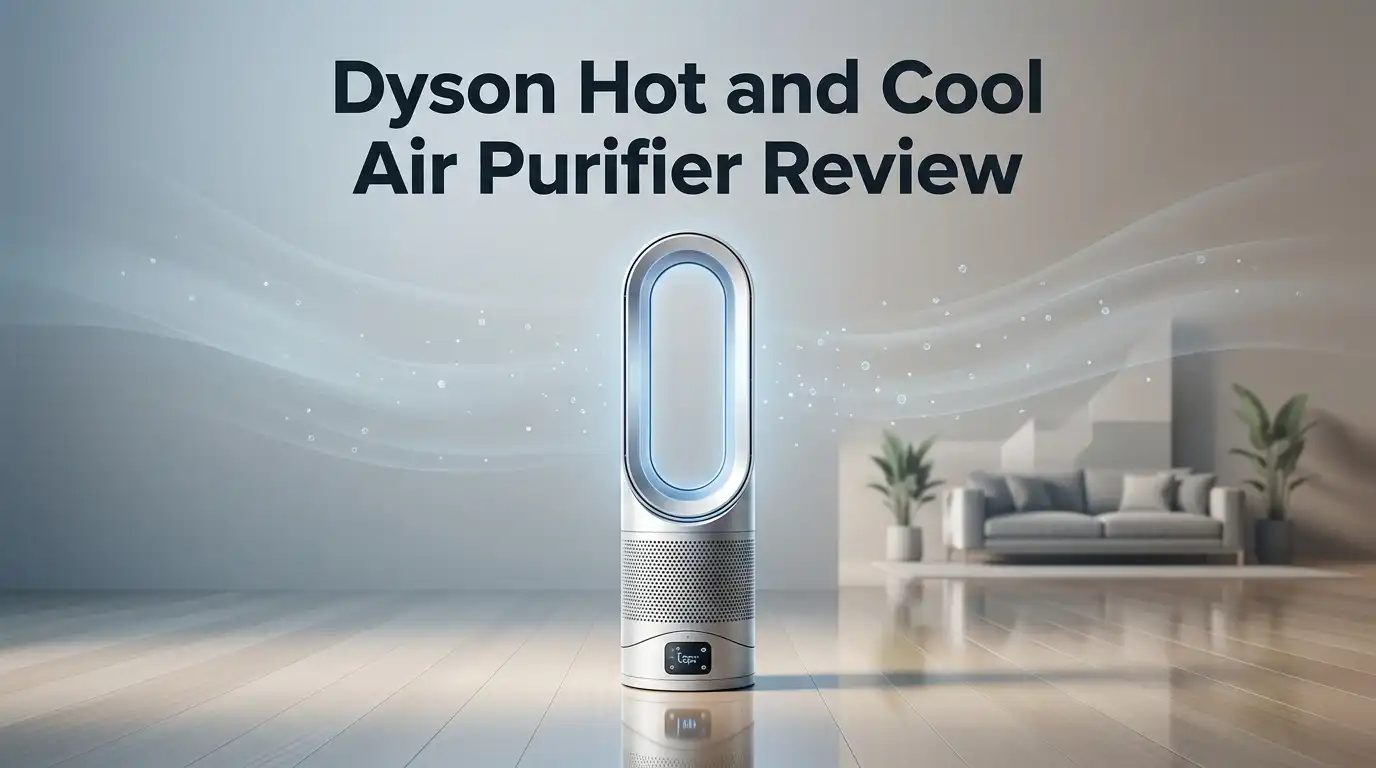
The HP07 sits at the center of the Hot+Cool range. It stands 30 inches tall, weighs roughly 12 pounds, and takes a footprint smaller than a dinner plate. The loop amplifier pushes air without visible blades, which makes it safe around curious kids and pets.
Three sensors run constantly. They track particulate matter at PM2.5 and PM10, volatile organic compounds, nitrogen dioxide, temperature, and humidity. The LCD screen on the base reports all of it in real time.
What struck me first was the feedback loop. I sprayed deodorant across the room and watched the PM2.5 reading jump within seconds. The fan ramped up on its own. Ninety seconds later the reading settled back to green.
That instant visibility changes how you treat your home. You start noticing which activities pollute your air. Frying food, lighting candles, and vacuuming all register clearly.
Unboxing Experience: What Arrives In The Box
The box is tall, narrow, and heavier than it looks. Dyson packs everything in molded cardboard instead of foam, so it feels clean and recyclable.
Inside you get the main unit, one 360 Combi Glass HEPA plus Carbon filter in two snap together halves, the curved remote, and a six foot power cord. There is no printed manual. Dyson points you to a PDF online, which annoyed me slightly on day one.
Assembly took under three minutes. You press each filter half into its outer cover, clip both around the base, and listen for the click. The click is loud and obvious, so you know it seated correctly.
One important tip: lift the machine by its base, never by the loop. The amplifier is not a handle, and gripping it stresses the joint.
Setup through the MyDyson app took another five minutes over Wi Fi.
Design And Build Quality
Dyson design still turns heads. The HP07 comes in white with silver or black with nickel, and both look like lab equipment in a good way. Guests ask about it.
The build quality holds up. Plastics feel dense rather than hollow. The base does not wobble. The oscillation motor runs smoothly across 45, 90, 180, and 350 degree sweeps.
The magnetized remote is a small masterpiece. It curves to match the top of the loop and snaps into place so you stop losing it. After years of hunting for fan remotes under sofa cushions, this detail felt earned.
Where the design falls short is portability. Twelve pounds in a narrow tower makes carrying it between floors awkward. There is no handle and no grab point. You end up hugging the base with both hands.
Top 3 Alternative for Dyson Purifier Hot+Cool HP07

Last update on 2026-10-04 / Affiliate links / Images from Amazon Product Advertising API
Dyson Purifier Hot+Cool Gen1 HP10


Last update on 2026-10-04 / Affiliate links / Images from Amazon Product Advertising API
Dyson Purifier Hot+Cool HP1

Last update on 2026-10-04 / Affiliate links / Images from Amazon Product Advertising API
Shark 3 in 1 Clean Sense Air Purifier MAX, Heater and Fan HC502
Dyson Purifier Hot+Cool Formaldehyde HP09 Review

Last update on 2026-10-04 / Affiliate links / Images from Amazon Product Advertising API
The HP09 is the HP07 with one extra trick. It adds a solid state catalytic filter that breaks formaldehyde down into water and carbon dioxide. That filter never needs replacing.
Formaldehyde matters if you own new furniture, fresh paint, laminate flooring, or pressed wood cabinets. These materials release it slowly for months. Standard carbon filters capture some, then saturate and release it again.
In my testing the HP09 behaved identically to the HP07 for dust, pollen, and odors. The difference showed only on the formaldehyde readout, which ran steady and low.
Is the premium worth it? Only if your home has new building materials or furniture. For an older house with settled materials, the HP07 covers your needs for less money. The HP09 also reads formaldehyde on screen, which gives useful peace of mind to anyone sensitive to chemical smells.
Purification Performance Tested
Purification is where Dyson delivers. The whole machine is sealed to HEPA H13 standard, so filtered particles stay trapped instead of leaking through gaps in the housing.
I ran smoke tests, dry shampoo tests, and cooking tests. In a 200 square foot bedroom the HP07 cleared visible haze in roughly four minutes on auto mode. PM2.5 readings dropped from purple warning levels to green in about ninety seconds.
My allergy symptoms improved noticeably within a week. Morning congestion eased, and the dust layer on my shelves thinned out.
The honest limit is airflow volume. Dyson prioritizes quiet operation and slim design over raw clean air delivery rate. In a large open plan living room the machine struggled to keep up. It works best in closed rooms under 400 square feet.
Heating Performance In Winter
The heating function surprised me. Dyson routes air across ceramic plates as it exits the front apertures, so the warm air arrives already purified.
In my 180 square foot office the HP07 raised the temperature by six degrees Fahrenheit in eight minutes. The thermostat then cycled the element on and off to hold the target, which saved power compared to constant running.
Safety features impressed me. The machine shuts off automatically if it tips over or overheats. There is no exposed glowing element, so nothing burns a curious hand.
Here is the catch. Heating pulls up to 1500 watts. That is the same draw as any standard space heater, so expect no magic efficiency savings. The heater also cannot be controlled through the app in most countries due to electrical safety rules. You need the remote in hand.
Cooling And Airflow In Summer
Cooling is the weakest of the three functions, and that needs saying plainly. The HP07 is a purifying fan, not an air conditioner. It moves air. It does not lower room temperature.
Airflow strength is moderate. I felt a clear breeze from two feet away on speed one, from four feet on speed five, and from roughly ten feet at maximum. Taller Dyson tower models push air further.
The 350 degree oscillation helps a lot. Set it wide and the machine circulates air around a whole room rather than aiming at one chair.
The backward airflow mode is the feature I used most. It sends purified air out the back of the machine so the room cleans itself without blowing cold air at you. Perfect for winter purification. The HP10 lacks this option entirely.
Noise Levels Day And Night
Noise behavior splits into two halves. Speeds one through five are quiet enough to forget. I measured roughly 30 decibels at speed one and about 41 decibels at speed five. That is softer than a whisper and comparable to light rain.
Speeds seven through ten get loud. My readings ran between 53 and 62 decibels depending on the model and setting. You will hear it over a television.
Night mode drops the fan to speed four, dims the display, and keeps purifying. I slept beside it with no trouble. You can still raise the fan speed in night mode, which means you avoid choosing between a bright screen and a stuffy room.
The heating element adds a faint tick as plates expand and contract. Most people stop noticing after a few nights.
App Control And Smart Features
The MyDyson app is genuinely useful rather than decorative. It logs air quality history, so you can scroll back and see when pollution spiked during the week.
It also pulls outdoor air quality data for your location. Comparing indoor and outdoor numbers side by side makes the machine feel like a monitoring tool rather than just an appliance.
Scheduling works well. I set the purifier to run auto mode from 7 am and switch to night mode at 10 pm. Voice control through Alexa, Google Assistant, and Siri handles fan speed and power.
Two limits stand out. Heating stays locked to the remote for safety reasons, and the HP10 has no app support at all. If smart control matters to you, skip the HP10 and pay for the HP07, HP09, or HP1.
Filter Life And Running Costs
Running costs deserve honest attention before you buy. The combined HEPA and carbon filter lists around 80 dollars. Dyson recommends replacing it every twelve months based on twelve hours of daily use.
Heavy use shortens that. If you run the machine constantly in a dusty home or near a busy road, expect eight to ten months instead. The screen tracks remaining filter life, which removes the guesswork.
There is no washable prefilter, so you cannot extend filter life the way some competing purifiers allow. You can brush dust off the inlet holes, and that helps airflow, but the filter itself is not cleanable.
Over five years you will spend roughly 400 dollars on filters alone. Add that to the purchase price when you compare the Dyson against cheaper machines. Remember to reset the filter counter after each change.
What The Dyson Hot And Cool Does Not Do Well
Every honest review needs this section. The HP07 has real weaknesses.
Price is the obvious one. You can buy a purifier with higher clean air delivery rate, plus a separate space heater and a separate fan, for less than this single machine costs.
Airflow volume lags behind cheaper boxy purifiers. Dyson trades raw throughput for quiet operation and slim styling. In rooms above 400 square feet the gap shows.
Cooling is not cooling. It is air movement. Anyone expecting relief in a 95 degree room will feel cheated.
Filters are expensive and not washable. There is no cheap maintenance path.
The app cannot control heating in most regions, which breaks the smart home promise during exactly the season you want remote control most.
Finally, twelve pounds with no handle makes room to room moving a chore.
Pros And Cons Of The Dyson Purifier Hot+Cool
Here is the balance sheet in plain terms.
Pros
- Three functions in one slim tower, which saves floor space and uses a single outlet
- Sealed HEPA H13 system captures 99.97 percent of particles down to 0.3 microns
- Real time sensor readings for PM2.5, PM10, VOCs, nitrogen dioxide, temperature, and humidity
- Very quiet on speeds one through five, with a usable night mode and sleep timer
- Bladeless loop is safe around children and pets, with tip over and overheat shutoff
- 350 degree oscillation plus backward airflow mode for purifying without a draft
- Excellent app with history graphs, scheduling, and outdoor air quality comparison
- Magnetized remote that stays put on top of the machine
Cons
- Expensive to buy and expensive to maintain
- Filter replacement costs roughly 80 dollars every twelve months
- Lower airflow volume than cheaper purifiers at the same price
- Cooling moves air but does not reduce room temperature
- Heating cannot be controlled through the app in most countries
- No washable prefilter to stretch filter life
- Heavy for its size with no carry handle
- Struggles in large open plan spaces
HP07 vs HP09 vs HP10 vs HP1: Which Model Fits You
Dyson model names confuse almost everyone. Here is the simple breakdown.
HP10 Gen1 is the budget entry. It purifies, heats, and cools, with ten fan speeds and 350 degree oscillation. It detects only PM2.5 and PM10, has no app, and lacks backward airflow. Good value when discounted.
HP1 replaces the HP10 and adds app connectivity. It sits between entry and premium.
HP07 is the full featured standard. You get app control, VOC and nitrogen dioxide sensing, backward airflow, and a temperature sensor.
HP09 adds catalytic formaldehyde destruction on top of everything the HP07 offers.
My recommendation is simple. Buy the HP07 for most homes. Buy the HP09 only if you have new furniture, paint, or flooring. Buy the HP10 or HP1 if budget rules and you can live without app data.
Who Should Buy It And Who Should Skip It
Buy the Dyson Purifier Hot+Cool if you live in a small or medium room, hate clutter, and want one appliance instead of three. Allergy sufferers benefit most, especially in bedrooms where quiet operation matters.
It also suits renters. You get heating without touching the thermostat, cooling without a window unit, and purification in a machine you can carry to your next apartment.
Skip it if you want maximum air cleaning per dollar. A plain box purifier moves far more air for a third of the price. Pair it with a cheap ceramic heater and you save hundreds.
Skip it also if your main room exceeds 500 square feet, or if real temperature reduction is your goal. An air conditioner does that job. This machine does not pretend to.
Final Verdict: Is It Worth It In 2026
The Dyson Purifier Hot+Cool HP07 is a very good machine at a frustrating price. The purification works. The heating works. The sensors and app turn invisible air quality into something you can read and act on.
What you pay for is integration, not raw power. One slim tower replaces three appliances, runs quietly, looks superb, and tells you exactly what your air contains. That package has real value for people with limited space.
What you sacrifice is efficiency per dollar. Separate appliances perform better for less money if you have the floor space and tolerate the clutter.
My honest score is eight out of ten. Buy it on sale rather than at full list price, budget 80 dollars yearly for filters, and place it in a closed room under 400 square feet. Do those three things and you will stay happy with it.
Frequently Asked Questions
Does the Dyson Hot and Cool really purify the air?
Yes. The sealed HEPA H13 system captures 99.97 percent of particles down to 0.3 microns, and the activated carbon layer reduces gases and odors. I measured fast drops in PM2.5 readings during smoke and spray tests. The purification is real and verifiable on screen.
How much does it cost to run?
Cooling and purifying draw modest power, roughly 6 to 40 watts depending on fan speed. Heating is the expensive part at up to 1500 watts. Running the heater several hours daily through winter will raise your bill like any space heater.
How often do I replace the filter?
Dyson recommends every twelve months at twelve hours of daily use. Heavy or dusty conditions shorten that to eight or ten months. The display tracks remaining life, and you must reset the counter after fitting a new filter.
Can it heat a whole house?
No. Dyson tested heating performance in rooms around 376 square feet. It warms one room well and quickly. It cannot replace central heating or warm multiple rooms at once.
Is the Dyson loud at night?
Not on low settings. Night mode caps the fan at speed four, dims the display, and measures around 30 to 35 decibels. Most people sleep through it without issue. Speeds eight through ten are noticeably loud.
Does it cool a room like an air conditioner?
No. It moves air and creates a cooling breeze on your skin. Room temperature stays the same. Anyone wanting actual temperature reduction needs an air conditioner instead.
Which model should I buy first?
The HP07 suits most buyers with its app control, full sensor array, and backward airflow. Choose the HP09 only if formaldehyde from new furniture or paint concerns you. Choose the HP10 or HP1 if you want the lowest price.

I’m Maya Brown, the voice behind Pure Breeze Vault. I write detailed, honest, and easy-to-follow air purifier reviews to help readers compare features, understand filter technologies, and choose products with confidence. My goal is to make research simpler, clearer, and more practical for anyone improving indoor air quality at home.