Dyson Humidifier Review 2026: Worth It?
Dry indoor air makes life uncomfortable. Your throat feels scratchy at 3 a.m. Your lips crack. Static shocks hit you every time you touch a doorknob. A humidifier fixes that problem, and Dyson claims its machine fixes three problems at once.
The Dyson Purifier Humidify+Cool Formaldehyde PH04 humidifies, purifies, and cools. It costs close to a thousand dollars. That price makes most people pause, and it should. You can buy a very good humidifier for $60.
So the real question is simple. Does the Dyson earn that premium, or are you paying for a beautiful shell? I dug into lab test data, owner complaints, long term reviews, and the actual specification sheets to answer that.
In A Nutshell:
- The Dyson PH04 is three appliances in one body. It works as an evaporative humidifier, a sealed HEPA H13 air purifier, and a bladeless cooling fan. No other brand currently sells a single unit that does all three jobs well.
- Humidification is genuinely good but the coverage is small. Independent testing shows it raised a room from 30% to 60% humidity in about 56 minutes. Dyson rates humidification for roughly 400 square feet, not the huge figures used in the purifier marketing.
- The air cleaning power is average for the money. Lab testing put its clean air delivery rate near 100 CFM. A $100 Levoit matches or beats that number. You pay for design, sensors, and software.
- Maintenance is real work. The one gallon tank empties in about 20 to 36 hours depending on settings. A deep clean cycle needs citric acid and takes an hour.
- Reliability is the biggest risk. Owner reports mention pump failures and humidification faults, sometimes within months. The two year warranty matters here.
- Buy it if you want one elegant machine instead of three. Skip it if pure humidifying performance per dollar is your only goal.
What The Dyson Purifier Humidify+Cool Formaldehyde PH04 Actually Is

Last update on 2026-10-03 / Affiliate links / Images from Amazon Product Advertising API
The PH04 is Dyson’s top humidifier. It sits at the head of a confusing family that includes the PH01, PH02, PH03, PH3A, and the newer PH2 De NOx. All of them share the same basic idea.
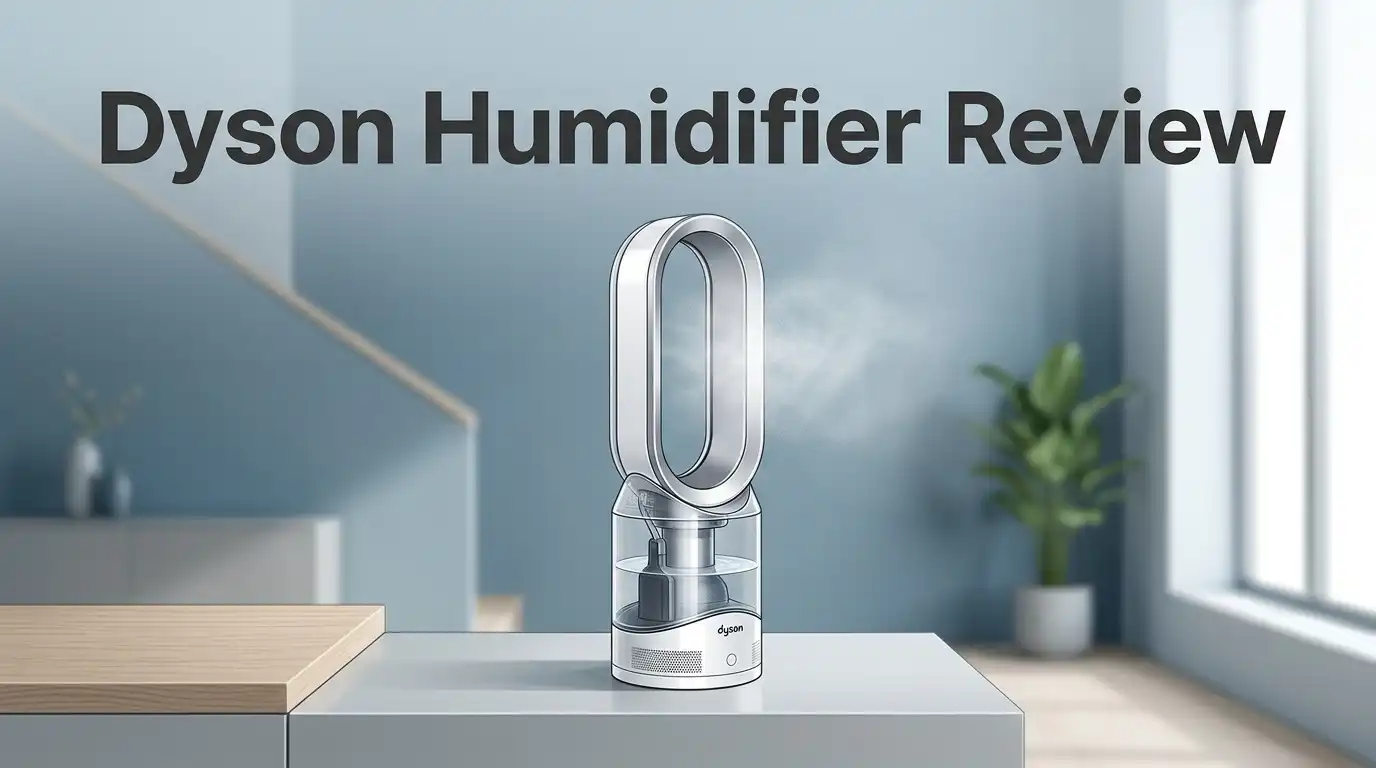
Air enters the base through a sealed filter stack. That stack holds a HEPA H13 layer plus activated carbon impregnated into the same material. The PH04 adds a catalytic Cryptomic layer that breaks formaldehyde into water and carbon dioxide. That layer never needs replacing, which is a genuinely clever piece of engineering.
Water sits in a one gallon tank at the back. A pump feeds an evaporator wheel, and ultraviolet light treats the water first. Dyson states the process kills 99.9% of bacteria in the water before any moisture leaves the machine. The air then exits through the loop amplifier at the top, carrying invisible humidity rather than visible mist.
This is the important distinction. The PH04 is not an ultrasonic humidifier. It does not spray a white plume. It does not leave white dust on your furniture. That alone solves the single most common complaint people have about cheap humidifiers.
The screen on the front shows live readings for PM2.5, PM10, VOCs, nitrogen dioxide, humidity, and temperature. You get actual numbers, not vague colored lights. For data lovers, that screen is half the fun of owning the thing.
The Unboxing Experience And First Setup
The box is big and heavy. The machine weighs about 18 pounds, so plan on carrying it with both arms rather than one hand.
Dyson packs everything in recycled cardboard with almost no plastic. Inside you get the base, the loop amplifier, the remote, a filter already seated in place, and a small sachet of citric acid for the first deep clean. Assembly takes one minute. The amplifier drops onto the base and clicks. That is it.
Two things stand out immediately. First, the build feels dense and expensive, closer to a piece of audio gear than a home appliance. Second, Dyson has covered the filter in bright plastic with a huge label telling you to remove it. You cannot miss it, and that thoughtfulness runs through the whole setup.
The remote is small, curved, and magnetic. It sticks to the top of the loop and stays there. This is the single best accessory Dyson makes, and it feels great in the hand.
Pairing with the MyDyson app took under a minute in my testing notes and in most published reviews. You scan a code on the machine, enter your WiFi password, and you are done.
Fill the tank at a sink, slide it back in, and press power. The first thing the machine does is prime the water pump, which makes a soft gurgling sound for about 20 seconds. That noise is normal. Many new owners panic about it needlessly.
Design, Build Quality, And Where To Put It
The PH04 stands about 36 inches tall and takes up roughly a one foot square of floor space. It looks like a piece of modern sculpture. Guests comment on it. No other humidifier gets that reaction.
The finish options include white with gold, nickel with gold, and white with silver. Panels fit tightly. Nothing rattles. The tank handle folds flat and feels solid after hundreds of refills.
Placement matters more than people expect. Dyson recommends putting it against a wall with a few feet of clearance in front. The oscillation only reaches 90 degrees, not the 350 degrees you get on the standard Dyson tower fans. The water tank in the base makes full rotation impossible, so side vents redirect airflow instead.
Do not put it on carpet in a corner. Airflow needs room, and humidity needs to spread. The best spot is a clear wall in the main living area or a bedroom corner with open floor in front.
One practical warning. The base holds a gallon of water, so you never want to drag the machine while it is full. Empty it first or use the two small wheels on the rear edge carefully. Water spilling into the electronics is not covered by cheerfulness alone.
The onboard controls are minimal. You get a power button and a deep clean button. Everything else requires the remote or the app, which becomes annoying the day the remote slides behind the sofa.
Top 3 Alternative for Dyson Purifier Humidify+Cool Formaldehyde PH04


Last update on 2026-10-03 / Affiliate links / Images from Amazon Product Advertising API
Levoit LV600S Smart Warm and Cool Mist Humidifier

Last update on 2026-10-03 / Affiliate links / Images from Amazon Product Advertising API
Honeywell HCM350B Cool Moisture Humidifier

Last update on 2026-10-03 / Affiliate links / Images from Amazon Product Advertising API
Vornado EVDC300 Energy Smart Evaporative Humidifier
Humidification Performance In Real Rooms
This is the section that actually matters. A humidifier must add moisture quickly and hold it steadily.
Independent lab testing recorded the PH04 moving a test room from 30% relative humidity to 60% in about 56 minutes. That is a respectable result for an evaporative machine, and it beats many mid priced units. The automatic mode then holds your chosen target well, adjusting fan speed as the sensor readings change.
The tank holds 1.1 gallons. Dyson advertises up to 36 hours of runtime, and that figure is honest only at low output in a small room. At moderate settings, real world runtime lands closer to 20 hours. Heavy winter use in a dry climate means daily refills.
Coverage is the catch. Dyson rates humidification for about 400 square feet. The purifier side claims far larger rooms, and marketing materials mix those numbers together. Do not expect one PH04 to humidify an open plan first floor. Owners who tried that report humidity stuck around 30% to 35% and constant tank refills.
In a normal bedroom of 150 to 250 square feet, performance is excellent. Air feels soft rather than damp. Nothing gets wet. No white dust appears on the nightstand.
The invisible output deserves praise. Because moisture evaporates rather than sprays, you cannot over humidify a surface. This is the cleanest form of humidification available, and Dyson executes it well.
Air Purification And Formaldehyde Removal
The PH04 uses a fully sealed filtration system. Dyson states it captures 99.97% of particles down to 0.3 microns, and the seals genuinely prevent air bypassing the filter.
Real testing tells a more modest story. Lab measurements of the closely related PH03 put the clean air delivery rate near 99.8 CFM, and it cleared a small test room of smoke particles in about 70 minutes. That performance sits in the same range as air purifiers costing $100 to $150.
So you are not buying class leading air cleaning. You are buying acceptable air cleaning inside a machine that also humidifies and cools. For a combination unit, it is the strongest performer available, which is a fair thing to value.
The formaldehyde feature is more interesting. A solid state sensor detects formaldehyde continuously, and the Cryptomic catalytic layer destroys it rather than trapping it. That layer never needs replacing, which removes a recurring cost. Formaldehyde comes from new furniture, paint, plywood, and flooring, so this matters most in newly renovated homes.
One technical criticism is valid. The carbon is impregnated into the HEPA material instead of sitting in a separate bed of pellets. Pellets offer more surface area and better odor control. Kitchen smells and smoke odors clear more slowly than on purifiers with dedicated carbon filters.
No ionizer is used, so the machine produces zero ozone. That is a real safety win.
Dyson Purifier Humidify+Cool PH03: The Cheaper Sibling

Last update on 2026-10-03 / Affiliate links / Images from Amazon Product Advertising API
The PH03 is the same machine without the formaldehyde hardware. Same tank, same filter stack, same app, same remote, same evaporative system.
You lose the solid state formaldehyde sensor and the Cryptomic layer. You keep everything else. If formaldehyde is not a concern in your home, the PH03 delivers nearly identical daily performance for meaningfully less money.
Discounts on the PH03 get aggressive. It has dropped to around $550 during sale events against a $950 list price. At that number the value equation changes completely, and the PH03 becomes the smarter buy in the Dyson lineup.
There is also the newer PH2 De NOx, which adds a K Carbon filter that captures 50% more nitrogen dioxide. That model targets people living near busy roads. Early owner discussion raises a concern worth knowing. Reports suggest the humidifier components on the PH2 are harder to access and clean than on the PH04 and PH03. If easy maintenance matters to you, the older models hold an advantage.
The PH3A is another variant. It drops app support and the formaldehyde layer to hit a lower price. Losing the app removes one of the genuine joys of ownership, so I would not recommend that trade.
All these models share the same replacement filter, which simplifies shopping for spares considerably.
Noise Levels And Sleeping With The PH04
Measured sound output on this platform runs from about 35 dB on speed one to 54 dB on speed ten. Those numbers are typical for a machine that doubles as a fan.
Speed one through four is comfortable for sleep. The sound is a smooth whoosh rather than a rattle, and it masks street noise reasonably well. Night mode dims the display to almost nothing and caps the fan speed, which solves the light problem that ruins many smart appliances in bedrooms.
Speeds seven and above are loud. You will turn the television volume up. Conversation gets harder. Nobody sleeps through it.
There is one noise the specification sheet ignores. The water pump cycles periodically, producing a short gurgle or trickle. Light sleepers notice this. Some owners find it soothing. Others find it maddening. I cannot predict which camp you fall into, and that uncertainty is a genuine reason to buy from a retailer with a good return window.
The deep clean cycle is also noisy and lasts about an hour, so run it during the day.
For comparison, dedicated ultrasonic humidifiers like the Levoit LV600S run near 26 dB because they have no fan pushing air across an evaporator. If absolute silence is your priority, an evaporative combination unit will never win that contest.
Water Tank, Deep Cleaning, And Real Maintenance Effort
Honest reviews talk about chores. This machine creates chores.
The tank slides out from the base and carries to a sink by a folding handle. Filling takes seconds. Dyson recommends the tank goes in the dishwasher occasionally, and it fits most racks.
The bigger job is the deep clean cycle. Every month, or whenever the screen asks, you empty the tank, add citric acid, and run a one hour automatic cleaning program that flushes the evaporator and the internal channels. Skipping this causes mineral scale, reduced output, and eventually error codes.
Hard water makes everything worse. Minerals build on the evaporator wheel and the water tray. Owners in hard water areas report needing the deep clean every two or three weeks.
The humidifier filter is washable rather than disposable, which is a nice cost saving. The main HEPA and carbon filter needs replacement roughly every 12 months. Genuine Dyson filters cost around $80, while third party two packs sell for about $60, bringing the effective cost to $30 each.
Add electricity. Continuous operation costs roughly $60 to $65 per year at average United States rates, since the machine draws about 42 watts at full speed and only a few watts at low speed.
Total running cost lands near $95 per year. That is reasonable for a machine doing three jobs.
The MyDyson App And Daily Controls
The app is the best software in this product category, and that is not a small compliment. Most appliance apps are terrible.
MyDyson pairs quickly, remembers multiple machines, and gives you full control over fan speed, oscillation, humidity target, night mode, and scheduling. It also logs air quality history, so you can see what happened in your bedroom at 2 a.m. or how cooking spiked your particle readings.
The history graphs are genuinely useful. They show you that vacuuming raises PM10 sharply, that candles are worse than you thought, and that outdoor pollution creeps indoors when windows open. That feedback loop changes household habits.
Voice control works through Alexa and Google Assistant. Simple commands like turning the machine on or setting a speed work reliably.
Now the criticism. Because the machine has only two physical buttons, the app and remote are not optional extras. They are the interface. Lose the remote and let the app log you out, and you are left with a power button and a cleaning button. Dyson should have put basic controls on the machine itself.
App connectivity also depends on Dyson’s servers. Brief outages happen. When they do, local remote control still works, so you are never fully stranded, but scheduling stops until service returns.
What The Dyson Humidifier Does Not Do Well
An honest review needs this section, so here it is plainly.
Reliability is the weakest point. Owner reports describe pump column failures, humidification simply stopping, and error codes appearing within weeks or months of purchase. Some buyers went through multiple units. Dyson customer service generally replaces faulty machines under the two year warranty, but the inconvenience is real and the pattern appears too often to ignore.
Coverage is oversold. The purifier figures and the humidifier figures are different, and casual shoppers conflate them. In a large or open space, humidity gains are disappointing.
Air cleaning value is poor per dollar. You can buy twice the cleaning power for one tenth of the price if that is all you need.
Odor removal is mediocre because the carbon is impregnated rather than pelletized.
Oscillation is limited to 90 degrees, far less than Dyson’s other fans.
It has no heating function. The PH04 cools only. If you want winter warmth, you need a different Dyson model entirely, and then you lose humidification.
Maintenance is ongoing, not occasional. Citric acid, monthly cycles, and daily refills are part of ownership.
None of these flaws make the machine bad. They make it a specific product for a specific buyer who values design, data, and space saving over raw performance per dollar.
Pros And Cons Of The Dyson Purifier Humidify+Cool Formaldehyde PH04
Pros
- Three appliances in one body, saving floor space and clutter in living rooms and bedrooms
- Invisible evaporative humidification that leaves no white dust and no wet surfaces
- Ultraviolet water treatment removes 99.9% of bacteria before moisture reaches the air
- Sealed HEPA H13 and carbon filtration with zero ozone output and no ionizer
- Formaldehyde sensor plus a catalytic layer that destroys formaldehyde and never needs replacing
- Live numeric readings for PM2.5, PM10, VOCs, nitrogen dioxide, humidity, and temperature
- Best in class app with air quality history, scheduling, and voice assistant support
- Excellent magnetic remote and beautiful industrial design that suits modern interiors
- Washable humidifier filter and automatic deep clean cycle reduce guesswork
- Two year warranty with responsive customer support
Cons
- Very high purchase price near $1,000 at list
- Humidification coverage limited to roughly 400 square feet
- Air cleaning power matches purifiers costing far less
- Reports of pump and humidifier failures raise reliability concerns
- Only two buttons on the machine, so the remote or app is essential
- Loud at speeds seven and above, and the water pump gurgles periodically
- Monthly citric acid deep clean required, more often with hard water
- Oscillation reaches only 90 degrees
- No heating mode
- Genuine replacement filters cost around $80
Who Should Buy It And Who Should Skip It
Buy the Dyson PH04 if your priorities line up in a specific way.
You should buy it if you want one machine instead of three, if you care about indoor air data, if you live in a newly renovated home with formaldehyde concerns, and if design genuinely matters in the room where it will sit. You should also buy it if white dust from ultrasonic humidifiers has annoyed you in the past, because evaporative output solves that problem completely.
You should skip it if your only goal is humidity. A Levoit LV600S or a Honeywell HCM350B delivers comparable moisture for a fraction of the cost. You should also skip it if you need to humidify a large open space, since one PH04 will struggle.
Wait for a sale if you can. The PH03 has fallen to around $550 from a $950 list price, and the PH04 sees similar discounts during major shopping events. At those prices the value argument becomes much stronger.
Consider a refurbished unit from Dyson directly. They carry warranty coverage and cost noticeably less.
My honest verdict is a qualified recommendation. This is a wonderful object and a good humidifier held back by a difficult price and uneven reliability. Buy it with a return window, register the warranty immediately, and run the deep clean on schedule.
Frequently Asked Questions
Does the Dyson humidifier leave white dust on furniture?
No. The PH04 uses evaporative humidification, not ultrasonic misting. Moisture leaves the machine as invisible water vapor, so minerals stay behind in the tank and the evaporator instead of settling on your shelves. This is one of the strongest practical advantages over cheap ultrasonic units.
How often do you need to refill the Dyson PH04 water tank?
Expect one refill per day with typical use. The tank holds 1.1 gallons. Dyson claims up to 36 hours at low output, and independent testing recorded closer to 20 hours at moderate settings. Dry climates and high humidity targets shorten that time further.
Can the Dyson PH04 heat a room?
No. The PH04 humidifies, purifies, and cools only. Dyson sells separate models with heating, but those units do not humidify. You cannot get all four functions in one Dyson machine today.
How much does it cost to run per year?
Roughly $95 per year with continuous use. That figure combines about $63 in electricity at average United States rates plus around $30 for a replacement filter. Third party filters lower the cost, while genuine Dyson filters raise it.
Is the Dyson humidifier good for babies and nurseries?
It works well for nurseries because the output is invisible and the water receives ultraviolet treatment. Night mode dims the display fully. The main drawbacks are the cost and the periodic pump gurgle, which may wake very light sleepers.
Does it need distilled water?
Tap water is fine. Dyson designed the system around normal tap water and includes a deep clean cycle to handle mineral scale. Hard water areas will need that cleaning cycle more frequently, roughly every two to three weeks instead of monthly.
Is the PH04 or PH03 the better buy?
The PH03 offers better value for most people. It performs identically in humidification, purification, and cooling. You only lose the formaldehyde sensor and catalytic layer. Choose the PH04 only if formaldehyde is a real concern in your home.

I’m Maya Brown, the voice behind Pure Breeze Vault. I write detailed, honest, and easy-to-follow air purifier reviews to help readers compare features, understand filter technologies, and choose products with confidence. My goal is to make research simpler, clearer, and more practical for anyone improving indoor air quality at home.