Dyson Purifier Hot+Cool Formaldehyde HP09 Review 2026: Still Worth It?
Air quality matters more than ever. Your home holds dust, pollen, pet dander, cooking fumes, and invisible gases that drift out of furniture and paint. Most people never notice them. A good purifier does.
The Dyson Purifier Hot+Cool Formaldehyde HP09 promises to handle all of that while also heating your room in winter and cooling it in summer. One machine. Three jobs. A price tag that makes most people pause.
I spent weeks living with this machine, running it through smoke tests, cold mornings, and hot afternoons. This review covers what the HP09 actually delivers in 2026, where it falls short, and whether the premium price still makes sense when cheaper rivals keep improving.
Key Takeaways
- Three machines in one body. The HP09 purifies air, heats rooms, and works as a bladeless fan. It covers spaces up to 800 square feet and oscillates across a full 350 degrees, which means air reaches every corner of a normal living room.
- Formaldehyde destruction is the headline feature. A selective catalytic oxidation filter breaks formaldehyde molecules into carbon dioxide and water. This filter never needs replacing, which saves money over the years.
- Purification speed impressed me. In testing, the machine dropped a PM2.5 reading from 200 down to 22 in roughly ten minutes inside a small office. Full recovery took about 19 minutes.
- Noise is the biggest weakness. Expect around 36dB at speed one and close to 78dB at speed ten. The heater adds extra noise on top. Quiet rivals manage 50dB at maximum.
- The price stays high. Retail sits near $849.99, though street prices drift lower during sales. Replacement HEPA and carbon filters cost around $79.99 each year.
- Buy it for versatility, not raw cleaning power. Pure air purifiers at half the price move more clean air per minute. You pay Dyson for design, sensors, heating, and the app.
Dyson Purifier Hot+Cool Formaldehyde HP09 Overview

Last update on 2026-11-17 / Affiliate links / Images from Amazon Product Advertising API
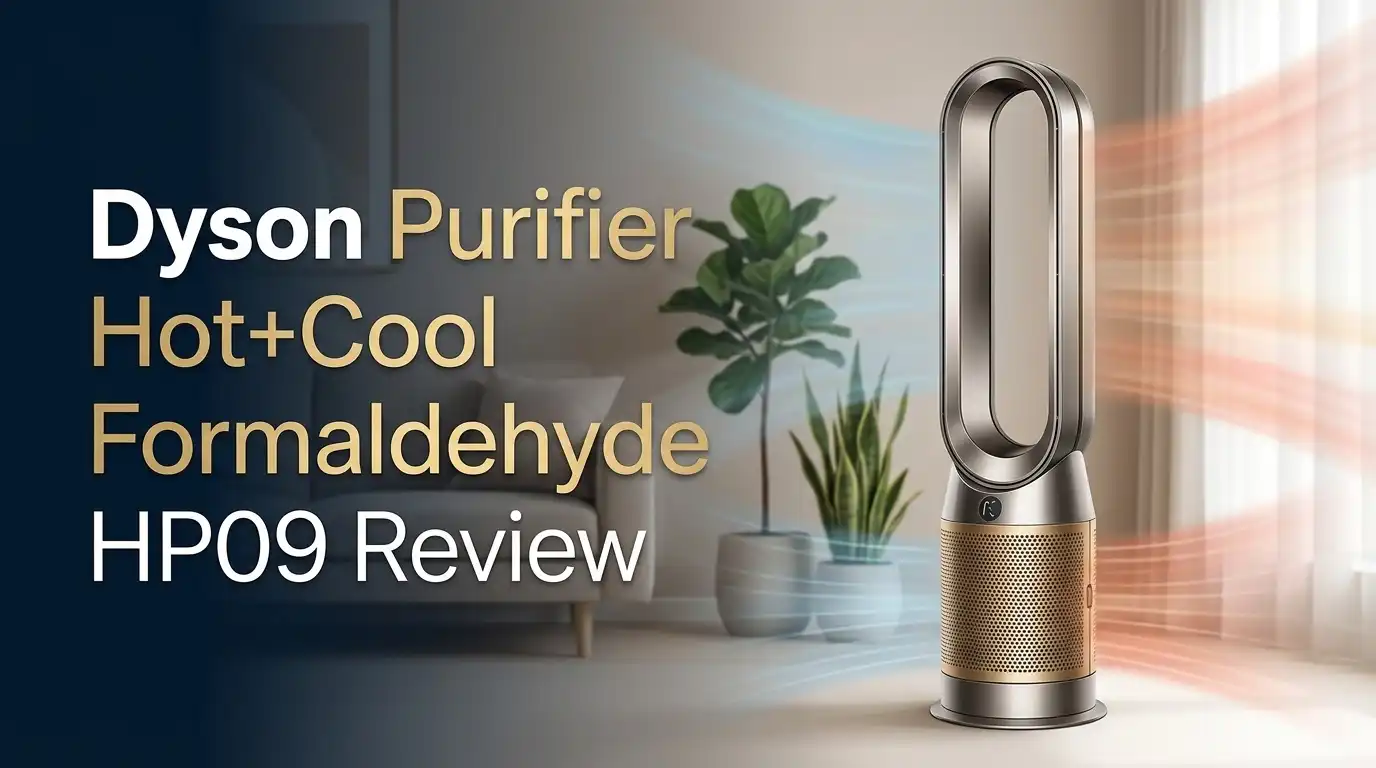
The HP09 sits at the top of Dyson’s heating purifier range. It stands 30 inches tall, measures 9.8 inches wide, and weighs 12.6 pounds. The white body with a gold base looks like sculpture rather than an appliance.
Inside the base sit two semicircular HEPA H13 filters and two activated carbon filters. Above them lives the catalytic filter that handles formaldehyde. A sealed housing stops dirty air from leaking back out.
The upper loop contains no blades. Air shoots through a thin aperture and pulls surrounding room air along with it. Dyson calls this Air Multiplier technology.
Sensors read PM2.5, PM10, formaldehyde, volatile organic compounds, nitrogen dioxide, temperature, and humidity. That sensor list beats almost every competitor on the market.
Unboxing Experience
The box arrives tall and surprisingly light. Dyson packs everything in moulded cardboard with no plastic foam, which feels good to unpack and easy to recycle.
Inside you find the main tower, the gold magnetic remote, two HEPA filter halves, two carbon filter halves, and a quick start guide with a QR code.
Assembly took me under five minutes. You pull the two outer covers off the base, slide the carbon filters in first, then press the HEPA filters over them until they click. The covers snap back on with a satisfying thunk.
The remote attaches magnetically to the top of the loop. It is a small detail, but it stops the remote from vanishing under the sofa. Plug in, press power, and the machine wakes up immediately.
Design and Build Quality
Dyson builds this machine like a premium product. The plastics feel dense. Panels line up cleanly. Nothing rattles when the unit oscillates.
The curved LED screen on the front displays air quality data in color. Green means good. Red means trouble. You can cycle through individual pollutant readings with the remote.
The base rotates smoothly across 45, 90, 180, or 350 degrees. Oscillation stays quiet and controlled, with no jerky movement.
At 12.6 pounds, carrying it between rooms is simple. There is no handle, so you grip the loop or the body.
My only design complaint involves the gold finish. It shows fingerprints quickly and needs regular wiping. The white version of the HP07 hides marks better.
Top 3 Alternative for Dyson Purifier Hot+Cool Formaldehyde HP09

Last update on 2026-11-17 / Affiliate links / Images from Amazon Product Advertising API
Dyson Purifier Hot+Cool HP07

Last update on 2026-11-18 / Affiliate links / Images from Amazon Product Advertising API
Shark 3 in 1 Air Purifier, Heater and Fan HC452

Last update on 2026-11-18 / Affiliate links / Images from Amazon Product Advertising API
Dreo Air Purifier Tower Fan Combo
Air Purification Performance
I ran the standard incense test in a 110 square foot office. The baseline PM2.5 reading sat at 01. I burned incense for ten minutes and watched the reading climb to 225.
With auto mode engaged, the fan jumped to high speed on its own. Three minutes later the reading showed 94. Six minutes in, it read 50. At ten minutes, it hit 22.
Full return to the original reading took 19 minutes. That is solid performance for a 110 square foot space.
Scale that up, though, and the picture changes. In larger rooms the HP09 works slower than dedicated purifiers with bigger fans. Independent testing labs rate its clean air delivery rate below many cheaper tower units.
It cleans well. It does not clean fastest.
Formaldehyde Detection and Destruction
This feature separates the HP09 from the HP07. Formaldehyde leaks out of plywood, pressed wood furniture, varnishes, glues, and some cleaning products. It is colorless and easy to ignore.
A solid state sensor monitors formaldehyde continuously and reports the level on screen and in the app. The reading updates in real time.
The catalytic filter then handles removal. Instead of trapping the molecules, it breaks them apart into carbon dioxide and water. Nothing saturates. Nothing needs swapping out.
This filter is permanent, which is genuinely rare. Carbon filters in other machines eventually fill up and stop absorbing gases.
Whether you need this depends on your home. New furniture and recent renovations push formaldehyde higher. Older settled homes often show readings near zero all day.
Heating Performance
The HP09 uses positive temperature coefficient ceramic heating plates with built in thermostats. You set a target temperature between 33 and 99 degrees Fahrenheit.
In my 110 square foot office, the machine lifted the room from 65 degrees to 75 degrees in ten minutes. Another eight minutes pushed it to 80 degrees.
That speed is respectable for a space heater. The 350 degree oscillation spreads warmth evenly instead of baking one spot.
One safety rule applies. You cannot control heating from the app. Dyson restricts heat activation to the physical remote and onboard controls, which prevents accidental remote startup.
Heating a large open plan room takes much longer. This machine suits bedrooms, offices, and small living rooms rather than cavernous spaces.
Cooling and Fan Performance
Ten fan speeds give you fine control. Speed one barely whispers. Speed ten pushes a strong column of air across a room.
The bladeless loop produces smooth airflow with no choppy pulsing. People sensitive to fan buffeting usually find it comfortable.
You can switch airflow direction. Front projection sends air at you for direct cooling. Rear diffusion pushes air backward, which circulates and purifies without a draft. The rear setting is excellent in winter.
Remember what this is. The HP09 is a fan, not an air conditioner. It moves air and creates a wind chill effect on your skin. It does not lower the actual room temperature.
On very hot days, the cooling feels pleasant but limited. Manage expectations here.
Noise Levels and Real World Living
Noise is where this machine frustrates people. Measured output reaches roughly 36dB at speed one, around 58dB at speed five, and close to 78dB at speed ten.
For comparison, quieter premium purifiers top out near 50dB. The difference is significant.
Night mode helps. It dims the display and drops the fan to its lowest setting. I slept comfortably with night mode running every night.
The heater creates a second noise issue. Some owners report clicking and ticking sounds as the ceramic elements cycle on and off. Mine produced faint ticks during warmup.
Speeds one through four work fine for background use. Anything above speed six turns the machine into a conversation stopper.
Smart Features and the MyDyson App
Setup through the MyDyson app took about four minutes. The app pairs over Bluetooth, then connects the machine to your dual band WiFi network.
The main screen shows indoor and outdoor air quality side by side. You see temperature, humidity, and the dominant pollutant at a glance.
Swipe up and historical charts appear for every measurement. You can review the past day, week, month, or year. These graphs are genuinely useful for spotting pollution patterns, like cooking spikes at dinner time.
Voice control works with Alexa and Google Home. Siri shortcuts function too.
Two gaps exist. There is no Apple HomeKit support and no IFTTT integration. Smart home enthusiasts will notice both absences.
Filter Life and Running Costs
The combined HEPA and activated carbon filter carries a 12 month rating based on roughly 12 hours of daily use. Replacements cost around $79.99.
The catalytic formaldehyde filter lasts the life of the machine. No replacement cost ever.
The app tracks remaining filter life as a percentage and sends a reminder when the time approaches. After fitting a new filter, you reset the counter through the remote or app.
Electricity use varies hugely by mode. Purification alone draws modest power. Heating draws up to 1575 watts, similar to any ceramic space heater.
Running the heater all winter will show up on your bill. Budget realistically. Over five years, filters alone add roughly $400 to ownership cost.
What the Dyson HP09 Does Not Do Well
Honest reviews list the weak points. Here they are.
The machine is loud above mid speeds. Full power sounds like a hairdryer in the next room.
Clean air delivery rate lags behind cheaper purifiers. Dedicated units with wider intakes clear large rooms faster for less money.
The 800 square foot coverage claim assumes ideal conditions. Realistically, performance feels strongest under 400 square feet.
It is not a humidifier and not an air conditioner. Dry winter air stays dry.
The remote is small, gold, and easy to lose despite the magnet. Replacements are hard to source and the heater will not operate without one.
Finally, the price stings. You are paying a large design premium over function.
Pros and Cons
Pros
- Three appliances in one body, saving floor space and clutter in small rooms
- Real formaldehyde detection and permanent catalytic destruction, a feature almost no rival matches
- Excellent sensor suite covering PM2.5, PM10, VOCs, nitrogen dioxide, temperature, and humidity
- Fully sealed HEPA H13 filtration that stops pollutants leaking back into the room
- Smooth 350 degree oscillation that spreads clean air and heat across the whole room
- Polished MyDyson app with detailed history charts and reliable voice assistant support
- Fast heating performance that warms a small room within ten minutes
- Premium build quality and a two year warranty
Cons
- Very loud at high fan speeds, reaching roughly 78dB at maximum
- High purchase price compared with purifiers that clean faster
- Annual filter cost of around $79.99 adds up over time
- No Apple HomeKit or IFTTT support for advanced smart homes
- Heating cannot be controlled through the app for safety reasons
- Coverage claim feels optimistic for genuinely large open spaces
- Gold finish attracts fingerprints and needs frequent cleaning
Dyson HP09 vs Dyson HP07
These two machines share the same body, same fan, same heater, and same app. The differences are narrow but meaningful.
The HP09 adds a formaldehyde sensor and the permanent catalytic filter. The HP07 has neither. The HP09 also comes in white and gold, while the HP07 wears white and silver.
Price separates them by roughly $100 at retail, though sale pricing shifts constantly.
Choose the HP09 if your home has new furniture, fresh paint, recent renovation work, or laminate flooring. Those sources release formaldehyde.
Choose the HP07 if your home is older and settled. You get identical purification, heating, and cooling for less money.
Owners who have used both report nearly identical noise levels, despite early rumors that the HP09 ran louder.
Final Verdict on the Dyson Purifier Hot+Cool Formaldehyde HP09
Last update on 2026-11-17 / Affiliate links / Images from Amazon Product Advertising API
The HP09 earns its reputation, with caveats. It purifies quickly in small and medium rooms, heats fast, moves air smoothly, and reports more air quality data than almost anything else you can buy.
The formaldehyde system is the standout. Permanent catalytic filtration removes an ongoing cost and solves a problem most purifiers ignore entirely.
Noise and price remain the obstacles. If you only want clean air, a Coway or Levoit unit will clear a room faster for a fraction of the cost.
Buy the HP09 if you want one elegant machine replacing three, and you value data and design. Skip it if raw cleaning performance per dollar is your priority. In 2026, it is still a very good product sold at a very confident price.
Frequently Asked Questions
Does the Dyson HP09 really remove formaldehyde?
Yes. The selective catalytic oxidation filter breaks formaldehyde molecules down into carbon dioxide and water rather than trapping them. The onboard sensor shows live readings so you can watch levels fall.
How often do I need to replace the HP09 filters?
The combined HEPA and carbon filter lasts around 12 months with 12 hours of daily use. The catalytic formaldehyde filter is permanent and never needs replacement.
Is the Dyson HP09 loud?
At low speeds it stays quiet, around 36dB. At maximum speed it reaches roughly 78dB, which is noticeably loud. Night mode keeps it quiet for sleeping.
Can the HP09 cool a room like an air conditioner?
No. It is a bladeless fan that moves air and creates a cooling sensation on your skin. It does not reduce actual room temperature.
Does the HP09 work with Apple HomeKit?
No. It supports Alexa, Google Home, and Siri shortcuts through the MyDyson app, but HomeKit and IFTTT are not supported.
What room size suits the Dyson HP09 best?
Dyson rates it for spaces up to 800 square feet. In practice, it performs strongest in rooms under 400 square feet.
Is the HP09 worth the extra money over the HP07?
It depends on your home. If you have new furniture, fresh paint, or recent renovations, the formaldehyde feature justifies the cost. Otherwise the HP07 delivers the same core performance for less.

I’m Maya Brown, the voice behind Pure Breeze Vault. I write detailed, honest, and easy-to-follow air purifier reviews to help readers compare features, understand filter technologies, and choose products with confidence. My goal is to make research simpler, clearer, and more practical for anyone improving indoor air quality at home.