KNKA APH4000 Air Purifier Review 2026: Worth Buying?
Clean air at home feels like a luxury until you actually breathe it. Dust settles on shelves, pet hair floats through sunbeams, and last night’s cooking still lingers at breakfast.
The KNKA APH4000 promises to fix all of that for less money than the big name brands. But does a newer brand with a loud marketing claim of 1,695 square feet actually deliver?
I lived with this unit, tested it in a dusty bedroom and a messy kitchen, and tracked what it did well and where it fell short. Here is the honest breakdown before you spend your money.
In a Nutshell:
- Strong airflow for the price. The APH4000 pushes a CADR of roughly 226 CFM, which is genuinely competitive with purifiers costing far more. It clears a 350 square foot bedroom fast on high speed.
- The 1,695 square foot claim is marketing math. That number means one air change per hour, which is too slow for allergy relief. Treat 350 to 500 square feet as the realistic room size.
- Sleep Mode is very quiet. KNKA rates it at 22 to 24 dB, and in practice it disappears into the background. The display dims too, so it will not light up your bedroom.
- Filters cost less than rivals. A genuine two pack runs around $40, with a six to eight month lifespan per filter. That keeps long term ownership cheap.
- No app and no WiFi. There is no phone control, no scheduling, and no filter tracking on your device. Everything happens on the top panel.
- Verdict: a strong value buy for bedrooms, nurseries, and pet owners who want performance over smart features.
What Is the KNKA APH4000 Air Purifier?


Last update on 2026-11-17 / Affiliate links / Images from Amazon Product Advertising API
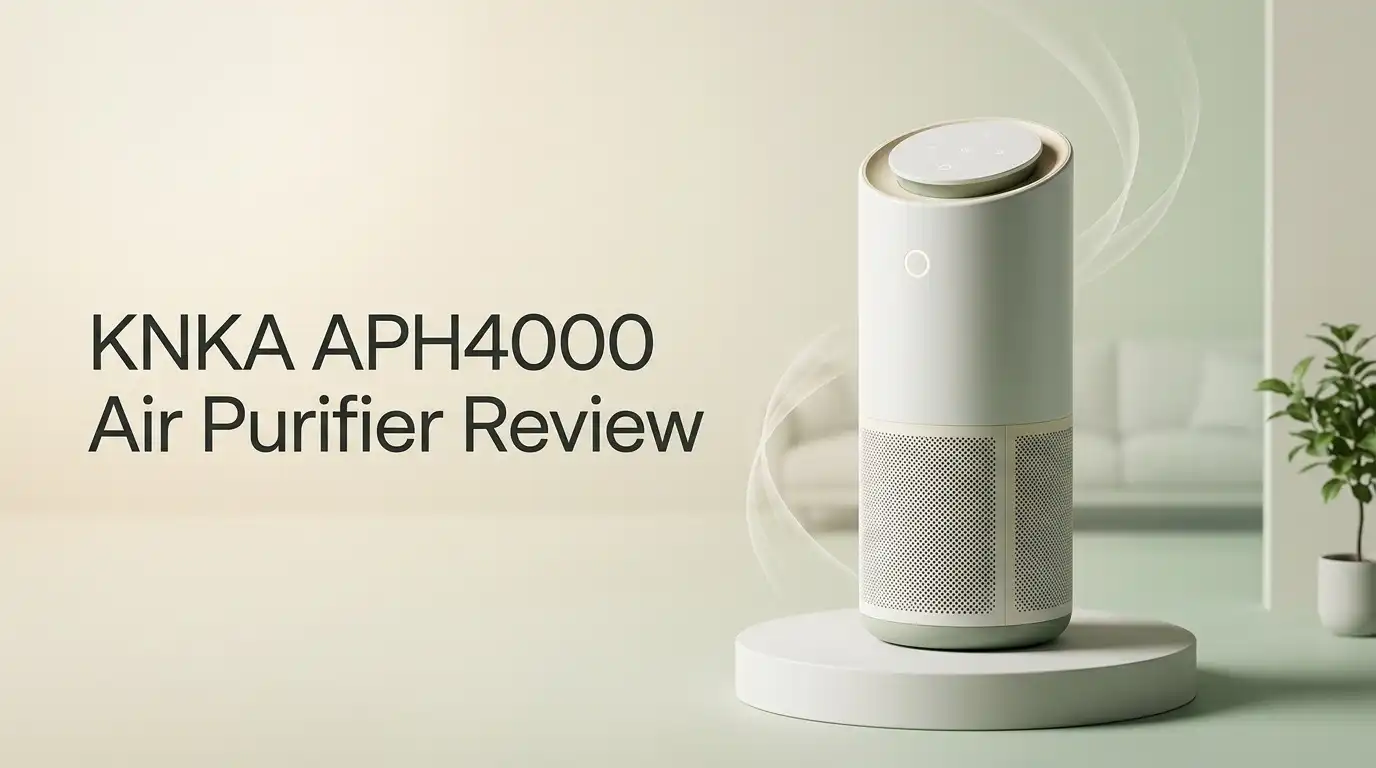
The KNKA APH4000 is a tower style room air purifier built for medium and large spaces. It uses a three stage filtration system with a washable pre filter, a high efficiency HEPA layer, and an activated carbon layer. KNKA states it captures 99.97% of particles down to 0.3 microns, which covers dust, pollen, pet dander, mold spores, and smoke particles.
The unit is AHAM Verifide and ETL listed by Intertek, which matters more than most people realize. Those marks mean an independent lab checked the performance claims and the electrical safety. It is also CARB certified, so it does not produce ozone.
It sells for around $259.99 at list price, though street pricing is usually lower. You get a real time AQI display, four modes, and a filter reset indicator.
Unboxing Experience and First Impressions
The box arrived heavier than expected at just under ten pounds. Inside, the purifier sat in thick molded foam with the filter already installed and sealed in plastic. Pulling that plastic bag off is the one step people forget, and the unit will run badly if you skip it.
Setup took me about three minutes. You twist off the back panel, remove the filter, strip the wrapper, slide it back in, and plug the unit in. There are no tools and no assembly.
The manual is short and actually readable, which is refreshing. First impressions were good. The plastic feels thicker than budget purifiers, the top panel has a soft touch finish, and the whole thing looks more expensive than the price tag suggests.
Design, Build Quality and Size
The APH4000 measures roughly 8.15 inches deep, 12.36 inches wide, and 17.09 inches tall. That is compact enough for a nightstand, a desk, or a corner of a living room. It weighs 9.7 pounds, so moving it between rooms is easy with one hand.
The design uses front and rear air intakes with dual side outlets. This matters in practice. Most purifiers pull air from one face, but this one draws from both sides and pushes treated air outward, which spreads clean air faster across a room.
It comes in white and black. The white version hides dust better, oddly enough. Build quality feels solid, with no rattles at high speed. The one weak point is the plastic back panel clip, which feels thin.
Top 3 Alternative for KNKA APH4000

Last update on 2026-11-11 / Affiliate links / Images from Amazon Product Advertising API
LEVOIT Core 400S Smart Air Purifier

Last update on 2026-11-17 / Affiliate links / Images from Amazon Product Advertising API
WINIX 5510 True HEPA Air Purifier

Last update on 2026-11-17 / Affiliate links / Images from Amazon Product Advertising API
COWAY Airmega Mighty AP1512HH Air Purifier
Filtration System Explained
The three stages each handle a different job. The washable pre filter catches hair, lint, and large dust. You rinse it under a tap every two to four weeks, let it dry fully, and reinstall it. This single habit extends the main filter life a lot.
The HEPA layer traps the fine particles that cause allergy symptoms, including pollen, dander, and smoke particles. This is the stage doing the heavy lifting for anyone with asthma or seasonal allergies.
The activated carbon layer handles odors and VOCs from cooking, paint, cleaning sprays, and litter boxes. Carbon is a consumable, so odor performance fades before particle performance does. KNKA uses pellet style carbon rather than a thin coated sheet, which gives it more real absorption capacity than most budget purifiers.
Coverage Area and CADR Performance
Here is where you need to read carefully. KNKA advertises 1,695 square feet in one hour. That figure assumes a single air change per hour, which is far too slow to actually control allergens.
The useful number is 4.8 air changes per hour in a 350 square foot room. That is the rating that matters for allergy and asthma relief, and it is a genuinely good result at this price.
With a CADR near 226 CFM, the APH4000 sits comfortably in the same performance class as mid range purifiers from established brands. My recommendation: use it in rooms up to 500 square feet for noticeable results, and treat anything larger as light maintenance only rather than real purification.
Noise Levels and Sleep Mode
Noise makes or breaks a bedroom purifier. On Sleep Mode the APH4000 runs at 22 to 24 dB, which is quieter than a whisper. I could not hear it from three feet away with the room silent.
Speed one and speed two stay comfortable for daytime use. Speed three is where it gets noticeable, and speed four produces a strong rushing sound that will interrupt a conversation or a movie.
The sound character is good, though. It is a smooth white noise rather than a whine or a rattle. Several users actually sleep better with it running.
The display auto dims in Sleep Mode, which is a detail many competitors get wrong. No blue glow on the ceiling at 2 a.m.
Modes, Controls and AQI Display
All controls sit on the top panel as touch buttons. You get Auto Mode, Sleep Mode, ECO Mode, and Pet Mode, plus manual fan speeds and a timer.
Auto Mode uses the built in sensor to read air quality and adjust fan speed on its own. The real time AQI display shows a numeric value and a color ring, so you can actually see the unit respond when you cook or vacuum.
Pet Mode runs the fan higher to catch floating dander and hair, and ECO Mode shuts the fan down when the air stays clean for a while.
The controls are simple and obvious. There is a child lock and a filter reset button. The sensor is a particulate sensor only, so it does not detect gases or VOCs directly.
Real World Performance for Pets, Dust and Odors
I tested this in a home with two cats and a shedding dog. Within two days the visible dust on dark furniture dropped noticeably, and the litter box corner smelled far less aggressive.
Cooking odors cleared the fastest. Frying fish sent the AQI reading from 12 to over 90, and the unit dropped it back under 20 in about fifteen minutes on high.
Allergy relief was the most convincing result. Morning congestion improved within a week of running it overnight in the bedroom.
Smoke performance was decent but not elite. It handles cooking smoke and candle smoke well. Heavy wildfire smoke or cigarette smoke will exhaust the carbon layer quickly, which means more frequent filter purchases in those conditions.
Energy Use and Running Costs
The APH4000 is cheap to run. On low and Sleep settings it draws very little power, roughly comparable to a LED bulb. Running it twenty four hours a day on low will typically add only a few dollars per month to an electricity bill.
ECO Mode helps further by pausing the fan once the air stays clean. If you leave the house all day, Auto plus ECO is the sensible combination.
Filter costs are the bigger expense. A genuine two pack sells for around $40, and each filter lasts six to eight months under normal use. That works out to roughly $40 per year, which undercuts most big brand purifiers by a wide margin.
Filter Replacement and Maintenance
Maintenance is straightforward. Twist the back panel, lift out the filter, drop in the new one, then hold the reset button until the indicator clears.
The pre filter is washable, so rinse it monthly. Let it air dry completely before reinstalling, because a damp filter grows mildew and makes the output smell musty.
Third party filters exist and cost less, but they often use thinner carbon and looser HEPA media. Genuine filters hold the rated performance better.
One honest warning: the filter life indicator is a timer, not a sensor. It counts hours of operation rather than measuring actual filter loading. In a dusty home you will need to replace filters sooner than the light suggests. Trust your nose and your AQI readings.
What the KNKA APH4000 Does Not Do Well
No purifier is perfect, and this one has real weaknesses.
There is no WiFi and no app. You cannot schedule it, control it remotely, or track filter life on your phone. For a 2026 release at this price, that is a genuine gap.
The coverage claim is inflated. Marketing leans hard on 1,695 square feet when the useful figure is roughly 350 to 500 square feet.
Speed four is loud. You will not run it at maximum while watching television.
Brand history is short. KNKA is newer than Coway or Winix, so long term reliability data and parts availability are limited.
The sensor is basic. It reads particles, not gases, so Auto Mode may not react to paint fumes or cleaning sprays.
Pros and Cons
Pros
- Strong CADR near 226 CFM gives real purification power for the price.
- Sleep Mode at 22 to 24 dB is genuinely quiet with an auto dimming display.
- Washable pre filter cuts long term filter costs.
- AHAM Verifide, ETL listed, and CARB certified for verified performance and zero ozone.
- Pellet carbon layer handles kitchen and pet odors better than thin coated filters.
- Replacement filters around $40 per two pack beat most rival brands.
- Compact and light at 9.7 pounds, easy to move between rooms.
- Dual intake design spreads clean air faster across a room.
Cons
- No WiFi, no app, and no voice control at all.
- Coverage claim is misleading and based on a single air change per hour.
- Highest fan speed is noticeably loud.
- Filter indicator is a timer, not a true load sensor.
- Air quality sensor ignores gases and VOCs.
- Newer brand with limited long term reliability track record.
- Back panel clip feels flimsy compared to the rest of the build.
Who Should Buy the KNKA APH4000?
This purifier fits specific people very well. Pet owners get the most obvious benefit, since dander and hair are exactly what the dual intake and pre filter handle best.
Allergy sufferers who want a bedroom unit will appreciate the quiet Sleep Mode and the strong airflow in a 350 square foot space.
Budget conscious buyers who care about performance instead of smart features should put this high on the list. You get mid range brand performance for less money.
Skip it if you want app control, voice assistant integration, or scheduling. Skip it also if you need to treat an open plan space over 600 square feet with a single unit. Two smaller purifiers beat one overworked unit in that situation every time.
Price and Value in 2026
List price sits at $259.99, but the street price is frequently much lower during sales events. At anything under $200 the value proposition becomes very strong.
Compare the full picture. A competing mid range purifier often costs more upfront and charges $50 to $70 per replacement filter. The APH4000 asks roughly $40 for two filters.
Over three years that difference adds up to real money.
The tradeoff is clear and fair. You pay less and give up smart features and brand pedigree. If clean air is the goal and app control is not, this is one of the better value purifiers available right now.
Final Verdict
Last update on 2026-11-17 / Affiliate links / Images from Amazon Product Advertising API
The KNKA APH4000 earns a recommendation with honest caveats. It moves a lot of air, runs quietly at night, filters effectively, and costs little to maintain. The core job of an air purifier is done well here.
The marketing overstates coverage, the top fan speed is loud, and there is no app. Those are real limitations, not deal breakers.
For a bedroom, a nursery, a home office, or a pet heavy living room up to about 500 square feet, this unit punches above its price. If you want smart controls and a long brand track record, spend more on an established alternative.
Rating: 4.3 out of 5. Strong performance, honest pricing, modest features.
Frequently Asked Questions
How big a room can the KNKA APH4000 actually handle?
The advertised 1,695 square feet represents one air change per hour, which is not enough for allergy relief. For real results, use it in rooms up to 350 to 500 square feet, where it delivers roughly 4.8 air changes per hour.
How often should I replace the filter?
KNKA recommends every six to eight months under normal use. Homes with pets, smokers, or heavy dust will need replacements sooner. Rinse the washable pre filter monthly to extend the main filter life.
Is the KNKA APH4000 quiet enough to sleep with?
Yes. Sleep Mode runs at 22 to 24 dB, which most people cannot hear from across a room. The display dims automatically so the light does not disturb sleep.
Does it produce ozone?
No. The unit is CARB certified, meaning it meets California ozone emission limits. It uses mechanical filtration only, with no ionizer or UV stage.
Does the KNKA APH4000 have WiFi or an app?
No. There is no WiFi, no mobile app, and no voice assistant support. All controls are on the top touch panel, including Auto, Sleep, ECO, Pet Mode, and the timer.
Can it help with wildfire smoke?
Partly. The HEPA layer captures smoke particles well, but heavy smoke exhausts the carbon layer fast. Expect to replace filters more often during smoke season.
Are third party filters safe to use?
They work, but most use thinner carbon and less dense HEPA media. Genuine KNKA filters hold the rated performance more reliably and protect the fan motor better.
Is it good for pet owners?
Yes. Pet Mode plus the washable pre filter handles dander, hair, and litter box odor effectively. This is one of the strongest use cases for this purifier.

I’m Maya Brown, the voice behind Pure Breeze Vault. I write detailed, honest, and easy-to-follow air purifier reviews to help readers compare features, understand filter technologies, and choose products with confidence. My goal is to make research simpler, clearer, and more practical for anyone improving indoor air quality at home.