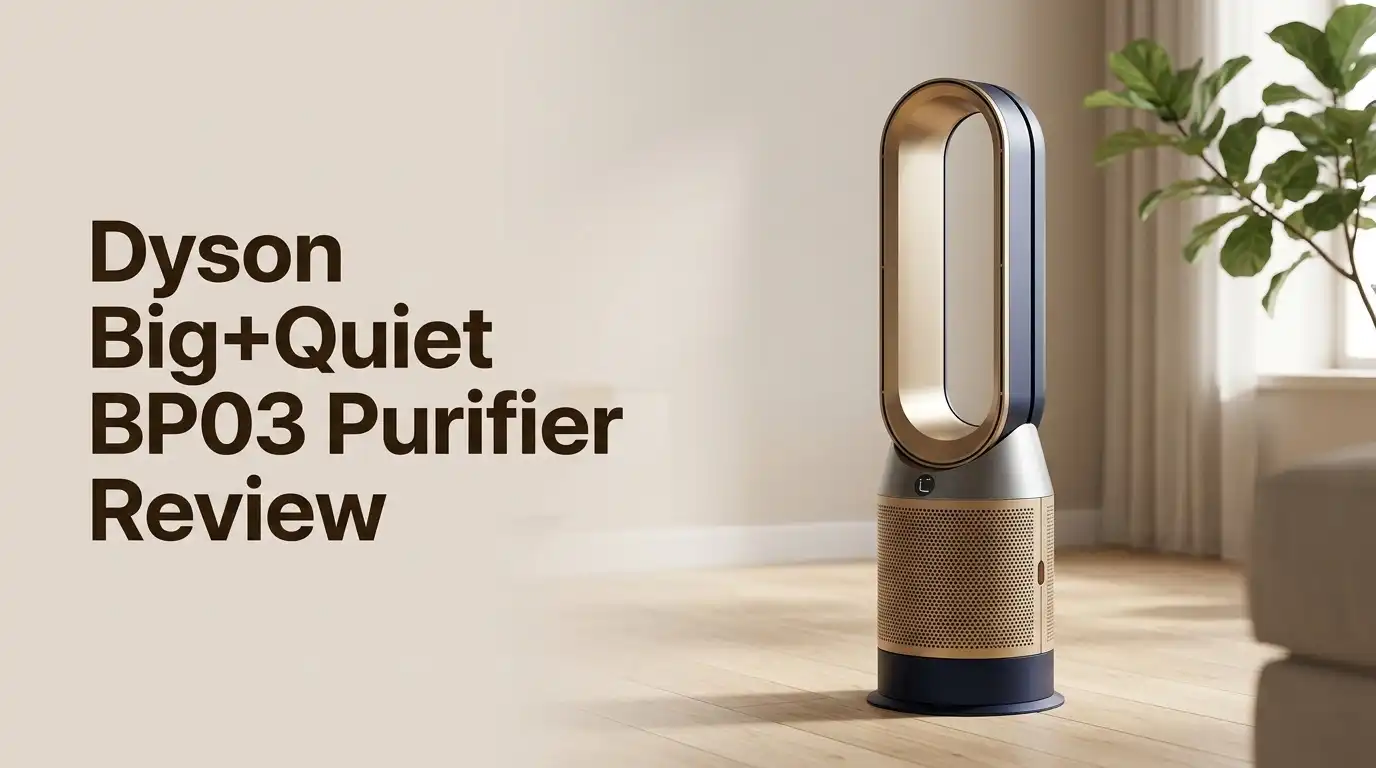
Dyson Big+Quiet BP03 Purifier Review 2026: Worth It?
Big rooms create big air problems. A small purifier spins its fan all day and still misses the far corner. The Dyson Purifier Big+Quiet Formaldehyde BP03 promises a fix. It throws clean air more than 32 feet across a room and claims coverage up to 1,076 square feet. It also runs quietly enough to sit beside your sofa.
But this machine costs around $999. That is real money. So the honest question is simple. Does the BP03 earn that price in 2026, or are cheaper purifiers just as good?
I dug into lab testing data, owner feedback, and the full spec sheet to answer that. Keep reading for the parts Dyson does not advertise.
In A Nutshell:
- Coverage is the headline feature. The BP03 handles rooms up to 1,076 square feet and projects purified air over 32 feet. Most rival purifiers struggle past 600 square feet in real use.
- Purification speed is genuinely fast. In independent incense testing, PM2.5 dropped from a reading of 200 down to a safe green level in roughly 10 minutes, with full clearing at 13 minutes.
- It really is quiet. Measured output sits near 38 dB on low and 50 dB on high. That is library quiet at the bottom and conversation level at the top.
- Filter costs look scary but stretch far. The HEPA filter lasts up to five years at $169.99. The carbon filter lasts two years at $89.99. Over five years that beats many cheaper machines.
- The price is the main weakness. You pay a strong premium for design, sensors, and the app. Raw clean air delivery per dollar is better elsewhere.
- No CO2 sensor and no humidifier. The pricier BP04 adds carbon dioxide sensing. The BP03 skips it.
What Is The Dyson Big+Quiet BP03?


Last update on 2026-11-17 / Affiliate links / Images from Amazon Product Advertising API
The BP03 is Dyson’s large format air purifier. It sits at the base of the Big+Quiet family, below the BP04 and the newer BP06. The machine uses a sealed three stage filter system. That means a HEPA H13 grade filter, a wrap around activated carbon layer, and a catalytic oxidation filter that breaks down formaldehyde.
The fan sits on top in a tilted silver cone. Dyson calls it a conic amplifier. It merges two air streams into one focused jet. The result is 21 gallons of purified air pushed out every second.
This is not a bedside gadget. It stands 32.6 inches tall and weighs 26.2 pounds. Dyson built it for living rooms, open plan kitchens, studios, and offices where small purifiers simply give up.
Unboxing And First Impressions
The box arrives heavy and tall. Dyson packs the unit in two main parts. The cylindrical base holds the filters. The fan head sits separately in molded pulp trays. You also get a slim magnetic remote, a quick start card, and a warranty leaflet.
Assembly takes about one minute. You drop the fan head onto the base and twist until you hear a firm click. That click feels satisfying. No tools and no screws are involved.
The first thing you notice is scale. Photos do not prepare you for how wide the cone actually is. The second thing you notice is the weight. Thankfully five small casters sit underneath, so you can roll it across hardwood with one hand.
The remote snaps onto the front magnetically. It is a small touch, but it stops the remote from vanishing into sofa cushions.
Design And Build Quality
Dyson gave the BP03 a Bright Nickel and Prussian Blue finish. The base feels dense and solid. Panels fit tightly with no creaking when you lift it. The casters roll smoothly and lock nothing, so the unit glides easily.
A one inch color LCD sits in the center of the fan dome. It shows live air readings. The screen is small, but it stays readable from a few feet away.
Here is the honest design critique. The BP03 is large and visually loud. It looks like equipment, not furniture. In a minimal living room it becomes the focal point whether you want that or not.
Build quality, though, is excellent. The materials feel worth the money even if the footprint does not suit every space. Owners report the finish holds up well after years of daily use.
Top 3 Alternative for Dyson Big+Quiet BP03

Last update on 2026-11-18 / Affiliate links / Images from Amazon Product Advertising API
Coway Airmega 400S

Last update on 2026-11-17 / Affiliate links / Images from Amazon Product Advertising API
Levoit Core 600S

Last update on 2026-11-19 / Affiliate links / Images from Amazon Product Advertising API
Blueair Blue Pure 311i Max
Filtration System Explained
The BP03 uses a fully sealed 360 degree filtration path. Air enters all around the base, so nothing leaks past the filter media. That sealing matters more than most buyers realize.
The first stage is a HEPA H13 grade filter. It captures 99.97% of particles down to 0.3 microns. That covers pollen, pet dander, dust, smoke particles, and bacteria.
The second stage is an activated carbon layer. It absorbs cooking smells, aerosol fumes, and general volatile organic compounds.
The third stage is the selective catalytic oxidation filter. This part targets formaldehyde. It breaks formaldehyde down into tiny amounts of water and carbon dioxide instead of trapping it. Because it destroys rather than stores, this filter never needs replacing.
Formaldehyde comes from new furniture, paint, flooring, and plywood. If you recently renovated, this stage has real value.
Real World Purification Performance
Independent testing tells a clear story. A reviewer placed the BP03 in a 110 square foot room with a baseline PM2.5 reading of 02. They burned incense for ten minutes until the display hit 200 and glowed purple.
The machine then ran in Auto mode. After three minutes the reading fell to 65. After six minutes it reached 40. At the ten minute mark the reading sat at 16 with a green indicator. Full return to the starting level of 02 took 13 minutes.
That is quick work for a room of that size. For comparison, a well regarded rival took 16 minutes to fully scrub the same space.
Auto mode responds fast too. Cooking smoke or a lit candle triggers a fan speed jump within seconds. You do not have to babysit the controls.
Noise Levels And Nighttime Use
Dyson named this machine Big+Quiet for a reason. Measured output lands at roughly 38 dB on the lowest speed and 50 dB on the highest. The low setting is barely audible. You notice it only when it stops.
The high setting produces a deeper whoosh rather than a high pitched whine. That tone is easier to ignore. Dyson achieved this partly through the cone shape, which reduces turbulence.
Night Mode dims the display and caps the fan speed. It works well in bedrooms.
One caveat deserves mention. Some owners report a popping or clicking noise when the oscillation reaches the zero degree position. Others mention motor bearing noise developing over time. These reports are not universal, but they appear often enough to note. The warranty covers such faults.
Sensors And The Display Screen
The BP03 packs a solid sensor array. It tracks PM2.5, PM10, nitrogen dioxide, volatile organic compounds, temperature, and humidity. You cycle through readings using the Information button on the remote.
Color coding keeps things simple. Green means good. Yellow means fair. Orange means poor. Red means very poor. Dark red and purple mean worse.
The sensors react quickly and accurately. Light a match across the room and the numbers climb within moments.
What is missing is a carbon dioxide sensor. The BP04 includes one. The BP03 does not. If you want to monitor stuffiness and ventilation quality, that absence stings at this price.
The one inch screen also limits detail. You see one metric at a time. The app gives a far fuller picture.
MyDyson App And Smart Controls
Setup through the MyDyson app takes a few minutes. Bluetooth finds the machine instantly. You then select your network, enter the password, name the room, and let a firmware update finish.
The home screen shows indoor air quality, temperature, humidity, and the dominant pollutant inside a house graphic. Outdoor readings for your location appear at the top.
Swipe down and you get historical charts. You can review PM2.5, PM10, formaldehyde, VOC, nitrogen dioxide, temperature, and humidity trends over days and weeks. This data is genuinely useful. It shows you which daily habits pollute your home.
Voice control works through Alexa, Google Assistant, and Siri. Apple HomeKit support is absent, and so is IFTTT. Smart home enthusiasts will feel that gap.
Airflow, Oscillation And Cooling
The BP03 doubles as a fan, and it is a strong one. Ten speed settings give you fine control. Three oscillation angles are available at 0, 25, and 50 degrees.
There is also a Breeze mode. It varies the angle and speed to mimic natural outdoor airflow. The effect feels more pleasant than a steady blast.
Because the cone points upward at an angle, air travels far before dispersing. In a 400 square foot living room you feel movement from across the space. That is rare in a purifier.
One honest limitation applies here. The airflow is not cold. It simply moves air. In a hot summer room this helps, but it never replaces air conditioning. Dyson does not claim otherwise, yet buyers sometimes expect more.
Filter Life And Running Costs
Filter economics look better than the sticker suggests. The HEPA filter lasts up to five years and costs $169.99. The carbon filter lasts two years and costs $89.99. The catalytic formaldehyde filter never needs changing.
Across five years you spend roughly $350 on filters. Compare that with purifiers needing yearly or twice yearly swaps, where five year costs often pass $500.
The app tracks filter life automatically and tells you when a change is due. Swapping takes under two minutes.
Energy use stays modest because the machine spends most of its time on low speeds in Auto mode. The real running cost concern is the upfront price, not the ongoing one.
What The BP03 Does Not Do Well
Honest reviews list the flaws. Here are the real ones.
The price is hard to defend on performance alone. Several purifiers under $400 deliver comparable clean air delivery rates in medium rooms. You pay Dyson for sensors, design, software, and that long filter life.
It takes up serious floor space. At nearly 33 inches tall with a wide base, it will not tuck into a corner discreetly.
The display is tiny. Reading it from across the room is impossible.
There is no CO2 sensor and no humidifier function. Some competitors at lower prices include both.
Finally, a minority of owners report motor or bearing noise after months of use. Quality control is not flawless.
Pros And Cons
Pros
- Covers rooms up to 1,076 square feet with real 32 foot air projection
- Fast purification, clearing heavy smoke in around 13 minutes
- Very quiet at 38 dB low and 50 dB high
- Five year HEPA filter life keeps long term costs reasonable
- Destroys formaldehyde permanently with a filter you never replace
- Excellent sensor data and detailed app history charts
- Works with Alexa, Google Assistant, and Siri
- Doubles as a powerful oscillating fan with Breeze mode
- Rolls easily on five casters despite the weight
Cons
- Costs around $999, which is a steep entry point
- No carbon dioxide sensor, unlike the BP04
- Large footprint dominates smaller rooms
- One inch screen is hard to read from a distance
- No Apple HomeKit or IFTTT support
- Airflow cools by movement only, not by chilling
- Some owners report motor noise over time
BP03 Versus BP04 And BP06
Dyson sells three Big+Quiet models, and the differences are small. The BP03 is the base version in Bright Nickel and Prussian Blue.
The BP04 costs around $1,099. It adds a carbon dioxide sensor and a K Carbon filter. Dyson claims that filter removes three times more nitrogen dioxide than the standard carbon layer. The colorway shifts to Prussian Blue and Gold.
The BP06 arrived more recently as a more affordable entry. It posts around 40 dB at low speed and 51 dB at high speed.
Practically speaking, owners report little difference in actual air cleaning between BP03 and BP04. Choose the BP04 only if CO2 monitoring or heavy traffic pollution matters to you. Otherwise the BP03 saves you a hundred dollars for nearly identical results.
Who Should Buy The Dyson BP03?
Buy this purifier if you have a genuinely large space. Open plan living areas, lofts, studios, and big offices are its natural home. Small purifiers waste energy in those rooms.
Buy it if you recently renovated or bought new furniture. The formaldehyde destruction stage adds real value during off gassing months.
Buy it if you want data. The sensor array and app history are among the best available.
Skip it if you only need to clean a bedroom. A $200 purifier will do that job fine.
Skip it if value per dollar drives your decision. The BP03 is a premium product with premium pricing, and it never pretends otherwise.
Final Verdict: Is It Worth It In 2026?
Last update on 2026-11-17 / Affiliate links / Images from Amazon Product Advertising API
The Dyson Big+Quiet BP03 does exactly what its name promises. It moves a lot of air, cleans it thoroughly, and stays quiet while doing so. Testing backs up the performance claims rather than contradicting them.
The value question depends entirely on your room size. In a large open space, nothing in the mainstream market matches its reach and silence. In a bedroom, the price looks indulgent.
Factor in the five year HEPA filter and the gap narrows. Long term ownership costs are lower than the sticker shock suggests.
My honest take is this. If you have the room and the budget, the BP03 delivers. If either is tight, the alternatives listed above serve you better.
Frequently Asked Questions
How big a room can the Dyson BP03 actually handle?
Dyson rates it for spaces up to 1,076 square feet. Real world performance supports large room use thanks to the 32 foot air projection. In rooms above 1,100 square feet, purification simply takes longer.
Does the BP03 remove formaldehyde permanently?
Yes. The selective catalytic oxidation filter breaks formaldehyde into trace water and carbon dioxide. That filter never needs replacing.
How often do I replace the filters?
The HEPA filter lasts up to five years and costs $169.99. The activated carbon filter lasts two years and costs $89.99. The app alerts you when either needs changing.
Is the BP03 quiet enough for a bedroom?
Yes on lower speeds. It measures roughly 38 dB on low, which most people find unnoticeable. Night Mode dims the screen and limits fan speed.
Does the BP03 have a CO2 sensor?
No. Only the BP04 includes carbon dioxide sensing. The BP03 tracks PM2.5, PM10, nitrogen dioxide, VOCs, temperature, and humidity.
Can it cool a room like an air conditioner?
No. It moves air strongly and creates a cooling breeze, but it does not lower actual room temperature.
Does it work with Apple HomeKit?
No. It supports Alexa, Google Assistant, and Siri voice commands, plus the MyDyson app. HomeKit and IFTTT are not supported.

I’m Maya Brown, the voice behind Pure Breeze Vault. I write detailed, honest, and easy-to-follow air purifier reviews to help readers compare features, understand filter technologies, and choose products with confidence. My goal is to make research simpler, clearer, and more practical for anyone improving indoor air quality at home.