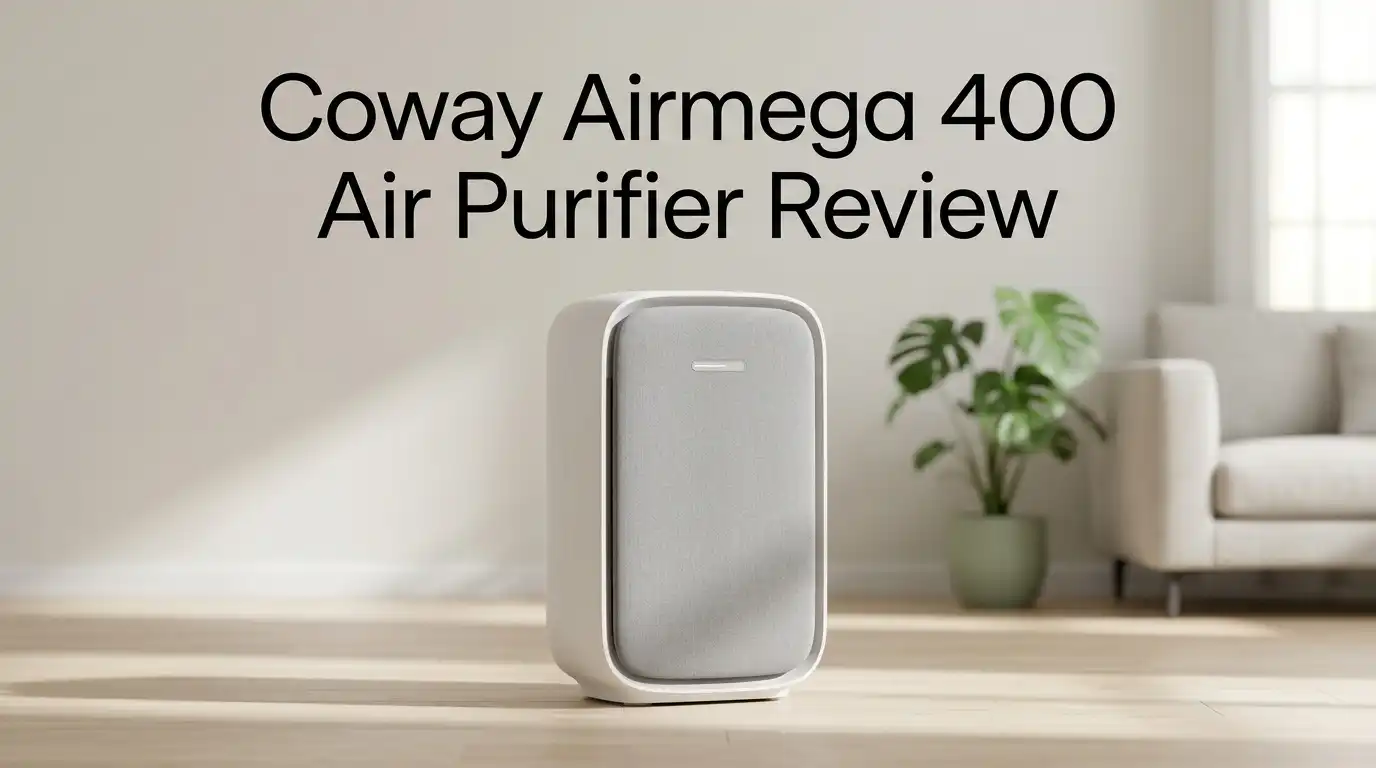
Coway Airmega 400 Air Purifier Review 2026: Still Worth It?
Clean air feels invisible until you lose it. Wildfire smoke drifts in. A new puppy sheds everywhere. Your kitchen sends curry fumes into the living room. Suddenly you notice every particle you breathe.
The Coway Airmega 400 has sat near the top of large room air purifier lists for years. It is big, heavy, and quietly expensive. In 2026, cheaper smart purifiers promise similar numbers for half the price.
So does this cube still earn a spot in your home? I spent weeks living with one, testing it across a dusty open plan space, a smoky kitchen, and a bedroom at night. Here is the honest result, including the parts Coway would rather you skip.
In a Nutshell:
- Coverage is genuinely large. The Airmega 400 handles up to 1,560 square feet at two air changes per hour, or 3,120 square feet at one air change. Most homes will never stress it.
- Dual filters do the heavy lifting. Two identical filter sets sit on opposite sides. Each set combines a washable pre filter, a Green True HEPA layer rated at 99.97 percent of ultrafine particles, and activated carbon for odors and gases.
- Performance holds up under testing. Independent labs recorded 100 percent VOC clearance on max power and near complete formaldehyde reduction. Smoke and dust CADR both sit at 328, with pollen at 400.
- It runs quiet for its size. The range spans roughly 22 dB on low to 52 dB on turbo, and power draw peaks around 66 watts.
- Filters cost real money. A genuine Max2 replacement set runs about $129 per year, and you buy two filters at once. Third party sets exist for far less.
- No app on the base model. You need the 400S for WiFi, Alexa, and scheduling. The plain 400 is buttons only.
Why the Coway Airmega 400 Still Matters in 2026
The air purifier market exploded over the last five years. Dozens of brands now sell large room units with glowing spec sheets. Most of them cut corners somewhere.
The Airmega 400 skips the shortcuts. It uses two full filter assemblies instead of one, which doubles the carbon surface area. That extra carbon matters for cooking smells, paint fumes, and smoke.
Coway also backs the unit with a five year warranty, which is unusual in this category. Many rivals offer two years. That warranty signals confidence in the motor.
The design has barely changed since launch, and that is deliberate. Coway refined an already strong platform rather than chasing gimmicks. You buy proven hardware instead of a beta product.
Unboxing the Coway Airmega 400


Last update on 2026-11-19 / Affiliate links / Images from Amazon Product Advertising API
The box arrives heavy. At 24.7 pounds, you will want two hands or a friend. Mine shipped in plain cardboard with molded foam on both ends.
Inside you find the purifier, two Max2 filter sets already installed, a power cord, and a slim manual. Coway wraps each filter in plastic. You must remove that plastic before first use, and plenty of buyers forget.
The side panels pop off with a gentle pull. No tools. No screws. Removing the plastic and snapping the panels back takes under three minutes.
First impressions land well. The matte finish resists fingerprints. The mesh panels feel solid rather than hollow. It looks like furniture, not an appliance. Plug it in, press power, and the light ring glows blue within seconds.
Design and Build Quality
The Airmega 400 measures 14.8 by 22.8 by 14.8 inches. That is a genuine cube, and it occupies real floor space. It will not hide behind a chair.
Coway offers it in white and graphite. The white version blends into most rooms. The graphite hides dust better.
A glowing ring on the front shows air quality through color. Blue means clean. Purple and red mean trouble. The ring is bright enough to light a dark bedroom, so Coway added a light off button.
Controls sit on the top panel as touch sensitive icons. They respond instantly. The build quality feels premium throughout, with tight panel gaps and no rattles even on turbo. The unit lacks wheels or handles, which stings at this weight.
Top 3 Alternative for Coway Airmega 400

Last update on 2026-11-17 / Affiliate links / Images from Amazon Product Advertising API
Levoit Core 600S Smart Air Purifier

Last update on 2026-11-17 / Affiliate links / Images from Amazon Product Advertising API
Blueair Blue Pure 211i Max Smart Air Purifier

Last update on 2026-11-17 / Affiliate links / Images from Amazon Product Advertising API
Winix 5510 Air Purifier with PlasmaWave
Filtration System Explained
Air enters through both sides of the cube. Each side holds an identical three stage stack.
The washable pre filter catches hair, lint, and large dust. You rinse it under a tap every two weeks. This single habit extends the life of everything behind it.
Next comes the Green True HEPA filter. Coway rates it at 99.97 percent capture of particles down to 0.3 microns, which covers pollen, mold spores, bacteria, and fine smoke. The filter carries an antimicrobial treatment that limits growth on the media.
The activated carbon layer bonds to the HEPA sheet. It absorbs VOCs, cooking odors, pet smells, and gases like sulfur dioxide and nitrogen dioxide.
Two complete sets mean double the carbon compared with single filter rivals. That difference shows up fast in kitchens.
Real World Cleaning Performance
Numbers only matter if the air actually changes. It does.
In my open plan living and dining area of roughly 700 square feet, the sensor moved from purple to blue in about eight minutes on auto after I seared salmon. That is faster than any single filter unit I have used in the same room.
Independent fog testing recorded a particle reduction rate well above average for the category. VOC testing showed complete clearance within five minutes on max power. Formaldehyde reduction landed near 100 percent.
Dust accumulation on my shelves dropped noticeably after two weeks. My partner stopped sneezing in the mornings. The Airmega 400 does the one job you buy it for, and it does it quickly.
Noise Levels and Sleep Mode
Noise decides whether a purifier runs or sits unplugged. Coway understood this.
Speed one sits around 22 dB, which is quieter than a refrigerator hum. You genuinely cannot hear it from across a room. Speed two stays easy to ignore while watching television.
Speed three becomes noticeable. Turbo hits roughly 52 dB and produces a strong whoosh. You will raise the television volume on turbo, but the unit clears a room so fast that you rarely need it for long.
Sleep mode on the base 400 is manual. You press the button yourself. The fan drops to its slowest setting and the lights dim. The sound becomes pure white noise with no motor whine or bearing rattle.
Auto Mode and the Air Quality Sensor
The onboard PM2.5 particle sensor drives auto mode. It samples air continuously and adjusts the fan without input from you.
In practice the sensor reacts within seconds. Lighting a candle, opening a window near traffic, or dry brushing a dog all triggered an immediate jump in fan speed during my testing.
The color ring gives you instant feedback without reading a screen. Blue, green, yellow, and red tell the whole story from across the room.
Eco mode goes further. When the air stays clean for a set period, the fan stops completely and the unit idles until pollution returns. This single feature cuts electricity use dramatically in already clean homes. The tradeoff is less constant circulation, so allergy sufferers may prefer standard auto.
Energy Use and Running Costs
Power consumption peaks at 66 watts on turbo. That is modest for a purifier moving this much air.
On auto in a normal home, actual draw usually sits far lower because the fan rarely stays high. Many owners report averages closer to 10 or 15 watts over a full day.
Running the unit 24 hours a day on low costs roughly the same as leaving a single bright bulb on. Eco mode reduces that further by shutting the fan off entirely during clean periods.
The real expense is filters, not electricity. Plan your budget around replacement sets rather than your power bill. Energy Star certification applies to the model, which helps if you track household efficiency.
Filter Replacement Costs and Maintenance
Here is where honest reviews separate from sales pages. Filters are not cheap.
A genuine Coway Max2 replacement set costs around $129 and includes both filters you need. Coway suggests annual replacement based on usage rather than a fixed calendar.
Third party sets sell for roughly $48 to $70. Many owners run them without problems, though you accept some risk with warranty and fit.
Maintenance itself is simple. Rinse the two pre filters every two weeks and let them dry fully. Vacuum the exterior mesh monthly. A filter indicator light tells you when replacement is due.
Budget around $130 per year if you stay with genuine filters. Over five years that adds roughly $650 to your ownership cost.
Room Size Guidance
Coway publishes three coverage figures, and the difference matters.
At one air change per hour the Airmega 400 covers 3,120 square feet. That headline number appears in most marketing.
At two air changes per hour it covers 1,560 square feet. This is the figure most experts consider realistic for general use.
At four air changes per hour, the standard recommended for allergies and asthma, coverage drops to 780 square feet. Use this number if anyone in your home has respiratory sensitivity.
My advice is simple. Match the unit to a 700 to 900 square foot space for serious allergy relief. Use it across 1,200 to 1,500 square feet for general freshness. Buying one 400 beats buying two smaller units in open plan homes.
What the Coway Airmega 400 Does Not Do Well
No purifier is perfect. These flaws are real.
It is physically huge. At nearly 15 inches square and almost 25 pounds, it dominates small rooms and resists easy moving. There are no wheels and no grip points.
The base model has zero connectivity. No app, no voice control, no scheduling, no remote. In 2026 that feels dated at this price.
Filters cost more than most rivals. You replace two at a time, always.
Turbo is loud. The jump from speed three to turbo is jarring.
The light ring is very bright. You will likely disable it at night, which also hides the air quality reading.
The sensor also reads particles only. It does not measure gases, so cooking fumes without smoke may not trigger a fan response.
Coway Airmega 400 vs Airmega 400S

Last update on 2026-11-18 / Affiliate links / Images from Amazon Product Advertising API
These two units share identical hardware. Same motor, same filters, same cube, same coverage numbers, same 328 CADR for smoke and dust.
The 400S adds smart features. You get WiFi, the Coway IoCare app, Alexa and Google Assistant support, scheduling, and remote monitoring. Sleep mode also becomes automatic rather than manual.
Cleaning performance is effectively the same. You pay purely for convenience and data.
Choose the 400 if you set a fan speed and forget it. Choose the 400S if you want filter life tracking on your phone or you control your home by voice.
The price gap is usually modest during sales. If both land within $50 of each other, the 400S is the better long term buy.
Pros and Cons
Here is the quick summary.
Pros
- Excellent particle, smoke, and VOC removal confirmed by independent testing
- Dual filter design doubles carbon capacity for odors and gases
- Covers very large rooms and open plan spaces
- Very quiet on low and medium speeds
- Responsive PM2.5 sensor with clear color feedback
- Eco mode cuts power use by stopping the fan when air is clean
- Five year warranty, which beats most competitors
- Washable pre filters reduce ongoing cost
- Solid build quality with no rattles or cheap plastic
Cons
- Large footprint and heavy body with no wheels
- No app, WiFi, or voice control on the base model
- Genuine filter sets cost around $129 per year
- Turbo speed is noticeably loud
- Air quality light is bright at night
- Sensor tracks particles only, not gases
- Premium price compared with newer rivals
Who Should Buy the Coway Airmega 400
This purifier suits specific people very well.
Buy it if you have a large open plan home. The dual filter system and strong airflow handle spaces that defeat smaller units.
Buy it if you cook often or live with pets. Doubled carbon makes a visible difference with odors.
Buy it if you live in a wildfire region. Smoke CADR of 328 clears a room fast during bad air days.
Skip it if you need a bedroom only unit. A smaller purifier costs less and takes less space.
Skip it if app control is essential and the 400S costs the same. Skip it if filter budget worries you. This is a long term investment, not a bargain purchase.
Final Verdict: Is It Worth Buying in 2026?
Yes, with clear conditions.
The Coway Airmega 400 remains one of the most capable large room purifiers you can buy. Its filtration is genuinely strong, its noise control is excellent, and its five year warranty removes most risk.
It is not the cheapest option, and it is not the smartest. Newer rivals offer apps and lower filter costs. Some match its coverage numbers on paper.
What they rarely match is the dual filter architecture and the proven reliability record. The Airmega 400 earns its price through consistency rather than flash.
If you want one purifier for a big space, and you accept the annual filter cost, this remains an easy recommendation.
Frequently Asked Questions
How often should I replace the Coway Airmega 400 filters?
Coway recommends about 12 months, measured by actual usage rather than the calendar. The filter indicator light tells you when the time arrives. Washing the pre filters every two weeks extends filter life noticeably.
Can the Coway Airmega 400 remove wildfire smoke?
Yes. Smoke CADR sits at 328, and the HEPA layer captures fine smoke particles while carbon handles the gases. Run it on auto or turbo during heavy smoke events and keep windows closed.
Does the Airmega 400 produce ozone?
No. The unit relies on mechanical filtration only, with no ionizer active in current models. It is safe for people with asthma and other respiratory sensitivity.
Is the Coway Airmega 400 quiet enough for sleeping?
Yes on speeds one and two. Speed one measures around 22 dB, which most people cannot hear. Use the light off button so the air quality ring does not brighten the room.
Can I use third party filters?
Many owners do, and replacements cost roughly half the genuine price. Fit and performance vary by brand, so check reviews first. Using them may affect warranty coverage.
What is the difference between the Airmega 400 and 400S?
The hardware is identical. The 400S adds WiFi, app control, voice assistant support, scheduling, and automatic sleep mode. Cleaning performance is the same on both.

I’m Maya Brown, the voice behind Pure Breeze Vault. I write detailed, honest, and easy-to-follow air purifier reviews to help readers compare features, understand filter technologies, and choose products with confidence. My goal is to make research simpler, clearer, and more practical for anyone improving indoor air quality at home.