Winix 5500-2 Air Purifier Review 2026: Still Worth It?
Dusty shelves, lingering kitchen smells, and spring pollen can make a home feel heavy. The Winix 5500-2 has been one of the most recommended air purifiers for years, and plenty of people still hunt for it in 2026.
It promises True HEPA filtration, a real carbon filter, and a price that undercuts flashier brands. But the model is aging, stock is shrinking, and newer rivals arrived with apps and smaller bodies.
So does this black box still earn a spot in your living room? This review breaks down the unboxing, the filters, the noise, the running costs, and the honest weak spots nobody mentions in the marketing copy.
In a Nutshell:
- Strong cleaning power for the money. Independent testing shows a dust CADR near 243 CFM, a smoke CADR near 232 CFM, and a pollen CADR near 246 CFM. That covers rooms up to roughly 360 square feet with solid air changes.
- Real pelleted carbon, not a thin sheet. The 5500-2 upgraded from carbon soaked fabric to granular activated carbon pellets, which handle cooking smells and pet odors far better than most budget units.
- The ionizer can be switched off. PlasmaWave is optional. The unit is CARB certified, and performance barely changes with the feature disabled, dropping by only about one minute in smoke clearing tests.
- Quiet enough to sleep beside. Speed one measures near 38.8 dBA at three feet. Turbo climbs to roughly 58.9 dBA, which is loud but normal for this class.
- Running costs stay reasonable. Expect around $138 per year combining electricity and genuine filters, with generic filters cutting that figure sharply.
- It is dated. No app, no setting memory after a power cut, and higher energy draw than 2026 models.
Winix 5500-2 Air Purifier

Last update on 2026-11-17 / Affiliate links / Images from Amazon Product Advertising API
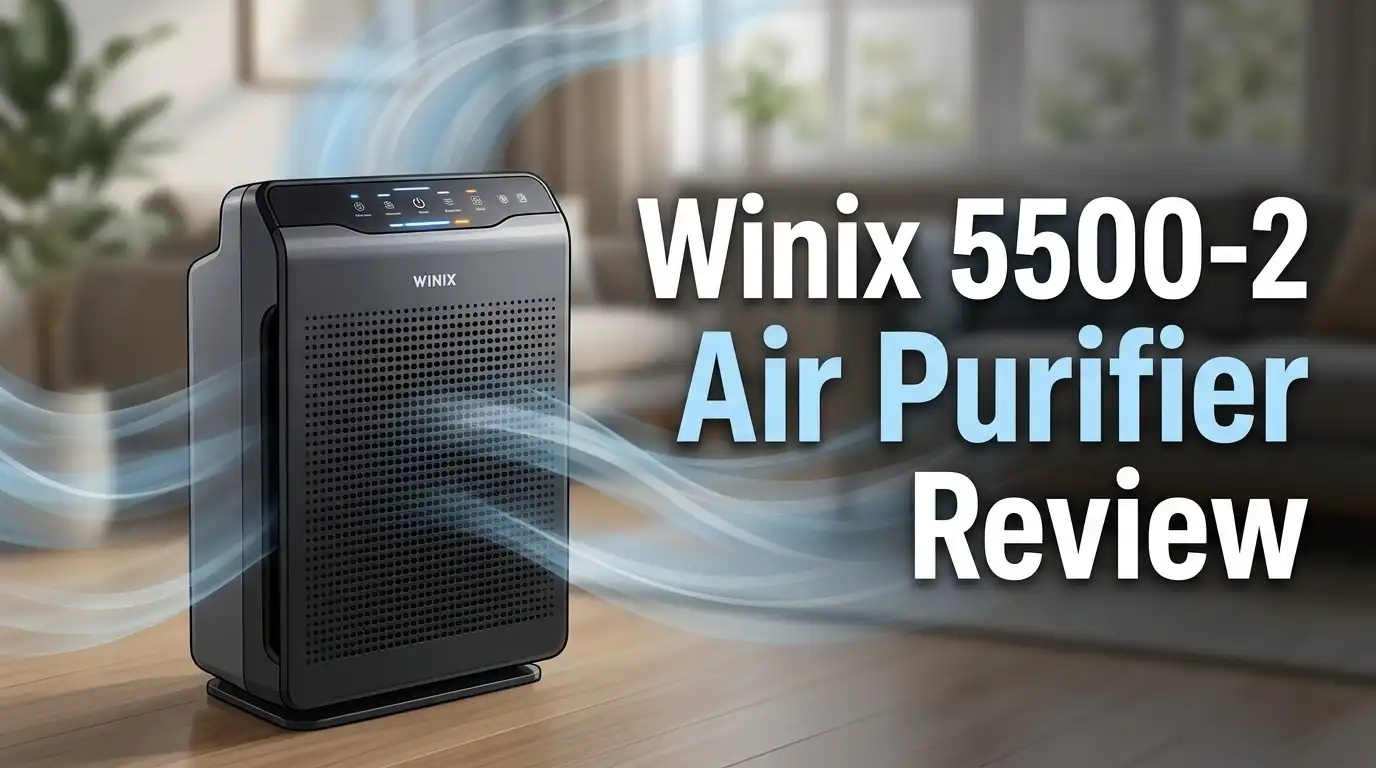
The Winix 5500-2 is a mid size tower purifier from a South Korean brand that has built air quality products since 1973. It uses a four stage approach: a washable mesh pre filter, a washable pelleted carbon filter, a True HEPA filter, and the optional PlasmaWave ionizer.
Winix states the HEPA layer captures 99.97 percent of particles down to 0.3 microns, and the company submits its units to AHAM Verifide testing, so the CADR numbers come from a third party rather than a marketing team.
The cabinet measures roughly 15 inches wide, 8.2 inches deep, and 23.6 inches tall, and it weighs about 14.8 pounds. You get four fan speeds, auto mode, sleep mode, a timer, a light sensor, and a remote control. That feature list still beats many purifiers selling at the same price in 2026.
Unboxing the Winix 5500-2: What Arrives in the Box
The box is plain brown with simple product art, and it feels heavier than expected. Inside, foam blocks hold the unit snugly, and the purifier slides out in one piece.
You will find the main tower, a small remote control with the battery already inserted, a quick start guide, and a warranty card. The filters sit inside the machine, already stacked in the correct order.
Here is the step people skip. Both filters arrive sealed in clear plastic bags. You must pop off the front panel, lift out the pre filter, pull both filters free, strip the plastic, and reinstall them.
Skip this and the fan simply pushes dirty air around the room. Setup takes about three minutes. There is no app, no account, and no pairing. You plug it in, press power, and the unit chimes softly.
Design and Build Quality: Plain but Practical
The 5500-2 wears a matte black shell with a wide front grille and a single air outlet on top. It looks plain, and that is the point. It blends into a corner instead of demanding attention. The older 5300-2 came in grey, while this version leans dark and neutral.
Build quality feels sturdy rather than premium. The plastic is thick, the panels snap on firmly, and nothing rattles at high speed. There are no wheels, but the recessed side handles make it easy to carry between rooms.
The control panel sits on top with clearly labeled buttons for power, fan speed, auto, sleep, PlasmaWave, and the timer. A small light under the panel glows blue, amber, or red based on current air quality. It is readable from across the room, which is handy at a glance.
Three Stage Filtration System Explained
The filtration stack is simple and effective. First comes the washable mesh pre filter, which traps hair, lint, and large dust. It clips off in seconds, so you can vacuum or rinse it every few weeks. This removable pre filter is a genuine advantage over rivals that bond the pre filter to the main cartridge, forcing full replacement.
Second comes the pelleted activated carbon filter. Winix swapped the old carbon coated fabric for real granular pellets, and the difference shows with cooking odors, smoke smells, and litter box smells. You can rinse this layer every three months and dry it fully before reinstalling.
Third is the True HEPA filter, which captures pollen, mold spores, fine dust, smoke particles, and pet dander. Always load the carbon filter first, then the HEPA filter. Reversing them reduces airflow and shortens filter life.
Top 3 Alternative for Winix 5500-2


Last update on 2026-11-17 / Affiliate links / Images from Amazon Product Advertising API
Winix 5510 Air Purifier

Last update on 2026-11-17 / Affiliate links / Images from Amazon Product Advertising API
Coway AP-1512HH Mighty Air Purifier

Last update on 2026-11-11 / Affiliate links / Images from Amazon Product Advertising API
Levoit Core 400S Smart Air Purifier
PlasmaWave Technology: Useful or Just Marketing?
PlasmaWave is Winix’s bipolar ionization system. It releases both positive and negative ions to break down odors and gases in the air. Winix argues this is different from a standard negative ion generator, and the unit holds CARB certification, meaning ozone output stays under the 0.05 parts per million limit.
Still, some owners report headaches or a faint metallic smell with ionizers running. The good news is that the button turns it off completely. Our research into independent testing shows the cleaning speed barely changes without it, moving from 23 minutes to 24 minutes in a smoke clearing test.
Here is the catch worth knowing. After a power outage, the unit forgets your choice and switches PlasmaWave back on. If you deliberately disable it, you need to check the panel after every blackout.
Real World Cleaning Performance
Independent lab testing gives this purifier credibility. In a sealed test room of roughly 728 cubic feet filled with incense smoke, the 5500-2 cleared fine PM1 particles in about 23 minutes at top speed. That result matches or beats purifiers costing far more, including the popular Coway Mighty, which took closer to 26 minutes in the same room.
Drop to speed two, which stays under 45 dBA, and the same room needs around 45 minutes. That is a realistic setting for overnight use. Most people will run speeds one and two almost all the time and reserve turbo for cooking or wildfire smoke.
In daily use, the auto mode reacts quickly. Frying onions or lighting a candle turns the indicator red within a minute, and the fan ramps up on its own before settling back down.
Noise Levels: Can You Sleep Next to It?
Noise decides whether a purifier gets used or unplugged. Measured from three feet away, speed one sits near 38.8 dBA, which reads as soft white noise. Speed two lands around 42.5 dBA. Speed three climbs to roughly 47.5 dBA, and turbo hits about 58.9 dBA.
The first two speeds are bedroom friendly. Many light sleepers actually prefer the steady hum because it masks street noise. Turbo is a different story. It sounds like a small fan heater and makes television dialogue harder to follow.
Sleep mode dims the lights and locks the fan to the quietest setting, which solves the glow problem in dark rooms. One small complaint remains: the unit plays a soft chime when powered on or off, and there is no way to mute it.
Energy Use and Yearly Running Costs
The 5500-2 carries an Energy Star rating, but it is still an older design. Measured draw sits near 6.5 watts on speed one, around 9 watts on speed two, about 15 watts on speed three, and roughly 53 watts on turbo. Standby pulls a negligible 0.34 watts.
Running the unit around the clock for a full year costs roughly $58 in electricity at average United States rates. Genuine filters carry a list price near $80 per year, although they frequently sell closer to $50. That puts total yearly upkeep around $138.
Generic filters change the math completely. Third party sets often cost $15 to $25 per year, which drops total running costs below $85. Quality varies between brands, so check reviews before committing to a multipack.
Filter Replacement and Maintenance Schedule
Maintenance is light but not optional. Vacuum or rinse the mesh pre filter every two to four weeks. A clogged pre filter can reduce HEPA efficiency dramatically, so this small habit matters more than most owners realize.
Rinse the carbon filter every three months under running water, then let it dry completely for at least 24 hours before reinstalling. Replace the combined HEPA and carbon filter set every 12 months. The filter indicator light reminds you, and you reset it by holding the sleep button for five seconds.
Wipe the air quality sensor every month too. It sits behind a small vent on the side, and dust buildup makes auto mode behave erratically, either running high constantly or failing to react at all. A dry cotton swab handles the job.
What the Winix 5500-2 Does Not Do Well
No purifier is perfect, and this one shows its age. There is no app and no smart home support. You cannot check air quality from your phone, schedule it through an assistant, or see historical pollution data. In 2026, that feels like a real gap.
The air quality readout is a single colored light, not a number. You know the air is bad, but not how bad. The sensor also reacts only to particles, not gases or VOCs.
The missing setting memory is the most irritating flaw. Every power cut resets PlasmaWave to on. Energy draw on turbo is higher than newer models that deliver similar airflow. The unit is also physically bulky for small bedrooms, and Winix has discontinued it in North America, so stock and official support will fade over time.
Pros and Cons of the Winix 5500-2
Pros
- Excellent cleaning speed for the price, clearing a medium room of fine particles in roughly 23 minutes at full power.
- Genuine pelleted activated carbon that handles cooking odors, smoke, and pet smells better than thin fabric filters.
- Removable and washable pre filter that extends HEPA life and lowers long term cost.
- AHAM Verifide CADR ratings and CARB certification, so the performance claims come from independent testing.
- Quiet operation on the lower two speeds, with sleep mode that dims all lights.
- Remote control, auto mode, and timer options included at no extra cost.
- Wide availability of affordable generic replacement filters.
Cons
- No app, no smart assistant support, and no numeric air quality display.
- Settings reset after a power outage, which silently turns PlasmaWave back on.
- Higher energy draw on turbo than newer competing models.
- Loud and intrusive at the highest fan speed.
- Bulky footprint for small bedrooms or desks.
- Discontinued in the United States and Canada, so official stock is shrinking.
Winix 5500-2 vs Winix 5510: Which One Should You Pick?
The 5510 is the direct replacement, and it answers several complaints. It is smaller, better looking, and adds app connectivity with a proper onboard air quality sensor. Cleaning power stays in the same league, so you are not giving up performance.
The trade off is filters. The 5510 uses a different cartridge, and the generic filter market for it is thinner, which raises long term costs for now. The 5500-2 benefits from years of third party filter competition.
Pick the 5500-2 if you find it discounted and you care about cheap filters. Pick the 5510 if you want app control, a tidier design, and confident access to official parts for the next several years. Both come from the same brand with the same filtration philosophy.
Who Should Buy the Winix 5500-2 in 2026?
This purifier suits allergy sufferers, pet owners, and renters in medium rooms up to about 360 square feet. If your main problems are dust, pollen, dander, and cooking smells, the combination of True HEPA and pelleted carbon handles all four well.
It is also a smart pick for anyone who wants simple controls. No account, no firmware updates, no notifications. You press a button and it works, which many people genuinely prefer.
Skip it if you want smart features, live air quality numbers, or coverage for a large open plan space. Skip it too if you need a compact unit for a desk or nursery corner. And if you plan to keep a purifier for a decade, the discontinued status is a fair reason to choose a current model instead.
Final Verdict: Is the Winix 5500-2 Still Worth Buying?
The Winix 5500-2 remains one of the best value air purifiers you can find, provided you catch it at a good price. It cleans a medium room quickly, uses real carbon pellets instead of a token odor layer, and keeps running costs low thanks to a healthy generic filter market. The washable pre filter is a small design win that pays off every single year.
The flaws are real but manageable. No app, no memory after a power cut, and a chunky body that will not hide on a nightstand. None of those affect air quality.
Our rating sits at 4.4 out of 5. If you value cleaning performance per dollar above smart features, this old favorite still delivers. If you want the 2026 experience, the 5510 is the natural step up.
Frequently Asked Questions
Is the Winix 5500-2 discontinued?
Yes. Winix has confirmed the 5500-2 and the 5300-2 are being phased out in the United States and Canada as remaining inventory sells through. Units are still available from many retailers, and replacement filters, both genuine and generic, remain widely stocked.
How often should I change the Winix 5500-2 filter?
Replace the HEPA and carbon filter set every 12 months under normal use. Heavy smoke, wildfire season, or multiple pets can shorten that to eight or nine months. Clean the pre filter every two to four weeks and rinse the carbon filter every three months.
Does the Winix 5500-2 produce ozone?
The unit is certified by the California Air Resources Board, meaning ozone output stays below 0.05 parts per million. That is considered safe. If you prefer zero ionization, press the PlasmaWave button to disable it, and check it again after any power outage.
What size room does the Winix 5500-2 cover?
Winix rates it for around 360 square feet at roughly 4.8 air changes per hour. For larger open spaces, it still helps but will take longer, so consider running it on a higher speed or adding a second unit.
Can I use generic filters in the Winix 5500-2?
Yes. Many owners use third party filter sets that cost a fraction of genuine ones. Quality varies between sellers, so look for sets that clearly state True HEPA material and include a separate carbon layer rather than a thin mesh.
Does the Winix 5500-2 help with pet odors?
It does. The pelleted activated carbon filter absorbs odor molecules far more effectively than carbon coated fabric. Combine it with regular pre filter cleaning to catch loose fur, and run auto mode so the unit reacts automatically when smells build up.

I’m Maya Brown, the voice behind Pure Breeze Vault. I write detailed, honest, and easy-to-follow air purifier reviews to help readers compare features, understand filter technologies, and choose products with confidence. My goal is to make research simpler, clearer, and more practical for anyone improving indoor air quality at home.