Inkbird Air Quality Monitor Review 2026: Worth Buying?
You cannot see carbon dioxide. You cannot smell it either. Yet it builds up in your bedroom every night while you sleep. By morning, the level in a closed room can pass 2000 ppm. That is the point where most people wake up groggy, foggy, and blame the mattress.
The Inkbird air quality monitor promises to show you that invisible number. It also tracks temperature, humidity, and air pressure. The headline claim is bold: Aranet4 performance at a far lower price.
This review covers the unboxing, the sensor accuracy, the app, the battery life, and the honest downsides. By the end, you will know if this monitor belongs on your desk or if your money belongs somewhere else. Keep reading.
In a Nutshell:
- The sensor is the real selling point. The Inkbird IAM-T1 uses a Senseair NDIR carbon dioxide sensor from Sweden. NDIR is the gold standard for CO2. Stated accuracy sits at ±30 ppm plus 3% of the reading, which matches monitors costing far more.
- Battery life is genuinely excellent. Two AA batteries run the unit for up to 18 months at default settings, and Inkbird claims four years at ten minute sampling. You will not babysit a charging cable.
- The E Ink screen is readable from any angle but it has no backlight. You cannot read it in a dark bedroom without turning on a lamp or opening the app.
- It is Bluetooth only, not WiFi. You get a 100 meter range and one year of app history, but no remote access when you leave the house. Data stores on the device for 30 days only.
- It does not measure particles. No PM2.5, no PM10, no VOCs, no formaldehyde. If wildfire smoke or dust is your worry, this is the wrong Inkbird model.
- Price is the deciding factor. At around $150 to $169 it is a smart buy. On sale near $100 it is one of the best value CO2 monitors you can own in 2026.
What Is the Inkbird Air Quality Monitor?

Last update on 2026-11-18 / Affiliate links / Images from Amazon Product Advertising API
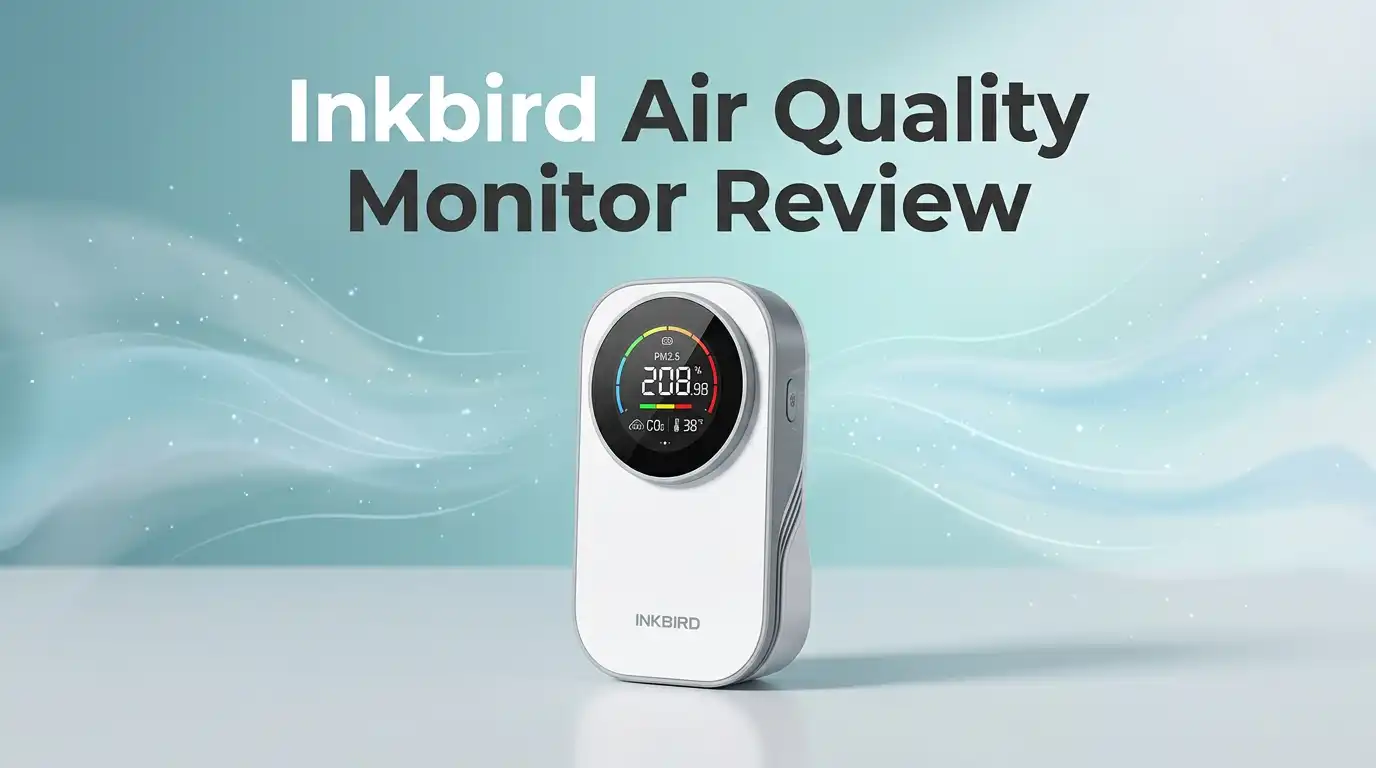
The Inkbird IAM-T1 is a four in one indoor air quality monitor. It tracks carbon dioxide concentration, temperature, relative humidity, and atmospheric pressure. The device shows CO2, temperature, and humidity on its screen. Air pressure appears only inside the app.
Inkbird is an IoT brand based in China. The company has built connected thermometers, grill probes, and humidity sensors for over a decade. The IAM-T1 sits at the top of its air quality range.
The target buyer is clear. This monitor suits office workers, students, classroom teachers, van dwellers, and anyone tracking ventilation. It is a portable device you can carry in a bag.
The CO2 range runs from 0 to 9999 ppm. Temperature covers 0 to 50 degrees Celsius. Humidity reads from 0 to 85 percent. The measurement range is wide enough for any home use.
Unboxing the Inkbird IAM-T1
The box arrives small and plain. Inkbird uses a simple white and blue sleeve with a product photo on the front. Nothing fancy. Nothing wasteful.
Inside, the monitor sits in a moulded insert. Lift it out and you find two AA batteries, a user manual, and an app quick start guide. The guide has a QR code that takes you straight to the correct app store.
The first thing I noticed was the weight. This device feels heavier than it looks. That heft reads as quality, not as bulk. The plastic does not creak. The fabric panel below the screen adds a soft touch detail.
Setup took under five minutes. Pop the back cover off, insert both batteries, flip the Bluetooth switch, and the screen wakes. No tools, no charging wait, no fuss. Readings appear within about a minute.
Design, Build Quality and Display
The IAM-T1 measures 75 x 80 x 33 mm. That makes it a small cuboid, slightly larger than an Aranet4 Home in every dimension. It is baggable but not truly pocketable.
The front holds a 2.13 inch E Ink screen above a fabric strip with the Inkbird logo. E Ink gives you superb viewing angles and almost no power draw. You can read the display from the far side of a room or from a sharp angle.
The layout is clean. A large CO2 number dominates the left. Temperature and humidity sit to the right. Three small icons show Bluetooth status, mute status, and auto calibration status.
My favourite touch is the traffic light bar along the bottom. Green, yellow, and red sections fill as CO2 rises. You can set your own thresholds in the app. It explains air quality to guests in two seconds flat.
The back cover pops off like an old phone. Underneath you get battery slots, a Celsius or Fahrenheit switch, and a Bluetooth toggle. There is also a wall mount hole.
Top 3 Alternative for Inkbird Air Quality Monitor

Last update on 2026-11-18 / Affiliate links / Images from Amazon Product Advertising API
Aranet4 Home Indoor Air Quality Monitor

Last update on 2026-11-17 / Affiliate links / Images from Amazon Product Advertising API
Qingping Air Monitor Lite


Last update on 2026-11-17 / Affiliate links / Images from Amazon Product Advertising API
Amazon Smart Air Quality Monitor
Sensor Accuracy: How Reliable Are the Readings?
Accuracy decides everything in this category. A pretty monitor that lies to you is worse than no monitor.
The IAM-T1 uses a Senseair NDIR sensor for carbon dioxide. Senseair and Sensirion supply almost every respected consumer CO2 monitor. The temperature, humidity, and pressure readings come from a Sensirion chip. Both brands have strong track records.
Independent side by side testing tells a good story. Placed in a ventilated box alongside an Aranet4 Home, a CO.Click Model C, and a Vitalight Mini, the Inkbird tracked the same curve. All four units stayed within roughly 50 ppm of each other at both low and high concentrations.
The Inkbird tends to read slightly higher than the Aranet4. That gap comes mostly from different calibration baselines. Some devices calibrate to 400 ppm, others to 420 ppm.
Here is the practical point. If one monitor says 2100 ppm and another says 2200 ppm, your action is identical. Open a window.
Calibration: Manual or Automatic?
NDIR sensors drift. Every single one of them does. Without calibration, readings slowly become fiction.
The IAM-T1 handles this in two ways. Manual calibration runs through the app. You expose the device to fresh outdoor air, then tap calibrate. The sensor sets a new baseline.
Automatic calibration runs every eight days. The device takes the lowest reading it saw in that window and treats it as ambient air.
Auto calibration sounds convenient. It is also a trap. The device must see genuinely fresh air at least once per week for it to work. A bedroom that always holds a sleeping person, or a lounge with pets, never drops to ambient level. The monitor then quietly reads low forever.
My advice is simple. Turn auto calibration off. Calibrate manually outdoors every few months. Inkbird itself recommends recalibration every six months or after any move.
Battery Life and Portability in Daily Use
Battery life is where the Inkbird embarrasses most rivals. Two AA cells deliver up to 18 months of use, and Inkbird quotes four years at the ten minute sampling interval.
Those long figures assume slow sampling. Real world use is different. At a one minute interval you should expect roughly five months. At two minutes, closer to ten months. Both numbers still beat almost everything else.
Compare that to portable CO2 monitors that die after a single day. The difference changes how you use the device. You stop thinking about power entirely.
Portability is decent rather than brilliant. The IAM-T1 slides into a backpack, handbag, or satchel without effort. It will fit in a jacket pocket. It will struggle in tight trouser pockets, and the weight drags.
One warning matters. The unit has large side vents and zero water resistance. Never pack it beside a water bottle.
The Inkbird App and Bluetooth Connectivity
The IAM-T1 runs Bluetooth 5.0 with a 100 meter line of sight range. There is no WiFi. That is the single biggest spec limitation.
Pairing was painless in my testing. Download the Inkbird app, create an account, and the device appears within seconds. It is one of the smoothest setups in the category. You can sign in with Apple ID or Google rather than handing over an email address.
The device screen shows three metrics. The app shows all four, including air pressure. Tap into history and you can view data by day, week, month, quarter, half year, and year.
The app also handles settings. You can change temperature units, CO2 thresholds, sampling interval, alarm behaviour, and firmware. Data export works, and files share by email or message.
One real flaw: app loading is slow, and the fastest refresh is one minute. There is no manual on demand reading.
Inkbird PTH-9A: The 6 in 1 Budget Option

Last update on 2026-11-18 / Affiliate links / Images from Amazon Product Advertising API
Some buyers want particle data, not just CO2. Inkbird sells the PTH-9A for that job. It measures PM2.5, PM10, AQI, CO2, temperature, and humidity on one large backlit screen.
The PTH-9A is a standalone device. No app, no Bluetooth, no WiFi, no history. You read it and that is all. For a wall in a cafe or a shelf in a garage, that simplicity works.
Independent testing gives mixed results. Particle readings landed within about 10 percent for PM2.5 and 20 percent for PM10 against a consumer reference. Good enough to spot trends.
The carbon dioxide sensor is the problem. One reviewer found the Winsen sensor drifted badly after a few days and read 300 to 500 ppm too low, with repeated calibration failing to fix it. Temperature also reads one to two degrees high, likely from internal heat.
Buy it for particles. Do not trust its CO2.
What the Inkbird Air Quality Monitor Does Not Do Well
Honest reviews list failures. Here are the IAM-T1 shortcomings I hit.
No backlight. You cannot read the E Ink screen at night. Checking bedroom CO2 at 3 am means grabbing your phone or a lamp.
No particle sensing. This device ignores PM2.5, PM10, VOCs, and formaldehyde entirely. Wildfire smoke, cooking fumes, and dust stay invisible to it.
No WiFi. Bluetooth means you check readings only when you are nearby. On device storage caps at 30 days, so you must sync monthly or lose data.
No on device calibration button. Every calibration runs through the app. If you want the monitor as a pure standalone unit, that is awkward.
The sensor drifts more than an Aranet4. The Sunrise sensor in the Aranet holds accuracy longer. Skip your calibrations and the Inkbird will wander.
Account required. You must register to use the app at all.
Pros and Cons of the Inkbird Air Quality Monitor
Here is the balance sheet.
Pros
- Swedish Senseair NDIR sensor delivers accuracy matching monitors that cost $80 more
- Up to 18 months on two AA batteries, with no charging cable to remember
- E Ink display with excellent viewing angles and a customisable green, yellow, and red threshold bar
- Smooth app setup plus one full year of history and working data export
- Strong build quality with a solid, reassuring weight and a wall mount hole
- Bluetooth 5.0 at 100 meters, so the whole house is in range
Cons
- No backlight, which makes night reading impossible without a light source
- No PM2.5, PM10, VOC, or formaldehyde sensing at all
- Bluetooth only, so remote monitoring away from home is not possible
- Slow app data loading and a one minute minimum refresh with no instant reading
- Calibration is app dependent, with no physical button
- Not pocketable and not water resistant
Price and Value for Money
The IAM-T1 launched at $169.99. Inkbird currently lists it around $149.99, and retail sales have pushed it toward $100 at times.
Context explains the appeal. The Aranet4 Home, its closest rival, sells near $250. The Aranet4 Pro runs about $290. CO.Click monitors land between $140 and $150, but they are not built for portability.
At full price you pay roughly $80 less than an Aranet for a feature set that is nearly identical. You give up the smaller size, the on demand reading, and the lower drift sensor. You keep the accuracy, the battery life, and the connectivity.
At a discount near $100, the comparison stops being close. The Inkbird becomes the obvious pick unless you specifically need Aranet features.
Budget buyers should know cheaper CO2 monitors exist from around $50. Most lack app support, data history, and comparable battery life.
Who Should Buy the Inkbird Air Quality Monitor?
This monitor fits specific people very well.
Buy it if you work from home. Afternoon brain fog usually traces back to CO2 above 1000 ppm in a closed room. Seeing the number changes your habits fast.
Buy it if you manage ventilation for health reasons. Teachers, clinic staff, and immunocompromised people use CO2 as a proxy for shared air. The portable form and long battery suit that job.
Buy it if you live in a van, RV, or small apartment. Tight spaces load up with CO2 quickly.
Skip it if smoke or dust is your main concern. Choose a particle monitor instead.
Skip it if you need remote alerts. Bluetooth cannot notify you at the office. Look at a WiFi model like the Inkbird INK-CO2W.
Skip it if you check readings in the dark. The missing backlight will frustrate you.
Final Verdict: Is It Worth Buying in 2026?
Yes, with clear conditions attached.
The Inkbird IAM-T1 is the best value connected CO2 monitor I have used. It pairs a trusted Senseair sensor with battery life measured in seasons, a readable E Ink screen, and an app that works properly. The build feels better than the price suggests.
It is not flawless. The missing backlight annoys. The Bluetooth only design limits it. The lack of particle sensing narrows its purpose sharply. The sensor needs manual calibration every few months to stay honest.
None of those faults break the device. All of them are predictable.
My rating: 4.5 out of 5.
If you want one number that tells you when to open a window, buy it. If you want full spectrum air analysis with smoke and VOC alerts, spend more and look elsewhere. Match the tool to the question you are asking.
Frequently Asked Questions
Is the Inkbird air quality monitor accurate?
Yes, for carbon dioxide. The Senseair NDIR sensor is rated at ±30 ppm plus 3% of reading up to 5000 ppm. Side by side tests against an Aranet4 Home showed agreement within roughly 50 ppm. Accuracy depends on regular calibration.
Does the Inkbird IAM-T1 measure PM2.5?
No. The IAM-T1 tracks only CO2, temperature, humidity, and air pressure. For particle readings, choose the Inkbird PTH-9A or the 10 in 1 IAQM-129-W model.
How long does the battery last?
Inkbird quotes up to 18 months on two AA batteries, and four years at ten minute sampling. At a practical one minute interval, expect about five months.
Does it work with WiFi or Home Assistant?
The IAM-T1 is Bluetooth 5.0 only. Community integrations for Home Assistant exist, but Inkbird does not support them officially. For native WiFi, look at the INK-CO2W.
How often should I calibrate it?
Inkbird recommends every six months, or after moving to a new environment. Calibrate outdoors with no people, pets, or plants nearby.
Can I export my data?
Yes. The Inkbird app exports readings as a text file you can share by email or save locally. The app keeps a year of history, while the device itself stores 30 days.

I’m Maya Brown, the voice behind Pure Breeze Vault. I write detailed, honest, and easy-to-follow air purifier reviews to help readers compare features, understand filter technologies, and choose products with confidence. My goal is to make research simpler, clearer, and more practical for anyone improving indoor air quality at home.