Qingping Air Monitor Review 2026: Worth Buying?
Your home air can look clean and still carry invisible problems. Stale bedroom air pushes carbon dioxide past 1,500 ppm overnight. Frying dinner sends fine particles across the kitchen.
You feel tired, foggy, or stuffy, and you never learn why. The Qingping Air Monitor promises to show you the numbers behind those feelings on a bright touch screen that sits on your desk like a small tablet.
This review covers what the Qingping Air Monitor measures, how accurate it really is, where it falls short, and whether it deserves a spot in your 2026 shopping list.
In a Nutshell:
- Seven metrics on one screen. The Qingping Air Monitor Gen 2 tracks PM2.5, PM10, carbon dioxide, VOCs, temperature, humidity, and noise. It also pulls outdoor AQI, weather, and UV index when connected to WiFi.
- Strong sensors for the money. Carbon dioxide readings come from a Sensirion SCD40 NDIR sensor with accuracy of ±(50 ppm + 5% of reading). Temperature and humidity use a Sensirion SHT4x. Particles use a laser based GrandWay module rated at ±10 μg/m³.
- The touch screen is the real star. A 4 inch IPS capacitive display at 254 ppi makes this the friendliest standalone monitor I have tested. You can set up WiFi, calibrate carbon dioxide, and build custom alerts without ever opening the app.
- Battery life disappoints. The internal cell lasts roughly four hours at best. Treat this as a plug in device that survives short power cuts, not a portable tester.
- The app feels thin. Qingping+ shows live data, 90 day history, and exports, but exports only come in 15 minute steps and many settings live only on the device.
- PM10 and VOC numbers need caution. PM10 is estimated from the same particle sensor, and VOCs report as a relative index rather than a true concentration. Read both as trends, not gospel.
What Is the Qingping Air Monitor 2?

Last update on 2026-11-18 / Affiliate links / Images from Amazon Product Advertising API
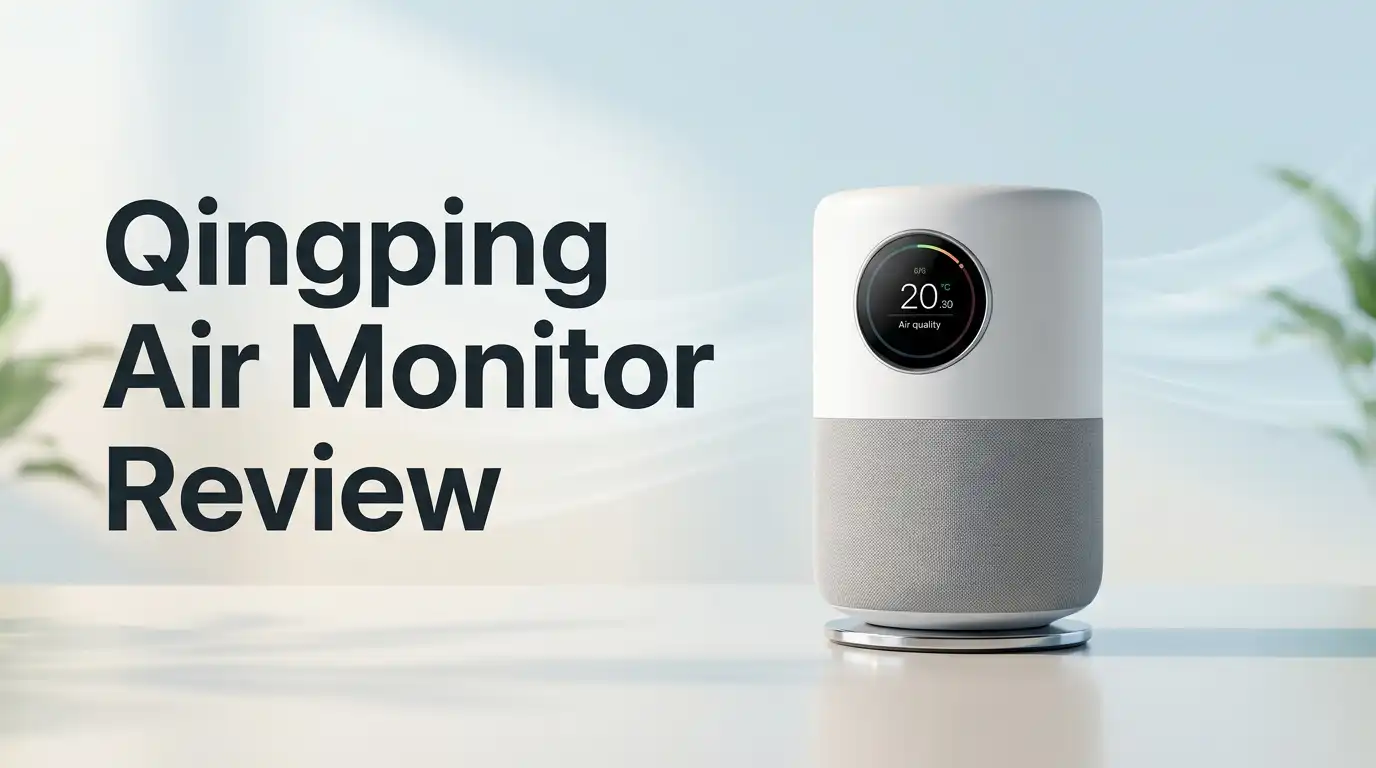
The Qingping Air Monitor 2 is an indoor air quality monitor built around a 4 inch touch screen. It measures seven environmental metrics and displays them in real time.
Qingping sells it as a desktop or bedside device, and the shape backs that up. The body forms a capital L, with the sensor chamber tucked into the base and the screen angled up at your face.
The device replaced the original Qingping Air Monitor, which sold for roughly $129. This second generation moves to a bigger screen, adds PM10 and noise tracking, and introduces an alarm clock.
A small internal fan pulls air through the chamber, so readings respond to a change in the room within seconds rather than minutes. It runs on USB C power and connects over 2.4 GHz WiFi.
Unboxing Experience
The box arrives small and dense, closer to a phone box than an appliance carton. Inside you get the monitor, a USB C to USB C cable, a printed manual, and a spare replaceable PM sensor module. That spare sensor surprised me. Most brands sell you a sealed box and hope the sensor outlives the warranty.
Lifting the monitor out, the weight registers first. At 0.56 lb and wrapped in an aluminium magnesium alloy shell, it feels denser than the price suggests. The screen sits under glass with almost no flex. Peel the film, plug in the cable, and the display wakes in a few seconds.
Setup takes about three minutes. You pick your language, join WiFi using the on screen keyboard, and the monitor starts reading immediately. No phone required at any point, which is rare.
Design and Build Quality
The L shaped body looks odd in photos and works well in person. The base holds the sensors, mainboard, and battery, which keeps the heat generating parts low and away from the temperature probe. Qingping placed that probe behind its own vent, separate from the particle intake. Small choice, real benefit for accuracy.
Air enters through openings on the back and exits through a thin horizontal vent below the screen. The fan stays quiet enough that I forget it exists on a desk two feet away. A light sensor above the display handles automatic brightness and resembles a camera, though no camera exists inside.
Colour options cover black and white. The power button sits on top. One USB C port handles power. No Ethernet, no replaceable battery, and no wall mount option, which limits placement in some rooms.
Top 3 Alternative for Qingping Air Monitor

Last update on 2026-11-18 / Affiliate links / Images from Amazon Product Advertising API
Aranet4 HOME Indoor Air Quality Monitor

Last update on 2026-11-17 / Affiliate links / Images from Amazon Product Advertising API
Airthings View Plus Radon and Air Quality Monitor

Last update on 2026-11-06 / Affiliate links / Images from Amazon Product Advertising API
SwitchBot Meter Pro CO2 Monitor
Display and Touch Interface
The 4 inch IPS touch screen defines this product. It runs at 254 ppi, so text stays sharp from across a room, and viewing angles improved noticeably over the first generation. A four core A53 chipset drives it, which explains why swipes feel close to phone speed instead of the sluggish taps most budget monitors deliver.
The home screen shows every metric at once. Tap any reading to promote it to the top, then tap the graph icon for 24 hour or 30 day history. A small information button explains each pollutant, its common sources, and the threshold standard in use. That feature alone makes this monitor my pick for first time buyers.
Swipe left for a weather page with forecast, outdoor AQI, and UV index. Swipe again for alarms, volume, brightness, and full settings. A customisable screensaver shows the clock and your chosen widgets.
Sensors Inside the Qingping Air Monitor
Qingping sourced good parts here. Carbon dioxide runs through a Sensirion SCD40 photoacoustic NDIR sensor, the same component found in several respected monitors, covering 400 to 9,999 ppm. VOCs use a Sensirion SGP40, an upgrade from the SGP30 in the first generation. Temperature and humidity come from a Sensirion SHT4x, rated at ±0.2°C and ±1.8% RH.
Particles pass through a laser based GrandWay module covering 0 to 999 μg/m³ with ±10 μg/m³ accuracy. For comparison, budget monitors often sit near ±20%. Noise uses a simple acoustic sensor reading 36 to 95 dB.
Privacy note on that microphone: Qingping states the sensor measures sound energy only and never records, stores, or uploads audio. The device also supports manual and automatic carbon dioxide calibration plus offset adjustment for temperature and humidity.
Accuracy Test Results
Accuracy is where most cheap monitors collapse. The Qingping holds up. Independent testing by AQMD on the first generation device, which uses the same particle sensor family, showed strong correlation with reference grade PM2.5 instruments. It scored better than monitors costing twice as much, though it trailed dedicated outdoor units.
Carbon dioxide tracked closely against an Aranet4 HOME, widely treated as the accuracy benchmark for consumer carbon dioxide meters. Both devices followed the same curve through a closed bedroom night and a window opening. Gaps appeared, but they stayed inside the stated tolerance of both units.
Reading stability impressed me more than peak accuracy. The numbers do not jump around randomly between refreshes. A monitor that drifts by 200 ppm every minute is useless for spotting trends, and this one simply does not do that.
PM2.5 and PM10 Readings
PM2.5 performance ranks near the top of the consumer category. Cooking, candles, and vacuuming all register within seconds thanks to the fan. Testing suggests the sensor slightly understates PM2.5 concentrations against reference equipment, so treat it as a conservative reading rather than a worst case one.
PM10 deserves a warning. Qingping added PM10 to this generation without adding any new hardware. The same sensor estimates PM10 from PM2.5 data, and low cost sensors handle that poorly. Testing of the Qingping Air Monitor Lite, which uses a sensor from the same brand, produced an R squared value around 0.37 to 0.43 against reference gear. A perfect match scores 1.0.
My advice: watch the PM2.5 figure and ignore PM10 entirely. It is a marketing line, not a measurement you can act on.
VOC and Noise Tracking
The VOC reading uses the Sensirion VOC Index, a 0 to 500 scale rather than a concentration. The value sits relative to the sensor’s own recent baseline, with 100 marking normal. Cleaner air than usual drops below 100. Perfume, paint, or cleaning spray pushes it up. Qingping labels 0 to 3 as Excellent, 3 to 37 as Good, 37 to 120 as Slightly High, 120 to 293 as High, and anything above 293 as Very High.
This limitation belongs to every low cost VOC sensor, not just Qingping. Different gases trigger different responses, so absolute values would mislead you anyway.
Noise tracking works as a rough indicator. It catches a loud TV, a noisy street, or a snoring partner. Do not treat it as a calibrated sound level meter, because Qingping never published an accuracy figure for it.
Qingping Plus App and Connectivity
Two apps exist, which confuses people. Qingping+ suits homes. Qingping IoT suits offices and teams who need shared access to several monitors. Both run on iOS and Android. The device also pairs with Mi Home, which lets it talk to Xiaomi air purifiers, and Qingping offers an API for advanced automation.
Pairing takes under a minute. Connect the monitor to WiFi, pick your app in the device settings, and enter the code shown on screen. You can skip account creation entirely, which I appreciate.
Inside the app you get live readings, historical charts, 90 day data export, and smart suggestions such as opening a window when carbon dioxide climbs. Beyond that, the app feels bare. No carbon dioxide calibration, no region standard switching, and exports limited to 15 minute intervals. Native Apple HomeKit support is also missing.
Battery Life and Power Options
The internal battery is the weakest part of this monitor. Expect roughly four hours at best, and often less depending on screen brightness and WiFi activity. The first generation shared this trait, and the second generation did not fix it.
Think of the battery as a backup, not a feature. It keeps the device alive through a power cut and lets you carry the monitor between rooms for a quick comparison. It will not get you through a workday or a flight.
Power arrives through USB C, and the bundled cable is USB C to USB C. Standard phone chargers work fine, which means you can plug it into almost any adapter already in your drawer. Anyone wanting genuine portability should look at a battery first design instead, because this housing was never built for a day away from an outlet.
Replaceable PM Sensor
Here is the feature I wish every brand copied. Pop off the back plate, like the battery cover on an old phone, and the particle sensor module lifts straight out. Swapping it takes under two minutes and requires no tools.
The logic makes sense. Particle sensors contain a fan, the only moving part in the device, so they fail first. Giving owners a path to replace that module instead of binning the whole monitor extends the product’s useful life by years.
Two catches apply. The module sits in proprietary housing, so you must buy Qingping replacements rather than generic parts, priced around $25. Finding official replacements through retailers has proved difficult, with most listings appearing on third party marketplaces. The good news is that these sensors rarely fail in normal indoor use, so the spare in the box may be all you ever need.
Pros and Cons
Pros
- Seven metrics on one screen, including carbon dioxide, PM2.5, VOCs, humidity, temperature, PM10, and noise
- Excellent 4 inch IPS touch screen at 254 ppi with fast, responsive navigation
- Full standalone operation, including WiFi setup, calibration, and alerts, with no phone needed
- Quality Sensirion sensors for carbon dioxide, VOCs, temperature, and humidity
- On screen explanations of every pollutant, its sources, and the standard in use
- Fully customisable alert thresholds for every single metric, with minimum or maximum triggers
- User replaceable particle sensor module plus a spare included in the box
- Premium aluminium magnesium build in black or white
- Quiet internal fan delivers fast, real time response to air changes
- Works with Qingping+, Qingping IoT, and Mi Home, plus an API for automation
- Active firmware support, with reported bugs patched within weeks
Cons
- Battery lasts only about four hours, so it needs constant power
- App lacks calibration, region switching, and flexible export intervals
- PM10 readings are estimated and unreliable
- No native Apple HomeKit support and no Home Assistant integration over WiFi without extra work
- Carbon dioxide thresholds default to a lenient Chinese standard
- Official replacement sensors are hard to source
- Requires 2.4 GHz WiFi, with no Ethernet option
- Noise sensor accuracy is never specified
What the Qingping Air Monitor Does Not Do Well
Honest reviews need this section. The battery is the clearest failure. Four hours of runtime from a device this size feels like an afterthought, and anyone expecting a portable monitor will feel cheated.
The app ranks second. Settings live almost entirely on the device, which sounds fine until you want to calibrate carbon dioxide from the sofa. Export granularity stuck at 15 minutes blocks anyone doing detailed analysis.
Smart home integration lags behind. No native HomeKit, no simple Home Assistant path over WiFi, and Bluetooth integration that often requires button combinations and workarounds. Power users will reach for an open source monitor instead.
The carbon dioxide thresholds use GB/T 18883 2002, a lenient Chinese standard, with no option to switch to stricter guidance. Qingping deserves credit for naming the standard on screen, but naming a weak standard does not fix it.
Qingping Air Monitor Lite vs Gen 2

Last update on 2026-11-17 / Affiliate links / Images from Amazon Product Advertising API
The Lite sits around $99 and covers PM2.5, PM10, carbon dioxide, temperature, and humidity. It skips VOCs and noise, uses a smaller display, and offers no touch interface. Its particle sensor comes from the same brand family, so PM2.5 performance lands in similar territory.
The Lite does offer one advantage: Apple HomeKit compatibility, which the Gen 2 lacks. That matters if your home runs on Apple devices. Owners also report the same battery complaint, with the device running warm and temperature readings skewing high as a result.
The Gen 2 earns its extra $50 for the screen alone. A responsive touch display, on screen education, custom alerts, and a replaceable sensor change how often you actually look at your air data. Buy the Lite for HomeKit or a tight budget. Buy the Gen 2 for the experience.
Price and Value in 2026
The Qingping Air Monitor Gen 2 sells around $150, roughly $20 above the first generation. That places it in the middle of the market. Cheaper options exist, including the Qingping Lite at $99 and various IKEA sensors. Pricier options climb fast: Awair Element at $299, Airthings Wave Plus at $299, AirVisual at $295, and uHoo at $399.
At $150 you get sensor quality that competes with $300 monitors. The SCD40 carbon dioxide sensor matches what sits inside far more expensive units. The nearest true rival on price is the AirGradient ONE, starting around $138 as a kit.
That comparison splits cleanly. AirGradient wins on openness, Home Assistant support, and component swapping. Qingping wins on polish, standalone use, and approachability. Neither choice is wrong.
Who Should Buy the Qingping Air Monitor?
Buy this monitor if you are new to air quality tracking. The on screen explanations remove the biggest barrier, teaching you what 1,200 ppm of carbon dioxide means while you look at it. No research required, no app tutorials, no guessing.
It also suits anyone who wants a device that works alone. Bedside tables, home offices, nurseries, and classrooms all fit. The alarm clock, weather page, and custom alerts make it useful even when air quality sits in the green.
Skip it if you need portability, deep smart home automation, raw data at one minute resolution, or native HomeKit. Power users will find the ceiling quickly. Radon tracking also sits outside its abilities entirely, so homes in radon prone regions need a different tool alongside it.
Final Verdict
The Qingping Air Monitor Gen 2 earns a strong recommendation in 2026. It pairs genuinely good sensors with the best interface in its class, and it does so at a price that undercuts monitors with weaker hardware. PM2.5 and carbon dioxide readings land where they should, and stability is excellent.
The flaws are real and worth knowing. Four hour battery life, a shallow app, estimated PM10 figures, and missing HomeKit support all count against it. None of them break the core function, which is showing you accurate, readable air data every single day.
My rating sits around 9 out of 10 for new buyers and 7 out of 10 for power users. If you already own the first generation, keep it. If you are buying your first indoor air quality monitor, this is the one I would hand to a friend.
Frequently Asked Questions
What does the Qingping Air Monitor measure?
It measures PM2.5, PM10, carbon dioxide, VOCs, temperature, relative humidity, and noise level. When connected to WiFi, it also displays outdoor AQI, local weather forecast, and UV index.
Is the Qingping Air Monitor accurate?
Yes for PM2.5 and carbon dioxide. Independent testing showed strong correlation with reference grade instruments for particles, and carbon dioxide tracked closely against an Aranet4. PM10 and VOC readings are far less reliable and should be treated as trends only.
How long does the battery last?
Roughly four hours at best, and often less. The device is built for continuous USB C power. The battery mainly covers short room to room moves and power outages.
Does it work with Apple HomeKit?
No. The Gen 2 lacks native HomeKit support. The cheaper Qingping Air Monitor Lite does offer HomeKit compatibility if that matters to your setup.
Does it need calibration?
Not usually. The particle sensor arrives factory calibrated and needs no adjustment. The carbon dioxide sensor self calibrates over time, and you can run a manual five minute calibration near an open window if readings look wrong.
Can I replace the sensor myself?
Yes. The particle sensor module pops out behind the back plate in under two minutes, and a spare ships in the box. Replacements cost around $25 but can be hard to source.
Does it need WiFi to work?
No. All sensors keep working offline and data stores on the device. WiFi adds app access, 90 day history, outdoor weather, and remote checking.
Is the Gen 2 worth upgrading from Gen 1?
Probably not. The bigger screen, PM10, noise, and alarm clock are nice additions, but the core accuracy is nearly identical. Buy Gen 2 only if this is your first Qingping monitor.

I’m Maya Brown, the voice behind Pure Breeze Vault. I write detailed, honest, and easy-to-follow air purifier reviews to help readers compare features, understand filter technologies, and choose products with confidence. My goal is to make research simpler, clearer, and more practical for anyone improving indoor air quality at home.