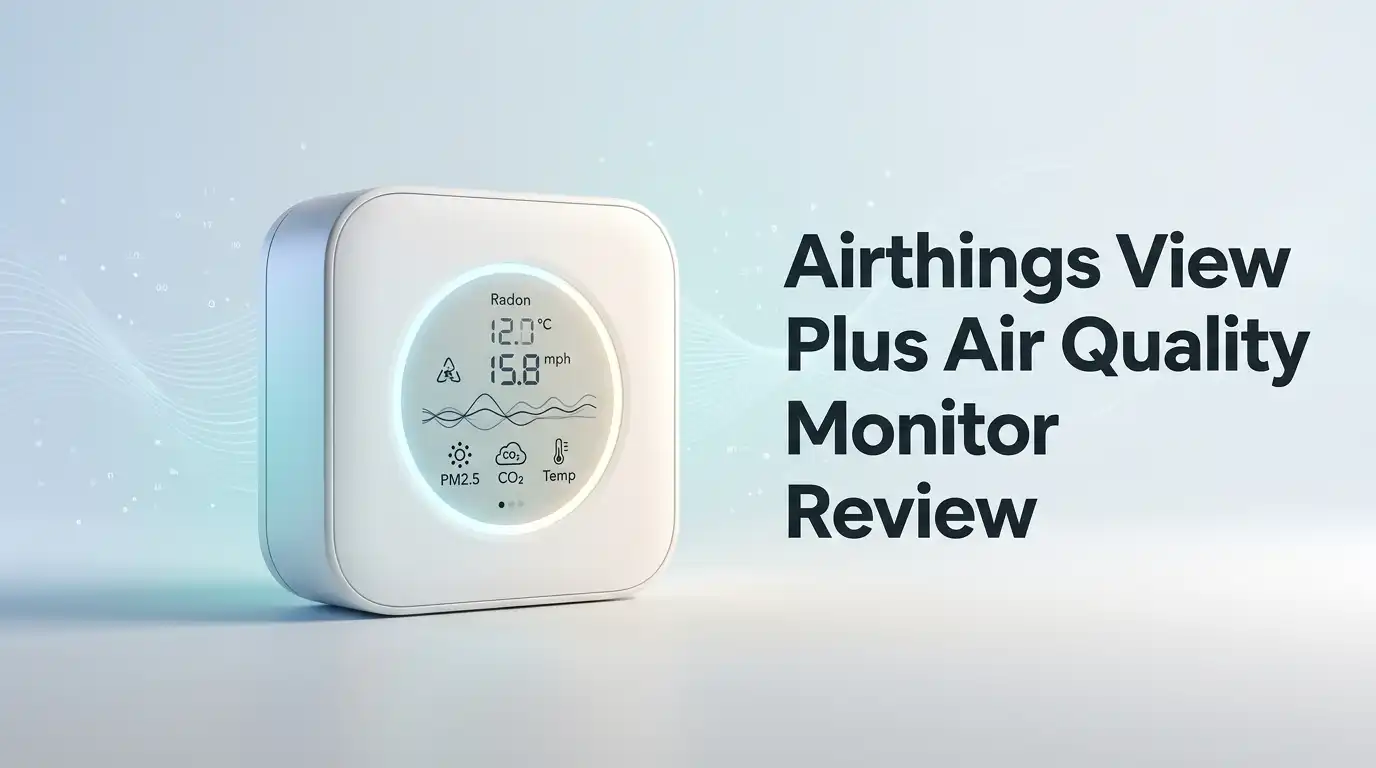
Airthings View Plus Air Quality Monitor Review 2026: Worth It?
Indoor air hides a lot. You cannot see radon seeping through a basement floor. You cannot smell carbon dioxide climbing in a closed bedroom. You breathe roughly 20,000 times a day, and most of those breaths happen indoors.
The Airthings View Plus promises to show you what is floating around your home. It packs seven sensors into one battery powered box, including a radon sensor that almost no competitor offers. It costs around $300, which is serious money for a gadget that just watches air.
I spent weeks living with this monitor, comparing its numbers, and poking at its app. This review covers the good parts, the clumsy parts, and the features Airthings quietly left out. If you want an honest answer before you spend $300, keep reading.
In a Nutshell:
- Seven sensors in one device. The View Plus tracks radon, PM2.5, PM1.0, CO2, VOCs, temperature, humidity, and air pressure. Finding radon plus particulate matter in a single consumer unit is still rare in 2026.
- Battery power is the standout feature. Six AA batteries run the unit for roughly two years. You can place it in a basement, closet, or nursery without hunting for an outlet. A USB Type C port exists if you prefer constant power.
- Accuracy is good, not perfect. Independent testing shows the CO2 sensor reads consistently high by roughly 10 to 100 ppm compared with reference grade sensors. PM2.5 tracking matches other monitors well but jumps around between readings.
- The app is simple to the point of being limited. You cannot set custom alert thresholds. You cannot manually calibrate the CO2 sensor. Data export dumps every sensor into a single column, which is frustrating for anyone who likes spreadsheets.
- Radon needs patience. The sensor requires about seven days before the first trustworthy reading appears, and long term averages take weeks to settle.
- Best for beginners, not enthusiasts. If you want a monitor that works out of the box and explains your air in plain language, this is one of the best available. If you want deep control, look elsewhere.
Airthings View Plus Air Quality Monitor

Last update on 2026-11-20 / Affiliate links / Images from Amazon Product Advertising API
The View Plus sits at the top of the Airthings lineup. Airthings is a Norwegian company that built its reputation on consumer radon detection, and this device is their most complete product.
The unit measures roughly 6.7 by 3.4 inches and weighs close to a pound with batteries installed. A small e ink screen sits on the front face. An LED strip above the screen glows green, yellow, or red based on overall air quality.
WiFi connectivity sends your readings to the Airthings app and web dashboard. The device also works as a hub for older Bluetooth only Airthings Wave monitors, which pushes their data online too.
The pitch is simple: one device, seven pollutants, zero cables. Whether that pitch justifies the price depends on how much you value radon data, which I cover below.
The Unboxing Experience
The box arrives slim and white with a photo of the monitor on the front. Airthings keeps packaging minimal, which I appreciate. Inside you find the monitor, a USB Type C cable, a wall mount plate, screws, and a short quick start card.
The six AA batteries come preinstalled. That small touch matters. You can power the device on within thirty seconds of opening the box.
The first thing I noticed was the weight. This feels like a solid product rather than a hollow plastic shell. The matte finish resists fingerprints, and the side grills look like a Bluetooth speaker. Visitors have genuinely mistaken it for one.
Setup took under five minutes. You download the Airthings app, create an account, hold your phone near the device, and connect to WiFi. No cryptic codes, no failed pairings on my first try.
Design and Build Quality
The View Plus follows the modern minimalist look. White body, soft curves, no logos screaming for attention. It blends into a shelf, a bedside table, or an office desk.
That e ink screen deserves comment. Contrast is excellent and readable across a room in daylight. There is no backlight, so the screen disappears completely in a dark bedroom. At night you rely on the LED strip instead.
The screen shows only two values at a time. You pick those two in the app. Waving your hand within about six inches cycles through additional readings, starting with PM2.5 and then humidity.
The cable routing is clever but fiddly. You remove the back plate and thread the USB Type C cable through a gap. It keeps cables tidy, though it means the device is not something you unplug and carry between rooms quickly.
Top 3 Alternative for Airthings View Plus

Last update on 2026-11-18 / Affiliate links / Images from Amazon Product Advertising API
Airthings Wave Plus

Last update on 2026-11-18 / Affiliate links / Images from Amazon Product Advertising API
Awair Element Indoor Air Quality Monitor


Last update on 2026-11-20 / Affiliate links / Images from Amazon Product Advertising API
Amazon Smart Air Quality Monitor
What Sensors Are Inside
Airthings publishes its component list, which earns credit for transparency. The CO2 sensor is a Cubic CM1106SL NS. The particulate sensor is a Cubic PM2105L. The VOC sensor is a Bosch BME680.
Cubic sits a tier below Sensirion and SenseAir in reputation. That is a curious choice for a premium monitor. Oddly, the cheaper Airthings Wave Plus uses a SenseAir Sunrise CO2 sensor, which is the better component.
The radon sensor is Airthings own passive diffusion chamber design. The company claims accuracy within 10 percent compared with professional AlphaGuard reference detectors after a settling period.
Sensor choice matters because off the shelf components define the ceiling of performance. No firmware polish turns a mid tier sensor into a laboratory instrument. The View Plus performs well despite this, but enthusiasts will notice the gap.
Radon Monitoring Explained
Radon is the headline reason to buy this device. It is a radioactive gas that seeps from soil into basements and ground floors. The EPA calls it the leading cause of lung cancer among people who never smoked.
Charcoal test kits give you one snapshot and then you wait for lab results. The View Plus gives you a rolling picture that updates continuously. That difference is genuinely useful, because radon levels swing with weather, season, and ventilation.
Patience is required. The first reliable reading appears after about seven days. The long term average, which is the number that actually matters for health decisions, needs several weeks to stabilize.
One warning worth stating plainly. Radon concentrates in basements. A monitor on your third floor will not tell you what is happening downstairs, so place it where you spend time at the lowest level.
Accuracy in Real World Testing
Independent testers have run the View Plus alongside better documented sensors, and the results are reassuring with caveats.
For CO2, the Airthings unit tracked trends closely against SenseAir S8 and Sunrise sensors but read consistently higher, typically between 10 and 100 ppm. The direction of change was always correct, which is what matters for ventilation decisions.
For PM2.5, readings matched Plantower reference sensors on average. The Airthings unit showed sharper peaks and more variation between individual readings, so averaging over time gives a clearer picture than watching single numbers.
VOC readings deserve a caution. The app displays them in parts per billion, which implies an absolute measurement. The BME680 actually reports a relative value based on recent exposure. Treat VOC numbers as a trend indicator, never as a precise concentration.
The Airthings App and Web Dashboard
You get both a mobile app and a browser dashboard, and both are included at no extra cost. No subscription gate blocks your own data, which deserves applause in 2026.
The app home screen shows color coded bars for each pollutant. Tap any one and you get a clean graph with minimum and maximum values plus a movable cursor.
A feature I genuinely like is the focus setting. You pick a concern such as sleep, asthma, productivity, or headaches. The app then combines the relevant sensors into one aggregate score. Asthma weights PM2.5, VOCs, and humidity. Productivity weights CO2.
The web dashboard handles longer analysis better. It also allows CSV export, though the export formatting is poor. Every sensor value lands in a single column separated only by timestamp, which means manual sorting before any charting.
Battery Life and Power Options
Six AA batteries deliver roughly two years of operation. For an always on WiFi device with seven sensors, that figure is remarkable.
The tradeoff is upload frequency. On batteries, the device sends data to the cloud at longer intervals to conserve power. The e ink screen updates more often than the app does. You can shorten the upload interval through the web dashboard, though battery life drops accordingly.
Plugging in the USB Type C cable gives you frequent updates and unlocks the Bluetooth hub function for Wave devices.
The battery compartment is the weakest piece of hardware design. Several owners report that the housing grips the cells tightly, making removal awkward. Prying batteries out of a $300 device with a butter knife feels wrong.
Smart Home and Integration Features
The View Plus connects with Alexa, Google Assistant, and IFTTT. You can ask a speaker for your current CO2 level or trigger routines when air quality drops.
A common setup pairs the monitor with a smart plug. When PM2.5 crosses the threshold, the plug switches on an air purifier. That automation turns a passive monitor into part of an active system.
Airthings also offers an open API, which developers use to pull readings into Home Assistant, Grafana, or custom dashboards. This is where power users reclaim some of the flexibility the app withholds.
The hub feature deserves mention again. If you own older Wave, Wave Mini, or Wave Plus units, the View Plus bridges them to WiFi. For a household with several Airthings devices, that consolidates everything into one dashboard.
Setup and the First Week
Installation is the smoothest part of the experience. Pull the battery tab, open the app, scan, connect. Most owners finish in under five minutes.
Then comes the waiting. Airthings asks for a seven day settling period before you trust the numbers, particularly radon and VOCs. During that window readings can look alarming or oddly flat.
Resist the urge to panic or return the device in week one. Many negative reviews trace back to users judging day two readings.
Placement matters more than people expect. Keep the monitor at breathing height, roughly three to five feet from the floor. Keep it away from windows, vents, doorways, and kitchens. A monitor sitting next to a gas stove will report numbers that reflect the stove, not your home.
Mount it on a wall with the included plate, or simply stand it on a shelf.
What the Airthings View Plus Does Not Do Well
Honest reviews list the failures, so here they are.
You cannot set custom alert thresholds. The app notifies you when CO2 passes 1000 ppm whether or not that number suits your tolerance. The LED uses three fixed colors, so 1400 ppm and 4000 ppm both glow red.
You cannot manually calibrate the CO2 sensor. The device relies entirely on automatic baseline calibration, which assumes exposure to fresh outdoor air every week. A monitor in a stuffy room that never reaches outdoor levels will slowly drift.
Data export formatting is genuinely bad. One column for every sensor forces tedious cleanup.
You cannot reorder the screens. Wave your hand and PM2.5 always comes second, humidity third. Want radon on demand? Set it as a home value or open the app.
No backlight, no PM10 reporting, and no manual way to request an instant reading on battery power.
Pros and Cons
Pros
- Seven sensors including radon, which almost no rival offers in one consumer unit
- Two year battery life from six AA cells, so placement is genuinely free
- Simple setup that non technical users finish in minutes
- Clean e ink display with excellent daylight contrast
- Free app and web dashboard with no subscription paywall
- Acts as a hub for older Bluetooth only Airthings Wave monitors
- Alexa, Google Assistant, IFTTT, and open API support
- Solid build quality and a reputation for responsive customer support
- Health focused app modes for sleep, asthma, and productivity
Cons
- Around $300, which buys two capable monitors from other brands
- CO2 readings run consistently high compared with reference sensors
- No manual calibration and no adjustable thresholds
- Screen shows only two values and the wave sequence is locked
- No backlight, so the display is invisible at night
- Awkward battery compartment that fights you during swaps
- CSV export crams every sensor into one column
- VOC values displayed as absolute when they are relative
- Radon requires roughly seven days before the first useful reading
Pricing and Value in 2026
Airthings lists the View Plus at $299 on its own store, and Amazon pricing has hovered near $330, with regular discounts pulling it closer to $250 during sale events.
That places it in the premium tier alongside the uHoo monitor and IQAir AirVisual Pro. At this price the device has to earn its keep.
Here is the honest math. The Airthings Wave Plus costs less and shares most sensors, though it skips PM2.5 and lacks WiFi. A Qingping or AirGradient monitor costs under $200 and performs well, though neither detects radon.
If radon matters to you, the View Plus becomes hard to beat. Buying a separate radon monitor plus a separate air quality monitor usually costs more and clutters your shelf. If radon does not concern you, cheaper options deliver similar value.
Who Should Buy the Airthings View Plus
This monitor fits specific people very well.
Buy it if you live in a radon prone region. Basement dwellers, homeowners in granite heavy geology, and anyone who got a worrying charcoal test result will get real value from continuous radon data.
Buy it if you want a device that simply works. The app explains air quality in plain language without demanding technical knowledge. It is the monitor I would recommend to a parent or grandparent.
Buy it if placement flexibility matters. Battery power lets you put the unit anywhere.
Skip it if you are an air quality enthusiast. The locked thresholds, absent calibration, and messy exports will frustrate you. An AirGradient ONE or a Qingping unit paired with a dedicated radon detector gives more control for less money.
Final Verdict
The Airthings View Plus is a very good monitor wearing a premium price tag. Sensor coverage is excellent, build quality is solid, and the radon feature is close to unique in this category.
Accuracy holds up well in independent testing. CO2 reads slightly high and PM2.5 fluctuates, yet both track real changes faithfully. You can act on this data with confidence.
The software is where Airthings chose simplicity over capability. That decision serves newcomers beautifully and annoys everyone else. Adding an advanced menu would fix most complaints without harming the beginner experience.
My score sits around 8 out of 10. It loses points for software limits and the awkward battery bay, and gains points for radon coverage, battery life, and genuine ease of use.
If radon data matters in your home, buy it. If not, your money stretches further elsewhere.
Frequently Asked Questions
Does the Airthings View Plus need a subscription?
No. The app, the web dashboard, data history, and CSV export all come free with the device. Airthings has kept its consumer features outside any paywall, which separates it from several rivals.
How accurate is the radon sensor?
Airthings claims accuracy within 10 percent against AlphaGuard professional reference detectors after the settling period. Independent users generally find readings consistent, though basement and upper floor levels differ sharply, so placement explains most reported discrepancies.
How long before the readings become reliable?
Allow seven days. Radon and VOC sensors both need that window to establish a baseline. CO2, temperature, humidity, and particulate readings become useful within hours.
Can it replace a professional radon test?
Not for real estate transactions. Most jurisdictions require certified testing for property sales. The View Plus works as an ongoing awareness tool that tells you when a professional test is worth ordering.
Does it work without WiFi?
Yes, partially. The e ink screen and LED keep working offline. You lose app syncing, graphs, history, and notifications until the connection returns.
How long do the batteries last?
Roughly two years on six AA cells at default upload intervals. Shortening the upload frequency through the web dashboard reduces that figure.
Does it detect carbon monoxide?
No. The View Plus measures carbon dioxide, not carbon monoxide. You still need a separate CO alarm, and no air quality monitor replaces a certified smoke and CO detector.
Can I use several monitors in one home?
Yes. Airthings supports multiple devices under one account, grouped by home and room. The View Plus also acts as a WiFi hub for Bluetooth only Wave units.
Is the display visible at night?
No. The e ink screen has no backlight. The LED indicator remains visible and shows green, yellow, or red based on overall air quality.
What does it not measure?
PM10, carbon monoxide, formaldehyde specifically, ozone, nitrogen dioxide, and mold spores all sit outside its range.

I’m Maya Brown, the voice behind Pure Breeze Vault. I write detailed, honest, and easy-to-follow air purifier reviews to help readers compare features, understand filter technologies, and choose products with confidence. My goal is to make research simpler, clearer, and more practical for anyone improving indoor air quality at home.