FreAire HAP607 Air Purifier Review 2026: Worth Buying?
Clean air sounds simple until you start shopping for it. Prices jump from $40 to $400. Brands throw big numbers at you. Coverage claims sound almost magical.
The FreAire HAP607 sits right in the middle of that noise, promising 2600 square feet of coverage, a washable pre filter, a real time air quality display, and a 22 decibel sleep mode for under $150.
So does it actually clean your air, or does it just look like it does? I tested this unit for several weeks in a bedroom, a living room, and a smoky kitchen.
In a Nutshell:
- The 2600 square feet claim is marketing math, not real world coverage. That figure assumes one air change per hour, which barely cleans anything. For proper allergy relief at four air changes per hour, treat this purifier as a 650 square foot machine. That still covers most bedrooms and medium living rooms.
- No published CADR rating exists. FreAire does not list an AHAM verified Clean Air Delivery Rate anywhere. Competing brands like Levoit and Winix publish theirs. That missing number is the single biggest red flag on this product.
- The hardware itself feels solid for the price. You get a true HEPA filter, an activated carbon layer, a washable pre filter, an infrared dust sensor, auto mode, a 24 hour timer, display lock, and memory function. The unit weighs 6.72 pounds and stands 15.8 inches tall.
- Sleep mode is genuinely quiet. The lowest setting disappears into room noise. Turbo mode, however, is loud enough to interrupt a conversation or a movie.
- Filter costs stay reasonable. Replacement filters run roughly $20 to $30 and last six to twelve months. The washable pre filter never needs replacing.
- Best fit: budget buyers who want visible air quality feedback in a bedroom or office. Poor fit: anyone with severe asthma who needs verified performance data.
FreAire HAP607 Air Purifier

Last update on 2026-11-20 / Affiliate links / Images from Amazon Product Advertising API
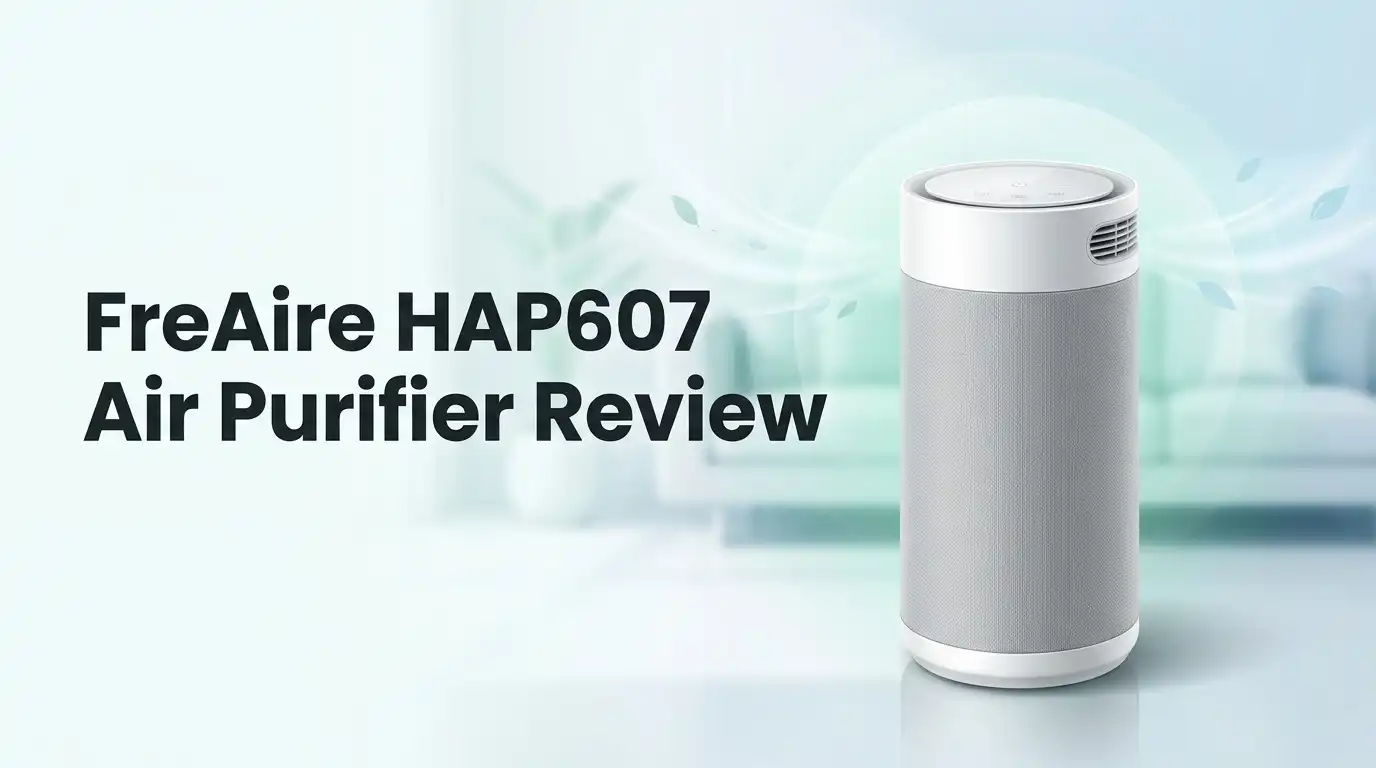
The HAP607 is a tower style air purifier built by XenonLab and sold under the FreAire name. It retails around $148.99 at full price, though it frequently drops lower.
The unit measures 12.6 by 6.1 by 15.8 inches, which makes it taller and slimmer than most budget purifiers. It pulls air through a front intake grille and pushes clean air out of the top vent.
Controls sit on the top panel as touch buttons. You get four fan speeds plus a separate sleep mode, an auto setting driven by a dust sensor, a timer, an air quality light ring, and a display lock for homes with curious children.
The display shows particulate readings, fan speed, or timer hours depending on what you last touched. It runs on a 24 volt adapter rather than a standard plug, which is worth knowing before you hide it behind furniture.
Unboxing Experience
The box arrives compact and surprisingly light. Inside you find the purifier wrapped in a thin fabric sleeve, a foam cap over the top vent, and a folded manual. The power adapter hides underneath the unit itself, tucked into a cutout in the base. I searched the box twice before finding it, and plenty of owners report the same confusion.
Setup takes about three minutes. You pull the front cover off from both sides, lift out the washable pre filter, then remove the main filter and strip off its plastic wrap. Skipping this step is the most common first use mistake, and it can cause the unit to overheat.
Slide the filter back with the side marked FRONT facing outward, click the cover on, plug in the adapter, and tap power. The purifier starts in auto mode by default and chirps once. No app download, no account signup, no pairing dance. That simplicity is refreshing.
Design and Build Quality
The HAP607 wears a matte white shell with a soft gray grille. It looks closer to a small speaker than an appliance, which helps it blend into a bedroom corner. Panel gaps are even, the front cover snaps on firmly, and the plastic does not creak when you lift the unit by its rear carry handle.
That said, this is clearly a value build. The shell feels thinner than a Levoit Vital or a Coway unit. Tapping the side produces a hollow sound. The top mounted touch buttons respond well but offer no tactile feedback, so you rely on the beep to confirm a press.
The air quality light ring glows green, blue, orange, or red, and it is bright enough to notice at night. You can switch it off with a single tap, which I appreciated. No remote control ships in the box, and there is no way to control the unit from your phone.
Filtration System Explained
FreAire uses a three stage filtration stack, and the order matters.
The washable pre filter sits first and grabs the big stuff: pet fur, lint, hair, and carpet fibers. Because it washes clean, it protects the expensive layer behind it and stretches total filter life.
The true HEPA filter handles the fine particles, capturing 99.97 percent of airborne material down to 0.3 microns. That covers dust, pollen, pet dander, mold spores, and smoke particles. Behind that sits the activated carbon layer, which absorbs cooking smells, pet odors, smoke, and volatile organic compounds.
One practical note: the HEPA and carbon layers come bonded as a single replaceable cartridge. You cannot swap one without the other. The carbon layer is also thin, more of a pellet dusted mesh than a deep bed, so heavy odor problems will outlast it faster than the HEPA side wears out.
Top 3 Alternative for FreAire HAP607


Last update on 2026-11-17 / Affiliate links / Images from Amazon Product Advertising API
Levoit Vital 200S P Smart Air Purifier

Last update on 2026-11-17 / Affiliate links / Images from Amazon Product Advertising API
Winix 5510 True HEPA Air Purifier

Last update on 2026-11-18 / Affiliate links / Images from Amazon Product Advertising API
Levoit Core 300S P Smart Air Purifier
Real World Performance Test
I ran three informal tests. First, incense smoke in a closed 180 square foot bedroom. The sensor jumped from green to red within twenty seconds and the fan ramped to turbo on its own. The visible haze cleared in roughly nine minutes, and the reading returned to single digits in about fourteen. That is a strong result for a budget unit.
Second, a seared steak in an open plan kitchen and living space of about 450 square feet. Here it struggled. The smell faded but took close to forty minutes on turbo, and a faint trace lingered. The thin carbon layer shows its limits here.
Third, overnight in a bedroom with a shedding cat. Mornings felt noticeably less stuffy after a week, and the pre filter collected a visible mat of fur. Dust on nightstands also dropped. Real improvement, just not miracle territory.
Noise Levels and Sleep Mode
FreAire advertises 22 decibels in sleep mode, and that figure holds up in practice. On sleep setting the fan produces a soft low hum you stop noticing within a minute. The display dims to almost nothing after three seconds, so nothing glows into your eyes at 2 a.m. This is the mode I used nightly.
Low and medium speeds stay comfortable for working or watching television. High becomes noticeable. Turbo is loud, roughly comparable to a box fan at full tilt, somewhere in the mid 50 decibel range by ear. It also produces a slightly higher pitched whine than larger purifiers because the fan is small and must spin fast to move air.
The practical routine: run turbo for fifteen to twenty minutes when you cook or vacuum, then drop back to sleep or low. The manual recommends exactly this, and it works.
Auto Mode and Air Quality Sensor
Auto mode uses an infrared dust sensor to read the room and pick a fan speed. Green means very good, blue means good, orange means moderate, and red triggers turbo. The sensor reacts fast, often within fifteen to twenty seconds of smoke, aerosol spray, or burnt toast.
Reaction speed is not the same as accuracy, though. Infrared sensors are the budget option, and they tend to overreact to humidity, steam, and cooking vapor while underreading very fine smoke. I saw the display spike after a hot shower in a nearby bathroom when nothing was actually polluting the air. Treat the particulate number as a trend indicator, not a laboratory measurement.
Auto mode also has a habit of hunting between speeds in borderline conditions, which creates small noise changes that some light sleepers find more distracting than a steady low fan.
Coverage Claim: 2600 Square Feet Truth
This deserves plain talk. No small purifier cleans 2600 square feet. That number comes from one air change per hour, which means the machine theoretically processes that volume of air once in sixty minutes. One air change does almost nothing for allergies.
Air quality specialists recommend four to five air changes per hour for allergy and asthma relief. Divide 2600 by four and you land near 650 square feet, which is the realistic working figure. For a bedroom, home office, nursery, or dorm, that is plenty. For an open plan great room, it is not.
Here is the deeper problem: FreAire publishes no AHAM verified CADR rating at all. CADR is the independently tested measure of how much clean air a purifier actually delivers. Levoit, Winix, Coway, and Blueair all publish theirs. When a brand skips that test, you are trusting marketing instead of measurement.
Filter Replacement Cost and Maintenance
Maintenance stays light. Vacuum or rinse the washable pre filter every two to four weeks, let it dry fully, and reinstall it. Wipe the shell with a dry cloth. Never wash the main filter, since water destroys HEPA media.
The main filter lasts roughly six to twelve months depending on how hard you run the unit. A red indicator light tells you when to swap it. Genuine FreAire replacements cost around $20 to $30, and third party multipacks sell for less. After installing a new filter, hold the reset button for five seconds or the light stays red forever.
Budget estimate: about $25 to $50 per year in filters. That is cheaper than most name brand purifiers, where single filters often cost $40 to $60. Low running cost is one of this product’s genuine strengths.
Energy Use and Running Cost
The adapter outputs 24 volts at 1.5 amps, so maximum draw sits near 36 watts. Real consumption is far lower on daily settings. Sleep and low modes pull only a few watts, similar to a small lamp.
Running the unit on sleep mode for eight hours nightly costs pennies per month in most regions. Even continuous low speed operation stays under a few dollars monthly at average United States electricity rates. Turbo is the only setting that meaningfully touches your bill, and you should only use it in short bursts anyway.
One caveat: the external power brick is a weak point. Adapters fail more often than purifiers do, and a proprietary 24 volt adapter is harder to replace than a standard cord. Keep your receipt and register the 12 month warranty.
What the FreAire HAP607 Does Not Do Well
Honest reviews list failures, so here they are.
No verified performance data. The missing CADR rating means you cannot compare this unit against tested competitors on any objective basis.
Weak odor control in large spaces. The slim carbon layer handles light cooking smells but surrenders to heavy frying, litter boxes, and cigarette smoke.
No app, no voice control, no remote. You walk to the unit for every change. Smart home users will find this dated.
Turbo noise is intrusive. You will not run it while sleeping or watching anything.
Sensor accuracy is approximate. Steam and humidity trigger false alarms.
Brand support is thin. XenonLab is a small operation reached through one email address and a phone line. Parts availability years from now is uncertain, and the warranty covers only 12 months.
Pros and Cons
Pros
- True HEPA plus activated carbon filtration at a budget friendly price point under $150
- Washable pre filter that never needs replacing and visibly extends main filter life
- Genuinely quiet sleep mode near 22 decibels with an auto dimming display
- Fast reacting auto mode that ramps to turbo within seconds of smoke or spray
- Low annual filter cost, roughly $25 to $50 per year
- Simple setup with no app, account, or pairing required
- Useful extras including a 24 hour timer, display lock, memory function, and a rear carry handle
Cons
- No AHAM verified CADR rating, so real performance remains unproven
- Coverage claim of 2600 square feet is inflated; plan on roughly 650 square feet
- Turbo mode is loud with a high pitched fan whine
- Thin carbon layer fades on strong odors within months
- No smart features, remote, or voice assistant support
- Proprietary 24 volt adapter creates a single point of failure
- Small brand with limited support and only a 12 month warranty
Who Should Buy the FreAire HAP607
This purifier makes sense for specific buyers. If you want visible air quality feedback in a bedroom, nursery, dorm, or home office under 650 square feet, it delivers real filtration at a fair price. Pet owners benefit most, since the washable pre filter traps fur that would otherwise clog an expensive cartridge.
It also suits people who dislike apps. Everything works from the top panel, and nothing phones home.
Skip it if you have severe asthma, serious allergies, or a doctor recommended air quality requirement. In those cases, buy a purifier with a published CADR rating so you can verify what you are getting. Also skip it for open plan great rooms, heavy smoke environments, or smart home setups where voice control matters. Paying $50 more for a tested Levoit or Winix unit buys peace of mind.
Final Verdict
Last update on 2026-11-20 / Affiliate links / Images from Amazon Product Advertising API
The FreAire HAP607 is a competent budget purifier wearing oversized marketing claims. The hardware works. The HEPA filter is real, the sleep mode is quiet, the sensor reacts quickly, and the filter costs stay low. In a bedroom sized space it measurably reduces dust, dander, and smoke.
The frustration is the missing data. A brand that publishes no CADR rating asks you to trust an advertisement instead of a test. That alone keeps it out of the top tier.
My score: 3.5 out of 5. Buy it on sale for a bedroom or office and you will likely be satisfied. Pay full price expecting whole home coverage and you will feel misled. Match your expectations to roughly 650 square feet and this becomes a reasonable purchase.
Frequently Asked Questions
Does the FreAire HAP607 really cover 2600 square feet?
Not in any useful sense. That figure represents a single air change per hour. For allergy relief at four air changes per hour, the realistic coverage is close to 650 square feet.
How often do I replace the main filter?
Every six to twelve months, depending on use. A red indicator light signals the swap. Hold the reset button for five seconds afterward or the light stays on.
Can I wash the HEPA filter to save money?
No. Water ruins HEPA media and creates mold risk. Only the pre filter is washable, and it should dry completely before reinstalling.
Is the HAP607 loud at night?
Sleep mode is quiet, around 22 decibels, and the display dims automatically. Turbo mode is loud and unsuitable for sleeping.
Does it have app or voice control?
No. There is no app, no voice assistant support, and no remote. All controls sit on the top panel.
Does it produce ozone?
No. The unit uses mechanical filtration only, with no ionizer or ultraviolet lamp, so it does not generate ozone.
Who actually makes the FreAire HAP607?
XenonLab manufactures it. The user manual, warranty, and support contacts all carry XenonLab branding, and the warranty period is 12 months.

I’m Maya Brown, the voice behind Pure Breeze Vault. I write detailed, honest, and easy-to-follow air purifier reviews to help readers compare features, understand filter technologies, and choose products with confidence. My goal is to make research simpler, clearer, and more practical for anyone improving indoor air quality at home.