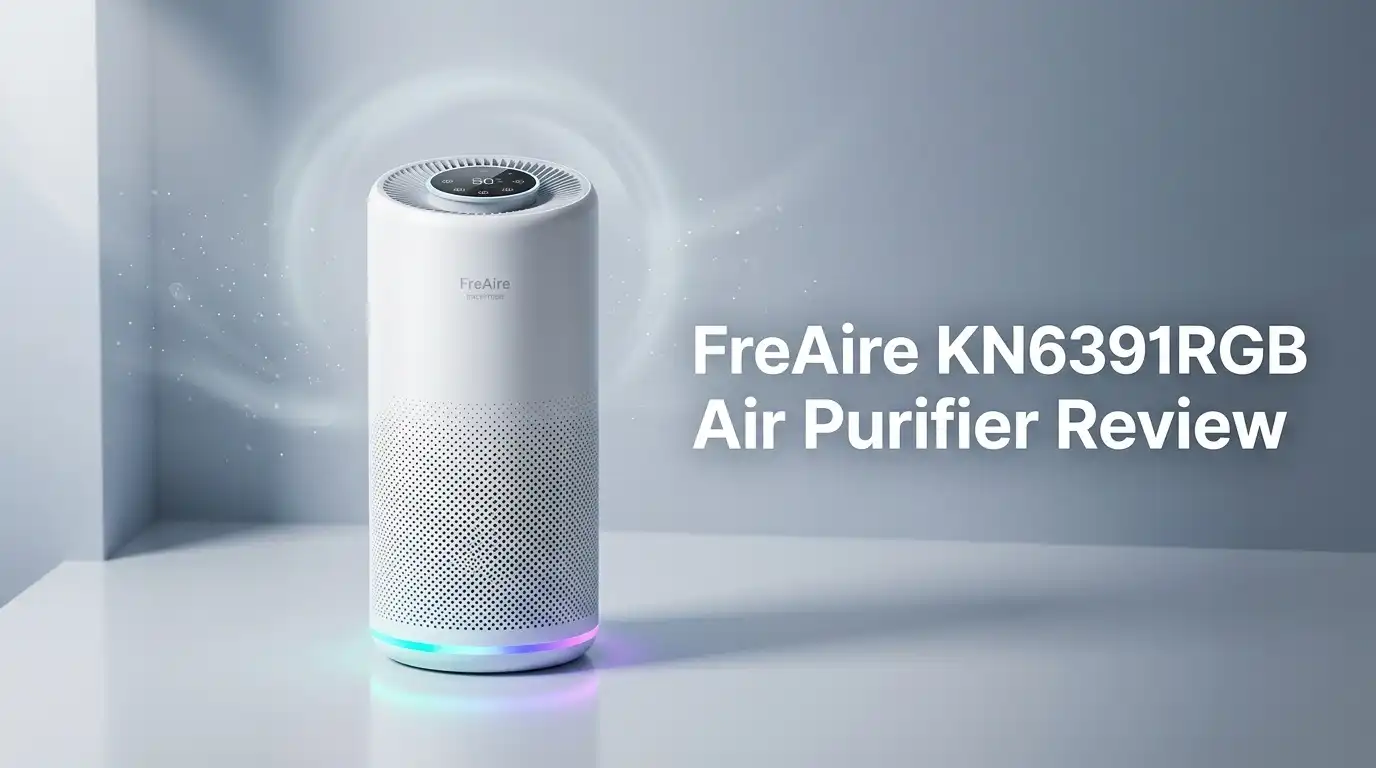
FreAire KN6391RGB Air Purifier Review 2026: Worth Buying?
Clean air at home should not cost a fortune. The FreAire KN6391RGB promises HEPA filtration, soft RGB lighting, and whisper quiet sleep mode for under forty dollars.
That combination sounds almost too good for the price. So I spent weeks with this little tower in a bedroom, an office, and a kitchen to see where it shines and where it stumbles.
This review covers the unboxing, the real noise levels, the filter costs, and the claims that do not hold up. By the end, you will know if this budget purifier belongs in your home or if your money is better spent elsewhere.
In a Nutshell:
- Price is the headline. The KN6391RGB usually sells near $39.98, down from a $66.99 list price. That puts it in impulse buy territory for a compact HEPA unit with a three speed fan, touch controls, and a timer.
- Size is tiny, coverage claims are big. The unit measures 6.1 x 6.1 x 9.7 inches and weighs only 3 pounds. FreAire advertises coverage up to 1086 square feet, but that number reflects one air change per hour in a very generous room, not true clean air delivery. Treat it as a small room purifier for spaces around 150 to 250 square feet.
- Quiet is real. Sleep mode drops to roughly 20 to 22 dB, which is softer than a refrigerator hum. Speed three is noticeably louder and sounds like a small fan.
- Extras add charm. Three ambient light modes and an aroma pad for essential oils make it feel more like a nightstand gadget than an appliance. Neither feature improves filtration.
- No smart features and no air sensor. There is no app, no WiFi, no particle readout, and no auto mode. You control everything by hand.
- Filters are cheap but needed often. Replacement 3 in 1 filters run about $8 each in two packs. Plan on swapping every three to six months.
What Is the FreAire KN6391RGB Air Purifier?

Last update on 2026-11-17 / Affiliate links / Images from Amazon Product Advertising API
The FreAire KN6391RGB is a compact tower purifier built for bedrooms, desks, dorms, and small offices.
It pulls air through two side vents and pushes clean air out of the top in a 360 degree pattern. Inside sits a single cylindrical cartridge that holds three filtration layers. The control panel uses touch buttons for power, fan speed, timer, and light.
FreAire sells it in white and black. The RGB in the name refers to the ambient light ring, not to gamer styling. It is a plug in AC unit with no battery and no app.
The model carries a CARB certification, which means it meets California ozone emission limits. On Amazon it holds a 4.6 star average across more than 3,600 ratings, and it sits inside the top twenty HEPA purifiers by sales rank.
Unboxing Experience: What Is Inside?
The box arrives small enough to carry with one hand. Mine shipped in its own product packaging with no extra outer carton, so the printed sleeve showed a few scuffs. Inside you get the purifier, a short power adapter, a quick start manual, and a thin aroma pad tucked in a paper envelope.
The filter ships preinstalled but sealed inside a plastic bag. You must twist off the bottom cover, pull the filter out, remove the bag, and reinstall it. Skipping that step is the number one reason buyers think the unit does not work. The whole setup takes under two minutes.
First impressions are positive. The plastic feels light but not flimsy. There is no chemical smell, which is rare at this price. Plug it in, tap power, and the light ring glows immediately.
Design and Build Quality
The KN6391RGB looks like a shrunken version of purifiers that cost three times more. The cylinder shape fits on a nightstand, a bookshelf, or a desk corner. At 3 pounds, you can move it between rooms without thinking about it.
The shell is matte plastic with a honeycomb grille on both sides. The top vent uses a circular pattern that spreads air outward rather than straight up. Touch controls respond on the first tap, though they lack any click feedback.
Weak points show up with time. The power cord measures just over four feet, which limits placement. The base has no rubber feet, so the unit slides on glass or polished wood. The plastic also picks up fingerprints quickly on the black version. Build quality is fair for the price, but this is not an heirloom appliance.
Filtration System Explained
FreAire uses a single cartridge with three stages. The outer mesh acts as a pre filter and catches hair, large dust, and lint. The middle pleated layer is the HEPA style media that traps particles down to 0.3 microns. The inner layer holds activated carbon granules for odors from cooking, pets, and smoke.
This design is common in budget purifiers and it works for everyday dust and dander. The carbon layer is thin, so heavy odors fade slowly rather than disappearing. Do not expect it to erase cigarette smoke in a living room.
One honest caveat matters here. FreAire does not publish an AHAM verified CADR rating. The brand instead cites a figure of 215 square feet in 12 minutes. That is a marketing stat, not a lab certified number, so compare it carefully against tested competitors.
Top 3 Alternative for FreAire KN6391RGB


Last update on 2026-11-19 / Affiliate links / Images from Amazon Product Advertising API
Levoit Core 300P Air Purifier

Last update on 2026-11-17 / Affiliate links / Images from Amazon Product Advertising API
AROEVE MK01A Air Purifier

Last update on 2026-11-17 / Affiliate links / Images from Amazon Product Advertising API
Afloia Kilo Air Purifier
Real World Performance in a Bedroom
I placed the unit about three feet from a bed in a 160 square foot room. Running on speed two overnight, the air felt noticeably fresher by morning. Dust on the dresser built up slower over two weeks compared to the weeks before.
Pet dander was the clearest win. With a cat in the room, the usual stale smell dropped within a day of continuous use. Morning congestion eased for one tester with mild pollen allergies, though that is anecdotal and not a medical result.
Cooking odors were a tougher test. Placed in a kitchen, the purifier softened fried food smells but did not clear them. You need speed three and an hour of runtime for any real effect. In short, it handles light daily air quality duty well and struggles with heavy loads.
Noise Levels and Sleep Mode
Noise is where this purifier earns its fans. Sleep mode measured around 22 dB on my phone meter, close to the advertised 20 dB figure. In a dark room, you hear a soft hush rather than a motor. Light sleepers should have no trouble with it.
Speed two sits near 35 dB and reads as gentle white noise. Speed three climbs to roughly 50 dB, which is similar to a small desk fan. That level is fine during the day and too loud for sleeping.
One nice detail is that the lights can be turned off completely while the fan keeps running. Many budget purifiers keep a bright LED burning all night. The motor on my unit stayed smooth with no rattle after weeks of use, though a few owners report bearing whine over longer periods.
Ambient Lights and Aroma Pad
The light ring offers three modes: a steady warm glow, a steady color, and a slow color cycle. The effect is soft rather than bright, so it works as a nightlight for kids or a mood accent in a dim room. It will not light a path to the bathroom.
The aroma pad sits in a small drawer near the base. You add four or five drops of essential oil, slide it back in, and the scent travels with the airflow. Oils are not included.
Here is the honest part. Adding fragrance to an air purifier works against the point of cleaning the air. The carbon layer will slowly absorb the oil you just added, which shortens filter life. Use the feature sparingly, or skip it if you bought this unit for allergies.
Coverage Claims: Does 1086 Square Feet Hold Up?
The listing advertises coverage up to 1086 square feet. That number comes from a single air change per hour calculation in a room with standard ceilings. One air change per hour is far below what health groups recommend for allergy relief.
Most experts suggest four or five air changes per hour for meaningful results. Run that math and the realistic coverage drops to roughly 200 to 250 square feet. For a small bedroom, a dorm, a nursery, or a home office, that is perfectly reasonable.
Do not buy this for an open plan living room or a large basement. You would need two or three units to match one midsize purifier. FreAire is not alone in using the generous number, but buyers deserve the clearer figure before they click add to cart.
Filter Replacement Cost and Maintenance
Maintenance is simple. Twist the base counterclockwise, lift out the cartridge, vacuum the outer mesh every two weeks, and reinstall. The pre filter is not washable with water, so keep it dry.
Replacement cartridges are widely available. Branded and compatible TZ K1 style filters sell in two packs near $15.99, which works out to about $8 per filter. That is cheap compared to name brand purifiers charging $25 or more.
FreAire suggests replacement every three to six months. Heavy pet homes should lean toward three months. There is no filter life indicator light, so you need to track dates yourself. Put a reminder on your phone. One real risk with small brands is supply. If FreAire stops selling filters, third party sellers currently fill the gap, but that is not guaranteed forever.
Energy Use and Running Cost
The KN6391RGB draws very little power. Typical consumption sits in the single digit watt range on low and climbs modestly on high. Running it continuously costs roughly one to three dollars per month at average United States electricity rates.
That low draw makes it practical to leave on all day. A purifier only helps while it runs, so low energy use genuinely matters here.
Add it all up for a full year. The unit itself costs about $40, filters add roughly $16 to $32, and electricity adds another $20 or so. Total first year ownership lands near $80. That is strong value for a bedroom sized purifier, as long as you accept the modest coverage and the missing smart features.
Pros and Cons of the FreAire KN6391RGB
Pros
- Very low price for a HEPA style purifier with three speeds, a timer, and touch controls
- Genuinely quiet sleep mode at roughly 20 to 22 dB, which works for light sleepers
- Compact and light at 6.1 inches wide and 3 pounds, so it moves between rooms easily
- Cheap replacement filters at about $8 each in multipacks
- Lights fully switch off while the fan keeps running, a detail many rivals miss
- CARB certified, so it meets California ozone emission limits
Cons
- No AHAM verified CADR rating, so performance claims are hard to confirm
- Coverage claim of 1086 square feet is inflated for real allergy relief
- No air quality sensor, no auto mode, no app, and no filter change indicator
- Thin carbon layer struggles with strong cooking smells and smoke
- Short power cord and a base with no grip pads
- Aroma pad shortens filter life and conflicts with the purpose of the device
What This Purifier Does Not Do Well
Honesty matters more than hype, so here is the plain truth. This unit will not clean a large room. It will not remove mold from walls, and it will not fix a humidity problem. It has no sensor, so it cannot react to smoke or cooking on its own.
It also will not help much with gases such as VOCs from fresh paint or new furniture. The carbon amount is simply too small for that job.
Support is another soft spot. FreAire is a small brand with a basic website and email only contact. Warranty service can be slow, and long term filter availability is a fair concern. If you want certified performance data and a brand that will still exist in five years, pay more for an established name.
Who Should Buy the FreAire KN6391RGB?
Last update on 2026-11-17 / Affiliate links / Images from Amazon Product Advertising API
This purifier fits specific people very well. Students in dorm rooms, renters in studio apartments, parents who want a quiet nightlight purifier in a nursery, and anyone adding a second or third unit to a home will get real value here. Desk use in a home office is another strong fit.
It also suits buyers who want to test whether a purifier helps their symptoms before spending two hundred dollars. At forty dollars, the experiment is low risk.
Skip it if you have severe asthma, if you live in a wildfire zone, if you need coverage over 300 square feet, or if you want smart controls and verified lab data. Those buyers should look at tested models from Levoit, Coway, or Blueair instead.
Final Verdict: Is It Worth It in 2026?
The FreAire KN6391RGB is a good small purifier wearing slightly oversized marketing claims. Strip away the 1086 square foot headline and you get a quiet, compact, inexpensive unit that visibly reduces dust and dander in a bedroom sized space.
I rate it 4 out of 5 for value and 3 out of 5 for raw performance. The sleep mode is the standout feature, and the cheap filters keep long term costs down.
Buy it with correct expectations and you will likely be happy. Buy it expecting whole home air cleaning and you will be disappointed. For forty dollars in 2026, few purifiers offer this mix of silence, size, and charm. Just remember to remove the plastic bag from the filter before you complain that it does nothing.
Frequently Asked Questions
Does the FreAire KN6391RGB use a true HEPA filter?
FreAire advertises filtration of particles down to 0.3 microns, which matches HEPA criteria. However, the company does not publish independent HEPA certification documents. Treat it as HEPA style media rather than a lab certified H13 filter.
How often should I replace the filter?
FreAire recommends every three to six months. Homes with pets or smokers should replace every three months. There is no reminder light, so mark your calendar when you install a new cartridge.
Can it remove cigarette smoke?
It reduces light smoke odor in a small room over time. It will not clear active smoke from a living room. The carbon layer is too thin for heavy smoke loads.
Is it safe to run all night?
Yes. The unit is CARB certified, draws very little power, and operates near 20 dB in sleep mode. Place it on a flat surface with clear space around the vents.
Does it produce ozone?
No ozone generator is included. The CARB certification confirms it meets strict ozone emission limits, so it is safe for bedrooms and nurseries.
Where should I place the purifier?
Put it one to three feet away from walls and furniture so air can enter both side vents freely. Nightstands, desks, and open shelves work best. Avoid corners and closed cabinets.

I’m Maya Brown, the voice behind Pure Breeze Vault. I write detailed, honest, and easy-to-follow air purifier reviews to help readers compare features, understand filter technologies, and choose products with confidence. My goal is to make research simpler, clearer, and more practical for anyone improving indoor air quality at home.