
PuroAir 240 HEPA Air Purifier Review 2026: Worth Buying?
Clean air inside your home should not be a guessing game. Yet most of us buy an air purifier based on a shiny box and a big room size number printed on the front.
The PuroAir 240 is one of the most purchased air purifiers on Amazon, and it carries some very loud marketing claims. It promises HEPA 14 filtration, coverage up to 1,000 square feet, and quiet sleep mode performance.
But does the unit actually deliver that in a real bedroom or living room? I looked at lab data, AHAM certified numbers, owner feedback, and independent test results to answer that question honestly. This review covers the good parts, the weak parts, and the parts the brand would rather not highlight.
In A Nutshell:
- The PuroAir 240 is a small tower purifier, roughly 8.5 inches wide and 14.25 inches tall, weighing about 8 pounds. It fits on a nightstand, a desk, or a corner of a bedroom floor without taking much space.
- The advertised room coverage is very optimistic. The AHAM certified report lists a recommended room size near 284 square feet for healthy air changes. The 1,000 square foot claim works out to roughly one air change per hour, which experts consider too slow.
- Air cleaning speed is average, not amazing. Independent testing clocked it at around 48 to 51 minutes to clear a small test room. Cheaper units finished the same job faster.
- It is genuinely quiet. Measurements showed about 36.9 dB on speed one and 52.2 dB at full blast. Sleep mode is soft enough for light sleepers.
- Filter costs are the biggest long term problem. Replacement filters run near $48 each, and PuroAir suggests changing them every 90 days. That adds up fast compared to rival brands.
- Best fit: a bedroom, nursery, office, or dorm under 300 square feet. It is not the right pick for an open plan living area.
PuroAir 240 HEPA Air Purifier

Last update on 2026-11-20 / Affiliate links / Images from Amazon Product Advertising API
The PuroAir 240 is a compact cylinder purifier built for homes with pets, dust, pollen, and cooking odors. It uses a single all in one filter cartridge that combines a mesh pre filter, a certified HEPA layer, and an activated carbon layer the brand calls CarbonTech.
Air enters through 360 degree side vents and exits from the top. The control panel sits on the lid with buttons for power, fan speed, timer, auto mode, and child lock. A small light ring glows blue, yellow, orange, or red based on the onboard PuroIQ particle sensor reading.
The company markets it as the first HEPA 14 home purifier. That phrase sounds impressive, though filtration grade alone does not decide how fast a room gets clean. Airflow matters just as much, and we will cover that shortly.
Unboxing Experience And First Impressions
The box arrives slim and surprisingly light. Inside you get the purifier, a power cable, a quick start card, and the filter already seated in the base. Do not skip the first step.
The filter ships inside a sealed plastic bag, and the unit will blow almost nothing until you twist off the bottom cover and remove that wrapper. PuroAir places a bright sticker on the filter as a reminder, which I appreciated.
The matte black finish looks sharp and hides dust better than glossy white rivals. Setup takes about two minutes. Plug it in, press power, and the sensor starts reading the room.
The first impression is positive. It feels modern and the branding is clean. The plastic shell, however, flexes a little when you squeeze it, which hints at the cost savings underneath.
Design And Build Quality
The design follows a familiar formula. A twist off base, a tube shaped filter with a fabric handle, and a top mounted control deck. Owners of other popular small purifiers will spot the resemblance immediately.
PuroAir did improve one real annoyance. Rubber pads on the bottom keep the base cover locked in place when you slide the unit across a floor, so the filter does not pop out.
Build quality is where the price starts to feel high. The plastic is thinner than I expected at this cost, and the filter frame has sharp molded edges.
Nothing rattles and nothing feels broken, but it does not feel premium. The control buttons respond well and the light ring is easy to read at night. Overall, the design is tidy and practical, just not luxurious.
Top 3 Alternative For PuroAir 240


Last update on 2026-11-18 / Affiliate links / Images from Amazon Product Advertising API
Levoit Core 300S Smart Air Purifier

Last update on 2026-11-17 / Affiliate links / Images from Amazon Product Advertising API
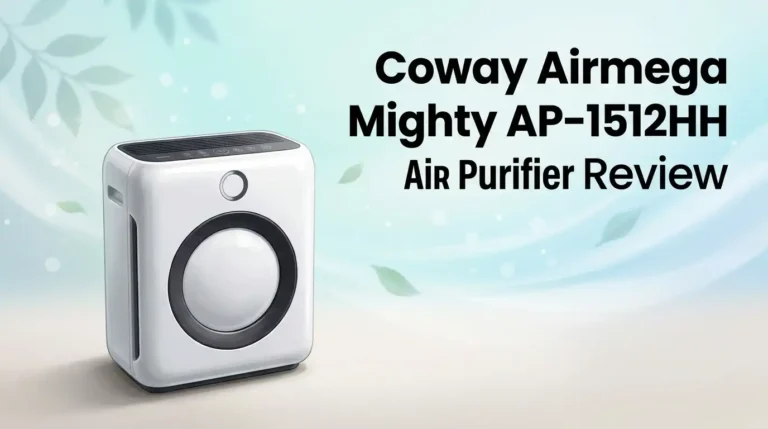
Coway Airmega Mighty AP1512HH Air Purifier

Last update on 2026-11-17 / Affiliate links / Images from Amazon Product Advertising API
Winix 5510 Air Purifier
Filtration Technology Explained
The PuroAir 240 uses a three layer cartridge. The outer fabric mesh catches hair, lint, and large dust. The pleated HEPA media captures fine particles including pollen, dander, smoke particles, and PM2.5.
A thin activated carbon layer sits on the inside to absorb odors from cooking, litter boxes, and pets. PuroAir rates the HEPA layer at H14 grade, which on paper traps 99.995% of particles at the hardest to catch size.
Here is the honest catch. A denser filter also restricts airflow. Independent testers have shown that a lower grade HEPA paired with a stronger fan often cleans a room faster.
So the H14 label is a marketing win more than a performance win. The carbon layer is also thin, so heavy smoke odor removal is limited compared to purifiers that use carbon pellets.
Real Room Coverage And CADR Numbers
This is the most important section of the review. The AHAM certified clean air delivery rate for the PuroAir 240 sits around 183 CFM for dust, 181 CFM for smoke, and 204 CFM for pollen. Those are decent numbers for a small unit. The certified recommended room size is roughly 284 square feet.
Marketing materials quote 1,000 square feet or more. That figure assumes a single air change per hour. Health guidance generally calls for four to five air changes per hour in a room where someone sleeps or works.
If you place this unit in a 900 square foot open space, you will not feel much difference. Put it in a 200 to 280 square foot bedroom and it performs the way you expect. Match the purifier to the room and you avoid disappointment.
Air Cleaning Performance In Daily Use
In controlled testing of a small sealed room filled with smoke particles, the PuroAir 240 needed roughly 48 to 51 minutes to bring readings back to zero on top speed. Several cheaper purifiers finished the same job in 23 to 40 minutes. So the 240 works, but it works slowly for its price tier.
Daily use tells a friendlier story. In a closed bedroom, owners report less dust on surfaces within a week, fewer morning sneezes, and noticeably lighter pet odor.
Cooking smells fade in about 20 to 30 minutes with the fan on speed three. Run it continuously rather than in short bursts. A purifier only helps while air is passing through it, and this model rewards patience more than speed.
Noise Levels And Sleep Mode
Noise is a genuine strength. Measured from three feet away, speed one registered near 36.9 dB, speed two near 42.2 dB, and speed three near 52.2 dB. Sleep mode dims the lights and drops the fan to a soft hush. Most people will not hear it over a ceiling fan.
The sound profile matters as much as the volume. The 240 produces a smooth low frequency whoosh instead of a whiny motor hum, which is easier to ignore while reading or sleeping. Speed three is noticeable but not harsh.
I would compare it to a quiet bathroom fan. If you are a light sleeper, run speed one or sleep mode overnight and bump it to speed three for an hour before bed. That routine gives you clean air without the noise.
Auto Mode And The PuroIQ Sensor
The onboard particle sensor drives auto mode and the color ring. Blue means clean, yellow means fair, orange means poor, and red means bad. It reacts quickly to obvious events. Light a candle, fry onions, or spray dry shampoo nearby and the ring jumps to red within seconds.
Accuracy is a fair concern. The sensor inside is an inexpensive infrared particle counter, not a laser grade meter. That means it detects big changes well but it will not give you precise readings.
Some owners also report the fan ramping up and down repeatedly in dusty homes, which can be distracting at night. Auto mode is convenient for daytime use. For bedtime, manual speed one or sleep mode gives you steadier, calmer operation.
Filter Replacement Cost And Running Cost
Here is the part that stings. A genuine replacement filter costs around $48, and PuroAir recommends changing it every 90 days. That is close to $190 per year on filters alone if you follow the schedule. Add roughly $40 of electricity for continuous use and your yearly cost lands near $230.
Competing small purifiers cost between $60 and $110 per year to maintain. You can reduce the bill by buying multi pack filter bundles, which drop the price per filter noticeably.
Generic third party filters exist at lower prices, though most are rated HEPA 13 rather than 14 and they may affect your warranty. Vacuum the outer mesh every two or three weeks and you will stretch filter life closer to four or five months in a clean home.
Energy Use And Everyday Convenience
Power draw is modest. Sleep mode pulls around 11.6 watts, speed one around 16 watts, speed two around 23 watts, and speed three around 37.6 watts. Running it nonstop at full speed adds only a few dollars a month to a typical electricity bill. That makes continuous operation realistic, which is exactly how a purifier should be used.
Convenience features are basic but useful. The timer offers two, four, six, and eight hour settings. The child lock prevents curious toddlers from changing settings.
A filter indicator light tells you when a change is due, and you reset it by holding a button for a few seconds. There is no app, no voice control, and no scheduling. For some buyers that simplicity is a plus, not a minus.
What The PuroAir 240 Does Not Do Well
Honesty matters, so here are the real weaknesses. The advertised room coverage is inflated, and that single issue causes most of the disappointed reviews online. Buyers place it in a large open space, see no change, and assume the unit is defective.
Second, the value equation is poor. You pay a premium price for cleaning speed that budget models beat. Third, filter costs are among the highest in this size class. Fourth, the pre filter is bonded to the cartridge, so you cannot wash it separately.
Fifth, documentation behind the HEPA 14 lab claims is not publicly available, which makes it hard to verify. Finally, there is no app support at a price where rivals include it. None of these make it a bad machine, but they do make it an expensive one.
Pros And Cons Of The PuroAir 240
Pros
- Very quiet operation, with sleep mode measuring under 37 dB and a smooth sound profile that fades into the background at night.
- Compact 8.5 inch footprint that slips beside a nightstand, desk, or sofa without blocking walkways.
- AHAM certified CADR ratings near 183 CFM for dust, which is respectable airflow for such a small body.
- Rubber base pads prevent the filter cover from popping open when you move the unit across carpet or tile.
- Simple controls with timer, child lock, auto mode, and a clear color coded air quality ring.
- Attractive matte black finish that hides dust and suits most room styles.
Cons
- Advertised 1,000 square foot coverage is misleading, since certified guidance points closer to 284 square feet for proper air changes.
- Slower room clearing than several purifiers that cost half as much.
- Filter replacements near $48 every 90 days push yearly running costs above $200.
- Pre filter cannot be removed or washed on its own.
- Plastic build feels thin and the filter frame has rough edges.
- No app, no voice assistant, and no scheduling at this price point.
Who Should Buy The PuroAir 240
Last update on 2026-11-20 / Affiliate links / Images from Amazon Product Advertising API
Buy this purifier if you want a quiet, good looking unit for a bedroom, nursery, home office, or dorm room under about 300 square feet. Allergy sufferers who sleep with the door closed will benefit most. Pet owners in small apartments also report real improvement in dander and litter odor.
Skip it if you need coverage for a great room, a basement, or an open kitchen and living area. Skip it as well if low maintenance cost is your top priority, because filter prices will outpace the purchase price within a year.
If you want smart features like app scheduling or air quality history on your phone, look elsewhere. Match your room size honestly to the certified numbers and your satisfaction with this machine goes way up.
PuroAir 240 Versus Levoit Core 300S
These two units compete directly and look remarkably similar inside and out. The PuroAir 240 posts a higher certified CADR, which gives it a small edge on raw airflow. The Levoit Core 300S counters with app control, voice assistant support, and cheaper filters.
Build quality favors Levoit. The plastics feel thicker and the filter frame is more solid. Noise levels are nearly identical, with both hovering in the mid thirties on the lowest speed. Price is usually close, though Levoit tends to sit slightly lower.
My practical take is simple. If you want smart features and lower long term costs, choose the Core 300S. If you prefer black styling, a stronger fan rating, and no app in your life, the PuroAir 240 earns its spot.
Final Verdict: Is The PuroAir 240 Worth It In 2026?
The PuroAir 240 is a competent small room air purifier wrapped in oversized marketing. It is quiet, compact, easy to live with, and genuinely effective in a bedroom sized space. The sensor reacts fast, the design looks good, and the filter change takes under a minute.
The problems are value and honesty about coverage. You can buy faster cleaning for less money, and filter costs will outpace most rivals over a two year period.
My rating is 3.5 out of 5. Buy it when it is discounted, place it in a room under 300 square feet, run it continuously, and clean the mesh regularly. Do those four things and you will likely be happy. Expect whole house performance and you will not be.
Frequently Asked Questions
How often should I replace the PuroAir 240 filter?
PuroAir recommends every 90 days. In a clean home with light use, many owners stretch this to four or five months. Vacuum the outer mesh every two weeks to extend filter life and keep airflow strong.
Does the PuroAir 240 really cover 1,000 square feet?
Not for meaningful cleaning. That number assumes one air change per hour. For four to five air changes per hour, which is the healthier target, plan on a room around 280 square feet.
Is the PuroAir 240 safe for people with asthma?
Yes. It uses mechanical HEPA filtration and does not produce ozone as a cleaning method. Keep the filter fresh and run the unit continuously in the bedroom for best results.
Can I use third party replacement filters?
You can, and they cost less. Most generics are rated HEPA 13 rather than 14. Performance stays similar in practice, though using them may affect your warranty coverage.
Does the PuroAir 240 have an app?
No. It offers manual controls, auto mode, sleep mode, a timer, and a child lock. There is no phone app, no WiFi, and no voice assistant support.
Where should I place the PuroAir 240 for best results?
Place it on the floor or a low table, at least a foot away from walls and furniture. Keep doors closed in the room you want cleaned so the unit is not fighting the whole house.

I’m Maya Brown, the voice behind Pure Breeze Vault. I write detailed, honest, and easy-to-follow air purifier reviews to help readers compare features, understand filter technologies, and choose products with confidence. My goal is to make research simpler, clearer, and more practical for anyone improving indoor air quality at home.