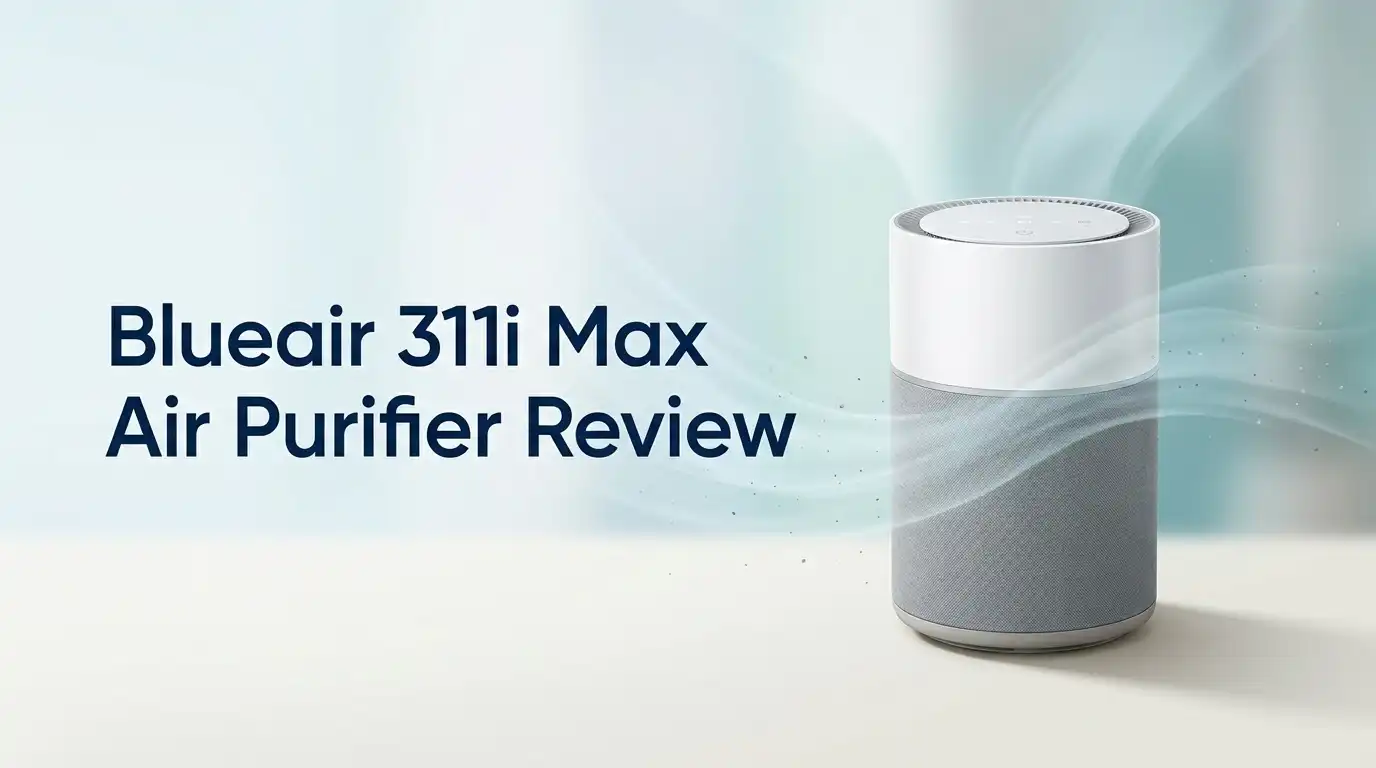
Blueair 311i Max Air Purifier Review 2026: Worth Buying?
Clean air sounds simple until you start shopping for it. Fan speeds, CADR numbers, filter costs, ionizers, app features, and dozens of brands all compete for your attention.
The Blueair 311i Max sits right in the middle of that crowd, promising strong airflow, low power draw, and a quiet motor inside a fabric wrapped cylinder that actually looks nice in a living room.
This review covers what the 311i Max genuinely does well, where it falls short, and whether it deserves a spot in your home in 2026. No fluff, no marketing copy, just honest observations and real numbers.
In A Nutshell:
- Strong particle removal for the price. The 311i Max delivers a measured CADR near 250 CFM, which clears a 320 square foot room by roughly 96 percent in one hour at top speed. That performance matches purifiers costing far more.
- Very low energy consumption. The motor pulls only about 27 to 30 watts at maximum speed and under 3 watts in sleep mode. Running it around the clock adds roughly $2.50 per month to a typical electricity bill.
- Quiet at low and medium speeds. Sleep mode measures near 35 to 40 dBA depending on test conditions. Top speed climbs to around 58 to 59 dBA and introduces a faint buzzing tone that some users find annoying.
- Weak odor and VOC control. The carbon stage uses a fibrous sheet coated in carbon rather than carbon pellets. It handles light cooking smells but will not fix heavy smoke, paint fumes, or strong pet odors.
- The ionizer cannot be switched off. HEPASilent technology relies on electrostatic charging, which creates trace ozone. The unit holds CARB certification, but people who want a purely mechanical purifier should look elsewhere.
- Running costs stay reasonable. Filters last six to nine months and cost around $45 for the official version, keeping yearly total costs close to $120.
Blueair 311i Max Air Purifier


Last update on 2026-11-19 / Affiliate links / Images from Amazon Product Advertising API
The Blueair 311i Max is a mid sized smart purifier built around a cylindrical filter and a 360 degree air intake. It stands 19 inches tall, measures 12.5 inches across, and weighs only 7.8 pounds. That light frame makes it easy to shift between rooms, though the height means it will not hide under a desk.
Blueair rates it for rooms up to roughly 465 square feet with frequent air changes, and independent testing places the comfortable sweet spot near 330 to 390 square feet.
Inside, the HEPASilent system pairs mechanical filtration with electrostatic charging to pull dust, pollen, smoke particles, and pet dander out of the air while using very little electricity.
You also get WiFi, an onboard PM2.5 sensor, auto mode, night mode, and voice assistant support. It is a genuinely smart purifier at a mainstream price.
Unboxing Experience And First Impressions
Opening the box takes about ninety seconds. Blueair ships the unit in molded cardboard with almost no plastic, and the filter arrives already installed inside the body. You lift the purifier out, peel off a protective sleeve, plug it in, and it starts working immediately.
Inside the carton you will find the purifier itself, the preinstalled particle and carbon filter, the fabric pre filter already stretched over the base, and a short manual. There is no remote and no extra filter in the box.
My first reaction was surprise at how light it feels. It weighs less than a gallon of milk. The fabric sleeve feels like upholstery rather than plastic mesh, and the top panel has a soft matte finish. Setup genuinely takes under two minutes if you skip the app pairing step.
Design And Build Quality
The 311i Max splits into two clear sections. The top quarter holds the motor, the control panel, and the exhaust vents. The bottom three quarters is a frame that holds the filter, wrapped in a washable fabric pre filter available in several colors.
That color choice matters more than it sounds. You can match the purifier to a sofa or a rug instead of hiding an ugly white box behind a chair. It genuinely looks like furniture rather than an appliance.
Build quality is good but not premium. The plastic shell feels thin when you lift the top section, and there is a small amount of flex if you press on the sides. Nothing feels fragile, though. The design prioritizes airflow and looks over heft, which suits a unit meant to sit in plain view.
Top 3 Alternatives for Blueair 311i Max

Last update on 2026-11-17 / Affiliate links / Images from Amazon Product Advertising API
LEVOIT Vital 200S-P Smart Air Purifier

Last update on 2026-11-17 / Affiliate links / Images from Amazon Product Advertising API
COWAY Airmega AP-1512HH Mighty Air Purifier

Last update on 2026-11-17 / Affiliate links / Images from Amazon Product Advertising API
BLUEAIR Blue Pure 211i Max Smart Air Purifier
Filtration System Explained
The 311i Max uses four stages, though only two of them need replacing. The first stage is the fabric pre filter that slides over the body like a sock. It catches hair, lint, and large dust, and it goes straight into the washing machine.
The second stage is a pleated particle filter that handles the real work. It traps dust, pollen, mold spores, and fine smoke particles. Blueair does not label it True HEPA, because the system relies on the combination of media plus charge rather than dense media alone.
The third stage is a carbon coated fabric layer sitting inside the filter cylinder. The fourth stage is the HEPASilent ionizer, which charges particles so they stick to the filter more easily. This combination is why the unit moves so much air using so little power.
Air Cleaning Performance Tested
Performance is where the 311i Max earns its keep. In a 320 square foot room running at maximum speed for one hour, measured PM2.5 dropped from 109 micrograms per cubic meter to under 5. That is a 96 percent reduction and matches results from far pricier machines.
A larger 560 square foot room produced an 89 percent reduction over the same hour, which shows the unit still works above its rated coverage, just more slowly. In smaller controlled chamber testing, it reached near zero fine particles in roughly 27 minutes.
Real life results felt consistent with those numbers. Dust settling on shelves dropped noticeably within two weeks. Morning allergy symptoms eased in the bedroom. For particles, this purifier performs at the top of its price class.
Noise Levels At Every Speed
Noise is a mixed story. Sleep mode and speed one are genuinely quiet, landing somewhere between 35 and 42 dBA depending on how close the meter sits. At those settings you can sleep, work, or watch television without noticing it.
Speed two measures around 48 dBA. That is audible but easy to tune out, and it still delivers solid cleaning speed. This is the setting I used most often.
Speed three is the problem. It measures close to 58 to 59 dBA, which is normal for this airflow, but the motor produces a faint buzzing undertone layered over the usual whoosh. Some people never notice it. Others find it grating. If background noise bothers you, plan to run this unit on speed two or lower.
Smart App And Controls
Physical controls are deliberately minimal. The top panel has a power button, a fan speed button, speed indicators, a WiFi light, and icons for night mode and auto mode. There is no screen and no numeric readout on the device itself.
The Blueair app fills that gap well. Pairing took under a minute on my first try, and the connection never dropped during weeks of use. You get real time PM2.5 readings, historical charts, remote fan control, child lock, filter life tracking, and scheduling.
My favorite touch is the fan slider, which lets you set speeds between the three preset levels. That flexibility is rare. The app is one of the best in the air purifier category, and it works with voice assistants too.
Energy Use And Running Costs
Power efficiency is the headline strength here. Standby draw sits under one watt. Sleep mode uses around 3 watts. Speed one uses roughly 5 watts, speed two about 13 watts, and top speed about 28 watts.
Running the unit nonstop at maximum speed costs roughly $2.40 to $2.70 per month at average electricity rates, or around $32 per year. Most comparable purifiers cost considerably more to operate because they push air through denser media with hungrier motors.
Filters add the bigger expense. Official replacements run near $45 and last six to nine months, which works out to roughly $90 per year. Total yearly running cost lands near $120. Generic filters exist for under $20 each, though performance varies and they lack the official media grade.
Filter Replacement And Maintenance
Maintenance is refreshingly easy. The fabric pre filter slides off, goes in the washing machine, and air dries. Blueair suggests washing it roughly twice a month, and doing so keeps airflow strong and extends main filter life.
Replacing the main filter takes about a minute. You lift the top section off, pull out the old cylinder, drop in the new one, and reset the indicator in the app. No tools, no screws, no fiddling.
One frustration deserves mention. Blueair changes filter designs between generations, so older 311 filters will not fit the Max version. Upgrading means buying into a new filter ecosystem. The rear air quality sensor is optical rather than laser, so wipe it clean every few weeks or readings drift.
Room Size Coverage
Blueair markets big numbers, and context helps. The 2,107 square foot figure describes a single air change per hour, which is marketing math rather than useful cleaning. The honest working range is narrower.
For five air changes per hour, which allergy sufferers actually want, the realistic coverage is around 330 square feet. For the standard four to five changes used by most testing bodies, roughly 387 square feet works well.
That makes the 311i Max a strong fit for bedrooms, home offices, nurseries, and medium living rooms. It still performed respectably in a 560 square foot space, just more slowly. Open plan homes above 600 square feet should step up to the 211i Max rather than hoping one 311i Max can manage the whole floor.
What The Blueair 311i Max Does Not Do Well
Honest reviews name the flaws, so here they are. Odor control is the weakest link. The carbon layer is a thin fibrous sheet rather than a bed of carbon pellets, and it simply does not hold enough carbon to absorb cooking smells, wildfire smoke odor, paint fumes, or strong VOCs.
The ionizer cannot be disabled. Competing brands like Coway and Winix include a switch for their ionizers. Blueair does not, which means trace ozone comes with every use. CARB certification confirms the levels stay well below legal limits, but the lack of choice frustrates some buyers.
The buzzing at top speed is real and inconsistent between units. There is also no remote control and no physical display, so deeper control requires your phone.
Pros And Cons
Pros
- Excellent particle removal for dust, pollen, pet dander, and fine smoke particles, matching units that cost significantly more.
- Very low power draw, around 28 watts at maximum, keeping annual energy costs near $32.
- Quiet operation at sleep, speed one, and speed two, suitable for bedrooms and offices.
- Attractive fabric wrapped design with washable pre filters available in several colors.
- Excellent smart app with real time air quality data, scheduling, remote control, and a variable fan slider.
- Fast one minute filter swaps and a machine washable pre filter that lowers upkeep effort.
- Warranty extends to three years with free registration on the Blueair website.
Cons
- Poor VOC and odor performance because the carbon layer is coated fabric rather than pellets.
- The ionizer cannot be turned off, so trace ozone is unavoidable.
- A noticeable buzzing tone appears at top fan speed on many units.
- Filters last only six to nine months, shorter than many similarly sized rivals.
- Optical dust sensor needs regular cleaning and drifts if ignored.
- Filters from older 311 models are not compatible.
Who Should Buy The Blueair 311i Max
This purifier suits specific people very well. If your main concern is dust, pollen, pet dander, or general particle pollution in a bedroom or medium living room, it delivers excellent results for the money.
It also fits anyone who runs a purifier around the clock. The low wattage makes continuous operation genuinely cheap, and the quiet lower speeds make it livable in a bedroom.
Smart home users will appreciate the app, the historical data, and the voice control support. Renters and design conscious buyers will like the fabric finish and color options.
Skip it if you need serious odor or chemical control, if you live with heavy wildfire smoke, or if you object to ionizers on principle. Those buyers should look at models with large pellet carbon beds instead.
Final Verdict
Last update on 2026-11-19 / Affiliate links / Images from Amazon Product Advertising API
The Blueair 311i Max earns a confident recommendation with clear boundaries. It cleans particles quickly, sips electricity, looks good, and pairs with one of the better apps in the category. For dust and allergy control in a room up to roughly 390 square feet, it is hard to beat at this price.
The flaws are equally clear. Odor removal is weak, the ionizer stays on permanently, and top speed buzzes. None of those issues ruin the product, but all three should shape your expectations before you buy.
Buy it for particles, not for smells. Judged that way, the 311i Max is one of the best value smart purifiers available in 2026, and the three year registered warranty adds welcome peace of mind.
Frequently Asked Questions
Does the Blueair 311i Max produce ozone?
Yes, it produces a small amount of ozone because HEPASilent technology uses electrostatic charging. The unit carries CARB certification, which means emissions stay far below the legal safety threshold. The ionizer cannot be switched off, so buyers who want zero ozone should choose a purely mechanical purifier instead.
What room size does the Blueair 311i Max cover?
Realistic coverage is around 330 square feet at five air changes per hour and roughly 387 square feet at four to five changes. It still improves air quality in rooms near 560 square feet, just more slowly. Larger open plan spaces are better served by a bigger model.
How often do you replace the filter?
The main particle and carbon filter lasts six to nine months depending on dust levels, pets, and how many hours you run the unit. The fabric pre filter never needs replacing. Wash it in the machine roughly twice a month to protect airflow and extend main filter life.
Is the Blueair 311i Max a True HEPA purifier?
Blueair does not label it True HEPA. The particle filter works together with electrostatic charging to capture particles, and the brand claims 99.97 percent capture down to 0.1 microns. Test results support strong real world particle removal, though the media alone is less dense than a traditional HEPA sheet.
Does it help with cooking smells and smoke odor?
Only lightly. The carbon stage is a thin carbon coated fabric, not a pellet bed, so it handles faint odors at best. Heavy smoke, kitchen grease, and chemical fumes need a purifier with several pounds of activated carbon pellets.
Do you need the app to use it?
No. The purifier runs fine with the two onboard buttons alone. The app adds remote control, real time and historical air quality data, scheduling, child lock, filter tracking, and voice assistant support, so most owners connect it within the first day.

I’m Maya Brown, the voice behind Pure Breeze Vault. I write detailed, honest, and easy-to-follow air purifier reviews to help readers compare features, understand filter technologies, and choose products with confidence. My goal is to make research simpler, clearer, and more practical for anyone improving indoor air quality at home.