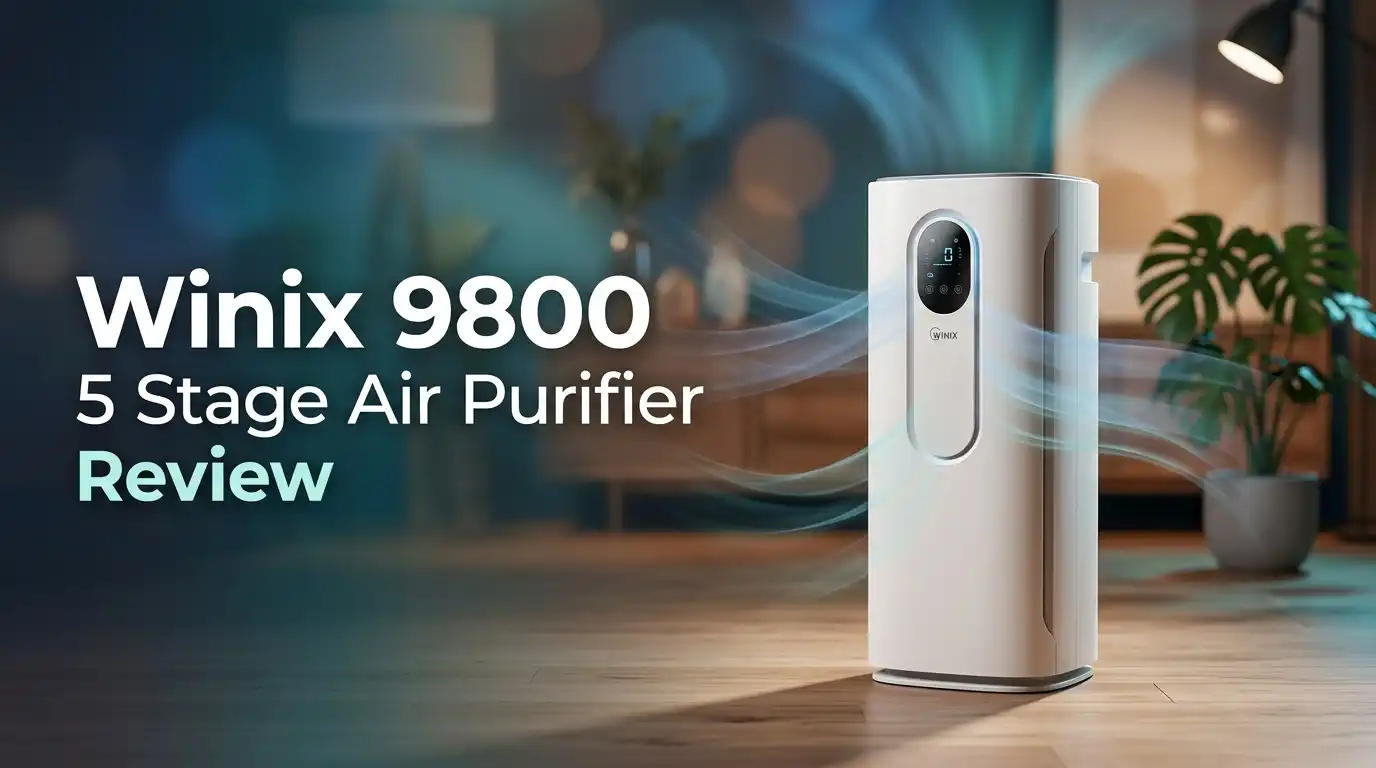
Winix 9800 5 Stage Air Purifier Review 2026: Worth Buying?
Clean air sounds simple until you start shopping for it. You open a tab, you see fifty models, and every single one claims to remove 99.97% of everything. The Winix 9800 sits right in the middle of that noise, and it quietly does a lot of things well.
I spent weeks with this unit in a 450 square foot living room with two cats, a gas stove, and a street full of traffic outside.
This review covers what the Winix 9800 actually delivers, what it fumbles, and whether the price makes sense in 2026. No fluff, no copied spec sheets, just honest observations and real numbers.
In A Nutshell:
- Strong cleaning power for the price. The Winix 9800 carries a CADR rating of 336 for dust, 323 for smoke, and 384 for pollen. AHAM verifies it for rooms up to 500 square feet with roughly 4.8 air changes per hour. That puts it in the same performance band as purifiers costing considerably more.
- The filtration stack is proven, not experimental. You get a washable mesh pre filter, an activated carbon layer, a True HEPA filter, and PlasmaWave ion technology. Winix officially calls this a 4 stage system, though many retailers market it as 5 stage by counting the washable mesh separately.
- Smart features work without drama. Wi Fi, the Winix Smart app, Alexa voice control, dual air quality sensors, and a light sensor that triggers Sleep Mode in a dark room. The auto mode reacts within seconds to cooking smoke.
- Power draw is the weak spot. At 95 watts rated, this unit eats more electricity than most rivals in its class. Expect roughly $34 per year at 8 hours of daily use, more if you run it around the clock.
- Noise swings widely. The lowest speed measures about 26 decibels, which is genuinely bedroom friendly. The top speed hits 59 decibels, loud enough to drown out a television.
- Best fit: large living rooms, open kitchens, pet households, and allergy sufferers who want AHAM verified numbers rather than marketing claims.
Winix 9800 4 Stage True HEPA Air Purifier With WiFi And PlasmaWave


Last update on 2026-11-19 / Affiliate links / Images from Amazon Product Advertising API
The Winix 9800 is a large console purifier built for open spaces. It stands 23.2 inches tall, measures 16.5 inches wide and 11.8 inches deep, and weighs 18.7 pounds. That weight feels light for the size, which tells you the housing uses thinner plastic than premium units.
Winix positions this model as the successor to the much loved AM90, with a stronger fan motor and a larger coverage rating. The design clearly borrows from the older WAC9500 console shape. Vertical air inlets run down the front panel, and air exits through the top.
The unit arrived with a price tag near $329, though it regularly drops closer to $279 during sales. At that discounted price it becomes one of the better value purifiers on the market. Both AHAM and CARB certify the unit, which matters because PlasmaWave technology produces a small amount of ozone.
The Unboxing Experience
The box is big. Not awkward big, but you will want two hands and a clear path to the room. Mine arrived double boxed with foam corner blocks, and the purifier sat inside a cloth bag rather than a thin plastic sleeve.
Inside you find the main unit, the pre installed filter set, a power cord, and a slim manual. There is no remote control in the box, which surprised me for a purifier at this price. The app replaces it.
Setup took about four minutes. You pull the front panel off, remove the plastic wrap sealing the HEPA filter, snap everything back, and plug in. Forgetting to unwrap the filter is the single most common complaint I found from new owners, and the manual warns about it in small print.
The Wi Fi pairing took longer. The app required a 2.4 GHz network, and my dual band router needed a temporary split before the unit connected.
Design And Build Quality
The Winix 9800 looks like an appliance, not a design piece. It sits low and wide, with a matte black finish that hides dust reasonably well but shows fingerprints near the control panel.
The diagonal control panel on top is a Winix signature. Buttons feel responsive, and the air quality LED ring glows blue, amber, or red depending on readings. At night the glow is bright enough to notice, though Sleep Mode dims it automatically.
The front panel attaches with magnets and pops off cleanly for filter access. Build quality sits firmly in the good but not premium category. The plastic flexes slightly when you lift the unit by its side grips.
There are no caster wheels, which is a real miss on an 18 pound console that many people will move between rooms. You carry it or you slide it.
Top 3 Alternative For Winix 9800

Last update on 2026-11-17 / Affiliate links / Images from Amazon Product Advertising API
Winix 5510 Air Purifier

Last update on 2026-11-17 / Affiliate links / Images from Amazon Product Advertising API
Coway Airmega Mighty AP 1512HH Air Purifier

Last update on 2026-11-17 / Affiliate links / Images from Amazon Product Advertising API
Levoit Core 600S P Smart Air Purifier
The Filtration System Explained
Air enters through the washable fine mesh pre filter first. This layer grabs pet hair, lint, and larger dust clumps. You vacuum it or rinse it every two to four weeks, and it costs nothing to maintain.
Next comes the activated carbon filter. This is the layer doing the heavy work on cooking odors, litter box smells, and volatile organic compounds. It also extends the life of the HEPA filter behind it.
The True HEPA filter forms the third stage. Winix cites independent IUTA testing showing capture of 99.99% of airborne particles down to 0.003 microns, which covers pollen, smoke, dander, and fine dust.
PlasmaWave sits last. It releases charged ions that break down certain odors and pollutants in the air. You can switch PlasmaWave off completely, and many owners do because of the faint crackling sound it produces.
Is It Really Five Stages?
This deserves a straight answer. Winix officially describes the 9800 as a 4 stage system with PlasmaWave technology. The brand says so on its own product page and in the user manual.
Retailers and review sites often list it as 5 stage. They reach that number by counting the washable mesh and the carbon layer as separate stages from the combined filter cartridge, or by counting the air quality sensor system as a stage. It is marketing arithmetic, not extra hardware.
Does this matter for performance? Honestly, no. Stage counting is one of the least useful metrics in the purifier industry. A single high quality HEPA filter paired with real carbon mass outperforms a six stage unit stuffed with thin filters.
Judge this unit by its CADR numbers and filter quality, not by the stage count on the box.
Room Coverage And Real Cleaning Power
AHAM verifies the Winix 9800 for 500 square feet at 4.8 air changes per hour. Winix lists 522 square feet on its own site using the same test standard with an 8 foot ceiling.
The CADR figures tell the clearer story: 336 for dust, 323 for smoke, and 384 for pollen. Those pollen numbers are excellent and explain why allergy sufferers rate this model highly.
In my 450 square foot room, the auto mode kept readings in the blue zone during normal days. Frying onions pushed the sensor to red within 20 seconds, and the fan ramped to maximum. Air quality returned to blue in roughly six minutes.
In a smaller 250 square foot bedroom, the unit rarely left its lowest speed. Buying this for a small room wastes most of its capability.
Smart Features And App Control
The Winix Smart app handles power, fan speed, mode switching, timers, and filter life tracking. It also logs air quality history, which is more useful than it sounds for spotting patterns.
Alexa voice control works for basic commands. Google Assistant support is absent, which is a genuine limitation if your home runs on Google hardware.
The dual smart sensors measure particulate levels and adjust fan speed automatically. Readings track closely with my separate handheld particle meter, usually within a reasonable margin.
The light sensor deserves praise. When the room goes dark, the unit drops to Sleep Mode, dims the display, and disables PlasmaWave. When light returns, it switches back to Auto. This single feature removes almost all manual interaction, and it works reliably every night.
Noise Levels In Daily Use
Speed one measures around 26 decibels. That is quieter than a whisper and easily ignored while sleeping. The sound profile is low pitched white noise rather than a high whine.
Speed two and three remain conversational. You hear the fan, but television and speech stay clear. This is where the unit spends most of its time in auto mode.
Speed four is loud. At roughly 59 decibels it dominates a room. You will raise your voice or pause the fan. It clears air fast, but nobody enjoys sitting next to it.
PlasmaWave adds a faint intermittent crackle. Some owners never notice it. Light sleepers do. Turning PlasmaWave off solves the problem with minimal impact on particle filtration.
Energy Use And Running Costs
Here is where the Winix 9800 disappoints. The rated power draw is 95 watts, which is high for this class. Competing purifiers with similar CADR numbers often draw 50 to 70 watts at maximum.
The unit carries Energy Star certification, so it is not wasteful by regulatory standards. Real consumption depends almost entirely on which speed the fan uses.
At 8 hours daily on mixed speeds, expect around $34 per year at average United States electricity rates. Running it 24 hours a day on higher speeds can push that figure past $90.
Auto mode is your best defense against the electricity bill. Let the sensors decide, keep the unit in a closed room, and the fan will idle on low most of the time.
Filter Replacement Costs
The Winix 9800 uses Filter A, the same 115115 cartridge found in several older Winix models including the 5300, 6300, and AM90. That shared design is good news for availability and pricing.
Genuine Winix replacement sets typically cost between $35 and $50. Third party compatible filters sell in multipacks for considerably less, though carbon quality varies between brands.
Winix recommends replacing the HEPA and carbon set every 12 months. Heavy pet households and smokers will need replacements closer to every 8 months. The filter indicator light tracks runtime hours rather than actual filter condition.
The washable pre filter never needs replacement. Rinse it, let it dry completely, and reinstall. Skipping pre filter cleaning shortens HEPA life faster than anything else.
What The Winix 9800 Does Not Do Well
Honest reviews list the failures, so here they are.
The power consumption is the clearest flaw. At 95 watts, this unit costs more to run than nearly every direct competitor with comparable output.
There is no remote control in the box. If your phone battery dies or your Wi Fi drops, you walk to the unit.
Google Assistant support does not exist. Alexa only.
The top fan speed is genuinely loud, and the auto mode triggers it often in kitchens.
No wheels on an 18 pound console feels like an oversight. Moving it between floors is a two hand job.
The warranty runs two years, which trails the three year coverage offered by Coway on several competing models. Finally, there is only one color option, and the black housing shows dust on the top panel quickly.
Pros And Cons
Pros
- AHAM verified coverage for 500 square feet with strong CADR ratings across dust, smoke, and pollen
- Dual smart sensors that respond within seconds and adjust the fan automatically
- Light sensor Sleep Mode that dims the display and quiets the unit without any input from you
- Washable pre filter that cuts long term maintenance costs
- Widely available Filter A cartridges shared with older Winix models, keeping replacements cheap and easy to find
- Quiet 26 decibel low setting that works in bedrooms
- CARB and UL certified, with verified low ozone output from PlasmaWave
Cons
- 95 watt power draw is high for this performance class
- No remote control included with the unit
- No Google Assistant support, Alexa only
- 59 decibels at top speed is disruptive in shared rooms
- No wheels on a large console that many people will move
- Two year warranty trails several competitors
- PlasmaWave crackle bothers some light sleepers
Who Should Buy The Winix 9800
Last update on 2026-11-19 / Affiliate links / Images from Amazon Product Advertising API
This purifier makes sense for people with large open rooms. If your living space runs between 350 and 500 square feet, the fan power and CADR numbers match the job properly.
Pet owners benefit the most. The washable pre filter handles fur, and the carbon layer manages litter and dander odors convincingly.
Allergy sufferers get real value from the pollen CADR of 384, which ranks near the top of the mid range segment.
Skip this model if your room is under 250 square feet. You will pay for capacity you never use. Also skip it if electricity costs run high in your area, because the 95 watt draw adds up over a year of continuous operation.
Smart home users on Google hardware should look elsewhere too.
Final Verdict
The Winix 9800 earns a solid recommendation with one clear caveat. The cleaning performance, sensor accuracy, and automation genuinely compete with purifiers priced $100 higher.
The energy consumption is the price you pay for that fan power. Accept it, run auto mode, and the yearly cost stays manageable.
Stage count marketing aside, this is a 4 stage purifier that performs like a strong mid range machine. Filters are cheap and easy to find. The app works. The sleep automation is excellent.
At $279 it is a very good buy. At $329 it faces tougher competition from the Levoit Core 600S and the Coway Mighty. Watch for a sale, then buy with confidence.
Score: 4.3 out of 5.
Frequently Asked Questions
Is the Winix 9800 really a 5 stage air purifier?
Winix officially describes it as a 4 stage system with PlasmaWave. Retailers sometimes count the washable mesh separately to reach five. The hardware is the same either way, and the performance numbers are what matter.
Does the Winix 9800 produce ozone?
PlasmaWave generates a trace amount. Winix reports an 8 hour time weighted average of 1.12 parts per billion in a 30 cubic meter chamber, well below safety thresholds. The unit holds CARB certification. You can also switch PlasmaWave off entirely.
How often should I replace the filters?
Winix recommends a yearly replacement of the combined HEPA and carbon filter. Heavy pet homes or smoking households should plan for 8 to 10 months. Wash or vacuum the mesh pre filter every two to four weeks.
Can I use the Winix 9800 in a bedroom?
Yes. The lowest speed measures roughly 26 decibels, and the light sensor automatically triggers Sleep Mode in the dark. The room size is the real question, since bedrooms under 250 square feet do not need this much capacity.
Does it work with Google Home?
No. The Winix 9800 supports Amazon Alexa and the Winix Smart app only. Google Assistant integration is not available.
What size room does the Winix 9800 cover?
AHAM verifies 500 square feet at 4.8 air changes per hour, and Winix lists 522 square feet. Larger spaces still benefit, but the air will cycle less frequently.
Is the Winix 9800 better than the Winix 5510?
The 9800 moves more air and covers larger rooms with Wi Fi included. The 5510 costs less, uses less electricity, and suits medium rooms better. Choose based on room size and budget.

I’m Maya Brown, the voice behind Pure Breeze Vault. I write detailed, honest, and easy-to-follow air purifier reviews to help readers compare features, understand filter technologies, and choose products with confidence. My goal is to make research simpler, clearer, and more practical for anyone improving indoor air quality at home.