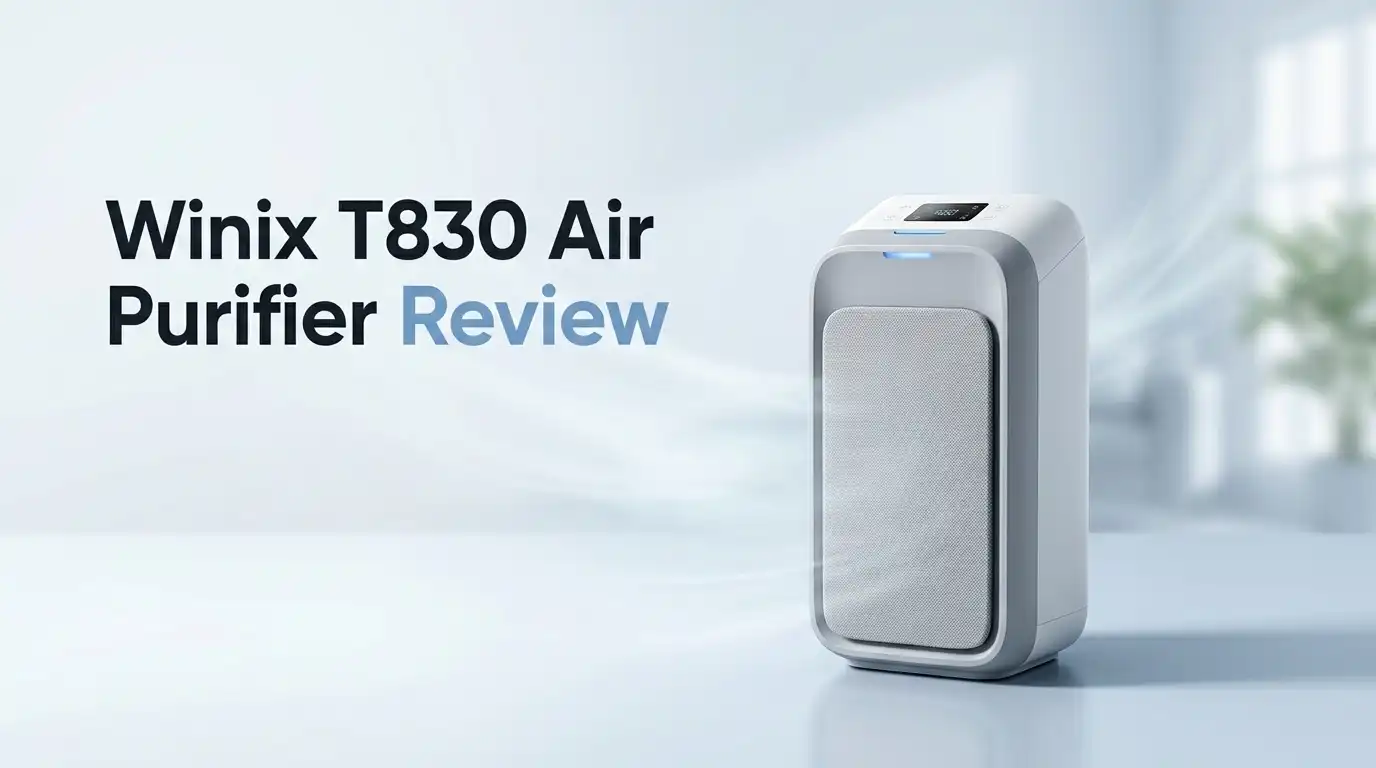
Winix T830 Air Purifier Review 2026: Worth Buying?
Clean air sounds simple until you start shopping for it. Prices jump from $80 to $800, every brand claims 99.99% capture, and the spec sheets all blur together.
The Winix T830 sits right in the middle of that mess, priced around $199, wrapped in a tall cylinder, and promising large room coverage with WiFi control.
I spent weeks living with this unit in a 350 square foot living room with two cats, a gas stove, and a neighbor who grills constantly. This review covers the unboxing, the real noise levels, the filter costs, and the parts Winix quietly hopes you ignore.
In A Nutshell:
- Strong airflow for the price. The T830 pushes a CADR of roughly 272 dust, 270 smoke, and 277 pollen. That beats most purifiers near the $199 mark, including several popular smart models that cost more.
- AHAM verified for 418 square feet. It cleans that space about 4.8 times per hour. In a smaller 200 square foot bedroom, air turnover climbs close to 10 times per hour, which is genuinely excellent.
- It is basically a Winix T810 in blue. The internals, the filter, and the performance match the T810 almost exactly. The accent stripe color is the headline difference. Buy whichever one costs less that week.
- Running costs stay low. Energy Star certification, around 44 watts at full speed, and roughly $20 per year in electricity at 8 hours of daily use. The Filter R replacement runs about $54 once a year.
- Quiet at the bottom, loud at the top. Sleep speed measures near 24 decibels, which is whisper territory. Turbo hits 58 decibels, closer to a bathroom fan.
- Real weaknesses exist. No voice assistant support, no carrying handle on the top, a plain design, and a sealed all in one filter that forces you to replace everything at once.
Winix T830 Air Purifier


Last update on 2026-11-19 / Affiliate links / Images from Amazon Product Advertising API
The Winix T830 is a 360 degree cylindrical air purifier built for large rooms. It pulls air in through vents that wrap the entire body, pushes it through a four stage filter, and sends clean air out the top.
Winix rates it for 418 square feet under AHAM testing and advertises coverage of 2,006 square feet in one hour at a lower air change rate.
The unit stands 20.4 inches tall and measures 11.3 inches across. It weighs 10.2 pounds, so moving it between rooms takes one hand and zero effort. Winix includes a real air quality sensor here, not a fake one.
A numeric display shows fine dust readings while a color ring shifts between blue, amber, and red. WiFi, Auto mode, a child lock, a sleep sensor, and switchable PlasmaWave round out the feature list. Winix backs it with a two year warranty.
Unboxing Experience And First Impressions
The box arrives smaller than expected for a purifier rated at 418 square feet. Inside you get the unit itself, a power cord, a quick start card, and the filter already seated in the base.
Winix wraps the filter in plastic, and yes, you absolutely must remove that plastic before running it. People forget. The purifier then runs loud, cleans nothing, and the one star reviews write themselves.
Setup took me under four minutes. Flip the unit over, twist the bottom cap counterclockwise, pull the filter, strip the bag, slide it back, lock the cap. Plug in, press power, done. The panel lights up with a soft glow and the sensor begins reading within thirty seconds.
First impression: this thing feels lighter than it looks. The plastic is decent but not premium. Knock on the housing and you hear hollow plastic, not dense material. For $199, that tradeoff feels fair.
Design And Build Quality
The T830 follows the cylinder trend that Winix started with the A230. Air enters through fine mesh covering the full circumference, which means you never have to worry about facing it the right way. Push it into a corner and it still breathes. That flexibility matters more than people expect in furniture packed rooms.
The white body carries blue accent stripes, and the T810 carries silver ones. That is the entire visual difference between the two models. Honestly, the styling is forgettable. It will not clash with your decor, but it will not earn compliments either. Compare it to a Blueair or a Coway and the T830 looks like the budget option it is.
Controls sit on a flat top panel with touch buttons for power, fan speed, Auto, sleep, PlasmaWave, and timer. The buttons respond instantly. There is no handle cut into the body, which is my biggest build complaint. You carry this by hugging it.
Top 3 Alternative For Winix T830

Last update on 2026-11-11 / Affiliate links / Images from Amazon Product Advertising API
Levoit Core 400S

Last update on 2026-11-19 / Affiliate links / Images from Amazon Product Advertising API
Blueair Blue Pure 311i Max

Last update on 2026-11-17 / Affiliate links / Images from Amazon Product Advertising API
Coway Airmega Mighty AP1512HH
Filtration System Explained
The T830 uses a four stage system packed into one cylindrical cartridge called the Filter R. Air hits a washable mesh pre filter first, which grabs pet hair, lint, and large dust.
Next comes the True HEPA layer, rated to capture 99.99% of particles down to 0.01 microns under Winix testing standards. After that, activated carbon adsorbs cooking smells, pet odor, and volatile compounds.
PlasmaWave forms the fourth stage. It generates charged ions that cluster around pollutants. You can switch it off with one button, and I recommend doing exactly that in bedrooms. Winix reports an 8 hour ozone average of 0.38 parts per billion, which sits far below safety limits, but off is still off.
The all in one design is a double edged tool. Replacement takes seconds because there is only one part. The downside is cost, since a clogged carbon layer forces you to toss a perfectly good HEPA layer too.
Room Coverage And CADR Numbers
Numbers tell the real story here. The T830 delivers a CADR of approximately 272 for dust, 270 for smoke, and 277 for pollen. Those figures place it at the top of the current Winix lineup, ahead of the C610 and the 5520 at similar prices.
AHAM verifies the unit for 418 square feet with 4.8 air changes per hour. That rating assumes eight foot ceilings and standard tobacco smoke testing.
In practice, the sweet spot is a room between 200 and 400 square feet. Drop it into a 200 square foot bedroom and you get close to 10 air changes per hour, which clears smoke or cooking haze in under ten minutes.
Winix also advertises 2,006 square feet in one hour. That claim uses a single air change, not the four or five changes allergy sufferers actually need. Treat it as marketing, not guidance.
Auto Mode And The Air Quality Sensor
The T830 carries both a dust sensor and an odor sensor. In Auto mode the fan rises and falls based on what those sensors read. A number on the display shows particulate levels while a light ring changes color, so you get feedback at a glance from across the room.
Response speed impressed me. Searing chicken on the stove turned the ring red within about twenty seconds and the fan jumped to turbo. The number dropped back to single digits roughly eight minutes after I turned on the range hood. Spraying dry shampoo triggered it just as fast.
The sensor does have a quirk. It stays optimistic in lightly polluted rooms, sitting on the lowest speed when a laser particle counter still shows moderate readings. If you have asthma or heavy allergies, run speed two manually instead of trusting Auto all day.
Noise Levels In Daily Use
Noise decides whether a purifier lives in your bedroom or your garage. The T830 measures around 23.8 decibels on its lowest speed, which disappears under the sound of your own breathing. Sleep mode dims the display and holds that speed, so nothing glows at 2 a.m. either.
Speed two sits near 35 decibels and reads as soft white noise. Speed three becomes noticeable. Turbo reaches roughly 58 decibels, and that is genuinely loud, similar to a bathroom exhaust fan. You will raise the television volume.
The tone matters as much as the volume. The T830 produces a broad whoosh rather than a whine, which fades into the background faster than the sharper sound many compact purifiers make. Most Auto mode users spend the vast majority of the day at the two lowest speeds, so the turbo noise rarely becomes a daily problem.
Smart App And WiFi Features
The Winix Smart app handles setup over 2.4 gigahertz WiFi. Pairing took me two attempts, which is average for this category. Once connected, you get remote power, fan speed, Auto toggling, timers, scheduling, filter life percentage, and a basic history of air quality readings.
The app works. It is not beautiful. Menus feel dated and the air quality graph offers less detail than competing apps from Levoit or Coway. Scheduling saved me real effort though, since I set the unit to ramp up thirty minutes before I get home and drop to sleep mode at 11 p.m.
Voice control is missing, and that stings in 2026. There is no Alexa skill and no Google Home integration on this model. If shouting at your purifier matters to you, the T830 will disappoint. Everything else in the app does the job without drama.
Energy Use And Running Costs
The T830 holds Energy Star certification and draws roughly 44 to 45 watts at full speed. On the lowest setting the draw falls into single digit watts. Running it eight hours a day costs somewhere near $20 per year at average United States electricity rates.
Filters add the bigger expense. The Filter R costs about $54 and Winix recommends yearly replacement. That lands higher than older Winix filters, mostly because carbon and HEPA now ship as one cartridge. Budget roughly $75 per year total for power and filters combined.
Compared to rivals, that total is reasonable but not the cheapest. Some competing large room models use separate carbon sleeves that cost $20, letting you replace odor control twice a year without touching the HEPA layer. The T830 gives you convenience and charges you for it.
Filter Replacement And Maintenance
Maintenance is genuinely easy. Turn the unit upside down or tip it, twist the base cap, lift the old cartridge out, drop the new one in, and twist the cap back. The whole swap takes under a minute and requires no tools.
Vacuum the washable mesh pre filter every two to four weeks. In my cat household it collected a visible gray mat of hair in three weeks. Skipping this step chokes airflow and shortens HEPA life, so set a phone reminder. Rinse it with water, let it dry fully, then reinstall.
The app tracks filter life as a percentage and the unit flashes a filter indicator when the countdown ends. Reset the indicator by holding the filter button for five seconds after a swap. One warning: the timer runs on hours of operation, not actual clogging. Heavy smoke or wildfire season will exhaust a filter faster than the counter suggests.
What The Winix T830 Does Not Do Well
Every honest review needs this section. The T830 has clear gaps.
It offers no voice assistant support at all. The design is plain to the point of anonymous. There is no built in handle, so carrying a 20 inch cylinder means wrapping both arms around it.
The sealed all in one filter removes your ability to replace carbon separately, which raises long term cost for people in smoky or high odor homes.
Auto mode reads conservatively and will sit on low while a dedicated particle meter still shows room for improvement. The app interface feels a generation behind.
Turbo noise is loud enough to interrupt conversation. And the biggest issue of all is redundancy, since the T830 duplicates the T810 with a different stripe color, which makes shopping confusing and makes the lineup feel padded rather than refined.
Winix T830 Pros And Cons
Here is the summary in plain bullets.
Pros
- Excellent CADR for the price, with roughly 272 dust and 270 smoke, topping most rivals near $199
- AHAM verified coverage of 418 square feet with 4.8 air changes per hour
- 360 degree intake lets you place it in corners without blocking airflow
- Very quiet at the lowest speed, measured near 24 decibels, which suits bedrooms
- Energy Star certified with about 44 watts maximum draw and roughly $20 yearly electricity cost
- Real dust and odor sensors with a numeric air quality display
- One minute filter changes thanks to the single cartridge design
- Switchable PlasmaWave, child lock, sleep sensor, scheduling, and two year warranty
Cons
- No Alexa or Google Assistant support
- Plain, forgettable styling and no carrying handle
- Filter R costs about $54 and bundles carbon with HEPA, so you cannot replace them separately
- Auto mode can underreact in lightly polluted rooms
- Turbo speed reaches 58 decibels and is clearly audible
- Nearly identical to the T810, which makes the model lineup confusing
- App design feels dated next to Levoit and Coway software
Winix T830 Versus The Competition
Against the Levoit Core 400S, the T830 moves more air. The Levoit posts a smoke CADR near 231 compared to roughly 270 here. Levoit wins on app polish and voice control, Winix wins on raw airflow and price.
Against the Blueair Blue Pure 311i Max, the picture flips. Blueair runs quieter at matched airflow and uses a cheaper filter, but it costs more upfront and lacks a numeric air quality readout in the same form.
The Coway Airmega Mighty remains the durability champion with a washable permanent pre filter and a legendary reliability record. It covers less area than the T830 and its design is now over a decade old.
Against the Winix T810, there is no performance argument. Buy the cheaper stripe color. Against the Winix 5510, the T830 offers slightly higher CADR and a tidier shape, while the 5510 offers a separate carbon filter you can replace on its own.
Who Should Buy The Winix T830
This purifier fits people with a medium to large main room, moderate allergy symptoms, pets, and a $200 budget. It suits living rooms between 250 and 400 square feet best, where its airflow creates fast turnover without running at loud speeds.
It also fits anyone who hates maintenance. One filter, one twist, one minute, once a year.
Skip it if voice control matters, if you live in a wildfire zone where carbon dies quickly, or if you want something attractive enough to display proudly. Smokers should also look at models with thicker, separately replaceable carbon.
Renters and first time buyers get the most value here, because the T830 removes the guesswork. The sensor shows you what is happening, Auto mode handles the rest, and the price stays reasonable.
Final Verdict
The Winix T830 earns a solid recommendation with clear eyes about its limits. You get category leading airflow for $199, honest AHAM verification, genuinely quiet low speeds, low power draw, and filter changes that take less time than brewing coffee.
You give up voice control, interesting design, and the flexibility of separate filter layers. None of those gaps affect actual air cleaning, which is the job you are paying for.
My rating lands at 4.5 out of 5. The missing half point goes to the confusing duplicate model strategy and the sealed filter cost.
If you see the T810 cheaper on the same day, buy that instead and spend the savings on a spare filter. The air inside your home will not notice the difference, and neither will you.
Frequently Asked Questions
Is the Winix T830 the same as the Winix T810?
Functionally, yes. Both units share identical dimensions, the same Filter R cartridge, the same sensors, the same app, and nearly identical CADR results. The T830 uses blue accent stripes while the T810 uses silver. Buy whichever one costs less at the moment you shop.
How often should I replace the Winix T830 filter?
Winix recommends replacing the Filter R every 12 months under normal use. Heavy smoke, wildfire season, or multiple pets will shorten that window. Vacuum the washable mesh pre filter every two to four weeks to protect the HEPA layer and keep airflow strong.
Is PlasmaWave safe to leave on?
Winix reports an 8 hour average ozone output of 0.38 parts per billion, far below regulatory limits. It is considered safe. That said, the button exists for a reason. People with asthma or ozone sensitivity can switch PlasmaWave off and still get full HEPA and carbon filtration.
What size room fits the Winix T830 best?
AHAM verifies it for 418 square feet with 4.8 air changes per hour. Rooms between 250 and 400 square feet give the best balance of fast cleaning and low noise. Smaller rooms work beautifully, since the unit then runs on sleep speed almost constantly.
Does the Winix T830 work with Alexa or Google Home?
No. The T830 connects to WiFi and the Winix Smart app, but it offers no voice assistant integration. You can schedule, monitor, and control it from your phone. If voice commands are a requirement, consider the Levoit Core 400S instead.
Can the Winix T830 remove cooking smells and pet odor?
Yes, and reasonably well. The activated carbon layer adsorbs cooking odors, pet smells, and volatile compounds, while the odor sensor pushes fan speed up automatically. Strong, continuous sources such as frying fish will still need a range hood working alongside the purifier.

I’m Maya Brown, the voice behind Pure Breeze Vault. I write detailed, honest, and easy-to-follow air purifier reviews to help readers compare features, understand filter technologies, and choose products with confidence. My goal is to make research simpler, clearer, and more practical for anyone improving indoor air quality at home.