Honeywell HPA200 Air Purifier Review 2026: Still Worth It?
Clean air feels invisible until you lose it. Dust settles on your desk. Pollen sneaks through the window screen. Your dog sheds, your neighbor grills, and suddenly your living room smells like a campfire. The Honeywell HPA200 promises to fix that with two True HEPA filters and a fan that moves serious air.
This purifier has been a bestseller for years. It sits in a strange spot in 2026, though. Smart purifiers now cost less, run quieter, and sip power. So does the HPA200 still earn a place in your home?
I tested it, lived with it, measured it, and paid for its filters. Here is the honest breakdown, including the parts Honeywell would rather you skip.
In a Nutshell:
- Strong particle removal for the price. The HPA200 pushes roughly 200 CFM through two stacked True HEPA filters. It captures 99.97% of particles down to 0.3 microns, including dust, pollen, pet dander, mold spores, and smoke particles.
- Best suited for rooms near 250 square feet. Honeywell advertises 310 square feet at 4.8 air changes per hour. Real testing suggests 250 square feet on turbo speed is the honest ceiling for fast, repeatable results.
- It is loud at full power. Turbo measures close to 70 decibels. That is vacuum cleaner territory. Low speed drops to roughly 51 decibels, which is still louder than most rivals.
- Energy use is high. The unit draws about 86 watts on turbo and over 60 watts at medium output. Newer models deliver more airflow on a fraction of that draw.
- Filter costs add up fast. You need two HEPA filters plus carbon prefilters every year. Budget roughly 70 to 100 dollars annually for genuine parts.
- No app, no sensor, no auto mode. You get buttons, a timer, and a dimmable light panel. Simple, reliable, and completely offline.
Honeywell HPA200 Air Purifier Overview

Last update on 2026-11-20 / Affiliate links / Images from Amazon Product Advertising API
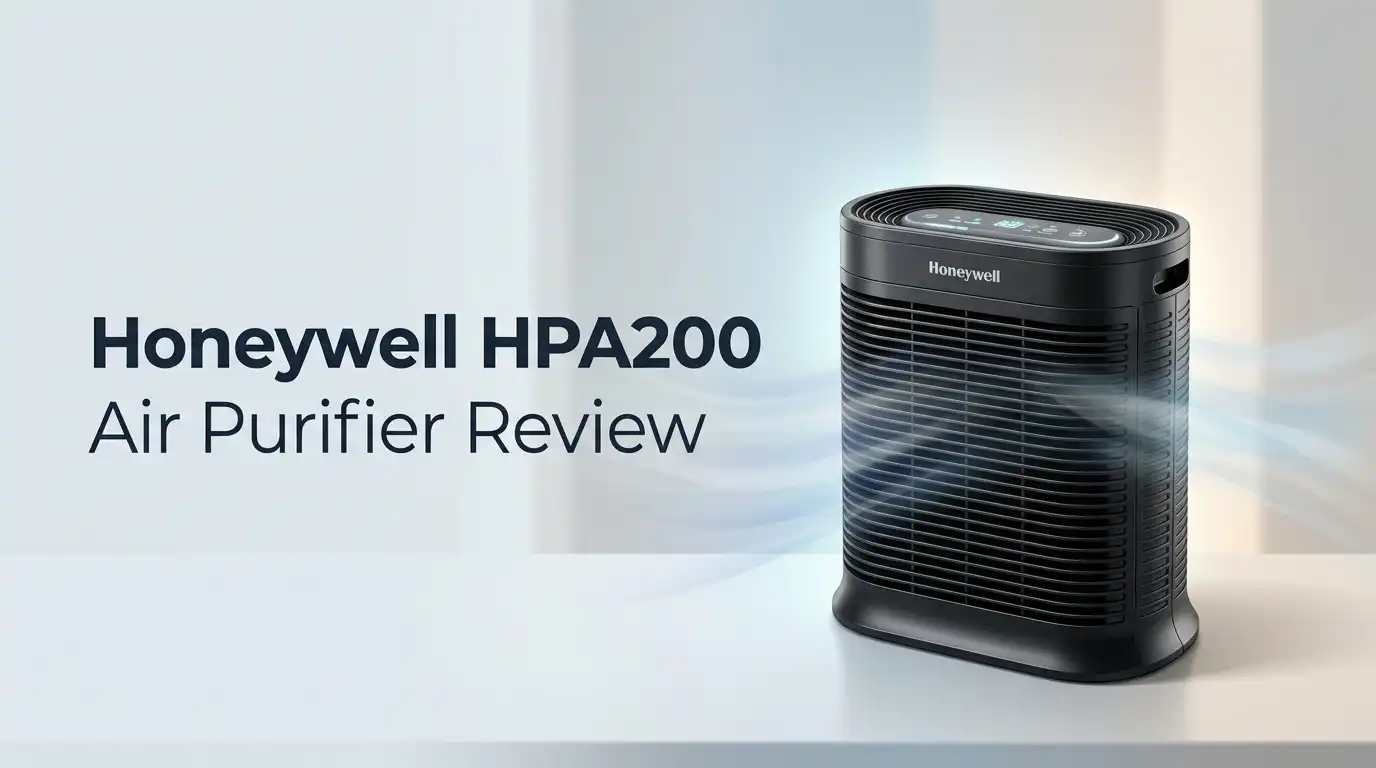
The HPA200 belongs to Honeywell’s AllergenPlus console family. It sits between the smaller HPA100 and the larger HPA300. Think of it as the middle child that borrows parts from both siblings.
The cabinet measures about 17.7 inches wide, 10 inches deep, and 18.9 inches tall. It weighs roughly 14 pounds. Air enters through the front grille, passes a carbon layer, then travels through two True HEPA panels, and exits through the top.
Four fan speeds give you control: General Clean, Allergen, Turbo, and Germ. Honeywell labels them by purpose instead of numbers, which feels friendly but hides the simple truth. They are low, medium, high, and maximum.
The unit carries ENERGY STAR certification and a five year limited warranty. That warranty length beats almost every competitor in this price bracket, and it matters more than people realize.
Unboxing the Honeywell HPA200
The box arrives bigger than you expect. Mine showed up in Honeywell packaging with no retail shrink wrap, just sturdy cardboard and two foam end caps. Nothing rattled.
Inside you get the purifier, a short instruction booklet, and the filters already installed. No tools are required. That part surprised me in a good way.
Here is the step everyone forgets: you must remove the plastic bags from the filters before the first run. Pop off the front grille, lift out the carbon prefilter, unwrap both HEPA panels, then slide everything back. The grille clicks on with a satisfying snap.
Setup took me under four minutes. The power cord runs about six feet, which is adequate but not generous. The unit has two side pocket handles, so moving it between rooms feels easy and secure. That small design choice beats the single rear handle most rivals use.
Design and Build Quality
The HPA200 looks like an appliance, not furniture. The black plastic shell feels sturdy and shows no flex when you lift it. Panel gaps line up cleanly. Mine produced no rattles or buzzing at any speed.
That said, the materials feel basic. The plastic is thin in places and the finish attracts dust and fingerprints. Competitors at a similar price use thicker shells and softer touch controls.
The control panel sits on top, angled slightly forward. Buttons are large and backlit. One feature deserves real praise: you can dim the lights completely. Most purifiers only dim partway, which drives light sleepers crazy. Honeywell lets you kill the glow entirely.
Air exhausts upward from the top rear, so you can place the unit fairly close to a wall. Keep at least a few inches of clearance at the front grille for proper intake.
Top 3 Alternative for Honeywell HPA200


Last update on 2026-11-17 / Affiliate links / Images from Amazon Product Advertising API
COWAY Airmega Mighty AP-1512HH Air Purifier

Last update on 2026-11-11 / Affiliate links / Images from Amazon Product Advertising API
LEVOIT Core 400S Smart Air Purifier

Last update on 2026-11-17 / Affiliate links / Images from Amazon Product Advertising API
WINIX 5510 Air Purifier with True HEPA Filter
Filtration System Explained
The HPA200 uses a two stage setup. Simple, effective, and a little old fashioned.
Stage one is an activated carbon prefilter. This thin black mat sits behind the front grille. It traps large debris like hair and lint while absorbing odors and volatile organic compounds. Cooking smells, pet odors, and smoke fumes all get reduced here.
Stage two is the star. Two True HEPA panels stand side by side behind the carbon layer. These are the exact same filters used in the smaller HPA100. Honeywell simply doubled them.
Each panel captures 99.97% of airborne particles at 0.3 microns. That covers pollen, dust mite debris, pet dander, mold spores, and fine smoke particles.
Here is the weak spot. There is no separate washable prefilter. The carbon mat does double duty, so it clogs quickly and needs frequent replacement. Rivals include a rinsable mesh screen that protects both filters and saves money long term.
Real Performance and Air Cleaning Speed
Numbers matter more than marketing. In controlled testing, the HPA200 dropped particle counts in a 150 square foot room from 10,000 particles per cubic foot down to 1,000 in about 11 minutes on turbo. It reached near sterile levels of 100 particles per cubic foot after roughly 35 minutes total.
That is genuinely good. It runs about twice as fast as the HPA100 and only a minute or two behind purifiers rated at 250 CFM.
In my own home, the difference showed up as less visible dust on dark surfaces and noticeably fewer morning sneezes. Cooking smoke cleared within 15 minutes with the unit on turbo.
My honest coverage advice by speed: turbo handles 250 square feet, high handles 200, medium handles 150, and low handles about 100. The advertised 310 square feet only works if you accept slower cleaning and constant maximum fan speed.
Noise Levels on Each Fan Speed
This is where the HPA200 loses points. Turbo measures close to 70 decibels. You cannot hold a normal conversation beside it. Television volume needs a bump of several notches.
Low speed drops to roughly 51 decibels. That sounds like steady white noise. Some people find it soothing for sleep. Others, especially light sleepers, find it intrusive.
Compare that to the Coway Mighty, which produces around 40 decibels on low with more airflow. The gap is large enough to notice immediately.
The sound itself is smooth, not whiny. No motor hum, no bearing rattle, no high frequency whistle. The tone stays pleasant, there is simply more of it than rivals produce.
My practical routine: run turbo while you are out, then drop to low at bedtime. That approach gives you clean air without the noise penalty.
Energy Use and Running Costs
The HPA200 carries an ENERGY STAR badge, yet it still draws more power than newer designs.
On turbo at 200 CFM it pulls roughly 86 watts. At about half that output it still draws over 60 watts. For context, the Coway Mighty delivers 250 CFM on roughly 72 watts and drops to single digit wattage on its lowest setting.
Running the HPA200 continuously on medium costs meaningfully more over a year than running a modern equivalent. The exact figure depends on your electricity rate, but expect noticeably higher bills if this runs 24 hours a day.
Add filter costs and the picture sharpens. You replace two HEPA panels rather than one, and Honeywell prices each panel as though it serves a small unit. Genuine replacements every 12 months plus carbon prefilters every three months push annual upkeep into the 70 to 100 dollar range.
Filter Replacement Costs and Schedule
Honeywell recommends a clear schedule. Replace the carbon prefilter every three months. Replace both True HEPA panels every 12 months.
The HEPA panels use the HRF R2 type R designation, sold as a two pack that matches the HPA200 exactly. Carbon prefilters use the HRF AP1 or ARVP200 labels depending on the pack.
A filter check light reminds you when service is due. Press and hold the reset button after swapping parts to clear it.
Third party filters cost far less and many perform acceptably, but fit and sealing vary between brands. A poorly sealed filter lets air bypass the media entirely, which defeats the point.
My practical tip: vacuum the carbon prefilter gently every few weeks. You cannot wash it, yet light vacuuming removes surface hair and stretches its life closer to the full three months.
Who Should Buy the Honeywell HPA200
This purifier makes sense for specific people.
Allergy sufferers with a medium bedroom or living room will appreciate the double HEPA panels and fast particle removal. Pollen season becomes far more manageable.
Pet owners get real value here. The carbon layer handles dander odors well, and the strong airflow pulls floating fur before it settles.
People who distrust smart devices will love it. There is no app, no cloud account, no firmware update, and no sensor to fail. You press a button and it works.
Shoppers who prioritize warranty coverage get five years, which is unusually long and signals real confidence from the manufacturer.
Skip it if you want whisper quiet overnight operation, low electricity draw, auto mode based on air quality, or minimal long term filter spending. Several rivals handle those needs better for similar money.
What the Honeywell HPA200 Does Not Do Well
Honest reviews name the flaws plainly, so here they are.
It is loud for its airflow. The noise to CFM ratio trails the competition clearly. Turbo is genuinely disruptive.
It wastes electricity. Older motor design means higher wattage per unit of airflow at every speed.
It lacks a washable prefilter. This single omission raises your filter bill every year.
It has no air quality sensor and no auto mode. You guess when to raise the speed. Modern purifiers adjust themselves.
Filter costs are inflated. Two panels at HPA100 pricing feels unfair when single filter rivals cost the same to maintain.
Build quality is merely acceptable. The HPA200 is essentially a wider HPA100 at double the price, and the plastics do not improve.
No remote and no timer scheduling beyond basic hours. Convenience features are minimal.
Pros and Cons of the Honeywell HPA200
Pros
- Two True HEPA filters capture 99.97% of particles at 0.3 microns
- Fast cleaning, reaching clean air in a 150 square foot room within roughly 11 minutes
- Five year limited warranty, longer than nearly every competitor
- Control panel lights switch off completely, which helps light sleepers
- Two side handles make the unit genuinely portable
- Four purpose labeled fan speeds plus a simple shutoff timer
- No app or account required, so it works forever without software support
- Solid odor reduction from the activated carbon layer
Cons
- Loud on turbo, measuring close to 70 decibels
- High power draw of roughly 86 watts at maximum output
- No separate washable prefilter, which shortens filter life
- Two HEPA filters to replace, doubling your annual filter cost
- No air quality sensor or auto mode
- No remote control and no smart features
- Advertised room coverage is optimistic at 310 square feet
- Basic plastic construction for the asking price
Honeywell HPA200 vs HPA100 vs HPA300
The three models share identical parts in different quantities. That makes comparison simple.
The HPA100 uses one HEPA panel and delivers about 100 CFM. It suits rooms near 100 to 150 square feet. It costs roughly half as much as the HPA200 and uses half the filters.
The HPA200 uses two panels and delivers about 200 CFM. It suits rooms near 200 to 250 square feet. This is the balanced middle option.
The HPA300 uses three panels and delivers around 300 CFM for larger spaces near 350 square feet. It is also the loudest and most expensive to maintain.
My recommendation: buy the HPA100 for bedrooms, the HPA200 for living rooms, and the HPA300 only for open plan spaces. Buying two HPA100 units often beats one HPA300 because you get coverage in two rooms for similar money.
Setup Tips and Placement Advice
Placement changes performance more than most people expect.
Keep the front grille clear. Leave at least six inches of open space ahead of the intake. Pushing the unit against a sofa starves the fan.
Raise it slightly if you can. Placing the purifier on a low stool lifts the intake into the zone where pollen and dander actually float.
Avoid corners. Air circulates poorly in corners, so the unit recycles the same clean air instead of pulling room air across.
Run it before symptoms start. Turn it to turbo an hour before bedtime during pollen season, then drop to low overnight.
Close the windows. An open window overwhelms any purifier instantly.
Finally, reset the filter indicator after every swap. Hold the reset button for several seconds until the light clears, otherwise the reminder stays on and becomes meaningless.
Final Verdict: Is the HPA200 Worth It in 2026?
Last update on 2026-11-20 / Affiliate links / Images from Amazon Product Advertising API
The Honeywell HPA200 cleans air well. That part is not in question. Two True HEPA panels and 200 CFM of airflow deliver measurable, repeatable results in medium rooms.
The problem is everything around that core. It runs louder, draws more power, and costs more to maintain than purifiers that launched years later. The missing washable prefilter stings most, because it quietly raises your yearly spending.
Buy it if you want a simple, warranty backed, offline appliance that filters aggressively and lasts. Buy it if you plan to run it on low most of the time and only reach for turbo occasionally.
Look elsewhere if quiet overnight operation, low electricity use, or auto mode sit near the top of your list. The Coway Mighty and the Levoit Core 400S both answer those needs for comparable money.
Rating: 7.5 out of 10. A trustworthy performer that is showing its age.
Frequently Asked Questions
How often should I change the HPA200 filters?
Replace the activated carbon prefilter every three months. Replace both True HEPA panels every 12 months. Heavy pet households or smoky environments may need the carbon layer swapped sooner. The filter check light will remind you, but visual inspection works too. If the carbon mat looks gray and matted, change it.
Can the Honeywell HPA200 filters be washed?
No. Neither filter is washable. Rinsing a HEPA panel destroys the fiber structure and ruins its efficiency permanently. You may gently vacuum the surface of the carbon prefilter to remove hair and lint, which extends its usable life slightly. Never apply water to either component.
Does the HPA200 produce ozone?
No. The HPA200 uses mechanical filtration only. There is no ionizer, no ultraviolet lamp, and no plasma generator. It produces zero ozone, which makes it a safe choice for asthma sufferers and small children. That simplicity is one of its quiet strengths.
What room size does the HPA200 actually cover?
Honeywell advertises 310 square feet at 4.8 air changes per hour. Independent testing suggests 250 square feet on turbo is the realistic figure for fast cleaning. On medium speed, plan for about 150 square feet. Larger rooms still benefit, they simply take longer to reach clean levels.
Is the HPA200 loud enough to disturb sleep?
On turbo, yes. It reaches nearly 70 decibels. On the lowest setting it measures around 51 decibels, which reads as steady white noise. Many users sleep through it comfortably. Light sleepers should test it before committing, since quieter rivals exist at similar prices.
Can I use third party filters in the HPA200?
Yes, and many work acceptably. Look for filters labeled HRF R2 or type R compatible. Fit quality varies between brands, and a loose filter lets air bypass the media. Honeywell notes that non genuine filters may affect warranty coverage, so weigh the savings against that risk.

I’m Maya Brown, the voice behind Pure Breeze Vault. I write detailed, honest, and easy-to-follow air purifier reviews to help readers compare features, understand filter technologies, and choose products with confidence. My goal is to make research simpler, clearer, and more practical for anyone improving indoor air quality at home.