Levoit Core 300 Air Purifier Review 2026: Still Worth Buying?
The Levoit Core 300 has sat near the top of Amazon’s air purifier charts since 2019. That is a long run for any appliance. In 2026, the question is simple. Does a purifier built seven years ago still deserve your money, or have newer models left it behind?
I have used this unit in a bedroom, a home office, and a small kitchen. I have weighed the filter cost, listened to it at 2am, and compared it against models that cost twice as much.
This review covers what the Core 300 genuinely does well, and where it falls short in ways the marketing pages skip. If you want a straight answer before you click buy, keep reading.
In A Nutshell:
- The price to performance ratio is still strong. The Core 300 delivers a CADR of roughly 140 CFM for smoke, 141 CFM for dust, and 145 CFM for pollen. You rarely find that output under $100.
- It cleans a small room well. Levoit rates it for 219 square feet at 4.8 air changes per hour. In independent testing it cleared a 728 cubic foot room of fine particles in about 54 minutes at top speed.
- It has no sensors and no auto mode. This is the single biggest limitation. You set the fan speed yourself. There is no app, no air quality reading, and no voice control.
- It is quiet where it matters. Sleep mode measures close to 24dB on paper and roughly 37dB in a real home. Top speed sits near 50dB, which is loud but not painful.
- Running costs are fair, not great. Expect around $109 per year including electricity and genuine filters. The newer Core 300S uses about 40 percent less power.
- Filters are cheap and easy to swap. Genuine replacements start near $30, and the twist off base takes seconds to open.
Levoit Core 300 Air Purifier Overview


Last update on 2026-10-05 / Affiliate links / Images from Amazon Product Advertising API
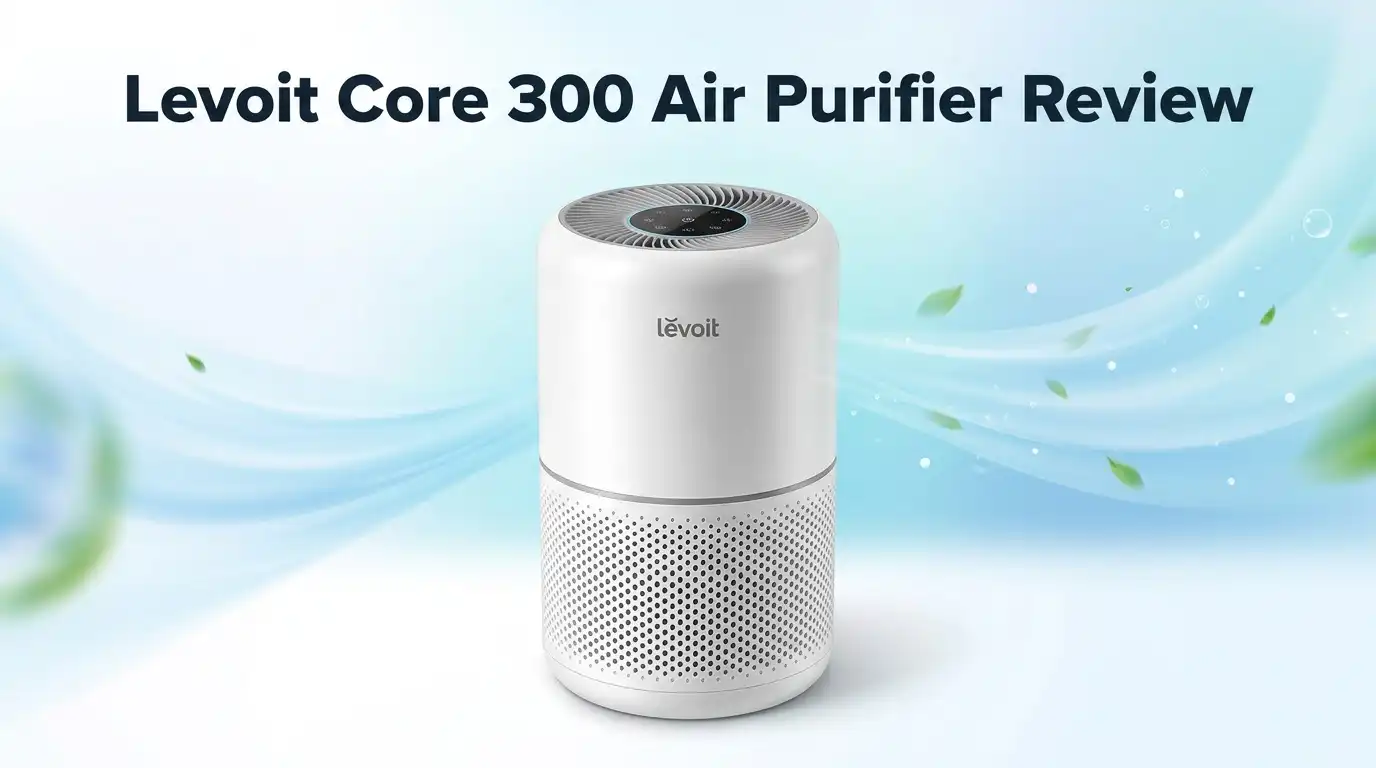
The Core 300 is a small tower purifier built for bedrooms, dorms, nurseries, offices, and kitchens. It stands 14.2 inches tall and measures 8.7 inches across the base. It weighs 7.48 pounds, so you can carry it room to room with one hand.
Air enters through a 360 degree intake ring around the bottom. Levoit calls the swirling airflow VortexAir technology. Clean air exits through the top vent. Three fan speeds, a sleep mode, a timer, a child lock, and a display off button cover every control you need.
There is nothing clever happening here, and that is the point. The Core 300 does one job. It pushes household air through a filter, fast enough to matter in a small space, at a price most people can justify. Levoit backs it with a two year warranty.
Unboxing Experience And First Setup
The box is smaller than most people expect. Inside you get the unit, the filter already seated in the base, a power cord, and a short manual. There is no plastic clamshell fight and no tool requirement. Levoit uses molded cardboard inserts, which feels tidy.
Do not skip this step. The filter ships sealed in plastic wrap. Twist the bottom cover counterclockwise, lift the filter out, peel off the wrapping, drop it back in, and lock the cover clockwise. That is the entire setup.
Plug it in, tap power, and it runs. Total time from box to clean air is under three minutes. The unit remembers your last fan speed after you unplug it, which I appreciated when moving it between rooms. First impressions are solid. The plastic feels light but not cheap, and the touch panel responds on the first press.
Design And Build Quality
The all white cylinder blends into almost any room. I prefer this over the gray fabric wrapped designs that show every speck of pet hair. The rounded edges mean no sharp corners near a bedside table.
The control panel sits on top in a neat ring of icons. It uses white symbols on a black touch surface. The buttons are responsive without being twitchy, so you will not change speeds by accident when dusting.
A few honest notes on build. The base cover can feel slightly loose if you do not twist it fully into the lock position. The pre filter layer is stitched onto the main filter and cannot be removed for washing, unlike higher Levoit models with a separate washable mesh. The power cord is short at around six feet.
Overall the build punches above its price bracket, but it is clearly made to a budget.
Top 3 Alternative For Levoit Core 300

Last update on 2026-10-03 / Affiliate links / Images from Amazon Product Advertising API
Levoit Core 300S Smart Air Purifier

Last update on 2026-10-05 / Affiliate links / Images from Amazon Product Advertising API
Blueair Blue Pure 511 Air Purifier

Last update on 2026-10-04 / Affiliate links / Images from Amazon Product Advertising API
Coway Airmega 100 Air Purifier
Filtration System Explained
The Core 300 uses a three stage filter in one replaceable cylinder.
Stage one is a nylon pre filter on the outer layer. It grabs hair, lint, and large dust. You can vacuum it gently to stretch the life of the inner layers.
Stage two is the main particle filter. Levoit states it captures 99.97 percent of particles down to 0.3 microns. Note that Levoit removed the HEPA wording from Core series marketing in 2023, so treat this as a high efficiency filter rather than a certified HEPA one.
Stage three is granular activated carbon. Pellets work better than the thin carbon coated fabric found in cheaper purifiers. This layer adsorbs cooking smells, pet odor, and light smoke.
Levoit sells four filter versions. The standard filter holds 40 to 50 grams of carbon. The Pet Allergy, Toxin Absorber, and Smoke Remover versions hold around 90 grams for stronger odor control.
Real Cleaning Performance In A Room
Numbers on a box mean little until you run the unit. Independent testing in a 728 cubic foot room showed the Core 300 clearing all fine particulate matter from incense smoke in 54 minutes at full speed.
That result beats purifiers costing five times more. For context, one popular premium tower took 92 minutes in the same room. The Core 300 embarrasses several expensive units.
Newer rivals do beat it though. The Winix A230 and the Levoit Vital 100S both finished in around 40 minutes. The Core 300S managed 45 minutes.
In daily use I noticed cooking smells fading within 20 minutes in a small kitchen. Dust on shelves dropped noticeably after two weeks in the bedroom. Speed two is the sweet spot for a 150 square foot room. Speed one alone struggles once the door stays open.
Noise Levels In Daily Use
Levoit claims 24dB in sleep mode. Real home measurements land closer to 37dB, because a sound meter also picks up background hum from a fridge or street traffic.
Sleep mode produces a soft, low pitch whoosh. I fell asleep beside it without trouble and forgot it was running. There is no rattle, click, or motor whine on my unit.
Speed two sits near 40dB. This is audible but easy to talk or work over. Top speed reaches roughly 50dB. That is fan noise you will notice during a film or a video call.
Here is the honest trade off. A purifier this size often needs speed two or three to keep up in a real room, so you will not always get the whisper quiet experience shown in the ads. The display off button helps in dark bedrooms.
Running Costs And Energy Use
The Core 300 draws about 19.7 watts on speed one, 24 watts on speed two, and 35.5 watts at top speed. Standby sits at 0.1 watts.
Running it 24 hours a day at full speed costs around $54 per year in electricity at average US rates. Genuine filters add roughly $55 per year if you replace every six months. Total yearly cost lands near $109.
This is where age shows. The Core 300S pulls only about 22 watts at top speed and costs closer to $33 per year in power. That gap narrows the upfront savings over two or three years.
Third party filters exist for under $30 for a two pack. They slow cleaning speed slightly, but they cut costs sharply. Given the filter is not certified HEPA anyway, generics are a reasonable choice for many buyers.
Filter Replacement And Maintenance
Maintenance is refreshingly simple. Levoit recommends a new filter every six to eight months. A red indicator light on the panel tells you when the counter runs out.
Replacement takes three steps. Twist off the bottom cover. Lift out the old filter and slide it straight into a bag so dust does not escape. Drop the new filter in and lock the cover.
Reset the indicator by holding the filter button for a few seconds. Vacuum the outer intake ring every month to stop dust building at the base.
One small annoyance. The filter life counter runs on a timer, not on actual air quality, so it will nag you even if the unit sat unused for weeks. There is also no washable pre filter to rinse, which higher priced Levoit models include.
Pros And Cons Of The Levoit Core 300
Pros
- Strong clean air delivery rate of around 141 CFM for a price usually under $100
- Compact 8.7 inch footprint fits on desks, counters, and night tables
- Very quiet sleep mode that suits light sleepers
- Granular activated carbon handles cooking smells and pet odor better than fabric carbon
- Simple touch controls with child lock, timer, and display off
- Cheap genuine filters plus wide generic filter availability
- Memory function recalls your last fan speed after unplugging
- Two year manufacturer warranty
Cons
- No air quality sensor and no auto mode
- No app, no WiFi, and no voice assistant support
- Less energy efficient than the newer Core 300S
- Carbon volume is too small for heavy smoke or chemical fumes
- Pre filter cannot be removed for washing
- Top speed at 50dB is noticeable in a quiet room
- Levoit no longer labels the Core series filters as HEPA
- Coverage limited to roughly 219 square feet at proper air change rates
What The Core 300 Does Not Do Well
Authentic reviews name the weak spots, so here they are plainly.
It cannot manage large or open spaces. Push it into a 400 square foot living room and it will run flat out without keeping up. Buy a Core 400S or Vital 200S instead.
It is not a solution for serious gas or VOC problems. The carbon layer helps with dinner smells. It will not clear paint fumes, formaldehyde off gassing from new furniture, or heavy wildfire smoke for long.
It cannot think for itself. No sensor means you guess the right speed. Many owners leave it on speed one and assume the air is clean.
It also lacks any humidity, temperature, or heating function. This is a filter box with a fan. Nothing more. If you want smart scheduling or air quality graphs, the Core 300 will frustrate you.
Levoit Core 300 vs Core 300S
The two units look identical and share the same filters. The differences sit inside.
The Core 300S adds AirSight Plus laser sensors, which power a real time air quality reading and auto mode. Fan speed adjusts itself as your air changes. That alone solves the Core 300’s main flaw.
The 300S also connects to the VeSync app, Alexa, Google Home, and Apple Home. You can check filter life and air quality from work.
Energy use drops to around 21.8 watts at top speed, cutting yearly running cost to roughly $33. It also cleaned a test room nine minutes faster.
The catch is price. The 300S usually costs about $50 more. If your budget allows it, pay the difference. The efficiency savings alone repay much of the gap within two years.
Who Should Buy The Levoit Core 300
Last update on 2026-10-05 / Affiliate links / Images from Amazon Product Advertising API
This purifier suits specific buyers very well.
Buy it if you need a first air purifier for a bedroom, dorm, nursery, or office under 220 square feet. Buy it if you want simple buttons instead of an app. Buy it if you dislike sharing data with a phone app and prefer no connectivity at all. Buy it if you find it discounted below $80, where its value becomes hard to argue with.
Skip it if you want auto mode, smart control, or air quality readings. Skip it if your room exceeds 250 square feet. Skip it if you face constant smoke, strong chemical odors, or severe allergy symptoms that call for a larger carbon bed.
Allergy sufferers with pets should consider the Pet Allergy filter version rather than a different machine.
Final Verdict
The Levoit Core 300 remains a genuinely good budget air purifier in 2026. It moves real air, it stays quiet at night, it costs little to run, and it asks almost nothing of you beyond two filter changes a year. Seven years after launch, that is impressive.
It is no longer the automatic recommendation though. Newer models in the same price range clean faster, use less power, and add sensors that take the guesswork away. The Core 300 now wins on price alone.
My honest advice is this. If you see it under $80, grab it without hesitation. At full price, spend a little more on the Core 300S and enjoy auto mode plus lower bills. Either way, you end up with a reliable small purifier from a brand that keeps filters cheap and available.
Frequently Asked Questions
Does the Levoit Core 300 use a true HEPA filter?
Levoit states the filter captures 99.97 percent of particles down to 0.3 microns. However, Levoit removed HEPA wording from Core series marketing in 2023, and no third party certification confirms HEPA grade performance. Treat it as a high efficiency particle filter.
How often should I replace the Core 300 filter?
Every six to eight months with normal use. Heavy smoke, pets, or dusty homes shorten that window. The red indicator light on the control panel signals when the timer expires.
Can the Levoit Core 300 remove pet hair and odor?
Yes. The nylon pre filter traps loose hair and dander well. The standard carbon layer reduces mild pet odor. For stronger smells, choose the Pet Allergy replacement filter with around 90 grams of carbon.
Is the Core 300 loud enough to disturb sleep?
No, not on sleep mode. It produces a soft low frequency sound near 24dB by specification. Top speed at roughly 50dB is noticeable, so most people run lower speeds overnight.
What room size does the Core 300 cover?
Levoit rates it at 219 square feet with 4.8 air changes per hour. Larger coverage claims use a single air change per hour, which is too slow for real allergy relief.
Does the Levoit Core 300 work with an app or Alexa?
No. The Core 300 has no WiFi and no app support. You need the Core 300S for VeSync app control, Alexa, Google Home, and Apple Home compatibility.
Can I use generic replacement filters?
Yes, and many owners do. Generic filters cost far less and often use pelleted carbon. Testing shows slightly slower cleaning performance, but the savings are meaningful over several years.

I’m Maya Brown, the voice behind Pure Breeze Vault. I write detailed, honest, and easy-to-follow air purifier reviews to help readers compare features, understand filter technologies, and choose products with confidence. My goal is to make research simpler, clearer, and more practical for anyone improving indoor air quality at home.