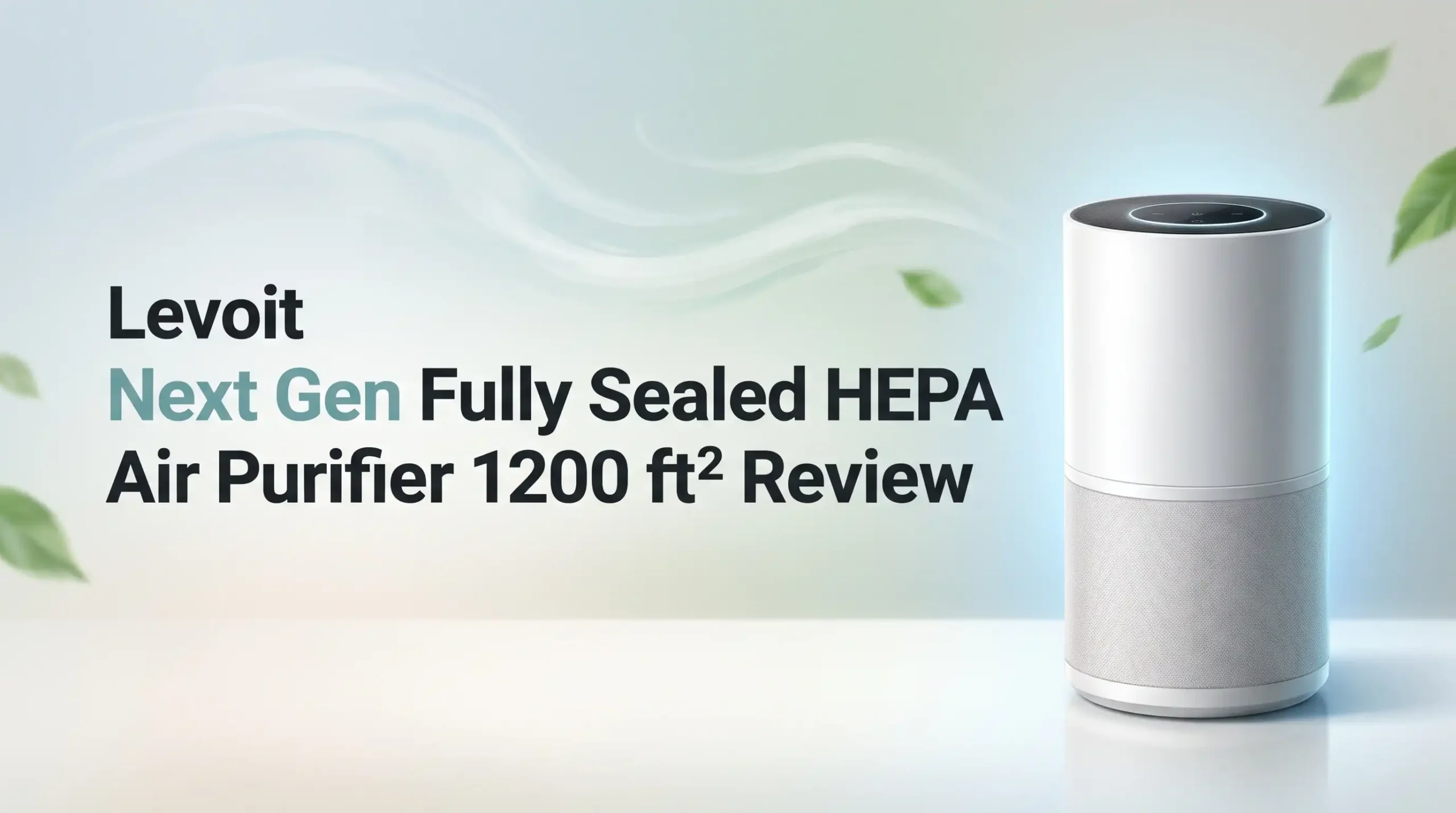
Levoit Next Gen Fully Sealed HEPA Air Purifier 1200 ft² Review 2026
Your bedroom air carries more junk than you expect. Dust lifts off your sheets every night. Pollen rides in on your clothes. Traffic fumes slip through a cracked window at 2 a.m.
Levoit says this purifier fixes all of that for $129.99. The model is the Eleva 300X, and it is the brand’s answer to years of complaints about bonded filters and fuzzy HEPA claims.
I set it up beside my bed, watched the numbers, and lived with the noise. This review covers what works, what annoys, and whether your money belongs here in 2026.
In A Nutshell
- The sealed design is the real upgrade. Air cannot sneak around the filter edges. Third party testing under the ASTM F3150 standard confirms capture of 99.97% of particles down to 0.3 microns. Older Levoit Core models never had this proof.
- Two separate filters save you money. The HEPA filter lasts up to two years. The carbon filter lasts about six months. You replace only the part that wears out instead of throwing away a healthy HEPA cylinder.
- The sensor is the hidden star. AirSight Plus 2.0 is a laser sensor that reads PM1.0, PM2.5, and PM10 as three separate numbers. It reacts in seconds, not minutes.
- Quiet enough to forget. Sleep mode runs near 36 dBA. Speed 2 stays under 40 dBA. Only turbo gets loud at roughly 55 dBA.
- The 1200 ft² number is marketing math. That figure assumes one air change per hour. For allergy relief you want four or five, which means 250 square feet is the honest ceiling.
- Low running cost. It holds ENERGY STAR certification and sips under 7 watts on speed 2. Electricity costs roughly $10 to $12 per year.
Levoit Next Gen Fully Sealed HEPA Air Purifier Eleva 300X


Last update on 2026-11-19 / Affiliate links / Images from Amazon Product Advertising API
The Eleva 300X is a tower style tabletop unit built for bedrooms, nurseries, and home offices. It measures 9.4 by 9.4 by 15.1 inches and weighs 9.9 pounds. The body is matte white plastic with a soft LED ring near the top.
Levoit rates it at 161 CFM CADR for smoke, dust, and pollen, verified by AHAM. The brand claims 1200 ft² in one hour or 250 ft² in 12.5 minutes at 4.8 air changes per hour.
The second number is the one that matters. It also carries ECARF allergy certification, ENERGY STAR approval, and HSA and FSA eligibility in the United States. That last detail surprises most buyers and can effectively cut your cost.
Unboxing Experience and First Impressions
The box arrived smaller and lighter than I pictured. Levoit packs the unit in molded cardboard rather than foam, which feels like a quiet win for the planet and for recycling day.
Inside you get the purifier, a pre installed HEPA filter, a carbon filter sealed in plastic, a power cord, and a thin manual. There is no remote in the box.
Setup took me under four minutes. You twist off the bottom cover, peel the wrap off the HEPA filter, drop the carbon filter into its own slot, and twist everything shut. The lock clicks firmly with no wobble.
My first reaction was that it does not look cheap. The finish is smooth, the seams line up, and it earns a spot on a nightstand instead of hiding behind a chair.
Design and Build Quality
Levoit built this one to be seen. Air enters through side vents around the base and exits from the top, so nothing blows directly at your face while you sleep.
A touch panel sits on the top surface and shows live particle readings. An LED ring glows blue, green, orange, or red depending on your air quality. You can dim it or shut it off entirely.
The base feels planted. A knee bump will not tip it. The touch controls respond fast, though they collect fingerprints within a day.
My main complaint is the missing carry handle. At 9.9 pounds you end up hugging the body when you move it between rooms. A simple grip cutout would have cost Levoit nothing.
Top 3 Alternative for Levoit Next Gen Fully Sealed HEPA Air Purifier

Last update on 2026-11-17 / Affiliate links / Images from Amazon Product Advertising API
Levoit Vital 200S Smart Air Purifier

Last update on 2026-11-19 / Affiliate links / Images from Amazon Product Advertising API
Levoit Core 300 Air Purifier

Last update on 2026-11-17 / Affiliate links / Images from Amazon Product Advertising API
Coway Airmega Mighty AP 1512HH Air Purifier
Fully Sealed HEPA Filtration Explained
This is the headline change. Many budget purifiers let a slice of air bypass the filter through gaps in the housing. That leak quietly ruins the 99.97% number printed on the box.
The Eleva 300X seals the whole air path, not just the filter media. Levoit calls it system level sealed filtration, and independent labs verified it under ASTM F3150.
The stack has three stages. A washable pre filter grabs hair and lint. The sealed HEPA layer traps fine particles down to 0.3 microns. A dedicated activated carbon filter handles odors and gases.
Older Levoit models bonded the carbon and HEPA into one cylinder. When the carbon saturated after six months, you tossed a HEPA filter that still had years left. This design ends that waste.
What the 1200 ft² Coverage Claim Really Means
Read this section before you buy. The 1200 ft² figure describes one air change per hour in a very large room. One air change per hour does almost nothing for pollen season or pet dander.
Health agencies suggest four to five air changes per hour for allergy relief. At that rate, this unit covers roughly 250 square feet. Independent testing lands near 247 square feet, which matches Levoit’s own fine print.
So treat this as a bedroom machine, not a living room machine. Place it in a 150 to 250 square foot space and it performs beautifully.
Push it into a 450 square foot open plan area and you will see the readings drop slowly. The sensor still works, but the fan cannot keep pace.
Real World Air Cleaning Performance
Numbers only matter if your room feels different. In my 190 square foot bedroom, PM2.5 fell from 38 to under 5 in about eleven minutes on turbo. The air had that flat, clean smell afterward.
Cooking smoke drifting from the hallway triggered the sensor within seconds. The fan jumped before I smelled anything myself.
Response speed is where this unit beats its price class. Cheaper purifiers use infrared sensors that lag by a minute or more.
Pet owners will notice dander readings drop fast. Odor control is a different story. The standard carbon filter is thin, so heavy cooking smells linger. Buy the premium carbon filter if you fry food often. It holds far more carbon and makes a visible difference.
Noise Levels and Sleep Mode
Measured from three feet away, sleep mode sits near 35.8 dBA. Speed 1 reads about 36.8 dBA. Speed 2 lands near 39.8 dBA. Speed 3 climbs to roughly 45 dBA. Turbo peaks around 55 dBA.
Everything below turbo qualifies as bedroom friendly. I slept next to it on speed 2 for two weeks and never once woke because of it.
The tone matters as much as the volume. This one produces a soft whoosh with no motor whine, no rattle, and no high pitched hum.
Sleep mode also dims the screen and kills the LED ring automatically. Turbo sounds like a hair dryer across the room. You will not run it overnight, and you will rarely need to.
Smart Sensor and Air Quality Readings
The AirSight Plus 2.0 is a laser sensor, which beats the infrared sensors found in cheaper units. Laser sensors see smaller particles, react faster, and need less cleaning.
It reports three channels separately. PM1.0 covers smoke, exhaust, and microplastics. PM2.5 covers dust and dander. PM10 covers pollen and coarse debris.
Seeing three numbers changes how you understand your home. I learned my PM10 spikes every time I change the sheets. My PM1.0 climbs during rush hour outside.
The onboard display cycles through all three readings. Accuracy tracked closely with a reference monitor I keep nearby. This sensor alone explains a large chunk of the price difference over a basic Core model.
VeSync App and Smart Controls
The VeSync app connects over 2.4 GHz Wi Fi and pairs in about a minute. Inside you get fan control, timers, scheduling, child lock, and filter life tracking.
Two sleep profiles stand out. Classic Sleep holds one low speed all night. Dynamic Sleep stays quiet but briefly ramps up when the sensor spots a pollution spike.
Dynamic Manual is the mode I use most. You lock the fan at speed 2 and allow short bursts when the air gets bad.
The app also supports Alexa and Google Assistant. Air quality charts show daily, weekly, and monthly trends. The AI Insights feature gives tips, though many read like common sense advice you already follow.
Energy Use and Running Costs
This purifier barely touches your bill. Standby draws 0.65 watts. Sleep mode uses 1.85 watts. Speed 1 pulls 5.33 watts. Speed 2 needs 6.91 watts. Speed 3 reaches 10.03 watts. Turbo tops out near 24 watts.
Running it on speed 2 around the clock costs roughly $10 to $12 per year at average United States electricity rates. That is less than one takeout lunch.
The ENERGY STAR badge is earned rather than decorative. Filters cost more than electricity here. Budget around $25 to $35 for a HEPA filter every two years, plus $18 to $25 for carbon filters twice a year. Total ownership stays reasonable.
Filter Replacement and Maintenance
Maintenance is simple but needs a routine. Vacuum the pre filter mesh every two to four weeks. Replace the carbon filter every six months, sooner with pets or heavy cooking. Replace the HEPA filter every two years.
The compartment opens with a twist. No tools, no screws, no fighting with clips.
Here is the catch. Levoit asks you to register each new filter in the app by scanning a code. Skip that step and the filter life tracker stops counting correctly.
Third party filters physically fit, but they will not register. Some buyers read this as a nudge toward genuine filters only, and that criticism is fair.
What This Levoit Does Not Do Well
Honest reviews name the flaws, so here they are. The 1200 ft² claim oversells real coverage. Treat 250 square feet as the limit for meaningful allergy relief.
The standard carbon filter is thin and saturates quickly in kitchens. The AI Insights feature adds app lag and vague suggestions.
There is no physical remote, so you depend on the touch panel or your phone. There is no carry handle either, which makes room to room moves awkward.
Turbo mode is loud enough to interrupt a conversation. Wi Fi setup sometimes fails on crowded 2.4 GHz networks and needs a router restart. None of these kill the deal, but all of them are real.
Pros and Cons
Pros
- Sealed HEPA filtration verified by independent third party testing under ASTM F3150
- Separate HEPA and carbon filters cut long term cost and waste
- Laser sensor reads PM1.0, PM2.5, and PM10 with fast, accurate response
- Very quiet below turbo, with sleep mode around 36 dBA
- AHAM Verifide CADR of 161 CFM, strong for the price class
- ENERGY STAR certified with tiny power draw
- VeSync app offers Dynamic Sleep and Dynamic Manual modes
- Two year HEPA filter life and two year warranty
- HSA and FSA eligible for many United States buyers
Cons
- Coverage claim overstates performance in large rooms
- Filter registration required for accurate life tracking
- Standard carbon filter is light on odor control
- No carry handle and no physical remote
- Turbo mode hits roughly 55 dBA
- AI Insights add little practical value
Who Should Buy It and Final Verdict
Last update on 2026-11-19 / Affiliate links / Images from Amazon Product Advertising API
This unit fits one buyer very well. You sleep in a room between 150 and 250 square feet. You have allergies, a pet, or a partner who loves open windows in April. You want data about your air, not just a spinning fan.
Skip it if you need to cover an open plan living area. A Vital 200S or a Coway Mighty suits that space better. Skip it also if you want one button and zero apps.
After weeks of use, it is still plugged in beside my bed. That is my clearest endorsement. Ignore the 1200 ft² headline, buy the premium carbon filter if you cook, and place it within ten feet of your pillow.
Frequently Asked Questions
Does this Levoit use a true HEPA filter?
Yes. It uses system level sealed HEPA filtration that captures 99.97% of particles as small as 0.3 microns, confirmed by independent testing under the ASTM F3150 standard. The sealed housing stops air from bypassing the filter.
How often should I replace the filters?
Replace the carbon filter every six months and the HEPA filter every two years under normal use. Pets, smoking, and frequent cooking shorten carbon filter life. The VeSync app tracks both once you register them.
Is it ozone free?
Yes. The unit uses mechanical filtration only. There is no ionizer, no UV lamp, and no plasma technology, so it produces zero ozone. That makes it safe for people with asthma.
Can it really clean 1200 square feet?
Only at one air change per hour, which provides weak allergy relief. For four or five air changes per hour, expect around 250 square feet of real coverage.
Does it work without Wi Fi?
Yes. Auto mode, fan speeds, sleep mode, child lock, and the air quality display all run from the touch panel. Wi Fi only adds scheduling, trend charts, voice control, and remote access.

I’m Maya Brown, the voice behind Pure Breeze Vault. I write detailed, honest, and easy-to-follow air purifier reviews to help readers compare features, understand filter technologies, and choose products with confidence. My goal is to make research simpler, clearer, and more practical for anyone improving indoor air quality at home.