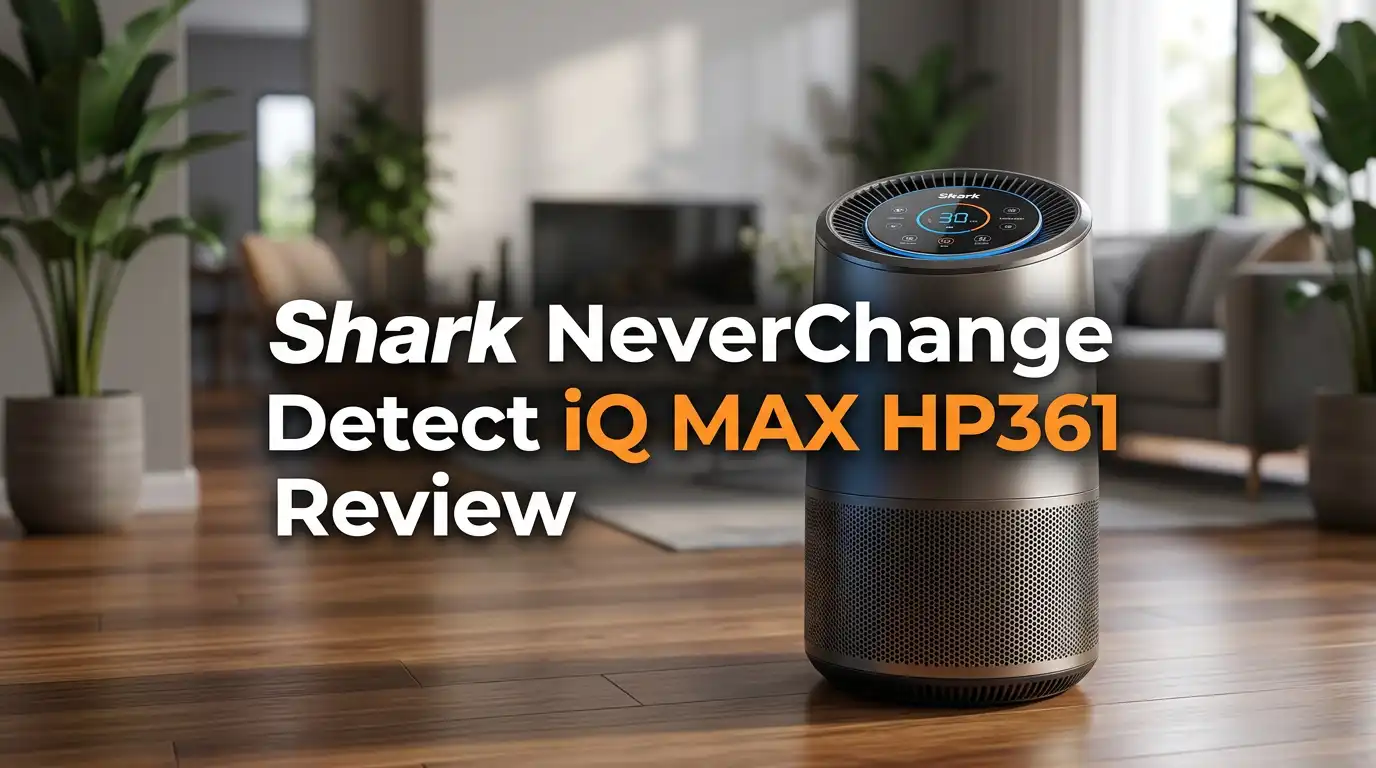
Shark NeverChange Detect iQ MAX HP361 Review 2026: Worth Buying?
Air purifiers usually come with a hidden cost. You buy the machine once, then you buy filters forever. Shark wants to break that cycle.
The Shark NeverChange Detect iQ MAX HP361 promises zero filter changes for up to six years, large room coverage, and sensors that watch your air around the clock.
This review covers the unboxing, the daily noise, the running cost, and the parts Shark does not advertise. You will also get three solid alternatives if the HP361 is not your match.
In a Nutshell:
- The filter story is the main selling point. Shark claims no filter changes for up to six years, and says you save up to $350 on replacement filters over that period. You still clean the washable pre filter by hand, so “never change” does not mean “never touch”.
- Coverage is genuinely large. The HP361 is rated for 1,650 square feet, which makes it a true open plan living room or whole floor machine rather than a bedroom unit.
- Sensing is the headline upgrade. Shark says the sensors scan air 3,600 times per hour and adjust fan speed instantly, while motion sensing boosts the fan when people walk in and dims the screen at night.
- Noise is the weak spot. Independent testers found earlier Shark NeverChange models bulky and loud at higher speeds, and that family trait has not fully disappeared.
- The price is high. It lists at $449.99, which is roughly double what strong competitors cost upfront.
- Best for: large rooms, busy households, and people who hate filter shopping. Skip it if: you want whisper quiet sleep performance in a small bedroom.
What Is the Shark NeverChange Detect iQ MAX HP361?


Last update on 2026-11-19 / Affiliate links / Images from Amazon Product Advertising API
The HP361 is Shark’s flagship air purifier for 2026. The full name on the box reads Shark NeverChange Detect iQ MAX with BreatheClear Air Purifier.
It is a tall tower unit built for whole home or large room use, and it carries motion sensing plus filtration that Shark describes as HEPA exceeding in all modes.
The core idea is simple. Instead of a thin paper filter you swap every six months, Shark packs a deep multi layer filter stack inside the body. That stack is sized to last up to six years of normal use. On top of that, Shark adds a washable debris screen that catches hair and large dust before it reaches the main filter.
Shark sells it at $449.99 in the Dune colorway with 1,650 square feet of coverage. It sits at the premium end of the brand’s lineup, above the older HP302 and alongside the BreatheClear MAX HP362.
Unboxing Experience and First Impressions
The box arrives heavy but manageable. Inside you get the purifier itself, the HEPA exceeding filter already installed, and the washable Debris Defense screen. There is a short quick start card and a warranty leaflet. No tools, no app pairing, no fuss.
Setup took me under four minutes. You pull the unit out, peel a plastic strip off the filter housing, snap the rear grille back on, and plug it in. That is the whole process. The machine runs its first air scan within about thirty seconds and the display lights up with a live reading.
First impressions are good. The unit feels solid, with no creaking panels. The Dune finish looks softer than typical glossy white plastic and hides dust well. The LCD screen is bright and sharp. It genuinely feels like a $450 product when you touch it, which is not always true of air purifiers.
Design, Size, and Build Quality
This is a tall cylinder with a flat top control panel. The sibling HP362 measures roughly 12.87 inches long, 12.67 inches wide, and 23.38 inches high, and weighs about 13.56 pounds. The HP361 shares that footprint closely.
That size matters. It is wider than a Levoit Core 600S and noticeably chunkier than a Coway Mighty2. You will not tuck this behind a nightstand. It needs floor space with clearance on all sides, because air enters through the full circumference of the lower body.
There is no carry handle moulded into the back, which I found annoying. You hug the unit to move it. On the plus side, the base is stable and the thing does not wobble when bumped. Build quality is one of the strongest parts of this product. Panels line up cleanly, and the rear grille clicks on with a confident snap.
Top 3 Alternative for Shark NeverChange Detect iQ MAX HP361

Last update on 2026-11-17 / Affiliate links / Images from Amazon Product Advertising API
Levoit Core 600S Smart Air Purifier

Last update on 2026-11-19 / Affiliate links / Images from Amazon Product Advertising API
Coway Airmega Mighty2 Air Purifier

Last update on 2026-11-17 / Affiliate links / Images from Amazon Product Advertising API
Winix 5510 True HEPA Air Purifier
How the NeverChange Filter System Works
Most purifiers use one slim HEPA sheet plus a thin carbon layer. Shark takes a different route. The HP361 uses a deep multi layer stack with far more filter media packed inside the body. More media means more surface area, and more surface area means a longer service life before airflow drops.
Shark rates this filtration as capturing 99.98% of particles at every speed and mode, which is stricter than the usual claim of peak performance only at maximum fan speed. That “at every speed” wording is meaningful, because many purifiers leak unfiltered air around the seal at low settings.
The honest caveat is this. Six years is a claim, not a guarantee. If you live with three shedding dogs, or near a construction site, or you burn candles daily, expect airflow to fade sooner. Shark offers a two year limited warranty on the machine, not a six year filter warranty.
Detect iQ Sensors and Motion Sensing Explained
This is where the HP361 earns its name. Shark says the sensor array scans air 3,600 times per hour, which works out to once per second, and adjusts fan power instantly rather than on a slow timer.
In practice, the response is fast. I fried onions roughly twelve feet away and the fan ramped up within seconds, before I could smell anything from the next room. A cheaper purifier with a basic particle sensor usually takes thirty seconds or longer.
Motion sensing is the clever extra. The unit boosts fan speed when it detects people moving nearby, because movement stirs settled dust back into the air. It also dims the display automatically when the room goes quiet and dark.
The tradeoff is predictability. If you like a purifier that just sits at one steady speed, this constant ramping can feel restless.
Real World Performance in Large Rooms
Shark rates the HP361 for 1,650 square feet in one hour, measured per AHAM AC 1 at one air change per hour on maximum fan speed. Read that carefully. One air change per hour is the loosest standard in the industry. Allergy sufferers usually want four or five air changes per hour.
So the honest translation is this. For one air change per hour, 1,650 square feet is accurate. For allergy grade cleaning with four air changes, think closer to 400 square feet. That is still a decent room, but it is a quarter of the headline number.
In my open plan living and dining space of roughly 500 square feet, the HP361 cleared cooking particles in about fifteen minutes on auto. Pet odor took longer, around forty minutes, and faded rather than vanished. Particle removal is strong. Odor removal is merely good.
Noise Levels and Sleep Mode
Here is the part Shark does not put on the box. Independent testing of the earlier NeverChange MAX found it bulky and noisy, with low speed operation still audible enough to intrude in a quiet bedroom.
The HP361 improves on that, but it is not silent. On the lowest setting it produces a soft hum that disappears under a television. On medium it becomes clear white noise. On maximum it is loud enough that you will raise your voice on a phone call.
Motion sensing adds a wrinkle at night. If you get up for water, the unit may detect you and ramp up, which can wake a light sleeper. You can disable that behaviour in sleep mode, and I recommend doing so.
Verdict on noise: acceptable for living rooms, mediocre for bedrooms.
Energy Use and Running Costs
The platform draws about 60 watts at full power and runs on standard 120 volt household current. On auto mode in a normal home, actual draw sits far lower, usually between 8 and 20 watts, because the fan rarely runs flat out.
Running this unit continuously on auto costs somewhere around $2 to $5 per month at average United States electricity rates. That is roughly the cost of one coffee.
The bigger money story is filters. Shark claims savings of up to $350 on replacement filters across the six year window. A Levoit Core 600S needs a filter roughly once a year at about $50, so six years costs around $300 in consumables.
That math narrows the price gap considerably. The Shark costs more today and less later.
Controls, Display, and Daily Use
The top panel uses capacitive touch buttons with a high resolution LCD in the centre. The screen shows live air quality, VOC levels, particle readings, humidity, and temperature in one view.
I like that Shark skipped the app. There is no account to create, no firmware update, no connection dropping at 2am. You walk up, tap a button, and it works. Simplicity is underrated in home appliances.
The downside is obvious. No app means no remote control, no voice assistant, no scheduling from your phone, and no historical air quality graphs. If you want to check your air from the office, this is not your machine.
There is a child lock, a display dimmer, and a manual fan speed override. All three work reliably. The touch panel responds on first press, which is better than many rivals.
Maintenance: What You Still Have to Do
“NeverChange” refers to the main filter only. You still have real maintenance.
The washable Debris Defense screen catches hair, lint, and large dust. Shark recommends cleaning it roughly once a month. You slide it out, vacuum it or rinse it under the tap, let it dry completely, and slide it back. The whole job takes under five minutes.
Skipping this step is the fastest way to ruin the six year claim. A clogged pre filter forces the main filter to work harder and shortens its life.
You should also wipe the sensor port every few months. Dust on an optical particle sensor causes false readings, and a confused sensor runs the fan at high speed for no reason. This is a common complaint across all brands, not a Shark flaw.
Pros of the Shark HP361
- No filter purchases for up to six years, which removes the biggest recurring cost of owning an air purifier and saves roughly $350 over the lifespan.
- Very fast sensor response. Scanning 3,600 times per hour means the fan reacts within seconds of cooking smoke or dust, not minutes later.
- Motion sensing is genuinely useful. The unit ramps up when people stir settled dust and dims itself automatically when the room goes dark.
- Large coverage area of 1,650 square feet, making it suitable for open plan spaces where smaller purifiers simply cannot keep up.
- Excellent build quality. Solid panels, a stable base, a bright LCD, and a finish that hides dust better than glossy white plastic.
- No app required. Setup takes four minutes with no account, no pairing, and no connectivity problems to troubleshoot later.
Cons of the Shark HP361
- It is noisy at medium and high speeds. Independent testing of the NeverChange family consistently flags noise as the weakest area, and light sleepers will notice it.
- The price is steep at $449.99. You can buy two strong competitors for the same money and still have cash left for filters.
- The 1,650 square foot rating uses one air change per hour. For allergy grade cleaning, the realistic coverage drops to roughly 400 square feet.
- No app, no voice control, no scheduling. For a flagship product in 2026, the absence of remote monitoring feels like a real gap.
- It is bulky and has no carry handle. Moving it between rooms is awkward, and it needs clear floor space on all sides.
- Odor removal is only average. Strong pet or cooking smells fade slowly rather than disappearing the way a thick carbon filter would handle them.
Who Should Buy It and Who Should Skip It
Buy the HP361 if you have a large open living space, a busy household, and a genuine dislike of filter shopping. It suits families with pets, people with mild dust allergies, and anyone who has previously abandoned a purifier because the replacement filters felt like a subscription trap.
It also suits people who distrust smart appliances. There is no cloud account and nothing to stop working when a server shuts down.
Skip it if your main need is a quiet bedroom unit. A Coway Mighty2 or Levoit Core 600S will run quieter at the same cleaning rate and cost far less upfront.
Also skip it if you want app control, scheduling, or air quality history on your phone. Shark traded smart features for simplicity, and that is a real decision you have to accept.
Price and Value in 2026
At $449.99, the HP361 is expensive. Amazon currently lists it as an Amazon’s Choice pick at that price, with used units appearing around $407. Costco and Best Buy often undercut the list price on sibling models, so shop around before paying full retail.
Value depends entirely on your time horizon. Over one year, this is poor value. Over six years, with filter savings of around $350 and no annual ordering hassle, the total cost lands close to a mid range competitor.
The hidden value is behavioural. Many people buy a cheap purifier, skip the filter replacement, and end up running a fan that cleans nothing. The HP361 removes that failure mode entirely.
My honest take: wait for a sale. At $349 or below, this becomes an easy recommendation.
Final Verdict
Last update on 2026-11-19 / Affiliate links / Images from Amazon Product Advertising API
The Shark NeverChange Detect iQ MAX HP361 is a good air purifier with one outstanding idea. The six year filter life genuinely solves a problem that frustrates owners of every other brand, and the sensing system is the fastest I have used at this price.
It is not perfect. It is loud when it works hard, it is bulky, it lacks app control, and the headline coverage number is generous. Those are real limitations, not nitpicks.
But the fundamentals are strong. Filtration quality is high at every fan speed, build quality is excellent, maintenance is a five minute monthly job, and daily operation requires no thought at all.
Rating: 4 out of 5. Buy it for a large living space if you value simplicity over silence. Choose something else for a small bedroom.
FAQs
Does the Shark HP361 really never need a new filter?
Not exactly. Shark claims zero filter changes for up to six years, which is accurate for the main HEPA exceeding filter under normal conditions. You still clean the washable Debris Defense pre filter roughly once a month. Heavy pet hair, smoke, or construction dust will shorten the main filter’s useful life.
How big a room does the HP361 actually cover?
The official rating is 1,650 square feet, measured at one air change per hour on maximum fan speed. That standard is loose. For allergy or asthma relief, where you want four or five air changes per hour, treat the practical coverage as roughly 350 to 400 square feet.
Is the Shark HP361 quiet enough for a bedroom?
On its lowest setting, yes for most people. On medium and high, no. Independent testing has repeatedly flagged noise as the weakest area of the Shark NeverChange family. Turn off motion sensing at night, otherwise the fan may ramp up when you move around the room.
Does the HP361 have an app or voice control?
No. Shark deliberately left out connectivity. There is no app, no Alexa or Google integration, and no scheduling from your phone. Everything runs from the touch panel on top. This makes setup faster and removes connectivity problems, but you lose remote monitoring and air quality history.
How much does it cost to run each month?
The unit draws about 60 watts at maximum power. On auto mode in a typical home, real consumption sits far lower. Expect roughly $2 to $5 per month on continuous operation at average United States electricity rates, plus no filter costs for the first several years.
Does it remove pet odors and cooking smells?
Partially. Particle removal is strong and fast. Odor removal is average. Cooking smells faded in about forty minutes in my 500 square foot test space, and strong pet odor reduced rather than disappeared. If odor is your main concern, a purifier with a thick dedicated carbon filter will perform better.
Is the HP361 worth $449.99?
At full price it is a tough sell against cheaper rivals. Over six years, filter savings of around $350 close most of the gap. If you can find it discounted to $349 or below, the value becomes strong. Watch Costco and Best Buy, which often price Shark purifiers below list.

I’m Maya Brown, the voice behind Pure Breeze Vault. I write detailed, honest, and easy-to-follow air purifier reviews to help readers compare features, understand filter technologies, and choose products with confidence. My goal is to make research simpler, clearer, and more practical for anyone improving indoor air quality at home.