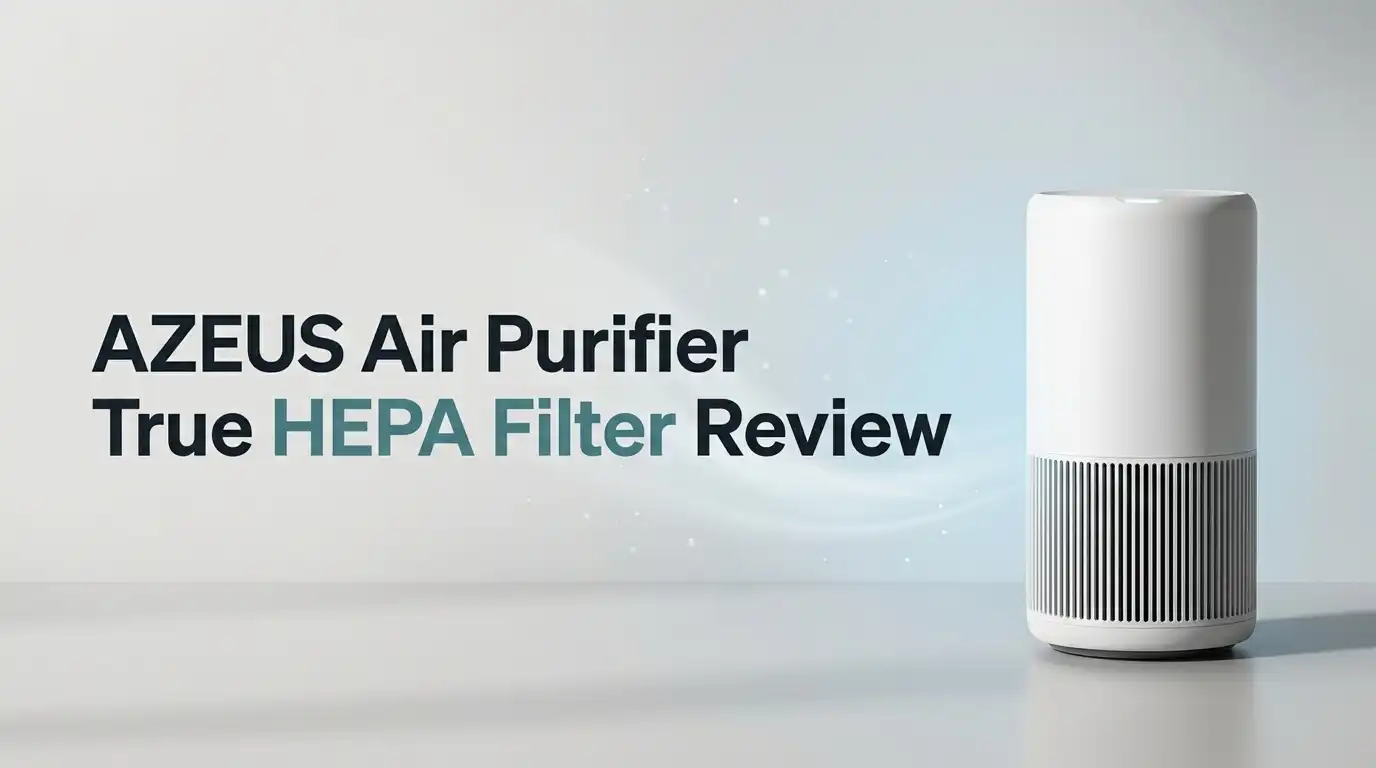
AZEUS Air Purifier True HEPA Filter Review 2026: Still Worth It?
Clean indoor air feels invisible until you lose it. Dust settles on your desk. Pet hair floats past a sunbeam. Wildfire smoke sneaks through a closed window in August. The AZEUS air purifier promises to fix all of that with a True HEPA filter and a quiet fan.
This review covers the real experience. I look at the unboxing, the filter stack, the noise, the running cost, and the parts that disappoint. You will also see how it stacks up against the usual favorites from Levoit, Winix, and Coway.
If you are shopping in 2026 and want a straight answer about whether this machine earns a spot in your bedroom or living room, keep reading.
In a Nutshell:
- True HEPA performance is the main selling point. The H13 grade filter captures 99.97% of particles down to 0.3 microns, which covers dust, pollen, pet dander, mold spores, smoke, and most common allergens.
- Coverage is generous for the price. AZEUS rates the popular GL-FS32 model for rooms up to roughly 1076 square feet at one air change per hour, or about 269 square feet at the more meaningful rate of four air changes per hour.
- It runs quietly at low speed. The updated model sits near 22dB on its lowest setting, which is softer than a whisper. High speed climbs to about 55dB, and that is clearly audible.
- The DC motor saves money. A 24V 40W brushless motor keeps electricity costs low, even if you run the unit around the clock.
- Filters cost real money. Replacement filters run near $40 and last six to eight months in a dusty home, so budget for that.
- It is not perfect. The ionizer, the plastic shell, and the vague app experience hold it back from a top tier rating.
What Is the AZEUS True HEPA Air Purifier?


Last update on 2026-11-19 / Affiliate links / Images from Amazon Product Advertising API
AZEUS is a smaller brand that sells air purifiers directly and through Amazon. The lineup includes compact desktop units and larger tower style models for big rooms.
The star of the range is the GL-FS32, a wide rectangular unit with a front intake panel and a top exhaust grille. It uses a three stage system: a washable pre filter, an activated carbon layer, and an H13 True HEPA filter.
Higher trims add a UV C lamp and an ionizer. A built in particle sensor reads the air and adjusts fan speed in auto mode. A colored light ring glows blue, green, or red to show air quality at a glance.
The pitch is simple. You get large room coverage and genuine HEPA filtration for well under $200.
Unboxing Experience and First Impressions
The box arrives heavier than you expect. Inside, the purifier sits between two thick foam blocks with a cloth sleeve over the body. AZEUS packs the remote, the power adapter, and a short manual in a separate cardboard tray.
Here is the step people forget. The HEPA filter ships inside a sealed plastic bag, and that bag sits inside the machine. You must pop off the front panel, pull the filter out, remove the bag, and slide the filter back in. Skip it and airflow drops to almost nothing.
Setup took me under four minutes. Plug it in, tap the power button, and the light ring glows. The first run smelled faintly of new plastic for about an hour, then the smell vanished.
Design and Build Quality
The GL-FS32 measures roughly 20.5 inches wide, 9 inches deep, and 16 inches tall. That wide stance makes it look like a sound bar standing on short feet. It fits under a window or beside a sofa without blocking a walkway.
The shell is ABS plastic in matte white. It feels sturdy enough, though the front panel flexes if you press the center. Panel gaps are even, and the magnetic grille clicks back into place cleanly.
Touch controls sit on the top edge. They respond on the first tap, which is more than I can say for some rivals. The light ring doubles as a night light at the lowest brightness setting.
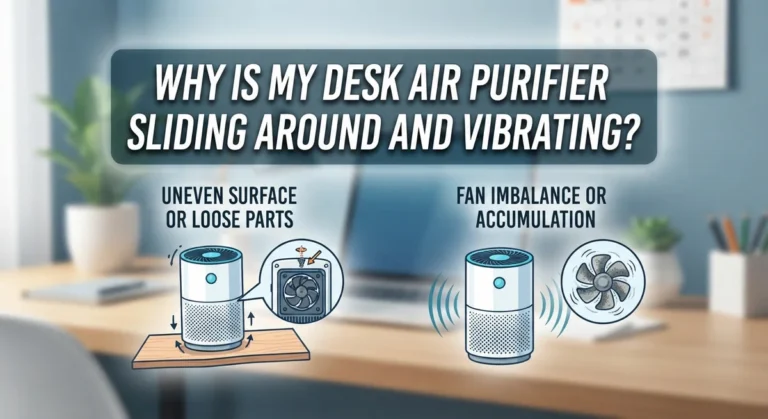
My gripe is weight distribution. The unit is light at under 13 pounds and slides easily on hardwood when you bump it.
Top 3 Alternative for AZEUS True HEPA Air Purifier

Last update on 2026-11-19 / Affiliate links / Images from Amazon Product Advertising API
LEVOIT Core 300-P Air Purifier

Last update on 2026-11-20 / Affiliate links / Images from Amazon Product Advertising API
Winix 5500-2 Air Purifier with True HEPA and PlasmaWave

Last update on 2026-11-17 / Affiliate links / Images from Amazon Product Advertising API
COWAY Airmega AP-1512HH Mighty Air Purifier
True HEPA Filtration Explained Simply
True HEPA is a performance standard, not a marketing word. A True HEPA filter traps 99.97% of airborne particles measuring 0.3 microns. That size is the hardest to catch, so smaller and larger particles get captured at even higher rates.
The AZEUS filter is rated H13, which sits at the entry point of medical grade. It handles pollen at 10 to 100 microns, pet dander near 5 microns, and fine smoke particles under 1 micron.
The carbon layer does a different job. It adsorbs gases and odors such as cooking smells, cigarette smoke, and some VOCs. Carbon saturates faster than HEPA, so odor control fades before particle control does.
Watch out for fake claims elsewhere. Many cheap purifiers say “HEPA type” or “HEPA style,” which means nothing. AZEUS states True HEPA and backs it with H13 media.
Room Coverage and Real World Performance
AZEUS advertises coverage up to 1076 square feet. Read the fine print. That number reflects one air change per hour, which barely helps during a pollen storm.
Divide by four for a realistic figure. At four air changes per hour, the sweet spot for allergy relief, the unit comfortably serves a room near 265 to 280 square feet. That covers most bedrooms, home offices, and medium living rooms.
In my 280 square foot living room, the sensor turned red within 90 seconds of me vacuuming. It dropped back to blue in about 11 minutes on auto mode.
Cooking tests were less flattering. Searing salmon pushed the sensor red, and the kitchen smell lingered for roughly 25 minutes before clearing.
Noise Levels and Sleep Mode
Noise decides whether a purifier stays plugged in or gets shoved in a closet. The updated AZEUS unit handles this well at the bottom of its range.
Speed one measures around 22 to 25dB. That is quieter than a refrigerator hum and easy to sleep through. Speed two and three add a soft whoosh that works as white noise.
Speeds five and six are a different story. The reading climbs near 55dB, similar to a window air conditioner. You will pause a conversation or raise the TV volume.
Sleep mode dims the light ring to off and locks the fan to its quietest setting. As a light sleeper, I ran it overnight for two weeks without waking once.
Smart Features, App Control, and Auto Mode
Newer AZEUS models add WiFi and app control. You get remote on and off, fan speed selection, a schedule, and a filter life readout on your phone.
Auto mode is the feature most people actually use. The laser particle sensor reads PM2.5 levels and picks a fan speed on its own. It reacts fast, often within 60 seconds of a change.
The sensor also leans sensitive. Walking past the intake in a wool sweater can trigger a speed bump, which is mildly annoying at 2am if you forgot sleep mode.
The app is functional but plain. It lacks historical air quality graphs, and setup over 2.4GHz WiFi took me two attempts before it paired.
Energy Use and Running Costs
The updated GL-FS32 uses a 24V 40W DC brushless motor. DC motors run far more efficiently than the older AC designs, and they last longer too.
At low speed, draw sits near 8 to 12 watts. At maximum speed, it tops out close to 40 watts. Running the unit at medium for 24 hours a day costs roughly $1.50 to $2.50 a month at average US electricity rates.
That is cheaper than most LED light bulbs left on all day. The low voltage design also means the adapter handles 100V to 240V, so the unit works abroad with a plug adapter.
Energy use is genuinely a strength here. Many large room purifiers pull triple the wattage for similar airflow.
Filter Replacement Cost and Maintenance
Maintenance is light but not free. The pre filter needs a vacuum every two to four weeks. Pet owners should do it weekly, because hair mats the mesh quickly.
The combined HEPA and carbon filter is a single cartridge. AZEUS lists replacements near $39.99 for the GL-FS32, and the official part carries the HHAP0009 designation. Expect six to eight months of life in an average home, or four to five months in a smoky or dusty one.
A filter indicator light tells you when the timer expires. Reset it by holding the button for three seconds after installing a new cartridge.
Factor about $60 to $80 a year into your budget if you run the machine daily. Third party filters exist and cost less, though fit and media quality vary.
What the AZEUS Air Purifier Does Not Do Well
Honest reviews need honest criticism, so here is the list.
The ionizer concerns me. Ionizers can produce trace ozone, and ozone irritates sensitive lungs. AZEUS says the unit meets California CARB standards, which is reassuring, but I still recommend leaving the ionizer switched off. The HEPA filter does the real work anyway.
Odor removal is average. The carbon layer is thin compared to dedicated smoke purifiers, so strong kitchen smells and litter box odors take longer to clear.
AZEUS also does not publish AHAM verified CADR ratings. That makes direct comparison with Coway or Winix harder.
Finally, brand support is a question mark. AZEUS is small, and filter availability depends on one supply chain.
Pros and Cons
Pros
- Genuine H13 True HEPA filter that captures 99.97% of particles at 0.3 microns
- Very quiet low speed near 22dB, which makes bedroom use easy
- Efficient 24V DC brushless motor that keeps electricity costs under $3 a month
- Fast and responsive air quality sensor with a clear color ring display
- Six fan speeds plus a usable auto mode and a sleep mode with lights off
- Strong coverage for the price, suitable for rooms up to roughly 280 square feet at four air changes per hour
- Simple filter swap that takes under two minutes
Cons
- No AHAM verified CADR rating published, so claims are hard to confirm
- Ionizer adds little value and is best left off
- Thin carbon layer means average odor and VOC removal
- High speeds reach about 55dB and sound loud
- App lacks air quality history and pairing can be fussy
- Smaller brand with less certain long term filter supply
- Plastic housing feels light and slides on smooth floors
How It Compares With Levoit, Winix, and Coway
The Levoit Core 300-P is the budget favorite. It is smaller, cheaper, and better suited to rooms under 220 square feet. AZEUS wins on coverage and sensor features.
The Winix 5500-2 brings a thick carbon filter and a washable pre filter. It beats AZEUS clearly on odor control and has a proven CADR rating. It also costs more and looks bulkier.
The Coway Airmega AP-1512HH remains the all round benchmark. It offers verified performance, excellent reliability, and a strong filter supply chain. Expect to pay a premium for that confidence.
AZEUS sits in the value lane. You trade third party verification and brand depth for a quiet, efficient, large room machine at a lower price.
Setup and Placement Tips for Best Results
Placement changes results more than most people realize. Give the unit at least 12 inches of clearance on the intake side and keep the top exhaust clear.
Avoid corners. Corners trap airflow and cut circulation. A spot along a wall near the middle of the room works better.
Keep doors and windows closed while the purifier runs. Open windows feed a constant stream of new particles and the sensor will chase them forever.
Run auto mode during the day and sleep mode at night. Running on high for 20 minutes before bed clears the room faster than eight hours on low.
One last tip. Vacuum and dust before you expect the purifier to help, not after you blame it for failing.
Final Verdict: Should You Buy It in 2026?
Last update on 2026-11-19 / Affiliate links / Images from Amazon Product Advertising API
The AZEUS True HEPA air purifier earns a solid recommendation with clear limits. It is quiet, efficient, and genuinely effective against dust, pollen, pet dander, and smoke particles.
Buy it if you want large room coverage on a modest budget and you care most about particles. Allergy sufferers and pet owners will notice the difference within a week.
Skip it if odor control is your priority, or if you want AHAM verified numbers and a decade of brand history behind your purchase. Winix and Coway serve those buyers better.
My rating is 4 out of 5. It is a strong value pick that does the core job well and skips the extras you can live without.
Frequently Asked Questions
Is the AZEUS air purifier ozone free?
The HEPA and carbon filtration produces no ozone. The optional ionizer can generate trace amounts, though the unit carries California CARB certification. Turn the ionizer off if you have asthma or sensitive lungs.
How often should I change the AZEUS HEPA filter?
Plan on every six to eight months with normal daily use. Homes with pets, smokers, or heavy dust may need a change every four to five months. The filter indicator light gives you a reminder.
Can the AZEUS purifier handle wildfire smoke?
Yes, for particles. The H13 True HEPA filter captures PM2.5 and ash effectively. Gases and lingering smoke smell clear more slowly because the carbon layer is thin.
Does the AZEUS air purifier work for pet allergies?
It works well. The filter traps pet dander and loose hair, and the washable pre filter catches the bigger fluff. Vacuum the pre filter weekly in a multi pet home.
Is the AZEUS air purifier loud at night?
No. Speed one runs near 22dB, which most people cannot hear from a bed. Sleep mode also turns off the light ring so the room stays dark.
Do I need the WiFi app to use it?
No. All functions work from the top panel and the included remote. The app simply adds scheduling and remote control from your phone.

I’m Maya Brown, the voice behind Pure Breeze Vault. I write detailed, honest, and easy-to-follow air purifier reviews to help readers compare features, understand filter technologies, and choose products with confidence. My goal is to make research simpler, clearer, and more practical for anyone improving indoor air quality at home.