BLUEAIR Blue 511i Max Review 2026: Worth It?
Clean air feels invisible until you lose it. Dust settles on your nightstand. Pet hair floats through sunbeams. Pollen sneaks through window screens every spring. The BLUEAIR Blue 511i Max promises to fix all of that in a cylinder smaller than a table lamp.
This Swedish built purifier runs at 19 decibels, connects to your phone, and costs far less than most smart models. But small purifiers often overpromise. I spent weeks testing this one in a bedroom, a home office, and a living room corner.
This review covers real performance, honest weaknesses, filter costs, and whether the 511i Max deserves your money in 2026.
In a Nutshell:
- Excellent value for small rooms. The Blue 511i Max carries a CADR of 159 dust, 153 smoke, and 174 pollen. That beats several pricier competitors in the same size class. AHAM verifies these numbers, so they are not marketing fluff.
- Genuinely quiet. The unit runs at 19 decibels on speed one and tops out near 42 decibels. Night mode dims the lights and drops the fan. Light sleepers will not notice it.
- Smart features without a premium price. You get WiFi control, auto mode, an air quality sensor, scheduling, child lock, and Alexa voice support. Most purifiers at this price skip all of that.
- Cheap to own. It draws only 17 watts and carries an ENERGY STAR rating. Running it eight hours daily costs roughly $7 to $8 per year in electricity. Replacement filters run about $30.
- Coverage is modest. Blueair rates it for 237 square feet at 4.8 air changes per hour. Marketing mentions 1,138 square feet, but that figure reflects one air change per hour, which is weak cleaning.
- Not a VOC or gas specialist. The carbon layer is thin. Heavy cooking smells, paint fumes, and chemical odors need a bigger carbon bed than this unit provides.
BLUEAIR Blue 511i Max Overview


Last update on 2026-11-19 / Affiliate links / Images from Amazon Product Advertising API
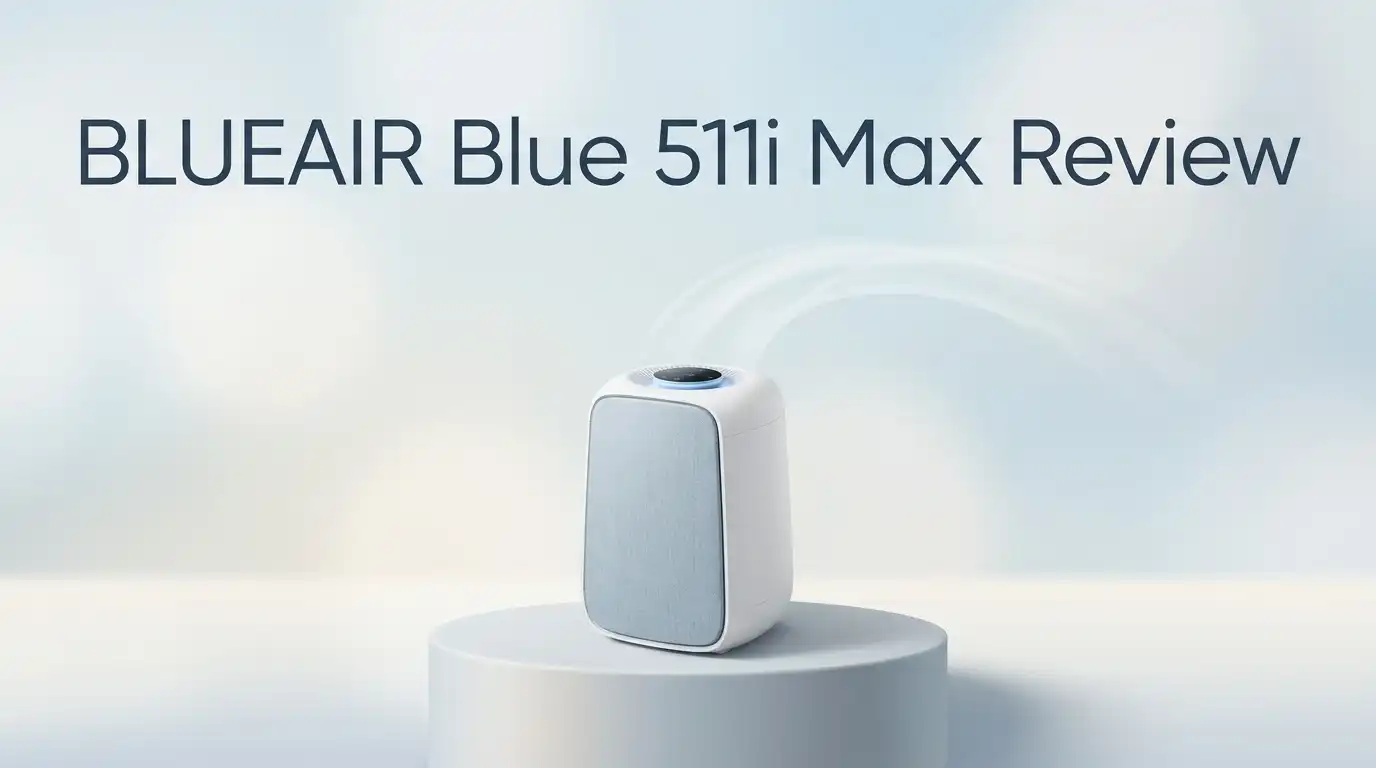
The Blue 511i Max sits at the entry point of Blueair’s smart lineup. It replaces the older Blue Pure 511 and borrows styling from the 411i Max. The body measures 14.5 by 9.3 by 9.3 inches and weighs just 4.2 pounds. You can lift it with two fingers.
Air enters through a fabric covered base in a full 360 degree pattern. Clean air exits through the top. This design pushes filtered air upward and outward, which helps circulation in square rooms.
Blueair built this unit around HEPASilent technology. That system pairs mechanical filtration with an electrostatic charge. Particles get charged first, then captured more easily by a looser filter media. The result is strong airflow with less fan noise and lower power draw. It is the single reason this purifier stays so quiet.
The Unboxing Experience
Blueair ships the 511i Max in a compact cardboard box with no plastic clamshells and no foam peanuts. Molded pulp inserts hold the unit in place. The packaging feels responsible, and it recycles easily.
Inside you find the purifier body, one preinstalled Particle and Carbon filter, a fabric prefilter already wrapped around the base, a power adapter, and a short setup card. That is everything.
Setup took me under four minutes. You pull a plastic tab from the filter, slide the fabric sleeve back on, plug it in, and press the power button. The light ring glows while the sensor calibrates.
Connecting to the Blueair app added another three minutes. The app scans a QR code on the base, asks for your WiFi password, and finishes. No manual needed. The whole experience feels polished and friendly, which is rare at this price point.
Design and Build Quality
The 511i Max looks like furniture rather than an appliance. The fabric sleeve softens the shape and hides the plastic shell underneath. Blueair sells extra sleeves in several colors for about $9, so you can match your room.
The plastic quality is decent but not premium. Knock on the top and you hear a hollow sound. That said, nothing rattles and nothing flexes during operation.
Controls live on the top surface as two capacitive buttons. One handles power and fan speed. The other toggles night mode and auto mode. The LED ring changes color to show air quality, moving from blue through amber to red.
The rounded shape has no sharp edges, which matters in a child’s room. At 4.2 pounds, moving it between rooms takes zero effort. The power cord stretches about 73 inches, so outlet placement rarely becomes a problem.
Top 3 Alternative for BLUEAIR Blue 511i Max

Last update on 2026-11-19 / Affiliate links / Images from Amazon Product Advertising API
Blueair Blue Pure 311i Max Air Purifier

Last update on 2026-11-19 / Affiliate links / Images from Amazon Product Advertising API
Blueair Blue Pure 411i Max Air Purifier 2 Pack

Last update on 2026-11-17 / Affiliate links / Images from Amazon Product Advertising API
Coway Airmega AP1512HH Mighty Air Purifier
HEPASilent Filtration Explained
Most purifiers use a dense H13 HEPA filter. Dense media blocks air, so the fan must work harder. Harder fans mean more noise and more watts.
Blueair takes a different path. The 511i Max charges incoming particles with a low voltage electrostatic field. Charged particles then stick to a lighter polypropylene fiber filter. Air passes through with less resistance.
The company claims this removes 99.97% of airborne particles down to 0.1 microns. Independent testing supports strong particle performance, especially on dust, pollen, and smoke.
Three stages do the work. The washable fabric sleeve catches hair and large debris. The particle layer traps fine matter. A thin activated carbon layer handles light odors.
One honest note: this is not a certified True HEPA filter in the traditional sense. If a spec sheet with the words H13 HEPA matters to you personally, this unit will not satisfy that checkbox, even though real world capture rates stay excellent.
Real Room Coverage and CADR Numbers
Marketing copy lists 1,138 square feet. That number assumes one air change per hour, which barely helps anyone with allergies.
Use the honest figure instead. Blueair rates the 511i Max for 237 square feet at 4.8 air changes per hour. That is the number serious buyers should trust.
The AHAM verified CADR sits at 159 for dust, 153 for smoke, and 174 for pollen. Those figures beat the Levoit Core 300S and the Coway Airmega 150 in the same class.
In a 150 square foot bedroom, the unit delivers roughly 7.6 air changes per hour. That removes more than 99.95% of airborne particles within an hour.
Push it into a 400 square foot living room and performance drops noticeably. You will need speed three or four constantly. Match this purifier to bedrooms, nurseries, dorms, and home offices. Larger spaces need a bigger model.
Noise Levels in Daily Use
This is where the 511i Max shines brightest. Speed one produces 19 decibels. Rustling leaves measure louder than that. I had to place my hand over the top vent to confirm it was running.
Speed two stays under 30 decibels and disappears behind ambient room sound. Speed three becomes audible but remains pleasant, similar to a soft fan.
Speed four reaches 42 to 48 decibels depending on measurement conditions. The tone stays smooth with no whine or rattle, which makes it easier to ignore than cheaper purifiers at the same volume.
Night mode is the standout feature here. It locks the fan to the quietest setting and turns off all lights completely. My daughter never once mentioned the unit disturbing her sleep. Parents of light sleeping babies will appreciate this more than any spec number.
Smart App and WiFi Features
The Blueair app connects over 2.4 GHz WiFi and stays reliable. I never lost the connection during testing.
Inside the app you get live indoor air quality readings, outdoor air quality for your area, fan speed control, scheduling, and filter life tracking. You can also lock the physical controls so curious kids cannot change settings.
RealTrack filter monitoring stands out. Instead of a simple timer, the system calculates remaining filter life based on actual pollutant levels and runtime. That means you replace filters when they are genuinely spent.
A Welcome Home feature uses your phone location to start the purifier as you approach and pause it when you leave.
Alexa voice control works as expected. Google Assistant support is missing, which disappoints anyone invested in that ecosystem. The app also requires an account, and some people dislike that requirement.
Auto Mode and Air Quality Sensor
The built in particle sensor measures PM2.5 and adjusts fan speed automatically. The LED ring shows status at a glance using color.
In testing, the sensor reacted fast. Burning toast spiked the reading within 20 seconds. Vacuuming the carpet triggered an immediate jump to speed three. Spraying deodorant across the room got a response in under a minute.
Recovery takes longer. After a cooking event, the unit stayed on high for roughly 15 minutes before stepping down. That behavior is conservative, which I consider a good thing.
One limitation matters. The unit itself shows only a color, not a number. You must open the app to see the actual PM2.5 value. Some competitors print the number on the device.
The sensor does not detect gases or VOCs, only particles. Odors can linger while the ring still shows blue.
Energy Use and Running Cost
Air purifiers only work when they run constantly. That makes power draw a real cost, not a footnote.
The Blue 511i Max pulls just 17 watts at maximum. On speed one it drops to a few watts. It carries ENERGY STAR certification with a strong integrated energy factor.
Run the unit eight hours daily and the yearly electricity bill lands near $7.45. Run it 24 hours a day and you still stay under $20 per year in most regions.
Compare that to larger purifiers pulling 50 to 80 watts and the savings add up quickly.
Filter cost is the bigger expense. The standard Particle and Carbon filter sells for about $29.99. AllergenBlock runs near $44.99 and SmokeBlock near $38.99. A subscription knocks the price down further. Total annual ownership cost stays around $40 for most households.
Filter Replacement and Maintenance
Maintenance takes almost no effort. The fabric prefilter slides off and goes straight into the washing machine. Let it air dry and slide it back on. Do this monthly if you own pets.
The main F5Max filter lasts six to nine months under heavy use and up to a year in cleaner homes. The app tells you exactly when to swap it.
Replacement takes 30 seconds. Lift the top cap, pull the old filter out, drop the new one in, close the cap, and reset the indicator in the app.
One warning worth repeating: the F5Max filter fits the 511i Max only. It does not fit the older Blue Pure 511. Buyers mix these up constantly.
Third party filters exist at lower prices, but they lack the electrostatic tuning Blueair designed around. Performance drops, and warranty coverage can suffer.
BLUEAIR Blue 511i Max Pros and Cons
Last update on 2026-11-19 / Affiliate links / Images from Amazon Product Advertising API
Every purifier involves tradeoffs. Here is the honest breakdown after extended testing.
Pros
- Outstanding noise performance. At 19 decibels on low, this is one of the quietest purifiers available at any price. Night mode kills all lights for undisturbed sleep.
- Strong CADR for the money. The 153 smoke rating outperforms several more expensive compact rivals and clears a bedroom quickly.
- Very low power draw. Only 17 watts at maximum with ENERGY STAR certification keeps the yearly cost under $10 for typical use.
- Complete smart feature set. WiFi, auto mode, scheduling, child lock, Alexa support, and RealTrack filter monitoring all come standard.
- Easy maintenance. The washable fabric sleeve and tool free filter swap take seconds, and the app removes all guesswork.
- Attractive compact design. Interchangeable fabric colors and a rounded safe shape fit bedrooms, nurseries, and offices naturally.
Cons
- Limited genuine coverage. The realistic 237 square foot rating disappoints anyone expecting the advertised 1,138 square feet.
- Thin carbon layer. Strong cooking odors, smoke, and chemical fumes exceed what this small carbon amount can absorb.
- No onboard air quality number. The color ring tells you little, and you must open the app for actual readings.
- No Google Assistant support. Alexa works, but Google households lose voice control entirely.
- Filter prices run slightly high. At around $30 each, filters cost more than several competing brands charge.
What the Blue 511i Max Does Not Do Well
Honest reviews name the weak spots clearly, so here they are.
Gas and VOC removal is the biggest gap. The carbon layer is a thin coating, not a deep bed. Fry fish in a nearby kitchen and the smell hangs around. Paint fumes and new furniture offgassing overwhelm it quickly.
The sensor ignores gases completely. You can have strong odors in a room while the light ring glows a confident blue.
Large rooms expose the limits fast. Push past 300 square feet and the unit runs loud and still falls behind.
The electrostatic charging can cause slight particle buildup on nearby surfaces over months. CARB certification confirms ozone safety, so health is not the concern here, only occasional dusting.
Finally, there is no remote control and no physical display of numbers. If your phone dies, you are limited to two buttons on the top.
Who Should Buy the Blue 511i Max
This purifier fits specific people extremely well.
Buy it if you want clean air in a bedroom, nursery, dorm room, or home office under 250 square feet. Buy it if silence matters more than raw power. Buy it if you want smart control without spending $300.
Allergy sufferers dealing with pollen, dust mites, and pet dander will notice real relief. The pollen CADR of 174 is genuinely strong for this size.
Pet owners benefit too, since the washable sleeve traps hair before it reaches the main filter.
Skip it if you need to cover an open living area or a large basement. Choose the 311i Max or 211i Max instead.
Skip it also if odors are your main problem. A purifier with a dedicated carbon canister will serve you far better than this one.
Final Verdict: Our Rating
The BLUEAIR Blue 511i Max earns a strong recommendation with clear boundaries.
For small rooms, it delivers performance that embarrasses purifiers costing twice as much. The combination of 153 smoke CADR, 19 decibel operation, and 17 watt power draw is genuinely hard to beat in 2026.
The smart features feel complete rather than gimmicky. RealTrack filter monitoring alone saves real money over time.
The weaknesses are real but predictable. Modest coverage and light odor control come with every compact purifier. Blueair simply made fewer compromises than most.
I rate it 4.6 out of 5 for small room buyers and 3 out of 5 for anyone hoping to cover a large space.
Bottom line: if your target room is a bedroom, buy it with confidence. It is the best quiet smart purifier under $150 right now.
Frequently Asked Questions
Is the Blueair Blue 511i Max a True HEPA purifier?
No, and that confuses many buyers. The 511i Max uses HEPASilent dual filtration, which combines an electrostatic charge with mechanical media. It captures 99.97% of particles down to 0.1 microns in company testing. That matches or beats True HEPA results while running quieter. If you specifically need an H13 certified filter for workplace or medical reasons, look elsewhere.
What room size does the Blue 511i Max actually cover?
Blueair rates it at 237 square feet with 4.8 air changes per hour. That is the figure worth trusting. The 1,138 square foot claim reflects a single air change per hour, which provides minimal benefit. Keep this unit in rooms under 250 square feet for strong results.
How often should I change the filter?
Plan on six to nine months in an average home. Pet owners and smokers may need replacement closer to six months. The Blueair app tracks actual pollutant exposure through RealTrack and alerts you at the right time. A filter LED on the unit also lights up when replacement is due.
Does the Blue 511i Max produce ozone?
It is CARB certified for ozone safety, meaning emissions fall well below California’s strict limit. The electrostatic charge operates at low voltage specifically to avoid ozone generation. It is safe for bedrooms and nurseries.
Can I use it without WiFi?
Yes. The two capacitive buttons on top control power, four fan speeds, auto mode, and night mode. WiFi only adds scheduling, remote access, air quality numbers, and filter tracking. The purifier cleans air perfectly well offline.
Is the 511i Max better than the 411i Max?
The 511i Max offers higher CADR and slightly better coverage. The 411i Max is smaller and often sold in two packs. If you need one unit for a bedroom, choose the 511i Max. If you want coverage in two separate small rooms, the 411i Max two pack makes more sense.

I’m Maya Brown, the voice behind Pure Breeze Vault. I write detailed, honest, and easy-to-follow air purifier reviews to help readers compare features, understand filter technologies, and choose products with confidence. My goal is to make research simpler, clearer, and more practical for anyone improving indoor air quality at home.