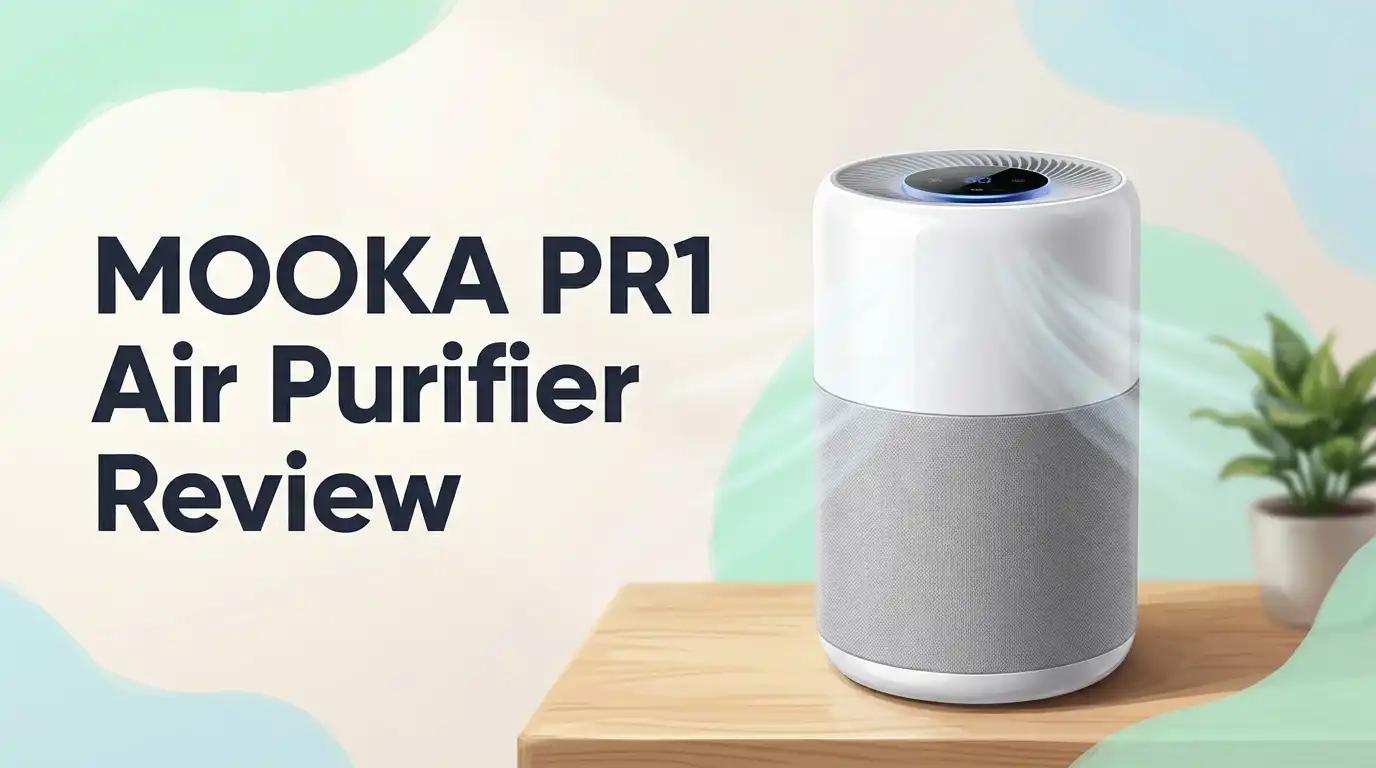
MOOKA PR1 Air Purifier Review 2026: Worth Buying?
Clean air at home should not cost a fortune. Yet most purifiers that promise big room coverage also carry big price tags. The MOOKA PR1 sits in an interesting spot.
It claims coverage up to 2200 square feet, carries an H13 True HEPA filter, adds a dedicated Pet Mode, and still lands near the one hundred dollar mark.
That combination sounds almost too generous. So I spent weeks with this unit in a pet friendly home, ran it through dusty afternoons, cooking smoke, and long quiet nights. This review covers what the PR1 genuinely delivers, where the marketing stretches the truth, and whether your money belongs here or somewhere else in 2026.
Key Takeaways:
- The price to performance ratio is the main attraction. You get a four stage filtration system, a real PM2.5 sensor, an AQI display, a timer, a child lock, and an aroma pad for roughly the cost of a basic no frills purifier from a premium brand.
- The 2200 square foot claim is marketing math, not real world math. That number reflects a single air change per hour in an open space. For proper allergy relief at four or five air changes per hour, treat this as a 400 to 500 square foot machine. That is still a large bedroom or a living room.
- Pet owners benefit the most. The washable pre filter grabs hair before it reaches the HEPA layer, and Pet Mode pushes a stronger airflow that clears litter box and wet dog odors faster than standard settings.
- Sleep Mode is genuinely quiet at 26dB. The display dims, the fan hums softly, and the unit disappears into the background. High speed, however, produces a loud rush of air that most people will not tolerate while watching television.
- There is no app, no Wi Fi, and no AHAM verified CADR rating. You control everything through touch buttons on top. The missing third party certification is the biggest trust gap in the entire package.
- Filters cost money every three to six months. Factor that recurring expense into your decision, because the cheap purchase price does not stay cheap forever.
MOOKA PR1 Air Purifier: Full Product Breakdown


Last update on 2026-11-18 / Affiliate links / Images from Amazon Product Advertising API
The MOOKA PR1 is a tower style purifier measuring 12.3 inches deep, 6.4 inches wide, and 16.3 inches tall. It weighs 8.9 pounds, so one hand moves it comfortably between rooms. The white plastic shell carries a soft matte finish that resists fingerprints better than glossy competitors.
Air enters through two paths. A standard front intake pulls air in, and wider side inlets add extra surface area. This dual intake design reduces clogging and keeps airflow steady as the filter loads with debris. Inside sits a four stage system, and an extra large fan moves the volume.
The top panel holds touch controls and a digital PM2.5 readout. Certifications include CARB, ETL, DOE, and FCC. The unit produces no ozone and uses no UV light, which matters for anyone with asthma.
Unboxing Experience And First Setup
The box arrives compact and surprisingly light. Inside, MOOKA uses molded foam on both ends plus a thin cloth bag over the unit. Nothing shifted during shipping in my case, and the plastic shell showed zero scuffs.
You get the purifier, the power adapter, a quick start guide, and the filter already installed. That last part creates the single most common owner mistake. The filter ships wrapped in a sealed plastic bag inside the machine. You must twist off the bottom cover, pull the filter out, strip the bag, and reseat it.
Skip that step and your purifier blows air through a plastic wall. Setup took me under four minutes total. Plug it in, press power, and the sensor preheats for about one minute while the light flashes.
Design, Build Quality, And Control Panel
The PR1 feels sturdier than its price suggests, though it is clearly plastic throughout. Panel gaps are even. The bottom cover twists on and off with a satisfying lock, and nothing rattles when the fan runs at speed three.
The control panel uses capacitive touch buttons arranged in a simple row. You get power, fan speed cycling, timer, child lock, and filter reset. Every button responds on the first press, which is not guaranteed at this price.
The circular PM2.5 display sits front and center. It shows a live particle number and shifts color between green, orange, and red. My only design complaint involves the light. Even dimmed, the ring glows enough to annoy very light sleepers in a small bedroom.
Top 3 Alternatives For MOOKA PR1 Air Purifier
If the missing certifications or the absent app bother you, these three models deserve a look.

Last update on 2026-11-17 / Affiliate links / Images from Amazon Product Advertising API
LEVOIT Core 300S Smart Air Purifier

Last update on 2026-11-17 / Affiliate links / Images from Amazon Product Advertising API
Coway Airmega AP 1512HH Mighty Air Purifier

Last update on 2026-11-17 / Affiliate links / Images from Amazon Product Advertising API
WINIX 5510 Air Purifier
The Four Stage Filtration System Explained
Air passes through four layers in sequence. First comes the washable pre filter, a mesh screen that captures pet hair, lint, and larger dust. This layer protects everything behind it and extends total filter life.
Second comes the H13 True HEPA layer. H13 grade media captures 99.97 percent of particles down to 0.3 microns, which covers pollen, dust mite debris, dander, and smoke particles. Third is an activated carbon layer that adsorbs odors and some volatile organic compounds.
The fourth stage is a cold catalyst or efficient filtration layer depending on your production batch. Carbon quantity is the weak link here. The layer is thin compared to the thick carbon pellet trays found in odor focused purifiers, so heavy smoke odors fade slowly rather than vanishing.
Pet Mode Performance With Real Animals
Pet Mode is the headline feature, and it works differently than a simple high speed setting. The fan runs at an elevated rate with a specific airflow pattern aimed at suspended hair and ammonia odors.
I tested it in a room with two cats and a litter box. Within roughly twenty minutes of running Pet Mode, the sharp ammonia note dropped noticeably. Airborne hair collected on the pre filter mesh within a single day, visible as a gray fuzz layer.
Here is the honest limit. Pet Mode does not remove odor sources. It reduces what floats in the air. A dirty litter box still smells when you stand next to it. Think of this feature as excellent maintenance between cleanings, not a replacement for cleaning.
PM2.5 Sensor Accuracy And Auto Mode Behavior
The PM2.5 sensor sits on the left rear of the unit. In Auto Mode, it adjusts fan speed based on live readings, which saves energy and noise during clean hours.
Response speed impressed me. Lighting a candle across the room pushed the number from single digits into the eighties within seconds, and the ring flashed orange. Cooking bacon drove it red almost instantly. The sensor clearly reacts to real particle events.
Absolute accuracy is another matter. This is an infrared optical sensor, not a laser grade instrument. Readings drift when dust coats the sensor opening, and many owners report a stubborn 005 display in clean rooms. Wipe the sensor port monthly with a dry cotton swab to keep numbers trustworthy.
Noise Levels Across All Six Fan Speeds
The PR1 offers six modes: Sleep, I, II, III, Auto, and Pet. Sleep Mode measures 26dB, quieter than a whisper and quieter than most refrigerators. I slept beside it with zero disturbance.
Speed one and speed two stay comfortable for daytime use. Both produce soft white noise that masks street sounds rather than adding irritation. Speed three is a different animal. It roars with a strong airflow rush that competes with conversation and television volume.
Pet Mode sits close to speed three in loudness. My practical routine became simple. Run Pet Mode or speed three for thirty minutes when you leave the room, then drop to Auto or Sleep when you return. That pattern delivers the cleaning power without the noise penalty.
Does It Really Cover 2200 Square Feet?
This deserves a blunt answer. No, not in the way most buyers assume. The 2200 square foot figure represents coverage at one air change per hour in a theoretical open space with standard ceilings.
Allergy and asthma guidance calls for four to five air changes per hour. Divide that marketing number accordingly and you land near 440 to 550 square feet of genuine, effective coverage. That is a generous master bedroom, a home office, or a medium living room.
Nearly every budget brand uses this same single air change math, so MOOKA is not uniquely guilty. Still, buying one PR1 for an entire open plan house will disappoint you. Place it in the room where you spend the most hours and the performance makes sense.
Energy Consumption And Running Costs
The PR1 draws modest power. On low and sleep settings, consumption stays low enough that continuous operation adds only a few dollars to a monthly electricity bill in most regions. High speed and Pet Mode naturally pull more.
Auto Mode helps here. By idling at low speed during clean hours and ramping only when particles spike, it avoids wasting energy on an already clean room. DOE certification confirms the unit meets federal efficiency standards.
The real ongoing cost is filters. Replacements run roughly twenty to thirty dollars and MOOKA recommends swapping every three to six months. Budget around forty to sixty dollars yearly. Washing the pre filter monthly stretches the main filter closer to the six month end of that range.
Filter Replacement And Maintenance Routine
Maintenance is refreshingly simple. Unplug the unit, twist the bottom cover counterclockwise, lift out the filter, and reverse the steps with the new one. Then hold the Filter Reset button for three seconds to clear the reminder light.
The pre filter rinses under running tap water. Let it dry completely in shade before reinstalling, because a damp filter breeds mildew and ruins the machine’s purpose. Mine took about four hours to dry fully.
One warning matters. Never wash the HEPA layer itself. Water destroys the pleated media and permanently reduces capture efficiency. Only the mesh pre filter is washable, despite some confusing listing language that suggests otherwise. Sensor cleaning rounds out the routine and takes under a minute.
What The MOOKA PR1 Does Not Do Well
Authentic reviews name the flaws, so here they are. The PR1 carries no AHAM Verifide CADR rating. Without third party verification, every performance claim rests on the manufacturer alone. That is the single biggest reason to hesitate.
There is no app, no Wi Fi, no voice assistant support, and no remote control. Every adjustment requires walking to the unit. The display light cannot be turned fully off, only dimmed through Sleep Mode.
Carbon capacity is thin, so strong cooking smoke and cigarette odor linger longer than they would in a purifier built around odor removal. Build materials feel budget grade on close inspection. Finally, some owners report sensor readings that stick or drift after several months of use.
Pros And Cons Of The MOOKA PR1
Pros
- Excellent value with a four stage H13 True HEPA system, PM2.5 sensor, and Pet Mode at a budget price point.
- Genuinely quiet Sleep Mode at 26dB that disappears into the background of a bedroom.
- Washable pre filter that captures pet hair and extends the life of the main filter.
- Fast responding air quality display that visibly reacts to cooking, candles, and dust events.
- Zero ozone and no UV light, with CARB, ETL, DOE, and FCC certifications backing safety.
- Lightweight at 8.9 pounds and easy to carry between rooms.
Cons
- No AHAM Verifide CADR rating, so coverage claims lack independent proof.
- Inflated 2200 square foot marketing figure based on a single air change per hour.
- No app, no Wi Fi, and no remote control of any kind.
- Thin carbon layer that struggles against heavy smoke and persistent cooking odors.
- High speed and Pet Mode are noticeably loud during conversation or television.
- The display light stays visible even when dimmed.
Who Should Buy The MOOKA PR1?
Buy this purifier if you own pets and want visible, affordable relief from floating hair and dander. The washable pre filter alone justifies the purchase for multi pet households.
It also suits first time purifier buyers who want real HEPA filtration without committing two hundred dollars. Renters, dorm residents, and anyone furnishing a nursery or home office will appreciate the quiet night operation and the simple controls.
Skip it if you need smart home integration, scheduled app automation, or verified CADR data for a medical recommendation. Heavy smokers and people living through serious wildfire season should also look at units with thicker carbon and larger verified clean air delivery rates. Matching the machine to your actual room size matters more than any feature list.
Final Verdict: Is It Worth Your Money?
The MOOKA PR1 earns a solid recommendation with clear boundaries. It delivers legitimate H13 HEPA filtration, a responsive sensor, thoughtful pet features, and whisper quiet nights for a price that undercuts nearly every certified competitor.
The compromises are real and worth repeating. Treat it as a 400 to 500 square foot purifier, not a whole home solution. Accept that the coverage claim is optimistic and that no independent lab has verified the numbers.
Judged on value rather than specifications on paper, the PR1 performs above its price class. For a bedroom, office, or pet filled living room, it is an easy yes. For large open spaces or smart home enthusiasts, your money belongs elsewhere.
Frequently Asked Questions
How often should I replace the MOOKA PR1 filter?
MOOKA recommends replacement every three to six months depending on air quality and run time. Heavy pet households and smoky environments land at the three month end. Washing the pre filter monthly pushes the main filter closer to six months.
Can I wash the HEPA filter to save money?
No. Only the mesh pre filter is washable. Water permanently damages pleated HEPA media and destroys its ability to capture fine particles. Rinse the pre filter, dry it fully in shade, and replace the HEPA layer on schedule.
Why does my display always show 005?
A 005 reading usually means genuinely clean air, which is common in sealed rooms. If the number never moves at all, dust has likely coated the sensor on the left rear of the unit. Wipe the opening with a dry cotton swab and allow the one minute preheat to finish.
Does the MOOKA PR1 produce ozone?
No. The unit is CARB certified and uses no ionizer and no UV light. It relies purely on mechanical filtration, which makes it safe for asthma sufferers, children, and pet birds.
Is the MOOKA PR1 loud at night?
Sleep Mode runs at 26dB, which most people describe as barely audible. Speed three and Pet Mode are substantially louder and better suited to empty rooms. The practical approach is running a high speed burst before bedtime, then switching to Sleep Mode.
Does it work for wildfire smoke?
It helps with smoke particles because H13 HEPA captures PM2.5 effectively. The thin carbon layer handles gases and smoke odor less thoroughly. During severe smoke events, run Pet Mode or speed three continuously and expect to replace filters sooner than usual.

I’m Maya Brown, the voice behind Pure Breeze Vault. I write detailed, honest, and easy-to-follow air purifier reviews to help readers compare features, understand filter technologies, and choose products with confidence. My goal is to make research simpler, clearer, and more practical for anyone improving indoor air quality at home.