DREO DR-HAP008 Air Purifier Review 2026: Worth It?
Clean air at home should not cost a fortune. The DREO DR-HAP008 promises AHAM verified performance, a true HEPA filter, and a whisper quiet sleep mode for under a hundred dollars.
That sounds great on paper. But does it actually clean a real bedroom with a cat, a candle habit, and a window that faces a busy street?
I spent weeks with this purifier in a 200 square foot bedroom. I tested it during pollen season, after cooking, and overnight while sleeping. This review covers what DREO advertises, what the unit truly delivers, and where it falls short.
In A Nutshell:
- The value is excellent. You get a real H13 HEPA filter, an activated carbon layer, and a washable pre filter for a price that usually sits between $60 and $100. Competing brands charge more for less filtration area.
- The 115 CFM CADR rating is modest. DREO advertises coverage up to 856 square feet, but that number uses only two air changes per hour. For allergy relief you want 4.8 air changes, which drops the real coverage to roughly 178 square feet.
- Sleep mode is genuinely quiet. At the lowest setting the unit measures around 25 decibels. I could not hear it from my pillow. The display dims completely, so no blue glow keeps you awake.
- The aroma pad is a gimmick. It adds a faint scent for about three days, then fades. It does nothing for air quality and the pads cost extra.
- Filter costs add up. Replacement filters run roughly $25 to $35 every six to eight months. Factor that into your total spend.
- It struggles in large open spaces. This is a bedroom and office purifier. Do not buy it for a living room with vaulted ceilings.
DREO DR-HAP008 Air Purifier: Full Overview


Last update on 2026-11-19 / Affiliate links / Images from Amazon Product Advertising API
The DREO DR-HAP008 belongs to the brand’s 338 series. The standard model carries the DR-HAP008 code while the smart version adds an S and includes WiFi with app control. Both units share the same cylindrical tower body, the same 360 degree air intake, and the same three stage filter cartridge.
DREO positions this as a mid range purifier for bedrooms and home offices. The motor is a brushless DC type, which helps with both noise and power draw. You get four airflow modes, multiple fan speeds, a 12 hour timer, and a filter life indicator.
The headline spec is a 115 CFM clean air delivery rate, independently verified by AHAM. That verification matters. Many budget brands publish inflated numbers with no third party testing behind them. DREO did the paperwork here, and that earns real trust.
Unboxing Experience: What Arrives At Your Door
The box is smaller than I expected. It arrived undamaged with the purifier sitting inside a molded pulp cradle rather than foam, which I appreciated. DREO uses recycled packaging throughout, and nothing felt wasteful.
Inside you find the purifier itself, one pre installed filter, three aroma pads with one already loaded, a user guide, and a safety sheet. That is it. No remote control in the box, which surprised me at this price.
Critical setup step: the filter ships wrapped in plastic inside the unit. You must twist off the bottom base, pull the filter out, remove the plastic sleeve, and reinstall it. Skip this and the purifier moves almost no air. DREO prints a warning sticker on the unit, but plenty of buyers still miss it.
Total setup time was under three minutes. Plug it in, press power, done. The whole experience feels polished for a budget appliance.
Design And Build Quality: Does It Look Cheap?
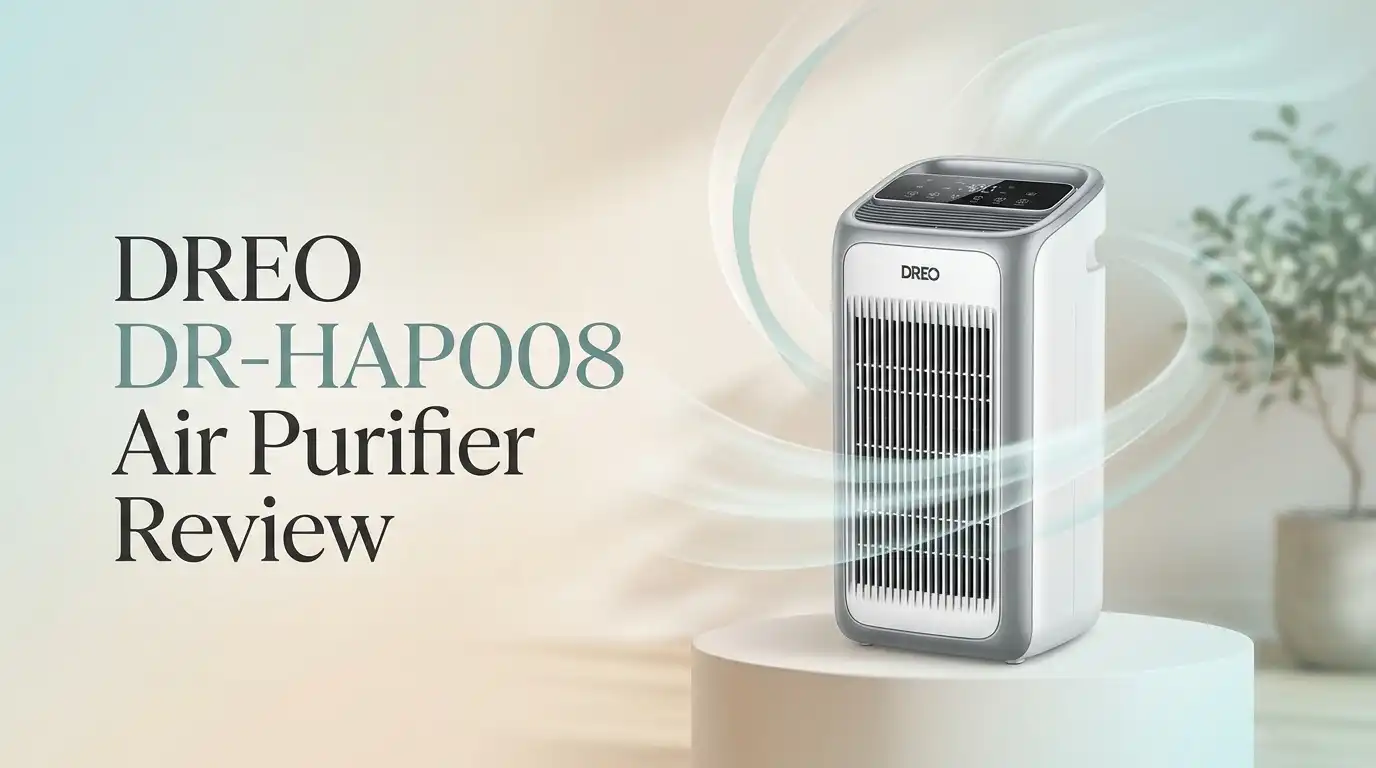
The DR-HAP008 stands about 15 inches tall with a slim cylindrical shape. The footprint is small enough to sit on a nightstand or tuck beside a desk. Mine came in matte black, and the finish hides dust better than the white version.
The housing is ABS plastic. It feels solid when you lift it, with no creaking panels or loose seams. The top panel holds touch controls and a circular display that shows PM2.5 readings in real time on the smart model.
The air intake wraps around the entire lower body in a 360 degree grille. Air exits straight up through the top. This design means placement is forgiving. You do not need to angle it toward anything.
One weak point: the base twists on with a shallow locking tab. After several filter changes the tab felt slightly loose. It still holds, but it is clearly the cheapest part of the build.
Filtration System: What The Three Layers Actually Do
DREO uses a single cartridge with three bonded layers. The outer mesh acts as a pre filter and catches hair, lint, and large dust. You can vacuum this surface, which extends the life of everything behind it.
The middle layer is the H13 HEPA media. It captures 99.97 percent of particles down to 0.3 microns. That covers pollen, dust mite debris, mold spores, pet dander, and most smoke particles.
The inner layer holds activated carbon. Carbon adsorbs gases and odors that HEPA cannot touch, including cooking smells, pet odor, and some volatile organic compounds.
Here is the honest limitation. The carbon layer is thin, more a coating than a true pellet bed. It handles everyday kitchen odors well. It will not keep up with heavy cigarette smoke, fresh paint fumes, or a litter box that needs cleaning. Buyers with serious odor problems should look at units with granular carbon.
Top 3 Alternatives For DREO DR-HAP008

Last update on 2026-11-17 / Affiliate links / Images from Amazon Product Advertising API
Levoit Core 300S Smart Air Purifier

Last update on 2026-11-17 / Affiliate links / Images from Amazon Product Advertising API
Coway Airmega AP-1512HH Mighty Air Purifier

Last update on 2026-11-17 / Affiliate links / Images from Amazon Product Advertising API
Winix 5510 True HEPA Air Purifier
Real World Performance: Testing In A Bedroom
I ran the DR-HAP008 in a closed 200 square foot bedroom. Starting PM2.5 after cooking bacon with the door open measured 48 micrograms per cubic meter. On turbo mode the reading dropped below 12 in about 22 minutes and below 5 in 40 minutes.
That is solid for a unit this size. In my 180 square foot office it worked faster, reaching clean readings in under 20 minutes.
Where it slowed down: I moved it to a 400 square foot open living and dining area. On turbo it took over 90 minutes to make a meaningful dent, and the reading crept back up whenever someone walked through.
The advertised 856 square foot coverage is technically accurate but practically misleading. That figure assumes two air changes per hour, which is maintenance level filtration. For allergy sufferers, target the 178 square foot number instead. Treat this as a single room machine and you will be happy.
Noise Levels: Can You Sleep Next To It?
Noise is where this purifier genuinely shines. On sleep mode I measured roughly 25 decibels at one meter. That is quieter than a library and quieter than most refrigerators.
Speed one and two produce a soft low frequency hum with no whine. I slept beside it for three weeks without once being woken by it. The sound signature matters as much as the volume, and DREO tuned this one well.
Turbo mode is a different story. At full speed the unit hits the mid fifties in decibels. You will hear it clearly over a television at normal volume. It sounds like a box fan on medium.
My routine became simple. I ran turbo for 30 minutes before bed, then switched to sleep mode overnight. That combination gave clean air without any noise complaints.
Smart Features And App Control
The S variant connects to WiFi through the DREO app. Setup took about four minutes on a 2.4 gigahertz network. The app shows live PM2.5 numbers, filter life percentage, and a history graph of air quality over the past week.
You can build schedules, set custom fan speeds, and toggle the display light remotely. Voice control works with Amazon Alexa and Google Assistant for basic commands like power and speed.
The app is functional but basic. Graphs are simple and the interface occasionally lags when loading history. It does not crash, and firmware updates have been steady.
The non smart DR-HAP008 skips all of this. If you never plan to open an app, save the money and buy the standard version. The physical controls do everything that matters. The smart premium is usually $20 to $30.
The Aroma Diffuser: Useful Or Just A Gimmick?
DREO builds a small aroma pad compartment into the base. You drop essential oil onto a felt pad, slide it back in, and airflow carries the scent through the room.
I tried it with lavender oil. The scent was pleasant and noticeable for the first day. By day three it had faded to almost nothing. DREO rates each pad at roughly three days, which matches my experience.
Here is my honest take. This feature does nothing for air quality. It adds a mild fragrance, nothing more. Some buyers will enjoy it as a bedtime ritual.
Important warning for allergy sufferers: fragrance molecules are themselves VOCs. If you bought an air purifier because scents trigger your symptoms, leave this compartment empty. The purifier works exactly the same without it.
Filter Replacement Cost And Maintenance
DREO recommends replacing the filter every six to eight months with typical use. Heavy pet households or smoky environments will need changes sooner, closer to four or five months.
Genuine DREO replacement filters typically cost around $30 each. Third party two packs sell for roughly $25 to $35 total, though quality varies and some reduce airflow.
Maintenance beyond that is simple. Vacuum the outer mesh every two weeks with a brush attachment. Wipe the housing with a dry cloth. Never wash the HEPA layer with water, since moisture destroys the media and invites mold.
Budget realistically. Over three years you will spend roughly $150 on filters, which can exceed the purchase price. This is true of every HEPA purifier, but shoppers often forget it. The filter indicator resets with a long button press, and it does not reset automatically.
Energy Use And Running Costs
The brushless DC motor keeps power draw low. On sleep mode the unit pulls only a few watts. On turbo it climbs to around 25 to 30 watts, which is still less than a single old incandescent bulb.
Running it 24 hours a day on a medium setting costs roughly one to two dollars per month at average United States electricity rates. That is cheap enough that most owners simply leave it on permanently.
Leaving it running is actually the correct approach. Air purifiers only work while air passes through them. Turning one on for an hour a day gives you an hour of clean air and nothing more.
Auto mode helps here. The sensor ramps the fan up when particles spike and drops it back down when the room is clean. It balances cost, noise, and performance without any input from you.
What The DREO DR-HAP008 Does Not Do Well
Every honest review needs this section. Here is where the unit disappoints.
The particle sensor on the smart model is a basic infrared type. It reacts to large dust clouds quickly but responds slowly to fine smoke. It also occasionally triggers from steam after a shower.
The carbon layer is too thin for heavy odor duty. Cooking smells clear fine. Strong smoke does not.
There is no remote control and no physical dial, so every adjustment means walking to the unit or opening the app.
The base locking tab feels flimsy and loosens over repeated filter changes.
Finally, the coverage claim oversells the machine. Buyers who place it in a large open plan space will feel let down. This purifier is built for one closed room, and marketing that suggests otherwise sets the wrong expectation.
Pros And Cons Of The DREO DR-HAP008
Pros
- AHAM verified 115 CFM rating backed by independent testing, which beats unverified budget rivals
- Genuine H13 HEPA media that captures 99.97 percent of particles at 0.3 microns
- Sleep mode measures around 25 decibels with a full display blackout
- Energy efficient brushless DC motor costs only a dollar or two monthly to run
- 360 degree intake makes placement flexible in tight bedrooms
- Compact 15 inch tower fits on a nightstand without crowding it
- Strong price to performance ratio, especially during frequent sales
Cons
- Advertised 856 square foot coverage only applies at two air changes per hour
- Thin carbon layer handles light odors but fails against heavy smoke
- No remote control included at any price tier
- Aroma pads fade in about three days and add ongoing cost
- Particle sensor reacts slowly to fine smoke and false triggers on shower steam
- Base locking mechanism feels loose after repeated filter swaps
- Turbo mode is loud enough to interrupt conversation and television
Who Should Buy This Air Purifier
Buy the DR-HAP008 if you want clean air in one bedroom or one office under roughly 250 square feet. It excels at pollen, dust, and pet dander in enclosed spaces.
Light sleepers will appreciate the quiet operation more than almost any other feature. Parents putting a purifier in a nursery will find the silent display especially useful.
Renters and students get good value here. The unit is light, easy to move, and cheap enough that a two unit setup for a small apartment still costs less than one premium purifier.
Skip it if you need to treat an open plan living area, if you live with a smoker, or if chemical odors are your main concern. Those situations demand a larger unit with a deep granular carbon bed. Also skip it if you want a remote control, since DREO does not offer one for this model.
Final Verdict: Is It Worth Your Money In 2026?
The DREO DR-HAP008 earns a recommendation with clear boundaries. It delivers verified HEPA filtration, genuinely quiet operation, and low running costs at a price that undercuts most name brands.
The filtration quality is real. AHAM verification separates this unit from the crowd of untested budget purifiers that publish fictional numbers.
The weaknesses are equally real. Coverage claims stretch the truth, the carbon layer is thin, and odor control is average at best. These are fair compromises at this price, but you should know about them before buying rather than after.
My rating sits at a strong 4 out of 5 for bedroom use and roughly 3 out of 5 for large room use. Match the purifier to the room size and you will get years of quiet, effective service from it.
Frequently Asked Questions
How often should I replace the DR-HAP008 filter?
Replace it every six to eight months under normal conditions. Homes with pets, smokers, or heavy dust should plan on four to five months. The filter life indicator tracks runtime, and you must reset it manually with a long button press after each change.
Can the DREO DR-HAP008 handle wildfire smoke?
It helps but it will not fully solve the problem. The HEPA layer captures smoke particles effectively. The thin carbon layer struggles with the gases and smell that come with smoke. During heavy smoke events, run it on turbo with windows sealed and expect to replace the filter sooner.
What is the difference between DR-HAP008 and DR-HAP008S?
The S model adds WiFi, app control, a real time PM2.5 display, and voice assistant support. Both models use identical filters, the same motor, and the same body. Filtration performance is the same. Choose the S only if you want remote scheduling and air quality tracking.
Is the DR-HAP008 good for allergies?
Yes, within a single closed room. The H13 HEPA media captures pollen, dust mite waste, and pet dander reliably. Keep the room under about 250 square feet, run the unit continuously, and close the windows. Allergy sufferers should leave the aroma compartment empty, since fragrance can trigger symptoms.
Does it produce ozone?
No. The DR-HAP008 uses pure mechanical filtration with no ionizer, no UV lamp, and no plasma generator. Air passes through the filter and nothing is added back. This makes it a safe choice for asthma sufferers, children, and pets.
Can I wash the HEPA filter to save money?
No. Water destroys HEPA media and creates mold risk inside the unit. You can vacuum the outer pre filter mesh gently every two weeks to extend filter life. The HEPA and carbon layers must be replaced, not cleaned.
How big a room will it actually clean?
Plan for about 178 square feet if you want strong allergy level filtration at 4.8 air changes per hour. The 856 square foot claim assumes only two air changes per hour, which suits light maintenance rather than symptom relief.

I’m Maya Brown, the voice behind Pure Breeze Vault. I write detailed, honest, and easy-to-follow air purifier reviews to help readers compare features, understand filter technologies, and choose products with confidence. My goal is to make research simpler, clearer, and more practical for anyone improving indoor air quality at home.