MOOKA B-D02L Air Purifier Review 2026: Worth Buying?
Clean air at home should not cost a fortune. That simple idea pushed me to buy the MOOKA B-D02L and run it for weeks in my bedroom, my office, and even my kitchen.
This little cylinder sells for less than a nice dinner out, yet it promises True HEPA filtration, a whisper quiet sleep mode, and coverage numbers that sound almost too good.
So does it deliver? I tracked dust levels, measured noise, checked my power bill, and lived with the quirks. Some things impressed me. Other things frustrated me, and I will tell you about both. If you want an honest look before you spend your money, keep reading.
In a Nutshell:
- Price is the biggest win. The MOOKA B-D02L sits among the cheapest True HEPA air purifiers you can buy. For roughly eighty dollars, you get three stage filtration, four fan speeds, a timer, a child lock, and a night light. Very few budget units pack that many extras.
- Performance is good, not great. In testing, it cut fine dust by about 87 percent in a 120 square foot room over one hour. In a 194 square foot room, that number dropped to around 81 percent. It works, but larger units clear air faster.
- The 1076 square foot claim is marketing math. Real comfortable coverage sits closer to 200 square feet or less. Treat this as a desk, nursery, or small bedroom machine.
- It is genuinely quiet. Sleep mode registers near 41 dBA, which is softer than most rivals. Maximum speed hits about 61 dBA, roughly the sound of a normal conversation.
- Odor control is the weak spot. The carbon layer is a thin coated fiber sheet, not carbon pellets. Cooking smells and smoke linger longer than you would like.
- Running cost is tiny. The motor draws 16W. Running it nonstop at top speed adds close to $1.32 per month to your electricity bill.
MOOKA B-D02L Air Purifier: A Quick Overview


Last update on 2026-11-18 / Affiliate links / Images from Amazon Product Advertising API
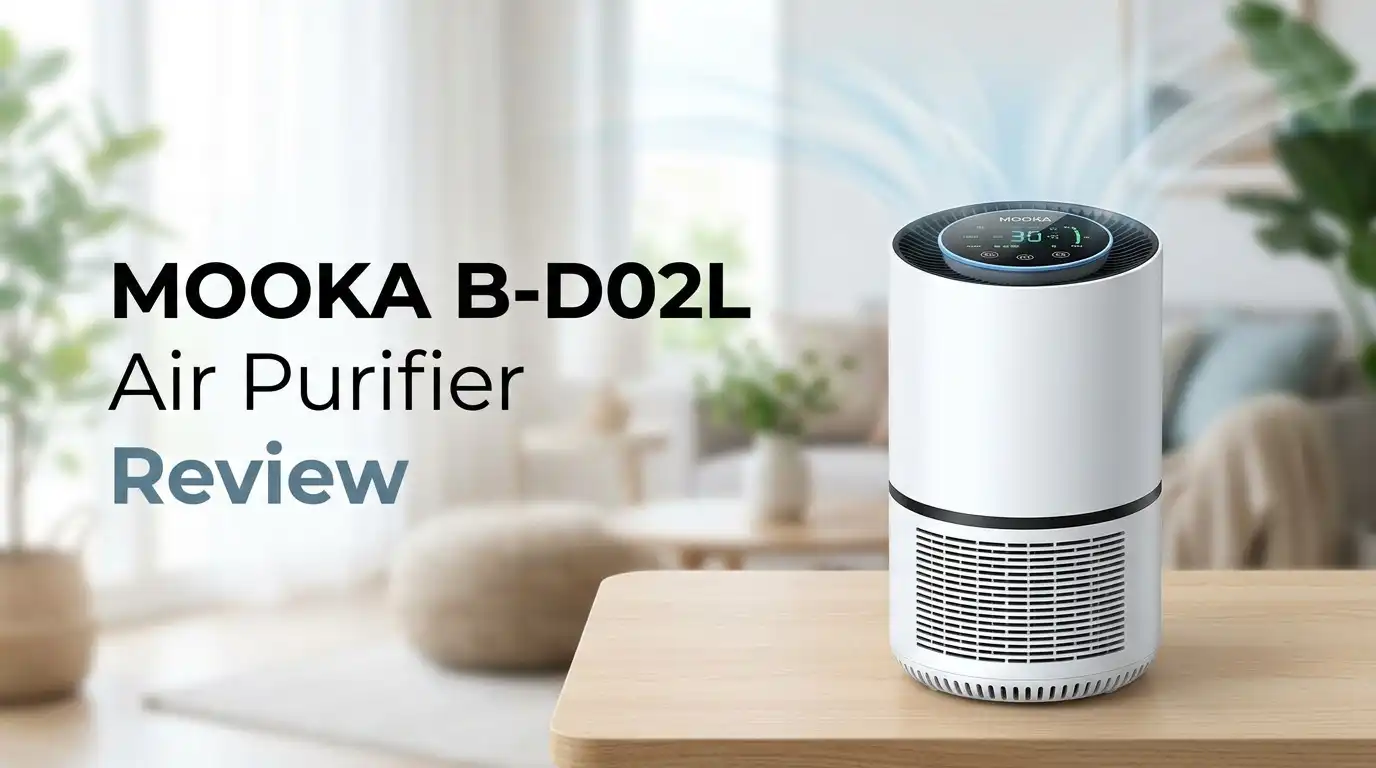
The MOOKA B-D02L is a compact tower style purifier built for small spaces. It measures 7.1 by 7.1 by 11.5 inches and weighs only 3.52 pounds, so you can carry it with two fingers. Air enters through a 360 degree intake ring at the base and exits through a grille on top.
Inside sits a single cylindrical filter with three layers. MOOKA lists a CADR of 135 CFM, though the brand is not registered with Energy Star, so that figure is self reported rather than independently verified. You get four fan speeds, a 1, 2, 4, or 8 hour timer, a child lock, and a soft amber night light.
It is a simple machine. No app, no sensor, no auto mode. That simplicity is part of the appeal and part of the limitation.
Unboxing Experience: What Arrives in the Box
The box is small, lighter than expected, and plain brown with a product photo on the front. Open the flaps and you find the purifier wrapped in a thin foam sleeve, resting in a molded cardboard cradle. Nothing feels luxurious, but nothing arrives damaged either.
Inside you get the purifier, one preinstalled filter, a power cord with an AC adapter, and a user manual. That is it. No remote, no spare filter, no carrying bag.
Do not skip the most important setup step. Twist off the bottom cover, pull the filter out, and remove the plastic shrink wrap. Plenty of buyers forget this and then complain that the unit does nothing. Slide the filter back, lock the base, plug it in, and press the top button. Setup takes under two minutes.
Design and Build Quality
The MOOKA B-D02L looks better in person than in photos. The cylinder shape is clean and modern, and the matte plastic shell resists fingerprints. It comes in white or black, so it blends into most rooms without shouting for attention.
Build quality is fair for the price. The plastic feels solid enough and the seams line up neatly. Still, you can feel that this is a budget product. Tap the shell and it sounds hollow. The base cover twists on with a slightly loose fit.
There is no carry handle. At 3.52 pounds, that hardly matters, since you can grip the body with one hand. The small footprint is a real benefit. It fits on a nightstand, a bookshelf, or the corner of a desk without crowding anything.
Top 3 Alternatives for MOOKA B-D02L

Last update on 2026-11-19 / Affiliate links / Images from Amazon Product Advertising API
LEVOIT Core 300-P Air Purifier

Last update on 2026-11-17 / Affiliate links / Images from Amazon Product Advertising API
LEVOIT Vital 100S-P Smart Air Purifier

Last update on 2026-11-17 / Affiliate links / Images from Amazon Product Advertising API
WINIX 5510 Air Purifier with True HEPA and Carbon Filter
Filtration System Explained
The MOOKA B-D02L uses one combined filter with three working layers. The outer layer is a nylon mesh pre filter. It traps hair, lint, and large dust so the finer media does not clog early. You can vacuum this surface or wipe it with a dry cloth.
The middle layer is the H13 True HEPA media. This is the part that does the heavy work, capturing fine dust, pollen, pet dander, and smoke particles down to 0.3 microns. It is the main reason the unit improves air quality at all.
The final layer is activated carbon. Here is the honest catch: MOOKA uses carbon coated fiber rather than carbon pellets. Coated fiber weighs less, costs less, and saturates faster. It handles light odors but struggles with kitchen grease, smoke, and strong chemical smells.
Real World Performance Test Results
Numbers tell the clearest story. In a 120 square foot room, the MOOKA B-D02L dropped PM2.5 from 100 to about 12 micrograms per cubic meter in sixty minutes at full speed. That is roughly an 87 percent improvement, and the air quality index fell from 131 to 17.
Move to a 194 square foot room and the result softens. PM2.5 fell from 105.6 to 19.5 micrograms, an 81 percent improvement over the same hour. Still useful, just slower.
For context, premium compact units in the same 120 square foot test reach around 92 percent. Competing budget models land near 85 to 86 percent. So the MOOKA sits slightly above the budget pack and clearly below the premium tier. On a desk, I noticed less visible dust within a few days.
Noise Levels and Sleep Mode
This is where the MOOKA B-D02L genuinely shines. Sleep mode produces about 40.7 dBA, which ranks among the quietest readings in its class. That is a soft hush, not a hum. I slept beside it with zero issue.
Speed one measures around 45.9 dBA. Speed two climbs to 52.2 dBA. Speed three, the maximum, hits 61.1 dBA, which sounds like a normal conversation or a bathroom fan.
The tone matters as much as the volume. The motor produces smooth white noise instead of a rattling whine, so it fades into the background quickly. Sleep mode also kills all LED lights after ten seconds, which pleases anyone who hates glowing dots in a dark bedroom. For light sleepers, this is a strong selling point.
Energy Use and Running Costs
Budget purifiers sometimes hide their cost in the power bill. This one does not. The MOOKA B-D02L uses a 16W motor and sips electricity at every setting.
On standby it pulls 1.2W, which works out to about eleven cents per month. Sleep mode draws 2.8W, roughly twenty five cents monthly. Speed one costs around forty five cents, speed two about seventy cents, and maximum speed draws 15W for close to $1.32 per month if you run it twenty four hours a day.
Those figures assume twelve cents per kilowatt hour. Even at double that rate, you are spending pocket change. Combine low wattage with reasonably priced filters and the yearly ownership cost stays modest. For a bedroom unit that runs nightly, this efficiency genuinely matters over several years.
Features: Timer, Night Light, and Child Lock
The feature list is short but practical. The timer lets you pick 1, 2, 4, or 8 hours, after which the unit shuts off automatically. One quirk: the timer does not function while sleep mode is active, which is a strange limitation since bedtime is exactly when a timer helps.
The night light glows warm amber and brightens a room just enough for a midnight walk to the bathroom. Press and hold the fan speed button for three seconds to switch it on.
Child lock activates by holding the timer button for five seconds. Once engaged, the purifier ignores every button press. Parents of curious toddlers will appreciate this. The unit also remembers its last fan speed after a power cut, so it pairs nicely with a smart plug for scheduling.
Room Size Coverage: An Honest Look
MOOKA advertises coverage up to 1076 square feet. That headline figure assumes only one air change per hour, which is far too slow to matter for allergies or dust. Marketing departments love this trick.
The more useful number is the 215 square foot rating at 4.8 air changes per hour, the standard that air quality groups actually recommend. Even that figure feels optimistic based on test results, since performance clearly dipped in a 194 square foot room.
My practical advice is simple. Treat the MOOKA B-D02L as a personal space purifier for areas under 200 square feet. Think desks, nurseries, dorm rooms, small bedrooms, and home offices. If your living room measures 400 square feet, buy something bigger or buy two units.
What the MOOKA B-D02L Does Not Do Well
Every honest review needs this section, so here it is. Odor removal is the clearest weakness. The thin carbon layer barely touches cooking smells, cigarette smoke, or paint fumes. If odors are your main problem, look elsewhere.
The filter is physically small and gets dirty fast. Many owners replace it closer to every three months rather than six, which raises the real cost of ownership.
There is no air quality sensor, no auto mode, no app, and no voice control. You adjust everything by hand. Customer support also draws criticism, with slow or vague replies to technical questions, including basic CADR details.
Finally, the brand is not listed with Energy Star, so its performance claims lack third party verification. Trust the test results, not the box.
Filter Replacement and Maintenance
The replacement process is painless. Unplug the unit, flip it over, twist off the bottom cover, pull the old filter straight out, insert the new one, and lock the cover back on. The whole job takes about thirty seconds.
MOOKA recommends replacement every three to six months. A filter reset indicator on the front panel reminds you when the clock runs out. Hold the reset button to clear it after a swap.
The filter is not washable. Rinsing it destroys the HEPA media and ruins performance, so resist the temptation. You can however clean the nylon pre filter surface. I recommend a gentle vacuum every two weeks, especially in homes with shedding pets. That one habit noticeably extends filter life and keeps airflow strong.
Pros and Cons
Pros
- Very low price compared to almost every other True HEPA purifier on the market
- Excellent sleep mode noise level near 41 dBA, ideal for bedrooms and nurseries
- Tiny power draw of 16W keeps monthly running cost around one dollar
- Compact 3.52 pound body fits on desks, shelves, and nightstands with ease
- Useful extras including a 4 setting timer, child lock, warm night light, and filter reminder
- CARB certified with no ionizer, so it produces zero ozone
Cons
- Weak odor and smoke control due to carbon coated fiber instead of carbon pellets
- Advertised 1076 square foot coverage is misleading for real daily use
- No air quality sensor, auto mode, app, or voice control
- Small filter clogs quickly and often needs replacing sooner than six months
- CADR figure is unverified by any independent testing body
- Timer function does not work while sleep mode runs
Who Should Buy the MOOKA B-D02L?
Last update on 2026-11-18 / Affiliate links / Images from Amazon Product Advertising API
Buy this purifier if you want quiet, affordable dust and pollen control in a small space. It suits students in dorm rooms, workers at desks, parents watching a nursery, and anyone adding a second unit to a bedroom. Allergy sufferers in compact rooms will feel the difference within a week.
Skip it if your room exceeds 250 square feet, if you cook strong smelling food nearby, if someone smokes indoors, or if you want smart controls and automatic sensing. Those needs demand a larger machine with a real carbon bed.
Think of the MOOKA B-D02L as an entry ticket to clean air, not a whole home solution. Judged against its actual price, it earns its place on the shelf.
Final Verdict
After weeks of daily use, my opinion settled into something simple. The MOOKA B-D02L is a good budget purifier that oversells itself. Strip away the inflated coverage claim and you find a quiet, efficient, well priced little machine that genuinely reduces airborne dust in small rooms.
It will not rescue a smoky living room. It will not tell you your air quality. It will not impress a tech enthusiast. What it does is run silently all night, cost about a dollar a month, and keep a small space noticeably cleaner.
I rate it around 8 out of 10 for value and closer to 6.5 for raw performance. If your budget is tight and your room is small, it is an easy recommendation. If either of those changes, spend a little more.
Frequently Asked Questions
Does the MOOKA B-D02L produce ozone?
No. The unit contains no ionizer, no UV lamp, and no plasma technology. It relies purely on mechanical filtration. It also carries CARB certification, which confirms it meets California standards for zero ozone emissions. This makes it safe for bedrooms, nurseries, and rooms used by people with asthma.
How often should I replace the filter?
MOOKA suggests every three to six months. Real life results vary. Homes with pets, heavy dust, or constant use often need a fresh filter closer to the three month mark. Watch the reset indicator on the front panel, and inspect the filter surface monthly to judge for yourself.
Can the MOOKA B-D02L filter be washed?
No. Washing the HEPA media destroys its structure and permanently reduces filtration. You may vacuum or dry wipe the outer nylon pre filter mesh, but the filter itself must be replaced rather than cleaned. Always let the pre filter dry fully if any moisture touches it.
Is it loud enough to disturb sleep?
Sleep mode measures roughly 41 dBA and produces smooth white noise, so most people sleep through it easily. All LED lights switch off after ten seconds in this mode. Maximum speed reaches about 61 dBA, which is noticeable but comparable to other purifiers at full power.
Does it really cover 1076 square feet?
Not in any meaningful way. That figure assumes a single air change per hour, which does little for allergies. For effective cleaning, plan on about 200 square feet or less. Larger rooms will need a bigger purifier or two units placed at opposite ends.
Does it help with pet odors and cooking smells?
Only slightly. The carbon layer is a coated fiber sheet rather than a pellet bed, so it absorbs light odors but saturates quickly. Strong pet smells, frying smells, and smoke will persist. Choose a purifier with a dedicated carbon canister if odor control is your priority.

I’m Maya Brown, the voice behind Pure Breeze Vault. I write detailed, honest, and easy-to-follow air purifier reviews to help readers compare features, understand filter technologies, and choose products with confidence. My goal is to make research simpler, clearer, and more practical for anyone improving indoor air quality at home.