LG PuriCare 360 Review 2026: Worth Buying?
Clean air sounds simple until you start shopping for it. Prices jump from forty dollars to nine hundred, every brand claims hospital grade filtration, and the spec sheets rarely match real life.
The LG PuriCare 360 sits right in the middle of that mess, promising a sleek white tower that pulls air in from every side and pushes it back out clean.
I spent weeks living with this purifier in a bedroom, a living room, and a dusty home office. I tracked the noise, the app behavior, the filter costs, and the moments it quietly disappointed me. This review covers all of it, including the parts LG does not advertise.
In a Nutshell:
- Strong real world cleaning power. The PuriCare 360 removes about 99.9% of particles down to 0.3 microns using a NanoFiber True HEPA layer. Independent testing places its CADR near 277 cfm for dust and smoke, which beats several pricier models.
- Room coverage claims are optimistic. LG advertises up to 2,059 square feet, but that number assumes one air change per hour. For allergy level cleaning, treat 400 square feet as the honest limit.
- It runs very quietly. Sleep mode measures around 25 decibels, softer than a whisper. Turbo speed climbs to roughly 53 decibels, similar to light rain.
- Energy use stays low. The unit draws about 41 watts, so eight hours of daily use costs close to $18 per year.
- Filters cost real money. Expect around $89 annually for replacements. The pet and smoke pre filters are sold separately, which stings at this price.
- Smart features work well. WiFi through the LG ThinQ app, auto mode, child lock, and a filter indicator all perform reliably.
LG PuriCare 360 Air Purifier


Last update on 2026-11-18 / Affiliate links / Images from Amazon Product Advertising API
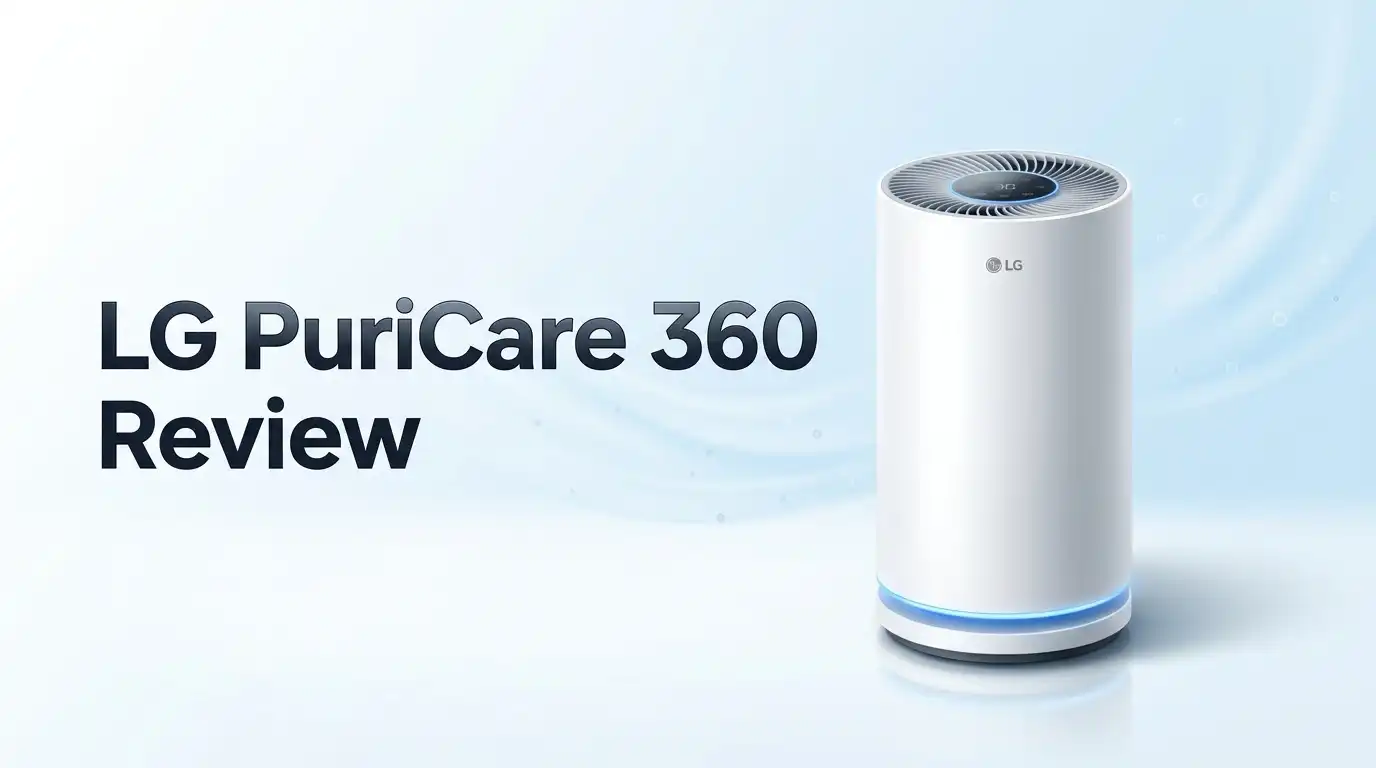
The PuriCare 360 is a cylindrical tower purifier built around one idea: air should enter from all sides, not just the front. Most purifiers use a flat face with a grille, which means furniture placement can choke airflow. LG wraps the intake around the full body instead.
The current model, AS601HBB0, stands 20 inches tall with a 12.4 inch diameter. It weighs 14.9 pounds, light enough to carry room to room without planning the trip. A touch panel sits on top, along with a color coded air quality ring that shifts from blue to orange as particles rise.
LG prices it near $299, though street prices often land closer to $269. That puts it against serious competition from Coway, Levoit, and Winix.
Unboxing Experience
The box arrives heavier than expected, and that first lift tells you something about build quality. Inside, LG packs the tower in molded foam with a cloth style sleeve over the body. No scuffs, no rattles, no loose screws floating around.
You get the purifier, the pre installed filter assembly, a quick start guide, and the power cable. That is it. No remote, no extra filters, no bonus accessories. Setup takes about four minutes. You twist off the bottom cover, pull the plastic wrap from the filter, snap the cover back, and plug it in.
The one fussy step is WiFi pairing. The ThinQ app needs a 2.4 GHz network, and my first attempt timed out. The second try worked. Honestly, the whole process feels polished for a first time buyer.
Design and Build Quality
LG clearly spent money here. The matte white shell resists fingerprints better than glossy rivals, and the perforated mesh wraps the body in a clean, seamless pattern. Nothing creaks when you lift it.
The top mounted touch panel reads easily from a standing position, which small boxy purifiers never manage. A soft nightlight glows under the control ring, and you can switch it off for sleeping.
Here is my honest complaint: the design is forgettable. It looks like a trash can from across the room, especially in white. LG dropped the tilting head that made the older flagship models distinctive. The result is handsome but anonymous. Function clearly won over personality in this generation. The casters some competitors include are also missing, so sliding it across carpet means bending down and lifting.
Top 3 Alternative for LG PuriCare 360

Last update on 2026-11-17 / Affiliate links / Images from Amazon Product Advertising API
Coway Airmega Mighty Air Purifier

Last update on 2026-11-11 / Affiliate links / Images from Amazon Product Advertising API
Levoit Core 400S Smart Air Purifier

Last update on 2026-11-17 / Affiliate links / Images from Amazon Product Advertising API
Winix 5510 Air Purifier
Filtration System Explained
The PuriCare 360 uses a three stage system wrapped in a cylinder. Each stage handles a different problem.
The mesh pre filter catches hair, lint, and large dust before anything reaches the expensive layer. You can rinse it under a tap, which saves money over time.
The NanoFiber True HEPA filter does the heavy work. It traps 99.97% of airborne particles at 0.3 microns, covering pollen, mold spores, dander, and fine dust. LG developed this filter in house and had it validated by multiple Korean labs.
The activated carbon deodorization filter absorbs odors, smoke, and volatile organic compounds like formaldehyde.
LG also sells specialized pre filters for pet ammonia and smoke related nitrogen dioxide. Neither one ships in the box. You pay extra, and that feels cheap on a $299 machine.
Real World Cleaning Performance
Spec sheets lie. Living rooms do not.
In a 300 square foot bedroom with the door closed, the PuriCare 360 took roughly 22 minutes to drop a smoke event back to baseline on turbo. Cooking smells from a nearby kitchen cleared in under half an hour on auto mode.
Lab style testing shows the unit removing about 99.9% of particles down to 0.3 microns in one hour across a 300 square foot space. That is strong, though a few rivals with higher CADR ratings edge past it.
Auto mode responds quickly. Burn toast, and the sensor ring flashes orange within ten seconds. The sensor reacts to aerosols too, so hairspray or cleaning sprays will spike the reading. That is accurate behavior, not a flaw, but it surprises new owners.
Room Coverage and CADR Numbers
LG markets coverage up to 2,059 square feet, and that number needs context. It describes one air change per hour, which barely counts as purification. Allergy sufferers need four or five air changes hourly.
Measured CADR sits near 277 for dust, 277 for smoke, and 282 for pollen. Run the math at proper air exchange rates and the realistic coverage lands around 400 to 430 square feet. That is a large bedroom, a studio apartment, or an open living area.
The unit delivers roughly five air changes per hour in that space, cleaning the room about every 12 minutes at full power.
My advice is simple. Ignore the marketing square footage and shop by CADR. If your room exceeds 450 square feet, buy two units or step up to a bigger model.
Noise Levels in Daily Use
This is where the PuriCare 360 genuinely shines. LG engineers understand acoustics.
On sleep mode, the unit measures about 25 decibels. I could not hear it from three feet away in a quiet bedroom. The fan produces soft white noise rather than the whining pitch cheaper purifiers make.
Speed two and speed three stay comfortable for conversation and television. At full turbo, output reaches roughly 53 decibels, comparable to light rainfall. It is noticeable but never harsh.
One small annoyance: the touch panel beeps on every press. You can disable it in the app, though the setting is buried. The LED air quality ring also stays bright on default, which bothered me at night until I found the dimming option.
Smart Features and the ThinQ App
The LG ThinQ app connects over WiFi and handles everything the touch panel does, plus a few extras. You can schedule operation, check filter life, view air quality history, and switch modes remotely.
Air quality history is the feature I used most. Seeing pollution spikes at 6 PM every evening told me my cooking habits mattered more than outdoor air.
Smart diagnostics suggest fan speeds based on readings, which helps beginners. Voice control works through compatible assistants on some regional models, though support varies and has been inconsistent across versions.
The app itself feels heavy. It bundles every LG appliance category into one interface, so reaching your purifier takes more taps than it should. Functional, yes. Elegant, no.
Energy Use and Running Costs
Air purifiers only work when they run continuously, so power draw matters more than people expect.
The PuriCare 360 consumes about 41 watts at maximum speed, which is modest for this airflow. Running it eight hours daily costs roughly $18 per year at average electricity rates. Running it around the clock still lands under $55 annually.
That gives the unit excellent performance per watt. It moves more air per watt than several competitors in the same price bracket.
LG stopped submitting this model for Energy Star certification, which looks odd on paper. The efficiency is there regardless.
Filter replacement is the real ongoing expense, not electricity. Budget around $89 per year for the combined HEPA and carbon filter. Washing the pre filter monthly extends that interval noticeably.
What the LG PuriCare 360 Does Not Do Well
Authentic reviews cover failures, so here they are.
Coverage claims mislead. The 2,059 square foot figure will disappoint anyone who buys based on it.
No AHAM verification. LG publishes its own numbers rather than submitting to the independent AHAM program most rivals use. The performance is real, but third party confirmation would help trust.
Filter costs run high for the price tier. Competitors charge $40 to $60 annually for similar coverage.
Specialized pre filters cost extra. Pet owners and smokers pay more for the features they specifically need.
No casters and no handle. Moving it means an awkward two hand lift.
Voice control support is uneven across regions and model years, despite appearing in marketing material.
None of these are dealbreakers, but together they explain why this unit is not an automatic recommendation.
Pros and Cons
Pros
- Genuinely quiet operation, with sleep mode near 25 decibels
- Strong particle removal at 99.9% down to 0.3 microns
- 360 degree intake means furniture placement matters less
- Excellent performance per watt at only 41 watts
- Solid 10 year warranty on the inverter motor
- Reliable WiFi control and useful air quality history
- Lightweight at 14.9 pounds and easy to reposition
- Responsive auto mode with a fast reacting sensor
Cons
- Advertised coverage is unrealistic for serious purification
- Annual filter cost near $89 feels steep
- Pet and smoke pre filters sold separately
- No AHAM certification to verify claims
- Plain design that blends into nothing
- The ThinQ app is cluttered and slow to navigate
- No casters or carry handle
Who Should Buy the LG PuriCare 360
This purifier suits specific people very well.
Light sleepers should look hard at it. The low noise floor beats almost everything in this price range, and the dimmable light ring helps.
Allergy sufferers with medium rooms between 250 and 430 square feet will see real relief. The HEPA layer handles pollen and dander effectively.
Smart home users already inside the LG ecosystem get easy integration and useful data.
Skip it if you own a very large open plan space, because you will need two units and the math stops making sense. Skip it also if filter costs matter more than brand reliability, since Levoit and Winix undercut LG significantly there.
Pet owners should budget for the extra pre filter before buying.
LG PuriCare 360 Price and Value in 2026
Last update on 2026-11-18 / Affiliate links / Images from Amazon Product Advertising API
At the $299 list price, the PuriCare 360 faces brutal competition. The Coway Airmega Mighty costs less and carries AHAM verification. The Levoit Core 400S delivers comparable airflow for under $230. The Winix 5510 offers similar coverage at a lower entry price.
What LG offers in return is build quality, acoustic engineering, and a 10 year motor warranty that competitors rarely match. Parts and labor carry a standard one year warranty.
Discounts appear often, dropping the price near $269. At that number the value improves considerably.
Buy it for the quiet operation and the warranty, not for raw specs per dollar. If the unit sits in your bedroom and runs every night, those strengths matter more than a slightly higher CADR rating on a competitor’s box.
Final Verdict
The LG PuriCare 360 earns a recommendation with conditions attached. It cleans air well, runs almost silently, sips electricity, and feels built to last a decade. The 360 degree intake solves a genuine placement problem that flat faced purifiers ignore.
It also overpromises on coverage, charges too much for filters, and hides useful features behind a clumsy app. LG’s decision to skip AHAM certification remains puzzling.
For a bedroom, nursery, or home office up to about 400 square feet, this is one of the better choices available in 2026. For a sprawling living room, buy something bigger or buy two.
Rated honestly, it sits comfortably in the very good category rather than the exceptional one.
Frequently Asked Questions
How often should I replace the LG PuriCare 360 filter?
LG recommends replacement roughly every 12 months under normal use. Heavy smoke, wildfire season, or multiple pets shorten that window to eight or nine months. The filter indicator light on the top panel tracks runtime and tells you when the time arrives.
Can the LG PuriCare 360 handle wildfire smoke?
Yes, reasonably well. The True HEPA layer captures fine smoke particles and the carbon filter absorbs odor. Close your windows, run turbo mode, and keep the unit in your main living space. Expect faster filter wear during smoke events.
Is the PuriCare 360 washable?
Only the mesh pre filter is washable. Rinse it monthly under cool water and let it dry fully before reinstalling. Never wash the HEPA or carbon filters, because water destroys the fiber structure and ruins performance.
Does it produce ozone?
No. The PuriCare 360 uses mechanical filtration without ionization or UV, so it does not generate ozone as a byproduct. That makes it a safe choice for bedrooms and nurseries.
Does the air purifier work without WiFi?
Yes. All core functions including auto mode, fan speeds, sleep mode, and child lock operate from the top touch panel. WiFi only adds remote control, scheduling, and air quality history.
How loud is it on auto mode?
Auto mode typically idles near sleep mode levels, around 25 to 30 decibels, then rises briefly when the sensor detects pollution. Most users report it stays quiet for the majority of the day.

I’m Maya Brown, the voice behind Pure Breeze Vault. I write detailed, honest, and easy-to-follow air purifier reviews to help readers compare features, understand filter technologies, and choose products with confidence. My goal is to make research simpler, clearer, and more practical for anyone improving indoor air quality at home.