Levoit Vital 200S Air Purifier Review 2026: Still Worth Buying?
Air purifiers used to be a luxury. Now they sit in bedrooms, nurseries, and home offices as standard equipment. The Levoit Vital 200S has become one of the most recommended models in that shift, and it keeps selling in 2026 even though newer units keep arriving.
So the real question is simple. Does a purifier released a few years ago still earn a spot in your home today?
I spent time with this unit, compared it against lab test data, tracked filter prices, and listened to it run at every fan speed. This review covers what the Vital 200S does well, what it handles poorly, and who should skip it entirely. No fluff, no recycled marketing copy. Just the details you need before spending roughly $190.
In a Nutshell:
- Cleaning power is the headline. The Vital 200S carries an AHAM certified dust CADR of 254 CFM and a smoke CADR of 250 CFM. In independent testing it dropped fine particles to zero in 23 minutes, matching purifiers that cost twice as much.
- Room coverage is honest at 400 square feet. Levoit advertises 1875 square feet, but that figure assumes a single air change per hour. For real allergy relief, plan on 373 to 400 square feet at five air changes per hour.
- It stays quiet when it matters. Speed 1 measures around 38 dB and speed 2 sits near 42 dB. Both fall below the 45 dB comfort line, so bedroom use works fine.
- Running costs stay low. Expect roughly $99 per year total, combining about $50 in electricity at heavy use and $50 for one genuine replacement filter.
- The bonded filter is the biggest flaw. Carbon and particle media are fused together. When the carbon stops absorbing odors after six months, you replace the whole unit anyway.
- No true HEPA H13 claim anymore. Levoit dropped that wording after an advertising challenge. Performance is still strong, but I would not use this unit in a medical setting.
Unboxing the Levoit Vital 200S


Last update on 2026-11-17 / Affiliate links / Images from Amazon Product Advertising API
The box arrives heavier than expected at roughly 13 pounds. Inside, Levoit keeps things plain. You get the purifier, a printed manual, and the filter already seated in the rear housing.
Setup took me under four minutes. The back panel pops off with a gentle pull. The filter sits inside a sealed plastic bag, and you absolutely must remove that bag before powering on. Skip that step and the purifier simply blows dirty air around your room.
The plastic shell feels solid rather than premium. Panel gaps are tight. The top control surface has a matte finish that hides fingerprints reasonably well. There is no remote control in the box, which surprised me at this price. Levoit assumes you will use the app or the top buttons instead.
First impression: practical, quiet, and clearly built for daily use rather than showroom appeal.
Design and Build Quality
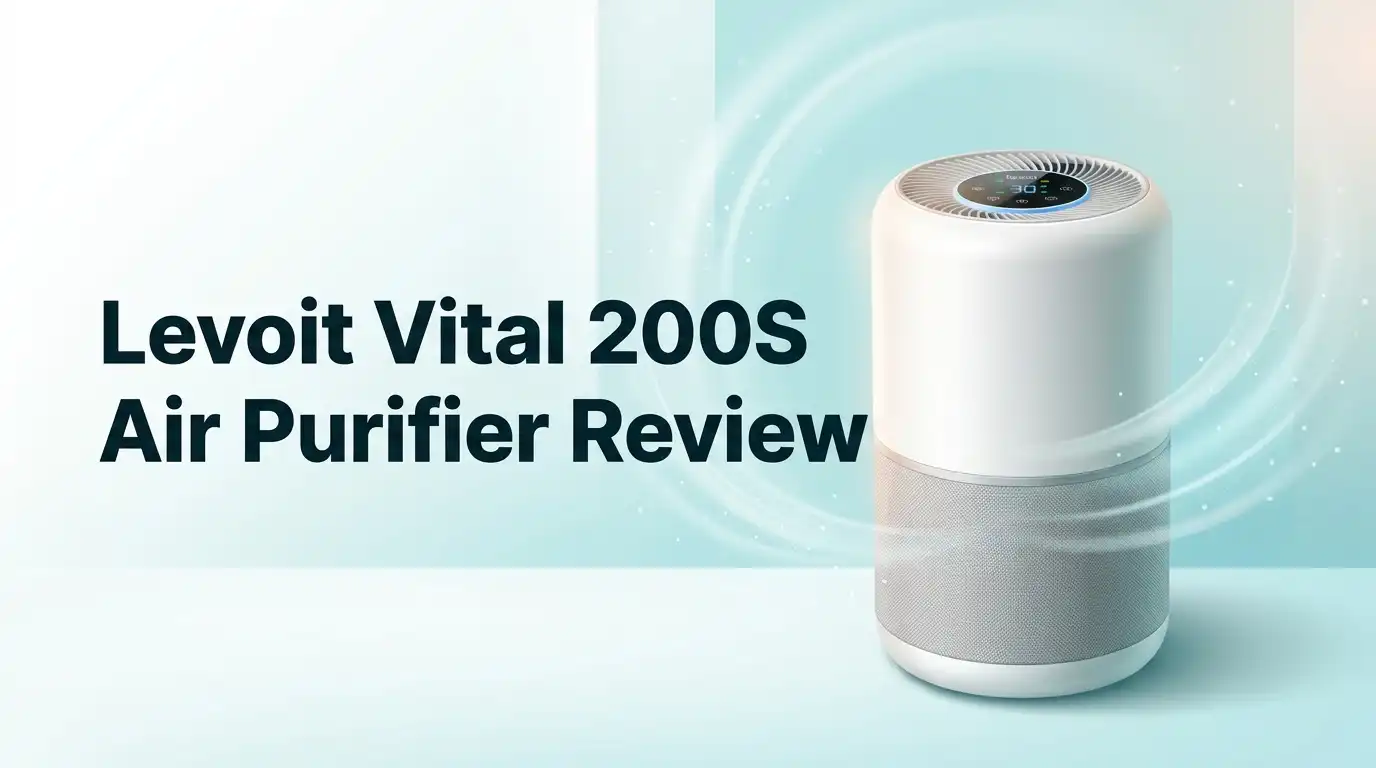
The Vital 200S skips the cylindrical tower shape Levoit used on the Core series. Instead you get a rectangular cabinet measuring 15.6 inches deep, 8.5 inches wide, and 19.8 inches tall.
Air enters through the wide front grille and exits from the top. That layout matters more than it sounds. Front intake means you can push the unit closer to a wall than a cylindrical purifier, which pulls air from every side.
The footprint is narrow but deep. It tucks beside a nightstand well. It looks awkward in a tight corner.
Controls sit flush on the top plate. You get buttons for auto mode, night mode, fan speed, power, timer, child lock, and display lights. An LED ring around the power button shifts color with air quality. Blue means clean, orange means moderate, red means poor.
Build quality feels appropriate for the money. It does not feel cheap, and it does not feel luxurious either.
What Is Inside the Filter
The Vital 200S uses a three stage system. A washable pre filter catches hair and large dust. A pleated particle filter captures fine particulates. A layer of pelleted activated carbon handles odors and gases.
The carbon choice deserves praise. Many budget purifiers use a thin carbon coated fabric that saturates within weeks. Levoit uses actual carbon pellets here, which hold far more odor molecules and last considerably longer.
The pre filter detaches completely, so vacuuming it takes seconds. That is a genuine improvement over the Core 300, where the pre filter wraps around the cylinder awkwardly.
Levoit originally marketed this as a True HEPA H13 filter. Dyson challenged that claim through the National Advertising Division, and Levoit removed the HEPA wording. The filter still captures fine particles effectively across multiple passes. It simply no longer carries a certified grade label.
Air Cleaning Performance Tested
This is where the Vital 200S justifies itself. Independent testing recorded PM1 particle levels dropping to zero in 23 minutes at top speed in a standard test room.
That result puts it among the fastest purifiers under $200. For context, the older Levoit Core 300 needed nearly three times longer. The much larger Core 600S finished only one minute faster.
At speed 2, under the 45 dB noise threshold, the unit still reached zero particles in 46 minutes. That number beats popular competitors like the Winix 5500-2 and Coway Airmega 250S at similar noise levels.
Here is the part I appreciate most. The Vital 200S achieves this without an ionizer. No ozone byproducts, no plasma marketing gimmicks, just a strong fan pushing air through good filter media.
Smoke removal impressed me during cooking mishaps. Burnt garlic smell cleared from my kitchen in roughly ten minutes on high.
Top 3 Alternative for Levoit Vital 200S

Last update on 2026-11-11 / Affiliate links / Images from Amazon Product Advertising API
Levoit Core 400S Smart Air Purifier

Last update on 2026-11-17 / Affiliate links / Images from Amazon Product Advertising API
Coway Airmega Mighty Air Purifier

Last update on 2026-11-17 / Affiliate links / Images from Amazon Product Advertising API
Levoit Core 600S Smart Air Purifier
Noise Levels in Real Rooms
Loud purifiers get unplugged. That is the honest truth about this category, so noise carries real weight.
Measured from three feet away, the Vital 200S produced 38.3 dB on speed 1, 41.9 dB on speed 2, 53.8 dB on speed 3, and 57.7 dB on speed 4.
Speeds 1 and 2 disappear into background noise. I slept beside it for weeks on speed 2 without issue. The sound is a smooth whoosh rather than a whine, which helps.
Speed 3 becomes noticeable. Speed 4 is loud enough to interrupt conversation and television. Most people will run speeds 1 through 3 and reserve speed 4 for cooking smoke or allergy flare ups.
Night mode dims all lights and drops the fan further. There is also a light detection feature that switches the display off automatically in dark rooms. That small touch makes bedroom placement much easier.
Smart Features and the VeSync App
The Vital 200S connects to WiFi through the VeSync app, which Levoit uses across its full product range. Setup took about two minutes on my phone.
Inside the app you can adjust fan speed, set schedules, check filter life percentage, and view a rolling air quality history. Voice control works through Alexa and Google Assistant.
One underrated feature: the unit remembers its settings after a power cut. Unplug it, plug it back in, and it resumes exactly where it left off. Plenty of smart purifiers forget everything.
My complaint concerns the app home screen. Levoit places promotional banners for other products there. Once you tap into the purifier controls the ads vanish, but the initial screen feels cluttered.
Overall the app works reliably. It is not beautiful, and it does not need to be. Connection drops were rare during my testing.
Auto Mode and the Air Quality Sensor
Auto mode adjusts fan speed based on sensor readings. It works well in practice. Cooking triggers a fast ramp up. Quiet evenings settle the unit into speed 1.
The sensor itself is the weak link. Levoit uses an infrared optical sensor rather than a laser sensor. Infrared sensors accumulate dust and gradually report inaccurate readings.
Levoit recommends cleaning the sensor every two months. That means removing a small side cover and wiping the lens with a dry cotton swab. It takes one minute, but you have to actually remember.
Compare that with laser sensors on pricier units, which need no cleaning and detect smaller particle changes faster. This is a clear cost cutting decision.
If you plan to rely heavily on auto mode, set a calendar reminder. A dirty sensor will leave your purifier idling while your air quality drops.
Room Size: What It Actually Covers
Levoit advertises coverage up to 1875 square feet. That figure is technically accurate and practically misleading.
Marketing coverage numbers assume one air change per hour. One air change does very little for allergies or smoke. Independent reviewers use five air changes per hour as the meaningful standard.
At five air changes per hour, the Vital 200S covers roughly 373 square feet. At four air changes it handles around 465 square feet.
So treat this as a purifier for medium rooms. Bedrooms, home offices, nurseries, and mid size living rooms all suit it well.
Open plan spaces above 500 square feet need something larger, like the Core 600S. Trying to purify a whole floor with one Vital 200S will disappoint you.
My rule: measure your room, then pick a purifier rated at four to five air changes for that size. Ignore the headline number on the box.
Energy Use and Yearly Running Costs
Energy draw is genuinely low. Measured consumption came in at 0.97 watts on standby, 3.21 watts in sleep mode, 5.71 watts on speed 1, 8.01 watts on speed 2, 31.96 watts on speed 3, and 44.55 watts at top speed.
Running it constantly at full blast for a year costs roughly $49 in electricity. Nobody does that, so your real bill will be lower.
Add one genuine replacement filter at $49.99 and your total yearly cost lands near $99.
That is excellent for this performance level. Many competitors demand $80 or more per year in filters alone.
The efficient fan deserves credit here. Moving 254 CFM of clean air on 45 watts shows good engineering. Speed 2, which most people use overnight, sips just 8 watts. That is less than a single incandescent nightlight.
Filter Replacement Cost and Options
Levoit rates the filter for 12 months of use. Real world lifespan depends on your air. Heavy pet dander or wildfire smoke will shorten it.
Genuine filters cost $49.99 for the standard version. Levoit also sells specialty versions: a pet allergy filter, a smoke remover filter, and a toxin absorber filter. Those range from roughly $45 to $65.
Generic third party filters exist in large numbers, often at half the price. Performance varies between brands, and some fit loosely. I would test one cautiously rather than buying a multipack immediately.
Here is the frustrating part. The particle media and carbon media are bonded into one unit. Carbon typically exhausts within six months while the particle filter still has plenty of life. You cannot replace one without the other.
That design keeps manufacturing cheap and repeat purchases steady.
What the Vital 200S Does Not Do Well
Honest reviews list failures. Here are mine.
The bonded filter wastes money. You discard functional particle media because the carbon ran out.
The infrared sensor needs regular cleaning and lacks precision. Laser sensors do this better.
No remote control ships in the box. Reaching over to the top panel gets old when the unit sits behind furniture.
Speed 4 is loud. You will not leave it there.
The HEPA labeling situation bothers me. Levoit marketed H13 grade filtration, then removed the claim after being challenged. Performance holds up, but I would not place this unit in a clinical environment or rely on it for immunocompromised care.
Coverage claims are inflated, as they are across this entire industry.
Finally, the rectangular cabinet is deep. It intrudes into small rooms more than its narrow width suggests.
Pros and Cons
Pros
- Cleared fine particles to zero in 23 minutes, matching purifiers at double the price
- Certified CADR of 254 CFM for dust and 250 CFM for smoke
- Quiet operation below 42 dB on the two lowest speeds
- Pelleted activated carbon handles odors far better than carbon coated fabric
- Total yearly running cost near $99, including filter and electricity
- No ionizer, so no ozone byproducts
- Removable pre filter that vacuums clean in seconds
- Remembers settings after power interruptions
- Light detection mode dims the display automatically at night
- Two year manufacturer warranty
- Plentiful generic filter options for budget owners
Cons
- Bonded filter forces full replacement when only carbon is spent
- Infrared sensor requires cleaning every two months
- No remote control included
- Top fan speed reaches 57.7 dB and feels intrusive
- Advertised 1875 square foot coverage is unrealistic for real use
- HEPA H13 claim was withdrawn after advertising scrutiny
- Deep cabinet takes more floor space than expected
- App home screen shows promotional banners
Vital 200S vs Core 400S
These two models sit close in price and confuse plenty of shoppers. Here is the short version.
The Vital 200S delivers slightly higher clean air output, around 254 CFM for dust versus roughly 231 CFM smoke CADR on the Core 400S. Testing also shows the Vital 200S clearing particles marginally faster.
The Core 400S uses a cylindrical body with 360 degree intake. That works better in open floor positions. The Vital 200S front intake works better against walls.
Sensor quality favors the Core 400S slightly. Its air quality reading responds a bit more accurately.
Filter economics favor the Vital 200S, since generic options are cheaper and more plentiful.
My pick between them: the Vital 200S for bedrooms and wall placement, the Core 400S for open room centers. Performance differences are small enough that price and shape should decide.
Who Should Buy the Levoit Vital 200S
Buy this purifier if you have a bedroom, office, or living space between 250 and 450 square feet and want strong performance without spending $300.
It suits allergy sufferers well. Pollen, dust, and pet dander all respond quickly to its airflow. Households with cooking odors will appreciate the pelleted carbon.
People who dislike ionizers should put this high on their list. Filtration only, no ozone risk.
Skip it if your space exceeds 500 square feet. Skip it if you need certified HEPA H13 documentation for medical reasons. Skip it if you want a laser grade sensor and set and forget auto mode with zero maintenance.
Budget shoppers who never plan to buy filters should reconsider the entire category. Filter costs are unavoidable, and a neglected purifier does nothing useful.
Maintenance Tips That Extend Its Life
Vacuum the pre filter every two to four weeks. Pet owners should do it weekly. This single habit extends main filter life noticeably.
Clean the air quality sensor every two months with a dry cotton swab. Never use water or cleaning spray on the lens.
Wipe the front intake grille whenever dust builds up. Restricted airflow reduces cleaning speed and raises fan noise.
Reset the filter indicator only after actually replacing the filter. Resetting early gives you false confidence.
Keep at least 15 inches of clearance above the top outlet. Blocked exhaust airflow drops performance sharply.
Run the unit continuously on a low speed rather than occasionally on high. Steady low speed operation keeps particle levels down better and uses less energy overall.
Store spare filters sealed in their bags so the carbon does not absorb odors before installation.
Final Verdict: Is It Still Worth It in 2026?
Last update on 2026-11-17 / Affiliate links / Images from Amazon Product Advertising API
Yes, with clear conditions.
At roughly $190, the Levoit Vital 200S delivers cleaning performance that competes with purifiers priced near $400. It runs quietly, costs about $99 per year to operate, and avoids ionizer gimmicks entirely. That combination remains hard to beat in 2026.
The flaws are real but manageable. The bonded filter wastes money over time. The infrared sensor needs your attention. Coverage claims need heavy discounting.
None of those problems undermine the core value. This is a strong, efficient, well priced purifier for medium rooms.
If your space is larger, step up to the Core 600S. If you want a laser sensor and premium build, spend more. For everyone else with a bedroom or office to clean, the Vital 200S remains one of the smartest purchases in its class.
Frequently Asked Questions
How long does the Levoit Vital 200S filter last?
Levoit rates the filter at 12 months. Real lifespan depends on your air quality. Homes with pets, smokers, or wildfire exposure often need replacement around six to eight months. The carbon layer usually exhausts before the particle layer. Watch for returning odors as your signal.
Does the Vital 200S produce ozone?
No. The unit uses mechanical filtration only, with no ionizer, no UV lamp, and no plasma technology. That makes it a safe choice for people sensitive to ozone byproducts.
Can the Vital 200S handle a whole house?
No. Despite the 1875 square foot marketing figure, it realistically covers 373 to 465 square feet with meaningful air changes. One unit per room works far better than one unit for a whole floor.
Is the Vital 200S quiet enough for sleeping?
Yes. Speed 1 measures around 38 dB and speed 2 around 42 dB. Both sit below normal conversation level. Night mode also dims the display, and light detection turns the lights off automatically.
Do generic replacement filters work?
Many do, and they often cost half the genuine price. Quality varies between sellers. Poor fitment allows unfiltered air to bypass the media, so buy a single filter first and check the seal before ordering multiples.
Does it help with pet hair and dander?
Yes. The washable pre filter catches loose hair effectively, and the particle filter handles dander. Levoit also sells a dedicated pet allergy filter version. Vacuum the pre filter weekly in pet households.
Is the Vital 200S better than the Core 300S?
For performance, clearly yes. The Vital 200S delivers roughly 254 CFM versus about 141 CFM on the Core 300S. The Core 300S costs less and suits small rooms under 200 square feet. Match the unit to your room size.

I’m Maya Brown, the voice behind Pure Breeze Vault. I write detailed, honest, and easy-to-follow air purifier reviews to help readers compare features, understand filter technologies, and choose products with confidence. My goal is to make research simpler, clearer, and more practical for anyone improving indoor air quality at home.