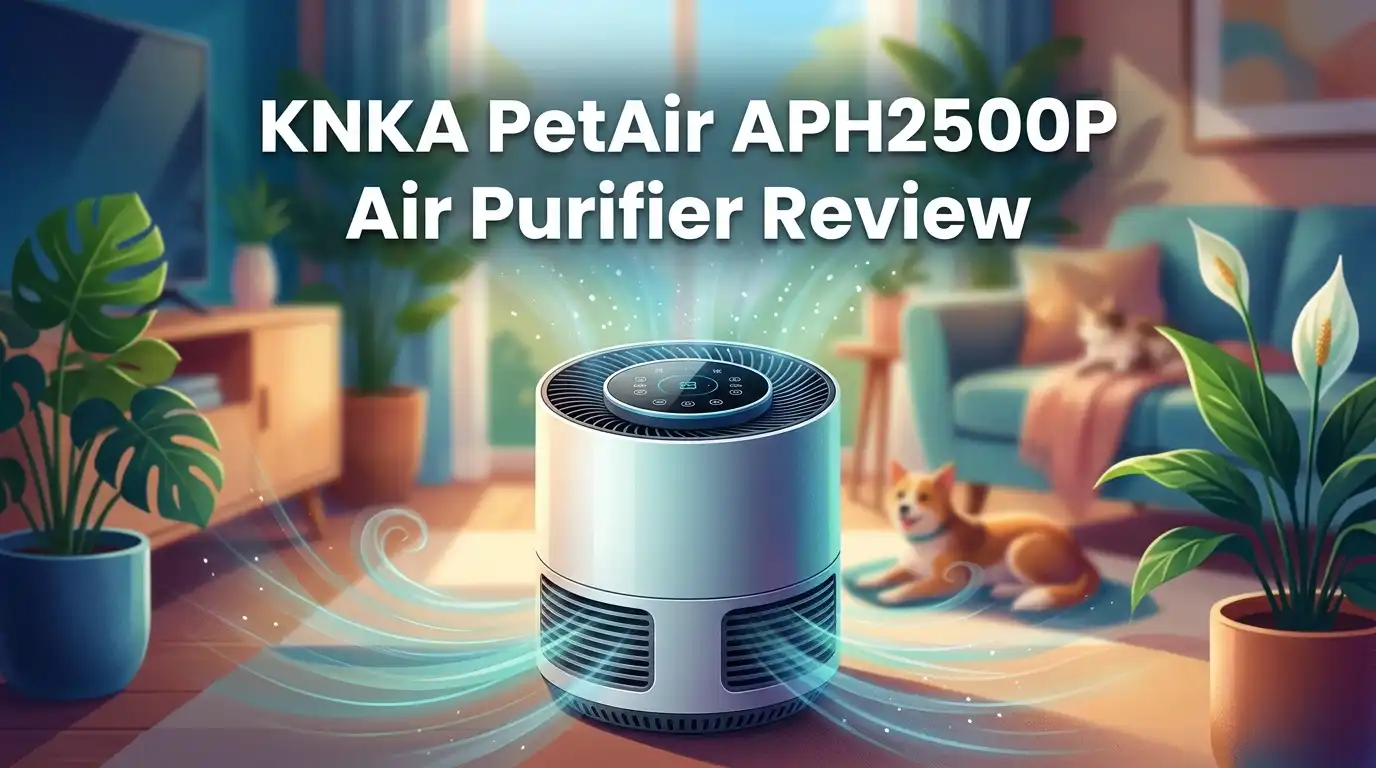
KNKA PetAir APH2500P Air Purifier Review 2026: Worth Buying?
Pet hair gets everywhere. It clings to the couch, drifts under the bed, and floats into your nose at 2 a.m. Most air purifiers ignore that problem completely. They pull air from the sides, high above the floor, while the real mess sits at ankle level.
The KNKA PetAir APH2500P takes a different route. It sucks air in from the bottom, where fur and dander actually collect.
KNKA sells it for around $100, wraps it in a short wide shell that doubles as a cat perch, and backs the performance claims with AHAM Verifide testing. That last part matters, because plenty of budget purifiers skip independent testing entirely.
In a Nutshell:
- The bottom intake is the real selling point. Six inlets along the base and lower sides pull in fur, lint, and dust near floor level. That is genuinely useful in homes with a shedding dog or a long haired cat, because most of that debris never rises high enough for a standard side intake purifier to reach it.
- The AHAM numbers are modest but honest. CADR comes in at 119 CFM for smoke, 123 CFM for dust, 147 CFM for pollen, and 121 CFM for PM2.5. That suits a bedroom or living room of roughly 180 to 240 square feet with strong air turnover. The headline “893 square feet” figure only applies at one air change per hour, which is too slow for allergy relief.
- Four modes keep it flexible. Auto reacts to the PM2.5 sensor, Eco idles the fan when air is clean, Pet runs a 30 minute high speed blast, and Sleep drops noise to roughly 22 to 28 dB with the lights off.
- Maintenance is cheap but constant. The pre filter washes under a tap. The main U shaped filter needs replacing every 3 to 6 months at about $40, which adds up to $80 or more a year in a heavy shedding home.
- It is not a premium machine. The shell is light plastic, there is no app or voice control, and KNKA offers a one year warranty with a brand track record shorter than Levoit or Winix.
- Best value case: one room, one or two pets, a budget near $100, and a willingness to vacuum the base.
KNKA PetAir APH2500P Pet Air Purifier


Last update on 2026-11-17 / Affiliate links / Images from Amazon Product Advertising API
The APH2500P is KNKA’s pet focused model, sold in white and black for about $99.99. The shape sets it apart immediately. Instead of a tall tower, you get a squat rounded unit that sits low and wide, closer to a sealed speaker than a traditional purifier.
That shape is deliberate. Air enters through six openings at the bottom and lower sides, then exits through a grille on top. The top panel is reinforced so a cat can sit on it without flexing the plastic. KNKA even added a small aroma pad compartment and a dust cover for the outlet.
Inside sits a 3 stage system: a washable pre filter, a U shaped high efficiency filter, and a high carbon layer for odor. The unit is AHAM Verifide and SGS safety certified, which is rare at this price point.
Unboxing Experience and First Impressions
The box arrives slim and surprisingly light. KNKA ships the purifier in molded cardboard inserts instead of foam, which feels better for the environment but offers slightly less drop protection. Inside you get the unit, a power adapter, and a short manual.
First job: remove the plastic wrap from the filter. The filter ships installed but sealed, and a shocking number of people miss this step and then complain the purifier does nothing. Flip the unit over, twist off the base cover, peel the bag, reseat the filter, and lock it.
Setup takes under three minutes. Plug it in, press power, and the AQI display lights up. The first reading is usually alarming. Mine style units often spike red for five to ten minutes while the sensor calibrates, then settle into green. That is normal behavior, not a broken sensor.
Design, Build Quality, and Footprint
The APH2500P measures roughly 16 inches across and about 12 inches deep, standing only 7 to 8 inches tall. It disappears beside a sofa or under a console table far better than a tower does. The matte finish resists fingerprints, and the touch controls sit on the top face for easy reach.
Build quality is fair rather than premium. The plastic is thin in places, and the base cover twists on with a shallow lock that feels slightly loose. Nothing rattles during operation, but the unit is light enough that a large dog can nudge it across a hardwood floor.
One smart touch deserves credit: raising the air outlet to the top keeps the airflow away from where your pet sleeps, so the room circulates without blasting cold air at a curled up cat.
Top 3 Alternatives for KNKA PetAir APH2500P

Last update on 2026-11-17 / Affiliate links / Images from Amazon Product Advertising API
Levoit Core 600S P Smart Air Purifier

Last update on 2026-11-17 / Affiliate links / Images from Amazon Product Advertising API
WINIX 5520 Air Purifier for Large Rooms

Last update on 2026-11-17 / Affiliate links / Images from Amazon Product Advertising API
KNKA APH4000 Air Purifier for Large Rooms
Filtration System Explained
The three layers each handle a different job. The washable pre filter grabs hair, lint, and large dust. This is the layer that saves you money, because every strand it catches is a strand the expensive filter never sees.
Next comes the U shaped high efficiency filter. KNKA folds the media into a curve rather than a flat panel, which adds roughly 30 percent more surface area. More surface means lower resistance, quieter airflow, and a longer service life. It captures fine particles down to the PM2.5 range, including dander flakes and pollen.
The final layer is high carbon granular media for odor. This is where pet smell actually gets removed, not just diluted.
The honest caveat: a $100 purifier carries a thin carbon layer. It softens litter box odor noticeably, but it will not erase a neglected box.
The 360 Degree Bottom Pet Hair Intake
This feature justifies the “PetAir” name. Standard purifiers draw air from panels 10 to 30 inches off the ground. Pet hair lives below that line. It settles, gets kicked up by footsteps, and settles again.
By pulling from six low inlets, the APH2500P intercepts that cycle. In practice you see the proof on the pre filter. After a week in a shedding household, the mesh looks like a lint roller sheet. Every clump there is one less clump on your rug.
The trade is maintenance. You will clean this pre filter far more often than you would on a side intake model, roughly every one to two weeks during heavy shedding season. It also collects more floor grit, so the unit needs a clear perimeter and a quick vacuum around the base.
CADR Ratings and Real Room Coverage
Here is where you need to read carefully. KNKA lists the APH2500P at 119 CFM smoke, 123 CFM dust, 147 CFM pollen, and 121 CFM PM2.5, all AHAM Verifide. Independent verification is a genuine mark of trust and many cheaper rivals simply invent their numbers.
Those figures place it in the mid small category. The listing claims an 893 square foot room refreshed once per hour, while KNKA’s own site quotes up to 1,119 square feet. Both numbers describe one air change per hour, which does almost nothing for allergies.
The number that matters is 4.8 air changes per hour, and that lands around 184 to 233 square feet depending on which page you read. Treat this as a bedroom, nursery, or medium living room unit. Do not buy it for an open plan great room.
Auto, Eco, Pet, and Sleep Modes
Four modes cover most daily situations. Auto reads the built in PM2.5 sensor and raises or lowers fan speed on its own. It reacts within seconds to cooking smoke or a dog shaking out its coat.
Eco goes further by idling the fan entirely once air quality stays clean, then waking when particles return. This cuts power draw and noise, though some owners dislike the silence because they cannot tell the unit is still working.
Pet mode runs a 30 minute high speed cycle. It is built for the moment you leave the house, or right after brushing your dog indoors. The fan is loud here, but it clears visible haze fast.
Sleep mode drops to the lowest speed, roughly 22 to 28 dB, and switches the display off completely. No glow, no beep, no blue halo on the ceiling.
Noise Levels and Bedroom Performance
Sleep mode is the quiet star. At around 24 dB it sits below a whisper, closer to a soft hum you forget within a minute. The display shuts off fully, which matters more than people expect in a dark bedroom.
Mid speeds produce a smooth white noise that masks street sound. Speed three and Pet mode are a different story. Expect roughly 50 to 55 dB, loud enough to raise the TV volume. That is typical for the price, but worth knowing if you planned to run it high overnight.
A quirk of the bottom intake design: placing the purifier on carpet can create a slight whistling sound as air squeezes under the base. Hard floors or a low profile mat solve it. Keep at least a few inches of clearance on every side.
Air Quality Sensor and AQI Display
The front panel shows a numeric PM2.5 reading plus a color coded ring. Green means clean, amber means moderate, red means poor. The feedback loop is satisfying, and it teaches you things about your home. You will discover that frying food, lighting a candle, and vacuuming all spike the number hard.
Accuracy is reasonable but not laboratory grade. The sensor tracks trends well. It is less reliable at absolute values, so do not treat the digits as a calibrated instrument.
Two honest warnings. First, the sensor port collects dust and needs a cotton swab cleaning every few months or readings drift high. Second, KNKA sensors on older models have failed after the one year warranty window in some owner reports. That is the main long term reliability question mark on this brand.
Controls, Timer, and Extra Features
The top panel keeps things simple. You get power, fan speed, mode, timer, and child lock. The child lock is a real benefit here, because a low sitting unit is exactly at toddler and cat paw height.
A filter replacement indicator tracks runtime and lights up when the media is due. You reset it with a long press after swapping the filter.
The purifier also hides an aroma compartment, a small pad where you add a drop or two of essential oil. Use it sparingly, since oils can load the carbon layer and shorten its life.
Finally there is an independently controlled purple light that runs for one hour then shuts off. KNKA is vague about what this light does, and I would not count it as meaningful sanitizing. Treat it as a bonus, not a reason to buy.
Filter Replacement Cost and Maintenance
Running cost decides whether a cheap purifier stays cheap. Genuine KNKA replacement filters for this model run roughly $39.99 to $42.99. KNKA advises replacing every 3 to 6 months, so budget $80 to $160 per year in a busy pet home.
That is not unusual, but it is not trivial either. Over three years you spend more on filters than you did on the machine.
The pre filter softens the blow. Rinse it under warm water, let it dry fully, and reinstall. A damp pre filter can breed odor, so give it a full day.
Third party filters exist and cost less, though they often use thinner carbon and can void support claims. The filter also sits in the base, which means you must lift and flip the unit for every change. Mildly annoying, not difficult.
Energy Use and Running Cost
Power draw is low. The APH2500P pulls roughly 23 watts at high speed and far less on Sleep or Eco. Running it 24 hours a day on a medium setting costs only a few dollars a month in most of the United States.
Eco mode helps more than the marketing suggests. By idling the fan during clean periods, it cuts both wattage and filter loading. A filter that moves less dirty air simply lasts longer.
Compare that to a 600 square foot class purifier drawing 40 to 50 watts and you see the appeal of right sizing. Buying one correctly matched purifier per room beats buying one oversized unit for the whole house, both for electricity and for actual clean air delivery where you breathe.
Pros of the KNKA PetAir APH2500P
- Bottom 360 degree intake genuinely captures pet hair at floor level, which standard side intake purifiers miss entirely.
- AHAM Verifide CADR ratings give you independently tested performance instead of invented marketing numbers.
- Washable pre filter traps hair and lint first, extending the life of the paid filter and lowering long term cost.
- Sleep mode runs near 24 dB with the display fully off, making it genuinely bedroom friendly.
- Pet mode delivers a 30 minute high output burst for brushing sessions or right before guests arrive.
- Low wide shape with a reinforced top hides beside furniture and doubles as a cat resting spot.
- Useful everyday extras including child lock, timer, filter reminder, AQI display, and an aroma pad.
- Strong value at roughly $99 with SGS safety certification and an unusually pet specific design.
Cons and What It Does Not Do Well
- Coverage claims are inflated. The 893 to 1,119 square foot figure applies at one air change per hour. Real allergy level performance covers closer to 184 to 233 square feet.
- The pre filter demands frequent cleaning. A floor level intake collects grit fast, so expect a rinse every one to two weeks during shedding season.
- Higher speeds are loud. Pet mode and speed three reach roughly 50 to 55 dB, which interrupts TV and conversation.
- Thin carbon layer. It reduces pet odor but will not conquer a strong litter box, ammonia smell, or heavy cigarette smoke.
- No app, Wi Fi, voice control, or remote. Everything happens at the panel.
- Filter sits in the base, so you must lift and flip the unit for every replacement.
- Brand longevity is unproven. KNKA is newer than Levoit or Winix, the warranty runs one year, and some owners of other KNKA models report sensor failures after that window closes.
- The purple light is unexplained and should not factor into your buying decision.
Who Should Buy It and Who Should Skip It

Last update on 2026-11-17 / Affiliate links / Images from Amazon Product Advertising API
Buy it if you share a bedroom or medium living room with a shedding dog or cat, your budget sits near $100, and your main complaints are fur on the floor and faint dander smell. The low intake solves a problem that pricier tower purifiers ignore, and the AHAM verification means you are not gambling on fiction.
Skip it if you need to clean a large open plan space, you want app control and scheduling, or you expect a purifier to erase strong odors on its own. Severe allergy sufferers in big rooms should step up to a Levoit Core 600S P or a Winix 5520 instead.
Also skip it if you dislike maintenance. This purifier rewards owners who rinse the pre filter regularly and punishes those who forget.
Final Verdict
The KNKA PetAir APH2500P is a focused tool rather than a universal one. It does one thing better than almost anything at its price: it pulls pet hair and dander out of the air near the floor, where that mess actually lives. The AHAM Verifide CADR numbers, the washable pre filter, and the genuinely quiet Sleep mode round it out into a sensible $100 package.
It is not a premium appliance. The plastic is light, the carbon layer is thin, the smart features do not exist, and KNKA’s long term reliability record remains short. Treat the room coverage claim as marketing and size it for about 200 square feet.
My take: a strong buy for single room pet homes, a poor fit for whole house ambitions. Rated roughly 4 out of 5 for value, 3.5 out of 5 for build.
Frequently Asked Questions
Does the KNKA PetAir APH2500P really remove pet odor?
It reduces pet odor noticeably. The high carbon layer absorbs the volatile compounds behind dander smell and mild litter box odor. It will not eliminate strong ammonia or a box that needs cleaning. Source control comes first, purification second.
How often should I replace the filter?
KNKA recommends every 3 to 6 months depending on use. Homes with multiple pets land at the short end. The filter indicator light gives you a runtime based reminder, and genuine replacements cost roughly $40.
Is it safe for cats to sit on top?
Yes. KNKA reinforced the top panel and added a dust cover over the outlet specifically for this. Just check the cover periodically, since fur on the outlet restricts airflow.
Can it cover my whole apartment?
No. Plan for one medium room of roughly 200 square feet for meaningful air turnover. Larger spaces need a bigger unit or a second purifier.
Does it have Wi Fi or an app?
No. There is no app, no Wi Fi, no voice assistant support, and no remote. All control happens through the top touch panel.
Is the KNKA PetAir APH2500P worth it over a Levoit?
At $100 it offers a feature Levoit does not: true floor level hair capture. Levoit wins on brand track record, app control, and larger room models. Pick KNKA for pet hair, pick Levoit for smart features and long term support.

I’m Maya Brown, the voice behind Pure Breeze Vault. I write detailed, honest, and easy-to-follow air purifier reviews to help readers compare features, understand filter technologies, and choose products with confidence. My goal is to make research simpler, clearer, and more practical for anyone improving indoor air quality at home.