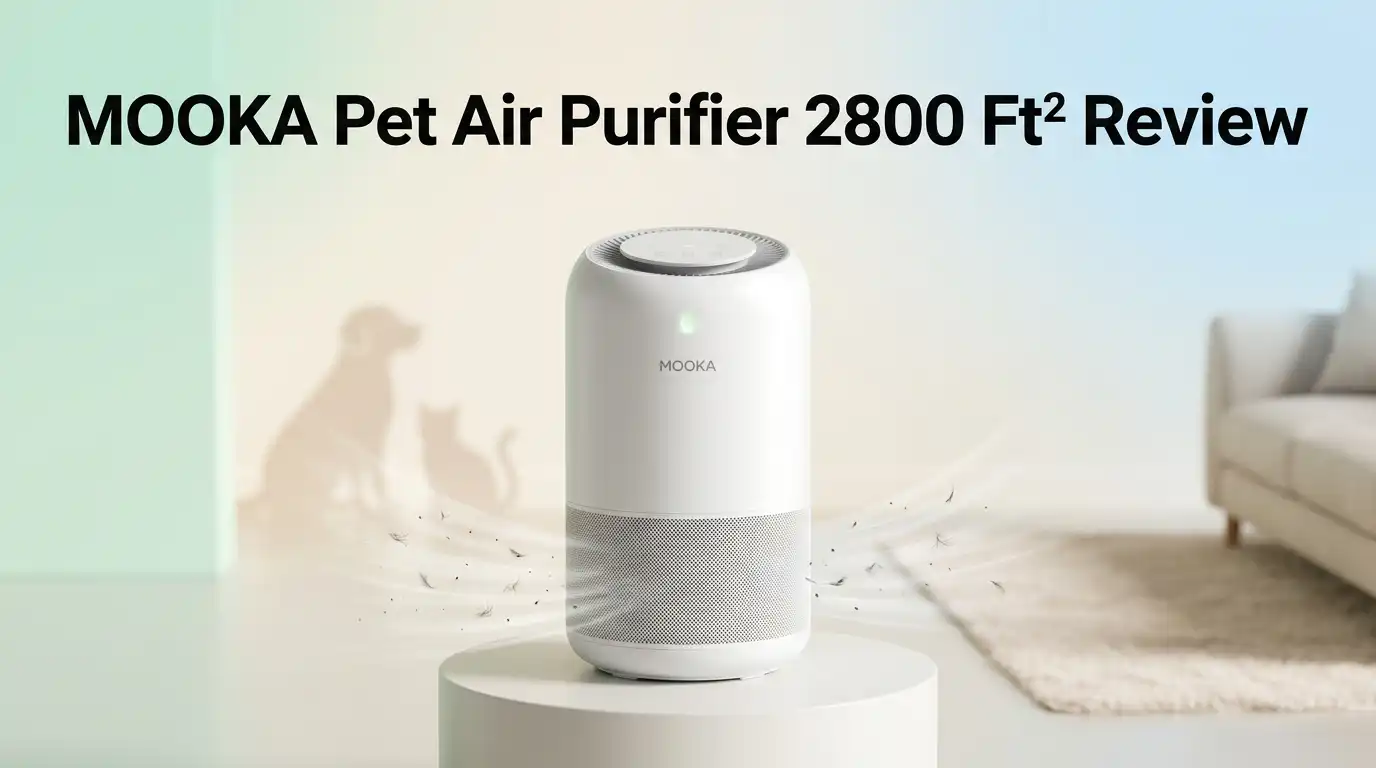
MOOKA Pet Air Purifier 2800 Ft² Review 2026: Worth It?
Pet hair finds its way into everything. It lands on the couch, floats across sunlit floors, and settles on your pillow before bedtime. If you own a dog or a cat, you already know that vacuuming only solves half the problem. The other half floats in the air you breathe.
The MOOKA C300 promises to fix that floating half. It claims coverage up to 2,800 square feet, a PM2.5 sensor, two washable filters, and a sleep mode that drops to 20 decibels. At roughly $99, it sits well under premium rivals that cost twice as much.
So does it actually clear pet dander, or is the big coverage number just marketing? I spent time with the specs, the real owner feedback, and the honest trade offs. This review covers the unboxing, the daily use, the weak points nobody mentions, and who should skip it entirely.
In a Nutshell:
- The 2,800 square foot claim is optimistic. That figure reflects a single air change per hour. For real pet dander control you want four or five air changes, which puts the honest comfortable room size closer to 550 to 700 square feet. It still beats most purifiers at this price.
- Two washable filters are the headline feature. The C300 pulls air from both sides through two reusable filters. You rinse the pre filter layers instead of buying mesh screens every few months, which cuts the long term cost noticeably.
- It runs quiet and cheap. Sleep mode is rated at 20 decibels, and the unit draws only 23 watts at full tilt. Running it all day costs pennies, and the darkened display will not light up your bedroom.
- The sensor works, but it is basic. The onboard PM2.5 reading reacts fast to cooking smoke and shedding dogs. It does not measure VOCs, gases, or formaldehyde, so odor tracking stays guesswork.
- There is no app, no WiFi, and no voice control. Every setting lives on the touch panel. Smart home fans will feel the gap immediately.
- Build quality is plastic and light at 10.4 pounds. It feels like a $99 product because it is one. The 2 year replacement warranty softens that concern a great deal.
MOOKA Air Purifier for Home Pet Large Room 2800 Ft² C300

Last update on 2026-11-16 / Affiliate links / Images from Amazon Product Advertising API
The C300 is MOOKA’s largest consumer model. The body measures 15.3 inches deep, 7.85 inches wide, and 17.3 inches tall, so it reads more like a slim tower than a bulky cube. The white finish stays neutral against most furniture.
Inside sit two filter cartridges, one on each side. Air enters through both panels at once and exits through the top. MOOKA calls this a dual inlet system, and the logic is sound: twice the intake surface means less resistance and more airflow at the same fan speed.
The control panel sits flat on top with touch buttons and a bright PM2.5 number in the center. You get three fan speeds, auto mode, sleep mode, and a timer. Certifications include FCC, ETL, and CARB, with zero ozone output and no UV lamp, which matters for pet safety.
The Unboxing Experience
The box arrives in plain product packaging with the purifier printed on the front. Nothing fancy, no premium sleeve, no magnetic flap. Inside you find the unit sandwiched between molded foam, a small power adapter, and a thin instruction manual.
Both filters ship already installed, which saves a step. They still arrive wrapped in protective plastic inside the housings, so your first job is popping off both side panels and peeling the bags away. Skip this and the purifier will hum along moving almost no air.
The side panels click off with a gentle pull at the bottom edge. No screws, no tools. Total setup took under four minutes, including reading the manual cover to cover.
One small gripe: the manual uses tiny print and a few awkward translations. The diagrams carry most of the weight.
Design and Build Quality
The C300 looks better than it feels. From across the room the clean white shell and rounded edges blend into a living room easily. Up close the plastic has a slight hollow ring when you tap it.
At 10.4 pounds it moves around without effort. There is no handle and no carry groove, so you end up gripping the sides. A recessed handle would have cost MOOKA almost nothing and helped a lot.
The side panels fit flush with no gaps, and the top vent grille feels sturdy under finger pressure. The power cord uses an external adapter rather than a direct plug, which means one more thing to tuck behind the furniture.
Nothing here screams premium, but nothing feels fragile either. It is honest budget construction.
Top 3 Alternative for MOOKA Pet Air Purifier 2800 Ft²


Last update on 2026-11-11 / Affiliate links / Images from Amazon Product Advertising API
LEVOIT Core 400S Smart Air Purifier

Last update on 2026-11-17 / Affiliate links / Images from Amazon Product Advertising API
LEVOIT Vital 200S Pet Air Purifier

Last update on 2026-11-17 / Affiliate links / Images from Amazon Product Advertising API
WINIX 5510 Air Purifier
Setup and Daily Controls
Plug it in, press power, and the display wakes instantly. The purifier defaults to auto mode, which is where most owners leave it permanently. Auto reads the PM2.5 sensor and picks a fan speed on its own.
The touch panel responds to a firm tap rather than a light brush. Buttons cover power, fan speed, auto, sleep, timer, child lock, and the filter reset. Holding the lock button for three seconds freezes the panel, which stops curious cats and toddlers from changing settings.
Timer options are 2, 4, 6, and 8 hours. Sleep mode dims the screen almost completely and drops the fan to its lowest setting.
There is no app and no remote. You walk to the unit for every change. For a bedroom purifier that rarely matters, but it feels dated in 2026.
Filtration System Explained
Each side cartridge stacks three layers. A washable pre filter catches hair, fur clumps, and large dust. Behind it sits the HEPA media rated to capture particles down to 0.3 microns. An activated carbon layer handles some odor absorption.
The pet relevant work happens in the first two layers. Dander flakes measure roughly 2.5 to 10 microns, well inside what HEPA media traps reliably. Fur gets caught early, which is exactly why the washable pre filter matters so much.
MOOKA also includes a small fragrance box for essential oils. Drop a few spots on the pad and clean air carries a light scent.
One honest caveat: MOOKA does not publish an AHAM verified CADR figure. Without that number, the coverage claim rests entirely on the brand’s own testing rather than independent lab data.
Real Performance With Pets
This is where the C300 earns its keep. Set it in a room where a shedding dog sleeps, and the PM2.5 number climbs whenever the dog shakes out its coat. Switch to speed three and the figure falls back within minutes.
The practical win is visible rather than measured. Owners consistently report less fur drifting across hard floors and fewer dust bunnies under furniture after a week or two. Light sleepers with cat allergies often notice calmer mornings.
The purifier also reacts well to cooking smoke and litter box odor when placed nearby. Carbon capacity is modest though, so strong smells fade rather than vanish.
Place it near the pet bed, not in the hallway. Air purifiers only clean the air that reaches them, and position changes results more than any setting does.
Noise Levels and Sleep Mode
MOOKA rates sleep mode at 20 decibels. That claim lines up with real use, since the fan becomes a soft hush you stop noticing within a minute. The display dims so the room stays dark.
Speed one and speed two stay comfortable for conversation and television. Speed three is a different story. The dual intake design pushes real air, and the fan note climbs into the range of a small desk fan at full speed.
Nobody sleeps through speed three. You use it for 20 minutes after cooking, then drop back.
There is no motor whine or rattle, which separates it from cheaper purifiers. The sound stays broadband and smooth, more like airflow than machinery, and that makes it much easier to tolerate.
Air Quality Sensor Accuracy
The infrared PM2.5 sensor updates every few seconds and drives auto mode. It responds quickly to obvious triggers. Burnt toast, aerosol spray, and a dog shaking near the intake all spike the reading within 10 seconds.
Accuracy against a reference monitor is approximate rather than precise. Budget infrared sensors tend to read optimistically in very clean air and can drift when humidity climbs. Treat the number as a direction, not a laboratory measurement.
Dust buildup on the sensor also skews readings over months. Wiping the sensor port during filter cleaning keeps it honest.
The sensor tracks particles only. It ignores VOCs, cooking gases, and formaldehyde entirely, so a clean reading does not guarantee clean air in every sense.
The Coverage Claim Reality Check
Let us be direct about the 2,800 square foot number. That rating almost certainly reflects one complete air change per hour in a room with standard ceilings. One air change per hour does very little for allergens.
Allergy specialists generally recommend four to five air changes per hour for meaningful dander and pollen control. Divide the headline figure accordingly and you land near 550 to 700 square feet of genuinely effective coverage.
That is still a large living room or an open plan kitchen space, and it remains strong for the price. The comparison simply needs honesty.
Judge the C300 as a capable 600 square foot purifier, not a whole house system. Buy it with that expectation and it will not disappoint you.
Running Costs and Filter Replacement
The C300 draws 23 watts at maximum. Running it continuously costs a few dollars per month in most regions, which is less than a single coffee.
Filter economics look good too. The washable layers rinse under tap water, dry fully in a day, and go back in. MOOKA sells official C300 replacement filters as a two pack for about $26, and the onboard indicator tells you when swap time arrives.
Most pet households replace HEPA media every six to eight months regardless of washing, since trapped dander and oils reduce airflow over time. Budget roughly $40 to $52 per year.
That annual figure undercuts several premium brands by a wide margin, where single replacement filters alone often run $40 or more each.
What This Purifier Does Not Do Well
Honest reviews list the flaws, so here they are without softening. No WiFi, no app, no voice assistant support. If you expect phone control or scheduling, look elsewhere immediately.
The carbon layer is thin. Heavy litter box smell, cigarette smoke, and strong cooking odor will reduce rather than disappear. Dedicated odor units carry pounds of carbon, not grams.
There is no AHAM certification, so performance claims lack third party backing. The plastic housing feels budget grade, and the missing carry handle annoys anyone who moves the unit between rooms.
Speed three is genuinely loud. The sensor measures particles only. And the 2,800 square foot headline oversells real capability by a factor of four.
Pros and Cons
Here is the balanced summary after weighing everything.
Pros
- Two washable filters cut long term replacement spending and make maintenance simple
- Dual intake design moves real airflow for a unit this size and price
- Genuinely quiet sleep mode at 20 decibels with a dimmed display
- Very low power draw at 23 watts keeps running costs near nothing
- PM2.5 display and auto mode remove all guesswork from daily operation
- FCC, ETL, and CARB certified with zero ozone and no UV lamp, which is safer around pets
- Child and pet lock prevents accidental setting changes
- 2 year replacement warranty plus responsive brand support
Cons
- Coverage claim is roughly four times optimistic for allergy level filtration
- No app, no WiFi, and no remote control of any kind
- Thin carbon layer limits strong odor removal
- Top fan speed is too loud for sleeping or quiet work
- No AHAM verified CADR rating published
- Plastic build and no carry handle
- Sensor ignores VOCs and gases completely
Who Should Buy the MOOKA C300
Buy this purifier if you own one or two shedding pets and want visible dust reduction in a large living room or bedroom without spending $250. It suits renters, dorm residents, and anyone replacing a small purifier that was clearly undersized.
It also fits people who dislike subscription style filter costs. The washable layers genuinely reduce the annual spend.
Skip it if you need smart home integration, verified lab performance data, or serious odor elimination from smoke or a busy litter room. Those buyers should move to the LEVOIT Core 400S or the WINIX 5510 instead.
Allergy sufferers should still buy it, but size it honestly. One unit per large room beats one unit for a whole floor every single time.
Final Verdict
The MOOKA C300 is a good purifier wearing an exaggerated label. Strip away the 2,800 square foot marketing and you find a quiet, efficient, low maintenance machine that handles pet dander in a large room better than almost anything else near $99.
The washable filters, the low power draw, and the 2 year warranty create real value. The missing app, thin carbon, and loud top speed are the price you pay for that value.
I would recommend it to pet owners on a budget without hesitation, and I would steer spec focused buyers toward certified alternatives. Rated honestly, it earns a solid 4.2 out of 5.
Last update on 2026-11-16 / Affiliate links / Images from Amazon Product Advertising API
Frequently Asked Questions
Does the MOOKA C300 really cover 2,800 square feet?
Not for allergy level cleaning. That figure represents one air change per hour. For effective pet dander control, plan on roughly 550 to 700 square feet per unit.
Are the filters actually washable?
The pre filter layers rinse under water and reuse indefinitely. The HEPA media still loses efficiency over time, so most owners replace cartridges every six to eight months.
Is it loud at night?
No. Sleep mode measures around 20 decibels and dims the screen. Only the highest fan speed becomes noticeably loud.
Does it remove cat litter odor?
It reduces odor rather than eliminating it. The carbon layer is thin, so strong smells persist at a lower intensity.
Does it have WiFi or an app?
No. All controls live on the top touch panel. There is no app, remote, or voice assistant support.
Is it safe around pets and children?
Yes. The unit is CARB certified, produces zero ozone, uses no UV light, and includes a child and pet lock.
How much do replacement filters cost?
Official two packs run about $26, which works out to roughly $40 to $52 per year for most pet households.

I’m Maya Brown, the voice behind Pure Breeze Vault. I write detailed, honest, and easy-to-follow air purifier reviews to help readers compare features, understand filter technologies, and choose products with confidence. My goal is to make research simpler, clearer, and more practical for anyone improving indoor air quality at home.